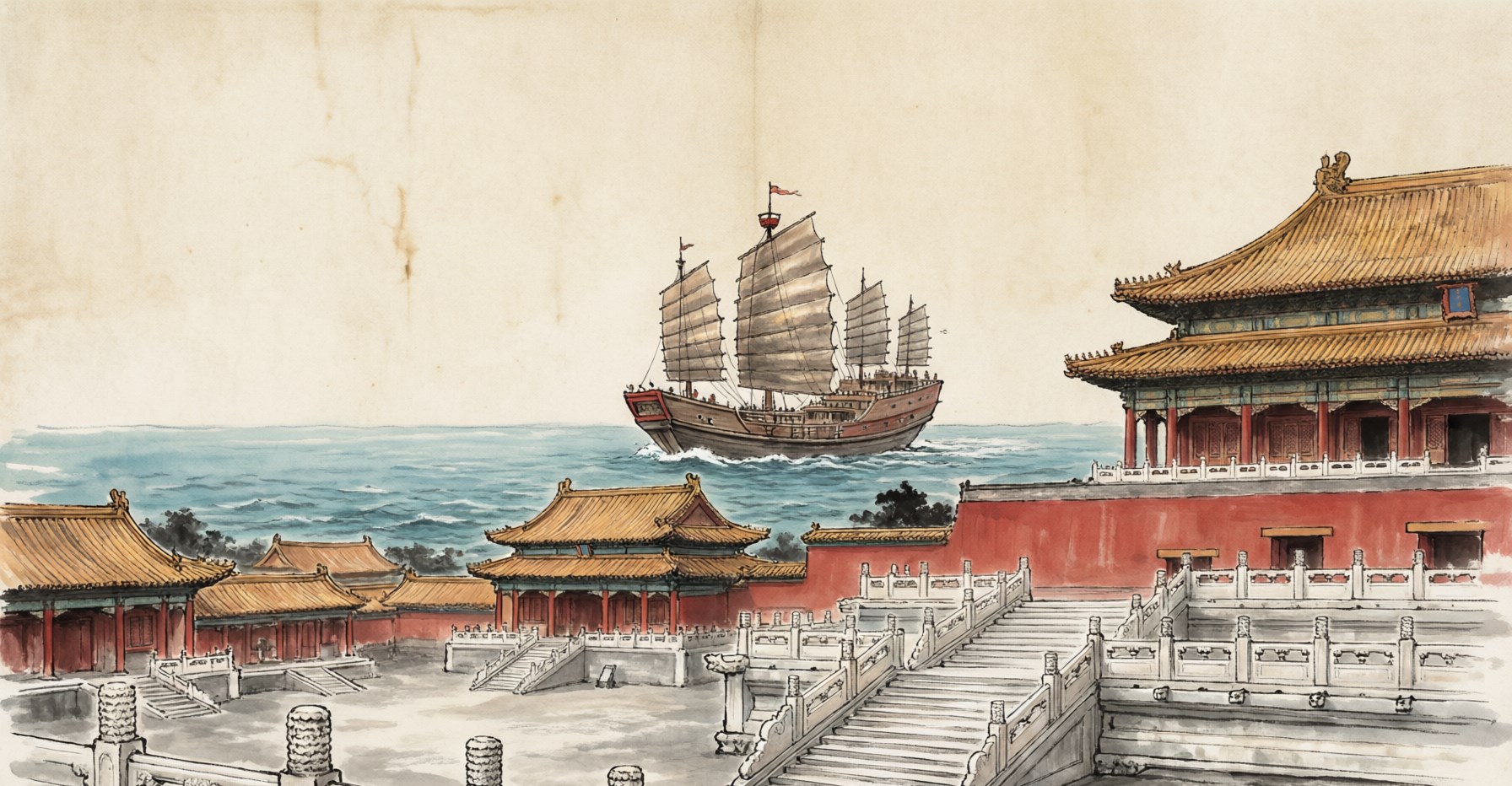
Walk through the gates of the Forbidden City, climb the stone ramparts of the Great Wall at Badaling, or hold a blue-and-white porcelain bowl up to the light, and you are holding the Ming Dynasty in your hands. Of all China's dynasties, the Ming is the one that most shaped the image of the country the world carries in its mind. Its palaces are still the heart of Beijing. Its walls are still the symbol of China itself. Its porcelain still defines what the word "china" means in English. And yet the dynasty that built all this began not in a palace but in a famine, with a starving orphan who had nothing left to lose.
The Ming (明, "Bright") ruled for nearly three hundred years, from 1368 to 1644. It was a dynasty of contradictions: a restoration of native Han Chinese rule after a century of Mongol domination, yet a court increasingly governed by palace eunuchs; a civilization that launched the greatest fleets the world had ever seen, then deliberately sailed them into history and closed the sea; an age of exquisite refinement in art and letters shadowed by secret police and sudden, arbitrary cruelty. To understand the China that visitors fall in love with today — its architecture, its crafts, its novels, its sense of itself — you must understand the Ming.
The Beggar, the Monk, the Emperor
No founder of a great dynasty started lower than Zhu Yuanzhang (朱元璋). Born in 1328 to a poor peasant family in what is now Anhui province, he watched his parents and brothers die within a few desperate days of famine and plague when he was sixteen. With nowhere to turn, the orphaned boy entered a Buddhist monastery, not from devotion but for food. When even the monastery could not feed him, he took to the road as a wandering beggar. It was, by any measure, the humblest origin of any emperor in Chinese history — and the memory of hunger never left him.
The China of Zhu Yuanzhang's youth was ruled by the Mongol Yuan Dynasty, and by the mid-fourteenth century the Yuan were crumbling. Floods, famine, and misrule had set the countryside alight with rebellion, much of it gathered under the banner of the Red Turbans, a millenarian movement tied to the White Lotus sect. Zhu joined the rebels, and he proved to be a natural commander — tall, ugly, fearless, and shrewd. He rose through the ranks, took the great city of Nanjing as his base, and spent more than a decade defeating rival warlords and consolidating the south. In 1368, with his armies marching north, he proclaimed a new dynasty, the Ming, and took the reign name Hongwu (洪武, "Vastly Martial"). That same year his generals captured the Yuan capital of Dadu — modern Beijing — and the Mongols fled back to the steppe. After roughly a century of foreign rule, a Han Chinese dynasty sat on the throne again.
The Hongwu Emperor never forgot where he had come from, and it made him a strange and terrible ruler. He was genuinely solicitous of the common people, lowering taxes, restoring farmland, and punishing corrupt officials with a savagery that bordered on obsession. He was also, by the standards of any age, a paranoid despot. Convinced that the scholar-officials looked down on him and plotted against him, he abolished the office of grand chancellor — the head of the civil bureaucracy — and concentrated all power in his own hands. He created a secret police force, the Embroidered Uniform Guard (锦衣卫, Jinyiwei), answerable only to the emperor, and he purged the founding generation of generals and ministers in waves of executions that claimed tens of thousands of lives. The peasant who had risen from nothing trusted no one, and he bequeathed to his descendants an autocratic system more centralized than any China had known.
"The people are the most important element in a nation; the spirits of the land and grain come next; the sovereign counts for the least." — Mencius (Mengzi), a maxim the peasant-emperor Hongwu knew well
The Forbidden City and the Northern Capital
The Hongwu Emperor had made his capital at Nanjing, in the prosperous lower Yangtze region. It was his son's son — actually his fourth son, Zhu Di, who seized the throne in a civil war — who would give the Ming, and China, its most enduring monument. Taking the reign name Yongle (永乐, "Perpetual Happiness"), the new emperor ruled from 1402 to 1424 and proved to be, after his father, the most energetic builder the dynasty produced. His power base had been in the north, at the old Mongol frontier, and he resolved to move the capital there, to Beijing, closer to the steppe he meant to dominate.
What rose in Beijing between 1406 and 1420 was the Forbidden City (紫禁城, Zijincheng, the "Purple Forbidden City") — the largest palace complex in the world, a walled city within a city of some nine thousand rooms laid out along a north-south axis that still organizes the heart of Beijing today. Its halls of golden-yellow glazed tile, its red walls, its white marble terraces, and its vast ceremonial courtyards were designed to embody the cosmic order itself: the emperor at the center of the world, as the pole star sits at the center of the heavens. For five hundred years, through the Ming and then the Qing, it would be the throne of China. To walk its courtyards today, dwarfed by the Hall of Supreme Harmony, is to stand inside the Ming imagination of power.
The Yongle Emperor did not stop at palaces. He rebuilt the Grand Canal so that grain from the fertile south could flow reliably to the new northern capital, binding the country's economic geography to Beijing for centuries to come. He also commissioned an encyclopedia of staggering ambition, the Yongle Dadian, which gathered the known literature of the Chinese world into thousands of volumes — most of it, tragically, later lost. Restless and grand in all things, he personally led armies against the Mongols on the steppe and died on campaign. It was under his patronage, too, that the Ming reached its single most spectacular — and most fleeting — moment on the world stage.
The Treasure Fleets of Zheng He
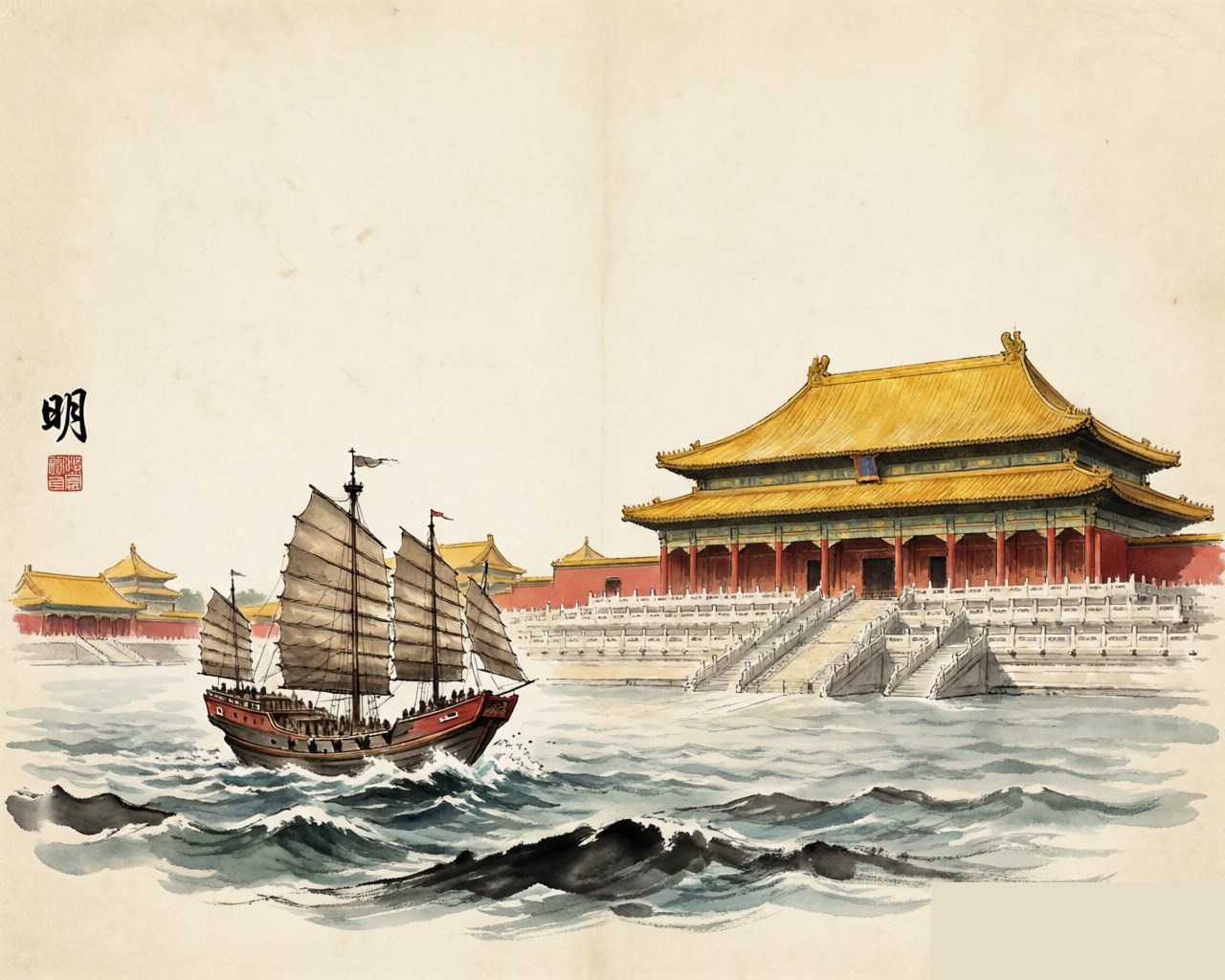
Between 1405 and 1433, the Ming court dispatched seven great maritime expeditions across the seas of Asia and beyond, commanded by an extraordinary man named Zheng He (郑和). A Muslim eunuch from Yunnan who had entered the Yongle Emperor's service as a boy, Zheng He was, by the accounts that survive, a giant of a man and a gifted diplomat and commander. His "treasure fleets" (宝船, baochuan) were unlike anything the world had seen: hundreds of vessels, carrying tens of thousands of sailors, soldiers, merchants, and envoys, with the largest ships said to dwarf the wooden vessels of contemporary Europe. (The exact dimensions recorded in later sources are debated by historians, but there is no question that these were the largest and most powerful fleets afloat in the fifteenth century.)
The fleets sailed from the ports of Fujian down through Southeast Asia, across the Indian Ocean to India and Sri Lanka, into the Persian Gulf and the Red Sea, and as far as the coast of East Africa. They carried silk, porcelain, and lacquerware, and brought back spices, gems, exotic woods, and curiosities — including, on one celebrated occasion, a giraffe, which the delighted court took to be the mythical qilin, an auspicious beast. These were voyages of prestige and trade rather than conquest, projecting the glory of the Ming and drawing distant rulers into the Chinese tributary system. Decades before the Portuguese rounded the Cape of Good Hope, China had demonstrated that it could command the oceans.
And then, almost inexplicably, it stopped. After the seventh voyage, the expeditions were abandoned, the shipyards fell quiet, and the Ming turned inward. The reasons were many and are still argued: the enormous cost, the opposition of Confucian officials who distrusted commerce and the eunuchs who ran the fleets, and a strategic turn of attention back to the land and the ever-present Mongol threat. The court issued and reinforced a series of sea bans (海禁, haijin) that restricted private maritime trade. China did not forget how to build ships; it chose, as a matter of policy, not to. Historians have often wondered what the modern world might have looked like had the treasure fleets kept sailing. As it was, the ocean that Zheng He had briefly mastered would, within a century, belong to others.
The Great Wall Reborn in Stone
Having closed the sea, the Ming poured its energies into the land — above all into the northern frontier, where the Mongols remained a threat for the dynasty's entire life. The memory of the Mongol conquest was fresh, and in 1449 a Ming emperor who personally led an army against the Oirat Mongols was captured in a humiliating defeat known as the Tumu Crisis. The lesson the court drew was not to attack but to defend. Over the following two centuries, the Ming undertook the largest and most sustained fortification project in Chinese history.
Earlier walls, including the first Great Wall of the Qin, had been built largely of rammed earth. The Ming rebuilt and extended the frontier defenses in stone and brick, adding the crenellated battlements, watchtowers, and fortified passes that the world now pictures when it hears the words "Great Wall" (长城, Changcheng). The famous stretches near Beijing — Badaling, Mutianyu, Jinshanling, Simatai — are almost entirely Ming work. Snaking across mountains and deserts for thousands of kilometers, studded with signal towers that could relay news of a raid by smoke and fire, the wall was less a single unbroken barrier than a layered system of defense in depth. It stands today as the most recognizable monument in China, and it is, almost in its entirety, a Ming creation.
Porcelain, Novels, and the Examination at Its Height
If the wall expressed the Ming's defensive grandeur, its arts expressed its refinement. Nowhere more so than in porcelain. At the imperial kilns of Jingdezhen (景德镇), in Jiangxi province, Ming potters brought the painting of cobalt-blue decoration under a clear glaze to a perfection that has never been surpassed. Ming blue-and-white (青花, qinghua) — its dragons, lotuses, and scrolling vines glowing in vivid blue against pure white — became the most coveted luxury good in the world, exported along maritime routes to Southeast Asia, the Islamic world, and eventually Europe, where it shaped the very idea of "china." The imperial kilns also produced the exquisite single-color glazes and the delicate doucai ("contrasting colors") wares prized by collectors to this day.
The Ming was equally decisive in literature. It was the age in which China's great vernacular novels took the form in which the world now reads them. Romance of the Three Kingdoms (三国演义), Water Margin (水浒传), and Journey to the West (西游记) — tales of warlords and heroes and a mischievous monkey king — were compiled and polished in the Ming into sprawling masterpieces that moved Chinese storytelling out of the classical language of the elite and into the living speech of ordinary readers. To this day these books are the bedrock of Chinese popular imagination, endlessly adapted into opera, film, and television.
Underpinning it all was the civil service examination system (科举, keju), which under the Ming reached its most elaborate and most rigid form. The exams, testing mastery of the Confucian classics and the composition of the highly stylized "eight-legged essay" (八股文), were the single ladder by which talented men of modest birth could rise to govern the empire. At its best, the system was a remarkable engine of social mobility and shared culture, binding the far-flung provinces to a common canon of learning. At its worst, it rewarded conformity and rote. But for better and worse, the Ming examination order defined the Chinese scholar-official for the rest of the imperial age.
Eunuchs, Rebellion, and the Fall of Beijing
The Ming autocracy that the Hongwu Emperor had built contained a flaw he himself had planted. Having abolished the chancellor and barred the palace eunuchs from politics, he left a system in which all power flowed to the emperor personally — and in which the only people with constant access to the emperor were the eunuchs who served his household. As later emperors withdrew from the daily grind of rule, the eunuchs filled the vacuum, becoming a shadow government of immense and often corrupt power.
The pattern deepened over the dynasty's second century. The Wanli Emperor (万历, r. 1572–1620) famously grew so alienated by disputes with his officials that he effectively went on strike, refusing to hold audiences or fill vacant posts for decades, leaving the machinery of government to rust. In the 1620s the eunuch Wei Zhongxian (魏忠贤) rose to a position of almost unchecked authority, terrorizing the court, persecuting the reformist Donglin faction of scholar-officials, and even allowing himself to be worshipped with honors reserved for sages. The secret police the Hongwu Emperor had created became instruments of factional terror. Beneath the surface splendor, the late Ming court was sick.
The final crisis came from two directions at once. Within, a wave of peasant rebellions swept the famine-stricken northwest, the most formidable led by a former courier named Li Zicheng (李自成), who gathered the desperate and the dispossessed into an army that marched on the capital. Without, a new power was rising beyond the northeastern wall: the Jurchen, later Manchu, tribes who had united under capable leaders and were pressing hard against the Ming frontier. The dynasty, exhausted and bankrupt, could not fight both.
In the spring of 1644, Li Zicheng's rebel army closed on Beijing. The last Ming emperor, Chongzhen (崇祯), a conscientious man who had inherited an impossible situation, found himself abandoned by the court he had tried to save. As the rebels entered the city, he climbed the hill behind the Forbidden City and hanged himself, reportedly leaving a final plea for the rebels to spare his people. With his death, the Ming Dynasty that had ruled from Beijing for more than two centuries came to an end.
But the story did not end there. A Ming general guarding the great pass at Shanhaiguan, where the wall meets the sea, faced a choice between the rebels and the Manchus — and opened the gates to the Manchus, who swept through, defeated Li Zicheng, and took Beijing for themselves, founding the Qing Dynasty. Ming loyalists retreated south, and for several decades a succession of rump regimes — known to history as the Southern Ming (南明) — kept the dynasty's banner flying in the south and along the coast, sustained by loyal generals and the memory of the fallen house. The last Ming pretenders held out, and the Zheng family of the pirate-loyalist Koxinga held Taiwan in the Ming name, until the 1660s and 1680s. The dynasty was dead, but its loyalists refused, for a generation, to let it be buried.
The China We Recognize
The Ming's legacy is, in a very real sense, the face of traditional China itself. When visitors picture the country — the golden roofs of the Forbidden City, the stone wall winding over the mountains, the blue-and-white bowl, the monkey king of Journey to the West — they are picturing things the Ming made or perfected. Even the word many Chinese use for themselves, "Han," and the sense of a continuous native civilization restored after foreign rule, was sharpened by the Ming's founding myth of liberation from the Mongols.
It was a dynasty that could do almost anything on a grand scale and then, by choice, decline to do it. It built the world's greatest palace and the world's greatest fleets, and then it closed the sea. It produced art of unmatched delicacy alongside a machinery of arbitrary terror. It restored native rule and yet, in the end, fell to a new conquest from the northeast that would rule China for nearly three more centuries. Perhaps that tension is the secret of its hold on the imagination: the Ming is the dynasty that shows China at its most magnificent and its most self-denying at once — a civilization that built monuments to last forever and then, quietly, turned its back on the horizon.