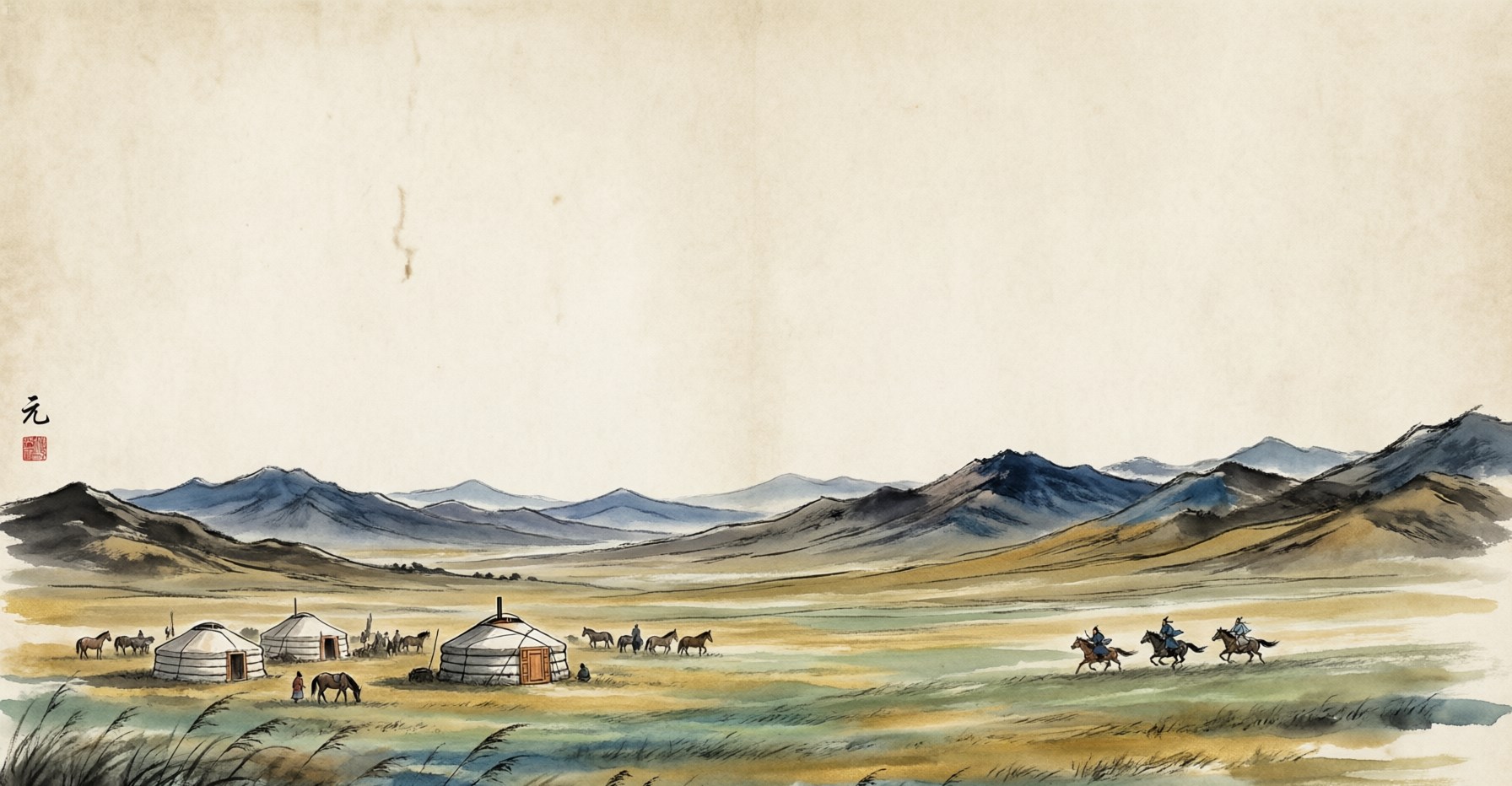
For the first and only time in its long history, all of China was ruled by a people from the steppe. The Yuan Dynasty (元朝, Yuanchao) was the Chinese face of the Mongol Empire — the largest contiguous land empire the world has ever known, a realm that at its height stretched from the Korean peninsula to the gates of Eastern Europe. To the Chinese who lived through it, this was a strange and unsettling age: their country governed by horsemen, their scholars pushed to the margins, their capital moved to a city built on the northern frontier. And yet the Yuan was also a time of astonishing openness, when the Silk Road reopened and the world came to China, when religions met in peace and a new popular theater was born. It is a dynasty that does not fit comfortably into the usual story of China — which is exactly why it matters.
The Yuan lasted barely a century, from 1271 to 1368, and it ended as foreign dynasties often do — driven back to the grasslands by rebellion and a native restoration. But in its short life it changed the shape of the country permanently. It gave China the city that has been its capital ever since. It bound the empire together with roads and canals and a single currency. And it opened China to the wider world more fully than at almost any other moment before the modern age.
The Storm From the Steppe
The Yuan cannot be understood without the man who set it in motion, though he died before it bore his family's name. In the early thirteenth century the scattered, feuding tribes of the Mongolian plateau were united by a chieftain named Temujin, who in 1206 took the title Genghis Khan — the "universal" or "oceanic" ruler. What followed was one of the most extraordinary military explosions in human history. With armies of superb horse archers, disciplined and ruthless, Genghis and his sons toppled empire after empire: the Western Xia, the Jin Dynasty of the Jurchens in northern China, the Khwarezmian Empire of Central Asia, and kingdoms across Persia and Russia. The scale of the conquest, and of the destruction that accompanied it, was almost beyond comprehension. Entire cities that resisted were razed; the death toll, in a world without reliable records, is impossible to fix and remains hotly debated by historians. What is not in doubt is that within a few decades the Mongols had redrawn the map of Eurasia.
It was Genghis's grandson Kublai Khan (忽必烈, Hubilie) who completed the conquest of China and transformed it into something new. Where his grandfather had been above all a conqueror of the steppe, Kublai was drawn to the settled civilization of the south. After a bitter struggle for the succession against his own brothers, he turned his full attention to the Southern Song, the last Chinese dynasty still standing. The war in the south was long and difficult — the Song fought hard, behind rivers and fortified cities — but in 1279, at the naval Battle of Yamen, the last Song court perished in the sea. For the first time, all of China answered to a Mongol khan.
Kublai Khan and the New Capital
Kublai understood that to rule China he could not remain merely a steppe warlord. In 1271 he gave his realm a Chinese name, drawing on the ancient Yijing, the Book of Changes: Da Yuan (大元), the "Great Origin" or "Great Primal." It was a deliberately Chinese gesture, a claim to the Mandate of Heaven and a place in the long line of legitimate dynasties. He adopted Chinese court ritual, employed Chinese and foreign advisers, and presented himself to his Chinese subjects as a true emperor.
His grandest statement was his capital. On the site of the old Jin capital, in what is now Beijing, Kublai built a magnificent new city called Dadu (大都), the "Great Capital." Planned on a vast geometric grid, with a great palace at its heart and broad avenues running north and south, Dadu was one of the most impressive cities in the world. It is the direct ancestor of modern Beijing; the city's famous central axis still follows the line the Mongol planners laid down. By choosing the north as his seat, Kublai shifted the center of Chinese power away from the ancient capitals of the Yellow River and the Southern Song's Hangzhou, and toward the frontier where steppe and farmland met. China's capital has stayed in the north ever since.
"The city is so great and so full of marvels that no man could describe it all... and indeed there is no city in the world to compare with it." — adapted from the account of Dadu (Cambaluc) attributed to Marco Polo
The World Comes to China
The great gift of the Mongol Empire to the world was, paradoxically, peace — or at least the kind of enforced order that lets trade flow. Historians call it the Pax Mongolica, the Mongol Peace. With a single authority controlling the breadth of Eurasia, the ancient Silk Road, long disrupted by war and banditry, reopened. Merchants, missionaries, and travelers could cross the continent under the protection of the khan's law. Goods, ideas, and diseases flowed in both directions: Chinese printing, gunpowder, and porcelain traveled west, while Central Asian astronomy, medicine, and crops traveled east.
The most famous of the travelers was a young Venetian named Marco Polo, who arrived at Kublai's court in the 1270s and, by his own account, served the khan for nearly two decades. Whether every detail of his book is true has been debated for centuries — some scholars doubt he ever reached China at all, though most accept the core of his journey. Whatever the uncertainties, his Travels gave medieval Europe its most vivid picture of the East: of paper money, which astonished him; of coal, "black stones that burn like logs"; of a postal system of relay stations spanning the empire; of the wealth and order of Kublai's court. He was not the only foreigner at Dadu. The Yuan capital hosted Persian astronomers, Central Asian merchants, Tibetan monks, and even Christian missionaries. For a moment, China was the most cosmopolitan place on earth.
A Society of Four Classes
The openness of the Yuan had its limits, and its social order was built on a frank hierarchy of conquest. The Mongols organized their subjects into four broad classes. At the top stood the Mongols themselves. Below them came the semu (色目), a catch-all category of Central and West Asians — administrators, merchants, and technicians whom the Mongols valued and trusted. Third were the northern Chinese, who had lived under Mongol or Jurchen rule the longest. At the bottom were the southern Chinese, the former subjects of the Song, conquered last and trusted least. The system was not always applied with rigid consistency, but its message was clear: the conquered were not the equals of the conquerors.
For the traditional Chinese scholar-official class, this was a humiliation. The civil service examinations — the ladder by which educated men had risen for centuries — were suspended for much of the Yuan, and when they were revived they carried less weight than before. Many scholars, barred from office and disdainful of foreign rule, withdrew into private life. They painted, wrote, and cultivated their gardens. This enforced retreat from politics, painful as it was, helped drive a remarkable flowering of literature and art, as educated men turned their talents to forms — drama, fiction, painting — that the old examination culture had looked down upon.
One area where the Yuan was genuinely liberal was religion. The Mongols, secure in their own belief in the eternal blue heaven, were remarkably tolerant of the faiths of their subjects. Buddhism flourished, especially Tibetan Buddhism, which enjoyed special favor at court. Islam spread widely through the merchant communities and the semu population, laying foundations that endure in China today. Christianity, in its Nestorian and newly arrived Catholic forms, found a foothold. Daoism continued among the people. At Kublai's court, representatives of these faiths debated and coexisted — a degree of religious pluralism rare in the medieval world.
The Birth of Chinese Drama
If the Yuan left one enduring gift to Chinese culture, it was the theater. With scholars shut out of government and a new urban audience hungry for entertainment, a popular dramatic form called zaju (杂剧), "variety drama," came into its own. Zaju combined song, spoken dialogue, and dance into full-length plays — a true theater, where earlier Chinese performance had been more fragmented. It was performed in the teahouses and pleasure quarters of the great cities, and it spoke in the living language of the people rather than the classical prose of the scholars.
The greatest of the Yuan dramatists was Guan Hanqing (关汉卿), a prolific playwright often called the father of Chinese drama. His most celebrated work, The Injustice to Dou E (窦娥冤), tells the story of a wronged young woman whose innocence is vindicated only by supernatural signs after her execution — a searing protest against corrupt authority that still moves audiences today. Alongside him, writers like Wang Shifu, author of the exquisite love story The Romance of the Western Chamber (西厢记), gave the form its lyric grace. The Yuan theater also nourished the roots of the Chinese novel, as storytellers' tales were gathered and expanded. The great classical novels of later centuries owe a debt to this age when educated men, denied their proper place, poured their genius into the stories of ordinary people.
Money, Canals, and the Machinery of Empire
The Mongols were conquerors, but Kublai's Yuan was also a working government, and it preserved much of the Chinese administrative machinery it had inherited. The empire was divided into provinces — a system whose outlines survive in China's modern map — and governed through a centralized bureaucracy that blended Mongol, Chinese, and Central Asian personnel. The Yuan kept the Chinese love of order: a vast postal relay network (the yam) carried messages and officials across the empire with astonishing speed, and a single paper currency circulated throughout the realm.
Paper money, which the Song had pioneered, became under the Yuan the backbone of the economy — and, eventually, one of the causes of its ruin. The Mongols issued notes on a vast scale and, for a time, managed them with care. But as the dynasty weakened, later rulers printed money to cover their debts, and inflation eroded public trust. The lesson the Song had half-learned — that paper currency rests on confidence, and confidence can be destroyed — the Yuan relearned at a cost.
The Yuan also reshaped China's physical infrastructure. The Grand Canal, the ancient waterway linking the fertile south to the political north, was extended and rerouted under Kublai so that grain and goods could flow directly to Dadu. This engineering achievement helped bind the empire together and confirmed the north's dependence on the south's rice — a relationship that the canal would sustain for centuries to come.
Decline and the Coming of the Ming
The Yuan's strength depended on strong leadership, and after Kublai's death in 1294 the dynasty struggled to produce it. The middle decades of the fourteenth century were marked by a rapid succession of weak or short-lived emperors, bitter court intrigues, and factional fighting among the Mongol elite. The natural world added its own blows: the Yellow River flooded catastrophically, famine followed, and the government's attempts to conscript hundreds of thousands of laborers to repair the dikes bred resentment across the countryside. Inflation gnawed at the economy. Banditry spread. The dynasty that had once commanded the world could no longer command its own provinces.
Out of this chaos rose a movement of popular rebellion, the most famous of them the Red Turban Rebellion (红巾军起义), so called for the red cloths its followers wore around their heads. The Red Turbans drew on a potent mixture of Buddhist millenarianism and anti-Mongol feeling, promising the coming of a savior and the restoration of native rule. From their ranks emerged a man of the humblest origins: Zhu Yuanzhang (朱元璋), a peasant who had been a beggar and a monk before the rebellions gave him a cause. Ruthless, brilliant, and patient, Zhu rose from rebel commander to warlord to emperor. In 1368 his armies took Dadu, and the last Yuan emperor fled north to the steppe. Zhu proclaimed a new dynasty — the Ming, the "Brilliant" — and the Mongol century in China was over.
The Legacy of the Mongol Century
The Yuan left China with a complicated inheritance. The Mongols had been conquerors, and for many Chinese the memory of their rule was one of subjugation and wounded pride; the Ming would define themselves partly by reversing the Yuan, restoring Chinese customs and reasserting native rule. Yet the Yuan also left things that no later dynasty could undo. They fixed the capital in the north, at the city we now call Beijing. They bound the country together with provinces, canals, roads, and a single currency. They opened China to the world and let the world in.
Culturally, the Yuan's greatest gifts were born of its contradictions. The scholars it sidelined created a new popular literature — drama and the seeds of the novel — that enriched Chinese culture permanently. The religious tolerance it practiced left lasting communities of Muslims and others woven into the fabric of Chinese society. And the very fact of Mongol rule expanded the Chinese imagination, reminding a civilization that often thought of itself as the whole world that there were other worlds beyond the mountains and the desert — worlds that could, on occasion, conquer it.
To remember the Yuan is to remember that China's story is not only the story of the Han Chinese. It is also the story of the horsemen from the steppe who rode in, ruled, and were absorbed — leaving the country larger, more connected, and more various than they found it. The Mongol century was brief and often brutal, but it stitched China into the wider world at a moment when the world was finally ready to meet it. When the dust settled and the Ming restored native rule, China carried the Yuan within it still: in the line of its capital's streets, in the flow of its canals, in the plays performed in its teahouses, and in the faces of the peoples who had come to stay.