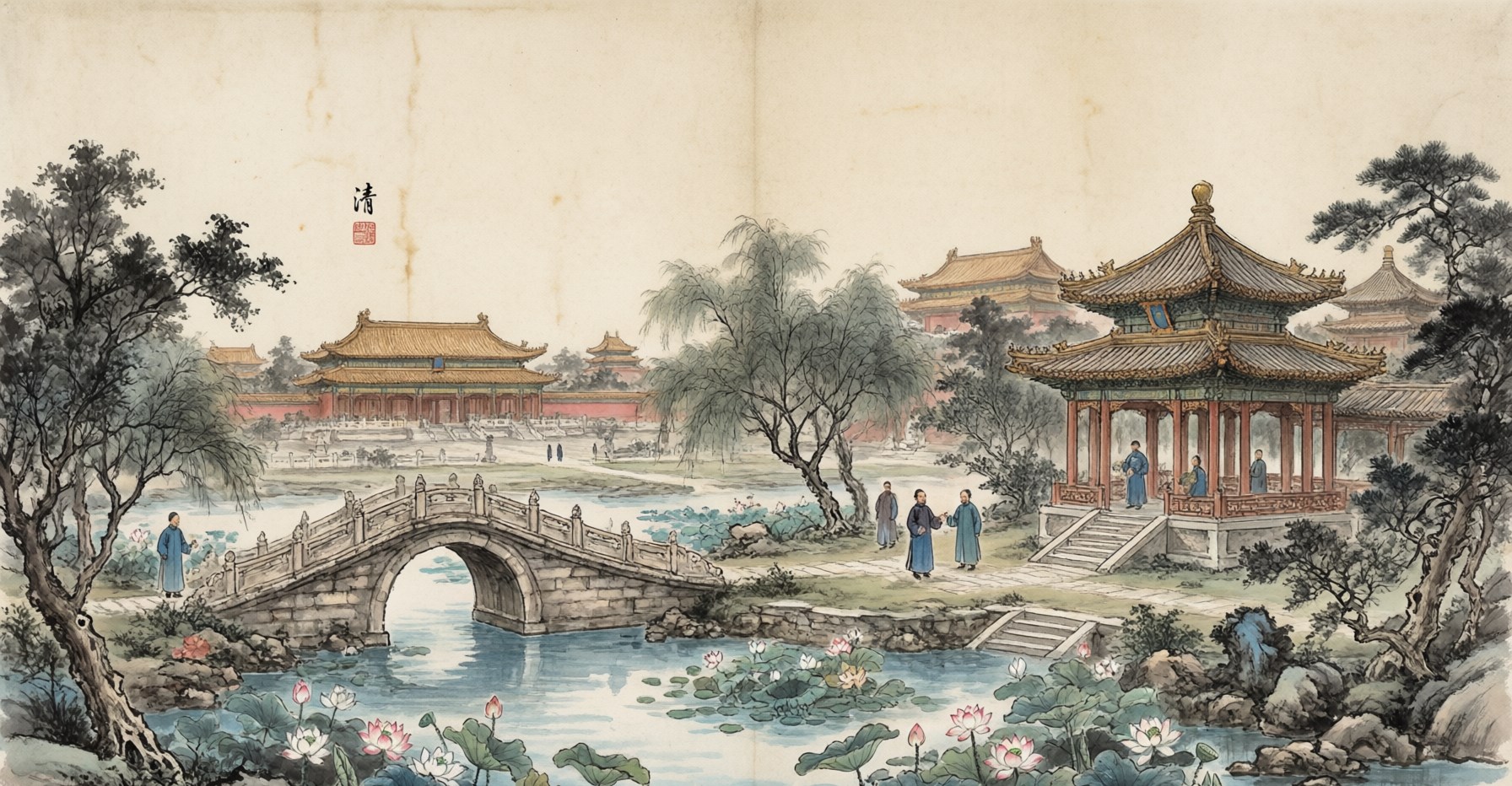
Every dynasty believes it will last forever, and most are wrong. The Qing (清, "Pure") knew better than most that dynasties fall — because they had watched one fall, and walked through the open gate. In 1644, a people from beyond the northeastern wall entered a Beijing that the dying Ming had already lost, and began a reign that would last nearly three hundred years. They would carry China to its greatest territorial extent and its most confident cultural flowering, and then preside over its most painful collision with the modern world. When the last Qing emperor — a small child — gave up the throne in 1912, an unbroken tradition of dynastic rule stretching back close to four thousand years came to an end. The Qing is where the long story of imperial China closes.
To understand the Qing is to hold two truths at once. They were, in their prime, one of the most successful empires in Chinese history — wise administrators, generous patrons of learning, and the rulers who gave China very nearly the borders it has today. And they were the dynasty under whose watch China suffered what its modern memory calls the "century of humiliation" (百年国耻, bainian guochi) — defeat, dismemberment, and the loss of the certainty that China stood at the center of the world. Both truths are real, and neither can be understood without the other.
From Beyond the Wall: The Rise of the Manchus
The Qing did not begin as Chinese emperors. They began as the Jurchen, a people of hunters, herders, and farmers in the forests and plains of the northeast — the region the Chinese call Manchuria. In the late sixteenth century, a chieftain of extraordinary ability named Nurhaci (努尔哈赤) united the scattered Jurchen tribes into a single military and political force, organizing them into "banners" (八旗, baqi) — colored military-social units that would remain the backbone of Manchu power for centuries. In 1616 he proclaimed a new state, the Later Jin, openly challenging the Ming.
It was Nurhaci's son and successor, Hong Taiji (皇太极), who transformed a frontier khanate into an empire. He renamed the people "Manchu" (满洲, Manzhou) and, in 1636, renamed the dynasty "Qing" and took the title of emperor himself, modeling his court on Chinese precedent while preserving Manchu martial discipline. The Qing built a multi-ethnic state from the start, ruling Manchus, Mongols, and Han Chinese through separate but coordinated institutions. They were patient, and they were ready. When the Ming Dynasty tore itself apart in 1644 — the capital taken by a peasant rebel, the last Ming emperor dead by his own hand — a Ming general at the great Shanhai Pass opened the gates to the Manchus rather than submit to the rebels. The Qing swept in, defeated the rebel Li Zicheng, and made Beijing their capital. A dynasty from beyond the wall now ruled the Middle Kingdom.
The Queue and the Dual Order
Conquest is one thing; ruling a vast, settled, culturally self-confident civilization is another. The Qing solved the problem with a blend of force and accommodation that proved remarkably durable. On one hand, they insisted on visible submission. The most infamous symbol was the queue (辫子, bianzi): an edict ordered Han Chinese men to shave the front of the head and wear the remaining hair in a long braid, in the Manchu fashion. "Keep your hair and lose your head, or keep your head and cut your hair," the order was said to run. To a Confucian culture that held the body, hair included, to be a sacred gift from one's parents, the demand was a profound humiliation — and the resistance it provoked was met with terrible violence, as in the massacres that followed the siege of cities like Yangzhou and Jiading.
On the other hand, the Qing were shrewd enough to govern through continuity rather than rupture. They kept the Ming administrative system almost intact, retained the civil service examinations and the Confucian classics at their center, and presented themselves as the rightful heirs to the Chinese imperial tradition, performing its rites and patronizing its scholars. Government operated through a dual structure in which Manchu and Han officials served side by side, the Manchus holding the balance of power. The result was a regime that was, at the top, a Manchu military aristocracy, and, below that, a thoroughly Chinese civil bureaucracy. It was an arrangement that allowed a small conquering people to rule the most populous empire on earth for nearly three centuries.
"Our Celestial Empire possesses all things in prolific abundance and lacks no product within its own borders. There was therefore no need to import the manufactures of outside barbarians in exchange for our own produce." — Qianlong Emperor, edict to King George III of Britain, 1793
The Three Great Emperors
The Qing's golden age was the long reign of three remarkable rulers who, between them, governed for well over a century. The Kangxi Emperor (康熙, r. 1661–1722) came to the throne as a boy and grew into one of the most capable monarchs in Chinese history — a tireless administrator, a patron of science and learning, and a commander who personally campaigned on the frontiers. He consolidated Qing rule, suppressed the great revolt of the Three Feudatories, and extended the empire's reach into Mongolia and Tibet. He was succeeded, after a contested succession, by the hardworking Yongzheng Emperor (雍正, r. 1722–1735), a stern reformer who tightened the finances, fought corruption, and made the bureaucracy run with new efficiency.
Then came the Qianlong Emperor (乾隆, r. 1735–1796), Kangxi's grandson, whose long reign marked the apex of Qing power and the high-water mark of imperial China itself. Under Qianlong, the empire reached its greatest territorial extent: the conquest of the Dzungar Mongols brought the vast western region of Xinjiang (新疆, the "New Frontier") firmly under Qing control, and Tibet, Mongolia, and Taiwan were all incorporated into a single, sprawling polity. At its height the Qing realm was among the largest empires the world has ever seen, and its population swelled enormously, fed by new crops from the Americas — maize, sweet potatoes, peanuts — that allowed farming to spread into new lands. Qianlong was a prodigious patron of the arts, a collector, and a poet of staggering output. He was also, in his later years, the captive of a corrupt favorite, Heshen, whose amassed fortune became legendary. The seeds of decline were sown at the very moment of greatest glory.
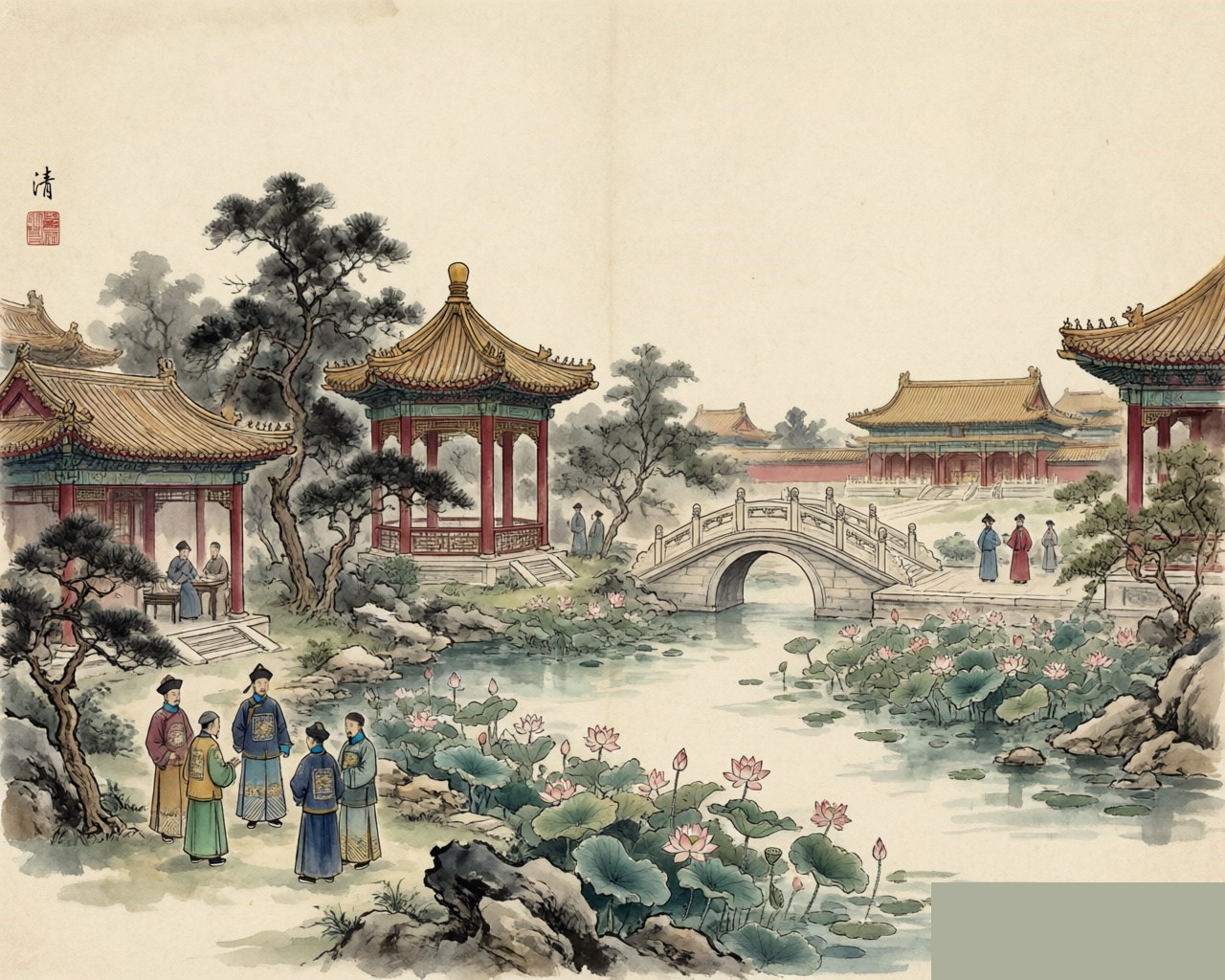
A Final Flowering of Learning
The confidence of the high Qing expressed itself, above all, in books. The emperors set themselves up as the guardians and summing-up of the entire Chinese literary tradition, and nowhere more grandly than in the great project of the Qianlong reign, the Siku Quanshu (四库全书), the "Complete Library of the Four Treasuries." Conceived as a gathering of all the important writing in the Chinese world — organized into the four traditional categories of classics, history, philosophy, and literature — it was copied by hand into thousands of volumes, one of the largest editorial undertakings in human history. It was an act of genuine preservation, and also of control: the same project that saved countless texts also screened them, and works judged seditious or offensive to the Manchu rulers were altered or destroyed. The library and the censorship were two faces of one imperial ambition — to possess, and to police, the whole of Chinese learning.
The same confidence poured into the arts. The Qing produced what many consider the supreme masterpiece of Chinese fiction, Dream of the Red Chamber (红楼梦) by Cao Xueqin — an immense, elegiac portrait of a great family's decline, written from inside the world of the Manchu-connected elite and revered to this day as the pinnacle of the Chinese novel. In painting, the early Qing saw both a revered "orthodox" school that refined the classical landscape tradition and a generation of fierce individualists — monks and Ming loyalists such as Bada Shanren and Shitao — whose bold, expressive brushwork turned personal grief and defiance into some of the most striking ink painting China has ever produced. At the imperial kilns of Jingdezhen, inherited from the Ming, potters developed brilliant new palettes, above all the soft pinks and enamels of the "famille rose" (粉彩, fencai) wares that became a hallmark of Qing taste. It was a civilization still capable of astonishing invention even as the political storms gathered.
This self-assurance also shaped the Qing's dealings with the outside world. Trade with European merchants was channeled and constrained through the Canton System (广州制度), which confined foreign traders to the southern port of Guangzhou (Canton) and allowed them to deal only through a licensed guild of Chinese merchants. The arrangement reflected a worldview in which China, self-sufficient and supreme, granted trade as a favor rather than a necessity. It was, for a time, a position of genuine strength — Chinese tea, silk, and porcelain were the goods the world wanted, and silver flowed in. But it also left the empire unprepared for the day when the merchants at the gate would come with warships.
The Century of Humiliation
That day came with opium. By the early nineteenth century, British merchants, desperate to balance a trade that drained silver into China, turned to smuggling opium from India into the country. The addiction it caused was devastating, and when the Qing court sent a determined commissioner, Lin Zexu, to suppress the trade at Canton, the British responded with gunboats. The First Opium War (1839–1842) exposed, with brutal clarity, how far the Qing military had fallen behind the industrialized West. China was defeated and forced to sign the Treaty of Nanjing, the first of the "unequal treaties" (不平等条约): it ceded Hong Kong, opened ports to foreign trade, and surrendered the right to set its own terms. The self-sufficient Celestial Empire had met the modern world, and lost.
What followed was a cascade of disasters. A Second Opium War in the 1850s and 1860s brought further humiliation, culminating in the burning of the Old Summer Palace (圆明园, Yuanmingyuan) outside Beijing by Anglo-French forces — a wound in Chinese memory that has never fully healed. More foreign powers extracted their own concessions; spheres of influence carved up the coast. And as if foreign invasion were not enough, the empire nearly tore itself apart from within. The Taiping Rebellion (1850–1864), led by a failed examination candidate named Hong Xiuquan who proclaimed himself the younger brother of Jesus Christ, swept across southern China and established a rival heavenly kingdom at Nanjing. The war to suppress it was one of the deadliest conflicts in all of human history; the precise toll is debated by historians, but it is reckoned in the tens of millions of lives. The Qing survived, but only barely, and only with the help of regional Han armies whose rise quietly weakened the center.
Reform, Reaction, and the Boxers
The dynasty's response to crisis oscillated between reform and reaction. The Self-Strengthening Movement (洋务运动) of the 1860s to 1890s attempted to graft Western technology onto the existing order — building arsenals, shipyards, and modern industries while leaving Confucian institutions untouched. Its limits were exposed in 1894–1895, when Japan, which had modernized far more thoroughly, defeated China in a war over Korea and stripped away the tributary state and the island of Taiwan. The shock was enormous.
In 1898, the young Guangxu Emperor attempted a sweeping program of modernization known as the Hundred Days' Reform (百日维新), issuing a torrent of edicts to overhaul education, the military, and government. It lasted barely three months. The real power at court, the Empress Dowager Cixi (慈禧太后), staged a coup, confined the emperor, executed several reformers, and reversed most of the changes. Cixi — formidable, conservative, and often blamed for the dynasty's final failures — would dominate Qing politics for decades. Then, in 1900, came the Boxer Rebellion (义和团运动), a violent anti-foreign, anti-Christian uprising that the court first tolerated and then half-embraced. An alliance of eight foreign powers marched on Beijing, crushed the Boxers, and imposed yet another punishing indemnity. The dynasty that had once commanded the world now seemed unable to command its own capital.
The Last Emperor and the Weight of a Legacy
By the early twentieth century, the Qing were ruling on borrowed time. Reform came too late: the abolition of the ancient examination system in 1905 severed the dynasty's oldest bond with the educated elite, and a program of "New Policies" only whetted appetites for change it could not satisfy. Abroad and in the treaty ports, revolutionaries gathered. Foremost among them was Sun Yat-sen (孙中山), whose vision of a modern republic — nationalism, democracy, and the people's livelihood — inspired a generation. The Qing court, discredited and bankrupt of legitimacy, could no longer command loyalty even among its own modernized armies.
The end, when it came, was almost swift. In October 1911 a mutiny among troops at Wuchang sparked a wave of uprisings; province after province declared independence from the dynasty. The Qing, with no reliable force left, turned to a general named Yuan Shikai, who negotiated rather than fought. On February 12, 1912, the abdication edict was issued in the name of the last emperor, Puyi (溥仪), a child of six who had reigned for barely three years under the era name Xuantong. With that document, the Qing Dynasty ended — and with it, the entire imperial system that had governed China, in one form or another, for nearly four thousand years. Puyi would live on through a strange afterlife as a puppet emperor of Japanese-occupied Manchuria and, finally, a gardener in the People's Republic, a living ghost of the world that had ended with his childhood.
The Qing leave a legacy as complex as any dynasty in the long record. They were the rulers who gave China, very nearly, its modern map — the vast, multi-ethnic territory that incorporates Xinjiang, Tibet, Mongolia, and the northeast, and that defines the country to this day. In their golden age they were enlightened administrators and generous stewards of Chinese culture, and the population and prosperity of the high Qing dwarfed anything that had come before. To dismiss them as mere conquerors, or as the dynasty of decline, is to miss how much of what we call China was, in fact, built under their rule.
And yet they are also the dynasty of the century of humiliation — the one that presided over defeat, addiction, dismemberment, and the loss of a civilization's ancient confidence. That trauma did not end with the Qing; it shaped the nationalism, the urgency, and the determination to "never again be weak" that runs through modern China to this day. The Qing are thus a hinge in the long story: the last act of the imperial age and the painful birth of the modern nation. To stand in the Forbidden City, which the Qing inherited from the Ming and made their own, is to stand at the place where four thousand years of emperors came, at last, to rest — and where the China of today began, in struggle, to be born.