The Sound You Cannot Ignore
There is no ignoring a suona (唢呐). Where the xiao whispers and the dizi sings, the suona shouts — a bright, piercing, gloriously unapologetic blast that carries across a whole village, cuts through the din of firecrackers and chatter, and announces, to anyone within earshot, that something important is happening. A wedding. A funeral. A festival. A homecoming. Whatever the occasion, the suona is its voice, and its voice is impossible to mistake: raw, reedy, triumphant, and a little wild, like a human cry pushed to its brightest extreme.
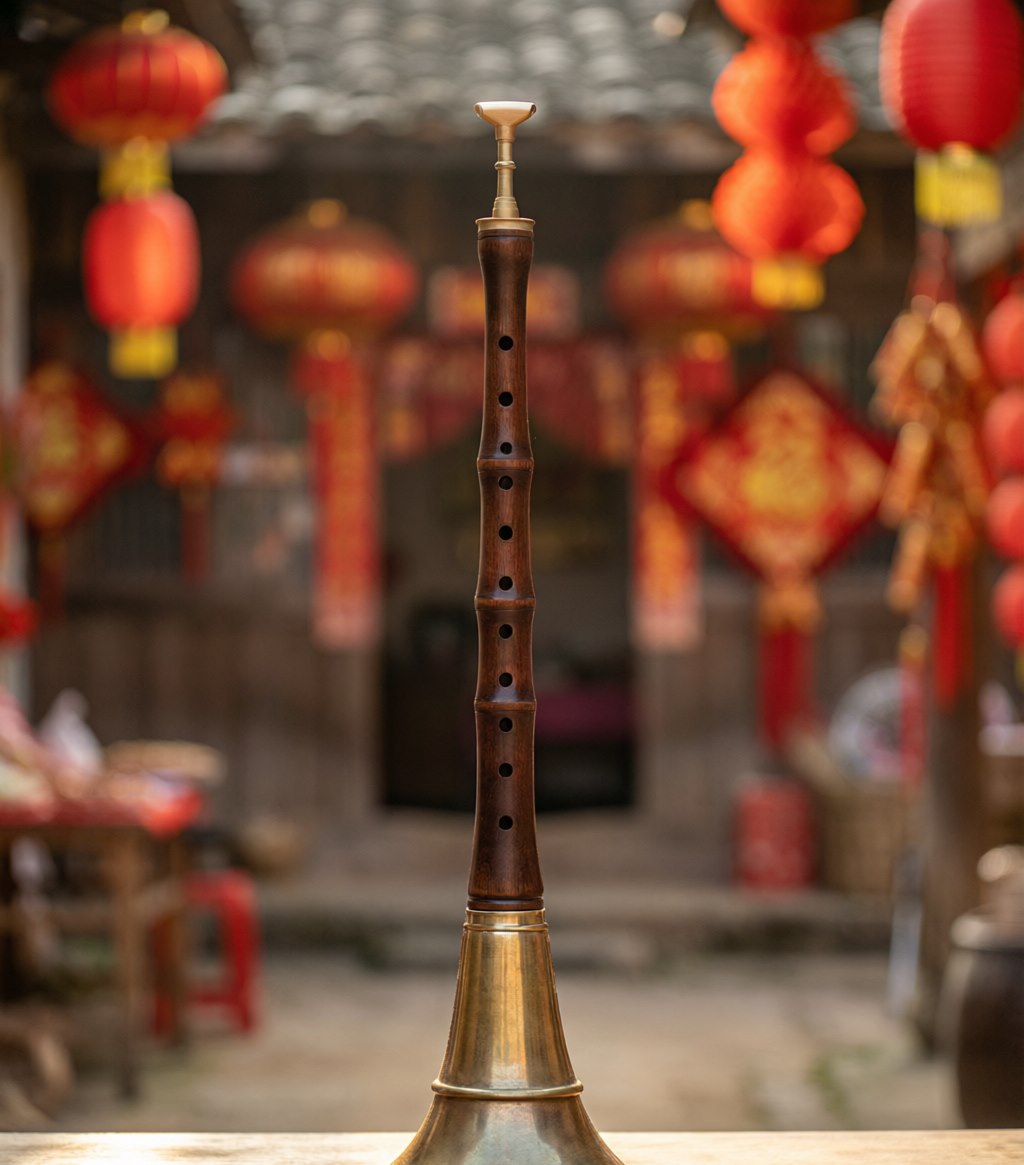
The instrument itself is a striking object. A slender conical body of hardwood, pierced with finger holes, tapers upward to a small double reed that the player takes between the lips. At the bottom it flares into a broad bell of brass or copper, which catches the light and throws the sound outward in a brilliant cone. Held aloft, the suona looks almost like a trumpet crossed with an oboe — and indeed it belongs to the same family of double-reed pipes found across Eurasia, from the Middle East to the Balkans. It is, in the most literal sense, an instrument of the open air, made to be heard at a distance and to fill a space no amplifier could improve.
For five centuries the suona has been the soundtrack of Chinese rural life, the instrument that marks the great passages of the human journey: birth, marriage, death, and every celebration in between. It is the sound of joy so loud it borders on grief, and of grief so loud it borders on joy. To understand the suona is to understand something essential about the Chinese relationship to ceremony — the conviction that the great moments of life deserve to be announced, publicly and without embarrassment, to the whole community and to heaven itself.
Origins: A Traveler from the West
The suona is, by origin, an immigrant. Its ancestors are the double-reed pipes of Central Asia and Persia — instruments known across the Islamic world as the surnay or surna, names from which "suona" is almost certainly derived. These horns traveled the Silk Road, carried by merchants, soldiers, and musicians, and they appear in Chinese sources by the late imperial period. A common account places the suona's arrival and popularization during the Ming dynasty (1368–1644), when it is said to have entered military and ceremonial use before spreading into the folk traditions of the countryside.
Once established, the suona naturalized rapidly and completely. Its penetrating volume made it ideal for outdoor ceremony and for military signaling, but it was in the villages that it truly found its home. By the Qing dynasty it was indispensable to the professional bands of wind-and-percussion musicians (吹打, chuida) who were hired for every significant occasion — the ensembles that provided the music for weddings, funerals, temple fairs, and harvest celebrations across northern and central China. The suona became the leading voice of these bands, the instrument around which the drums, gongs, and cymbals arranged themselves.
This foreign origin is preserved in the instrument's very name, yet few Chinese instruments feel more thoroughly native. The suona's sound is, for hundreds of millions of people, the sound of "home" in its most visceral sense — of the village, the family compound, the ancestral hall. That an instrument born on the Persian steppe could become the defining voice of Chinese rural ceremony is one of the quiet triumphs of cultural exchange, and a reminder that "traditional" Chinese culture has always been, in part, a story of arrival and adoption.
Construction: Reed, Body, and the Brass Throat
The suona's design is a masterclass in acoustic efficiency. The sound begins at the reed (哨子, shaozi), a small double reed made from a sliver of river reed or cane, soaked and shaped until it vibrates freely when blown. The player takes this reed entirely into the lips, which press against a small metal staple, and sets it vibrating with a focused, high-pressure airstream. The reed is the soul of the instrument's timbre — bright, buzzy, and penetrating — and players guard their reeds jealously, shaping and trimming them to personal preference.
Below the reed, the body (杆, gan) is a conical tube of dense hardwood, bored with a tapering interior that amplifies and colors the sound. Most suona have eight finger holes — seven on the front and one for the thumb at the back — which the player covers to produce the scale. The conical bore is crucial: unlike the cylindrical bore of a clarinet, it gives the suona its brilliant, overtone-rich tone and its ability to project so powerfully. The player's embouchure, meanwhile, must be extraordinarily strong and supple, capable of sustaining the high pressure the reed demands while bending notes and producing the instrument's characteristic wails and whoops.
At the base, the body opens into the bell (碗, wan), a flaring cone of brass or copper that can be detached for transport. The bell does the final work of projection, throwing the sound outward and adding its metallic ring to the tone. Some players manipulate the bell with a free hand, cupping it to mute the sound or lifting it to unleash the full blast, a technique that adds dramatic dynamic contrast. The whole instrument, from reed to bell, is engineered for a single purpose: to be heard, clearly and brilliantly, across a great distance and a great deal of noise.
Technique: The Horn That Can Imitate Anything
The suona's technique is as exuberant as its sound. At its foundation is circular breathing (循环换气, xunhuan huanqi), the ability to inhale through the nose while simultaneously pushing air out through the mouth with the cheeks, allowing a single note to be sustained without interruption for as long as the player can manage. In the hands of a master, the suona can sound a continuous, unbroken tone for minutes on end — a feat that leaves audiences gasping and that gives the instrument its hypnotic, relentless power at ceremonies.
Beyond this, the suona is a virtuoso of imitation. Its flexible reed and supple embouchure allow the player to bend pitch with extraordinary freedom, producing slides, shakes, and vocal effects that can mimic, with uncanny accuracy, the calls of birds, the cries of animals, the inflections of human speech, and even the sound of laughter and weeping. The player can flutter the lips, growl into the reed, and produce a battery of ornamental effects that make the instrument seem less a horn than a living voice. This imitative genius is the heart of the suona's most famous showpiece, in which a single player conjures an entire aviary.
"When the suona sounds, the whole village stops what it is doing. No other instrument commands a crowd like that — not the dizi, not the erhu. The suona does not ask to be heard. It simply is."
— A common observation on the suona's unmatched power to dominate an outdoor gathering
This dominance is not accidental. The suona evolved to compete with firecrackers, with crowds, with the wind, with the very noise of life, and it won. Its technique is therefore a technique of power as much as of finesse — of lungs like bellows, of lips of iron, of a stamina that can carry a player through a wedding procession that lasts for hours. It is among the most physically demanding of all wind instruments, and its greatest players are regarded with the awe reserved for athletes and acrobats.
Bai Niao Chao Feng: A Thousand Birds, One Horn
If one piece captures the suona's genius, it is Bai Niao Chao Feng (百鸟朝凤, "Birds Paying Homage to the Phoenix"), a traditional work drawn from the folk repertory of Shandong and refined over generations into a virtuoso showcase. The title evokes an ancient image of reverence — all the birds of the air gathering to honor the mythical phoenix — and the music brings it to life with astonishing literalness. One by one, the suona imitates the calls of bird after bird: the cuckoo, the lark, the swallow, the magpie, each rendered with such precision that listeners can name them, until the whole air seems alive with wings and song.
The piece is a tour de force of the instrument's imitative and technical resources. It demands the full vocabulary — circular breathing, rapid tonguing, bending slides, vocal growls, and dynamic extremes from a whisper to a shout — and it builds toward a climax of such brilliance that it has become a rite of passage for serious players. To perform Bai Niao Chao Feng convincingly is to demonstrate mastery of the suona itself. It is the piece that audiences request and that players fear, the mountain every suona student must one day attempt to climb.
The work also carried the suona onto the world stage. The 2016 Chinese film Song of the Phoenix (百鸟朝凤), directed by Wu Tianming, took the piece as its central symbol and told the story of an aging suona master and his struggle to pass the tradition to a new generation in a changing rural China. The film, a lament for vanishing folk arts, moved audiences deeply and sparked a renewed public interest in the instrument. Bai Niao Chao Feng, the piece within the film, became an emblem of cultural inheritance itself — a beautiful, demanding tradition that must be fought for if it is to survive.
The Voice of Ceremony: Weddings, Funerals, and the Spaces Between
The suona's true home, however, is not the concert hall but the ceremony. In rural China it has long been the indispensable voice of the great occasions, and its repertory is divided, broadly, between joy and sorrow — though the line between them is thinner than outsiders might expect. At a wedding, the suona leads the procession that fetches the bride, its bright blasts scattering evil spirits and announcing the union to the neighborhood. The music is exuberant, rhythmic, full of good luck and noise; a wedding without a suona, many would say, is hardly a wedding at all.
At a funeral, the same instrument takes on a different character. Here the suona plays the long, keening laments that accompany the mourning and the procession to the grave, its bending notes imitating the sound of weeping, its sustained cries giving voice to a grief too large for words. The transition from wedding brilliance to funeral lament is, for a professional player, a matter of repertory and mood rather than of instrument; the same horn that shouted for joy now wails for loss. This duality — the suona as the voice of both the happiest and the saddest days — is central to its meaning.
Between these poles lie all the other occasions of communal life: temple fairs, harvest festivals, the New Year, the dedication of a building, the celebration of an elder's birthday. The suona-and-percussion band is hired for them all, and its music binds the community together, marking the event as public, as shared, as worthy of noise. In a culture that places enormous weight on ritual propriety (礼, li), the suona is the sound of that propriety made audible — the announcement that the right thing is being done, loudly, in the presence of everyone.
Symbolism: Joy, Grief, and the Refusal of Silence
The suona carries a symbolism as large as its sound. It is, above all, the instrument of emotional extremity — of feelings too strong for understatement. Where the literati tradition prized the quiet guqin and the restrained xiao, the suona belongs to the opposite aesthetic: the aesthetic of fullness, of public expression, of joy and grief worn openly and shouted to the sky. It is the instrument of the people rather than the scholars, of the body rather than the mind, of the village square rather than the mountain retreat.
This association with raw emotion gives the suona a particular power in the modern imagination. It has become, in film and literature, a symbol of rural China itself — of its vitality, its stubbornness, its deep feeling, and its vulnerability to the forces of modernization. The image of a lone suona player on a dusty road, or of an old master teaching a reluctant apprentice, has become an emblem of cultural continuity under threat. The instrument's very loudness reads, in this context, as a kind of defiance: a refusal to go quietly, to be forgotten, to let the great occasions pass without their proper voice.
"A life without the suona is a life unlived — for who will announce your joy, and who will weep at your going, if the horn is silent?"
— A saying reflecting the suona's role as the indispensable voice of life's great passages in rural China
There is, in the end, something profoundly democratic about an instrument whose whole purpose is to make private moments public. The suona insists that joy should be shared and grief should be witnessed, that the great passages of life belong not to the individual alone but to the whole community. In a world that increasingly privatizes even its celebrations, the suona stands for the older, louder, more communal way: the way in which a whole village stops, listens, and knows that something has changed.
The Suona in Modern Life
The suona's modern story is one of both decline and revival. The urbanization of China and the transformation of rural life have thinned the ranks of traditional wind-and-percussion bands, and the film Song of the Phoenix captured, with painful accuracy, the fear that the tradition might die with its aging masters. Young people in the cities often associate the suona with the countryside, with old customs, with a world they have left behind. For a time, it seemed the horn that had shouted for five centuries might finally fall quiet.
And yet the suona has proven remarkably resilient. It holds a secure place in the conservatory and in the modern Chinese orchestra, where its brilliance is deployed in composed concertos and showpieces. It has found new life in popular music and in "national style" (guofeng, 国风) productions, where its unmistakable timbre cuts through electronic arrangements and reminds listeners of its power. Viral videos of suona virtuosity — players imitating birds, sustaining impossible notes, or dueling with rock bands — have introduced the instrument to a young online audience that might never attend a village wedding. The horn that was feared to be dying has become, in some corners, newly fashionable.
Perhaps the suona's survival is fitting for an instrument whose whole nature is refusal — refusal to be quiet, to be ignored, to be refined into something polite. It is, and will remain, the sound of life at full volume: of joy that must be shouted, of grief that must be wailed, of a community that gathers and makes noise because the occasion demands it. As long as people marry and mourn and celebrate, the suona will have work to do. And when it sounds — bright, brassy, and utterly unashamed — the whole village will still stop, and listen, and know.