The Instrument That Weeps and Laughs
Of all Chinese instruments, the erhu (二胡) is the one most often said to sound like the human voice. It is a claim that survives contact with the instrument. Listen to a master draw the bow across its two strings and you will hear something uncanny: a tone that swells and fades like a breath, that bends between notes the way a speaking voice does, that can sob, sigh, shout, and croon with an intimacy no keyed or fretted instrument can match. The erhu does not merely play melody; it seems to utter it, with all the grain and waver of a living throat.
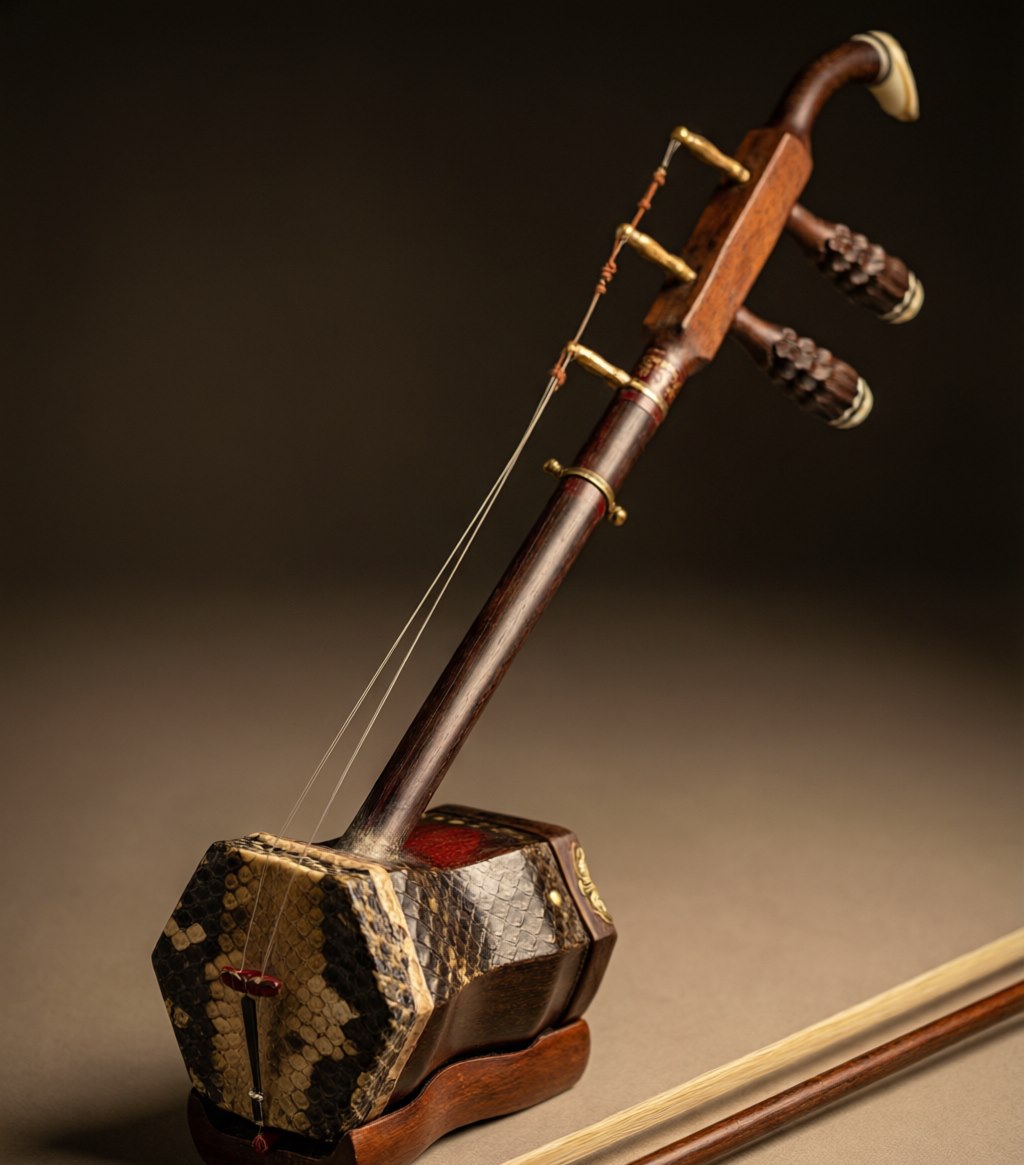
It is also, to look at, almost absurdly simple. A long wooden neck. A small hexagonal or round sound box at the base, faced with a taut skin. Two strings. A bow strung with horsehair. There are no frets, no fingerboard in the Western sense, no keys, no valves. The player's left hand stops the strings in mid-air, pressing them without touching the neck, and the right hand draws the bow between them. From this bare minimum, an entire emotional world is drawn out. The erhu is proof, once again, that Chinese instrument design has always trusted the player more than the mechanism.
Today the erhu is arguably the most recognizable of all traditional Chinese instruments, both within China and abroad. It is the star of the conservatory, the soloist of the modern Chinese orchestra, the instrument that film composers reach for when they want instant, aching emotion. Yet its rise to this eminence is a modern story. For most of its history the erhu was a humble accompanist, a folk instrument, the voice of street performers and opera pits. Its journey from the margins to the center is one of the great transformations in Chinese musical history.
Origins: A Gift from the Northern Steppe
The erhu's ancestry points, like so much else in Chinese music, toward the frontier. Bowed string instruments are generally believed to have entered the Chinese cultural sphere from the nomadic peoples of the north and west, carried by the horsemen of the steppe for whom a small, portable fiddle was an ideal companion. The ancestor most often cited is the xiqin (奚琴), a two-stringed bowed instrument associated with the Xi (奚) people of the northeast, which appears in Chinese records by the Tang dynasty (618–907 CE) and was originally played with a bamboo strip rather than a horsehair bow.
Over the following centuries, bowed fiddles proliferated and evolved under the broad family name huqin (胡琴) — literally "barbarian string instrument," a term that preserves the memory of foreign origins even as the instruments became thoroughly Chinese. The horsehair bow, the defining feature of the modern erhu, gradually replaced the bamboo stick, a change that gave the instrument its smooth, sustained, singing tone. By the Song and Yuan dynasties the huqin family was well established, and it became indispensable to the flourishing traditions of regional opera and narrative singing.
For most of this long history, however, the erhu was a supporting player. It accompanied singers, doubled melodic lines in ensembles, and provided the emotional undercurrent beneath theatrical performance. It was the instrument of the opera pit and the street corner, not the concert platform. Its very name — er (二, "two") plus hu (胡) — marks it as one of a family, a workhorse rather than a soloist. The transformation of this humble fiddle into a virtuoso concert instrument would have to wait for the twentieth century, and for a handful of extraordinary players.
Anatomy: Skin, Strings, and the Bow Between
The erhu's construction is a study in elegant economy. The neck (琴杆, qingan) is a long rod of dense hardwood — often rosewood or sandalwood — rising from the sound box and topped by two tuning pegs. The sound box (琴筒, qintong) is a small resonating chamber, typically hexagonal, octagonal, or round, and its front face is the single most important element of the instrument: a membrane of python skin (蟒皮, mangpi), stretched taut and glued into place. It is this skin, vibrating in response to the strings, that gives the erhu its warm, nasal, voice-like timbre.
The two strings — traditionally of silk, now usually of steel — run from the pegs, over a small bridge (码子, mazi) that stands on the python skin, down to the base of the instrument. Crucially, the bow (弓子, gongzi) is not drawn across the outside of the strings, as a violin bow is, but passes between them. The horsehair of the bow is threaded through the gap separating the two strings, so that the player sounds the outer string by pushing the bow outward and the inner string by pulling it inward. This arrangement, unique to the huqin family, is what allows the erhu to shift so fluidly between voices and to sustain a seamless legato.
Because there is no fingerboard, the left hand stops the strings by pressing them in the air, the fingers acting against the tension of the string alone. This demands an exquisite sensitivity of touch: the slightest change in finger pressure alters the pitch, and the player exploits this constantly, producing the slides, vibratos, and microtonal inflections that make the erhu so vocal. There are no frets to guarantee correct intonation; the player's ear is the only guide. The erhu is, in this sense, an instrument of pure listening, and its difficulty lies less in mechanics than in the cultivation of an unfailingly sensitive ear and hand.
Technique: Making Two Strings Sound Like Many
The erhu's technical vocabulary is built around the illusion of a voice. The left hand produces a wide range of ornamental effects: the rou xian (揉弦), a vibrato made by rocking the fingertip on the string, which can range from a gentle warmth to an anguished wail; the hua yin (滑音), the expressive slide between notes that is the instrument's signature gesture; and a host of grace notes, trills, and flicks that decorate the melodic line. A skilled player can make the two strings suggest the inflections of speech so convincingly that listeners swear they hear words.
The right hand, meanwhile, controls the bow with a vocabulary of strokes that shape every phrase. Long, sustained bows produce the singing legato for which the instrument is famous; short, detached strokes create rhythmic articulation; rapid bouncing and spiccato effects add brilliance and excitement. The player can also pluck the strings (拨弦, boxian) for percussive color, and can imitate, with startling accuracy, the sounds of horses, birds, and human laughter. The famous showpiece Saima (赛马, "Horse Race") puts this imitative power on full display, the erhu conjuring an entire galloping field from two strings and a bow.
"The pipa speaks in pearls; the guqin speaks in jade; but the erhu speaks in tears — it is the one instrument that cannot hide a broken heart."
— A traditional comparison of Chinese instruments, on the erhu's unmatched emotional directness
This emotional directness is the erhu's greatest gift and, in the hands of a lesser player, its greatest danger. Because the instrument sounds so much like a voice, it can tip easily into sentimentality, into a weeping that earns nothing. The masters are those who temper its expressiveness with restraint, who know that a single well-placed slide can break the heart more completely than a hundred. The erhu rewards taste as much as technique, and the greatest players are remembered not for how much they could make it cry, but for how little they needed to.
Abing and Erquan Yingyue: Sorrow Made Immortal
No piece is more inseparable from the erhu than Erquan Yingyue (二泉映月, "The Moon Reflected on the Second Spring"), and no story more inseparable from the piece than that of its composer, Abing (阿炳). Born Hua Yanjun (华彦钧) in 1893 in Wuxi, Abing was a Daoist musician of prodigious talent who, in middle age, lost his sight to illness and fell into poverty, playing for alms on the streets and in the temples of his city. He was, by the time scholars recorded him in 1950, a blind, ailing street performer — and the author of one of the most beloved instrumental works in the Chinese repertory.
Erquan Yingyue takes its name from the "Second Spring," a famous spring beneath Mount Hui in Wuxi, where the moon's reflection could be seen in the water. But the music is no mere landscape painting. It is a long, aching meditation, a theme unfolded through a series of variations that rise and fall like waves of grief and resignation. The melody climbs into the erhu's upper register with a keening intensity, then subsides into quietude, again and again, as though the composer were circling a sorrow too large to face directly. It is, by common consent, one of the saddest and most beautiful pieces ever written for the instrument.
The recording of Abing in 1950, made only months before his death, is one of the treasures of Chinese musical heritage. He played Erquan Yingyue and a handful of other pieces on his own erhu, and those recordings preserved not only his compositions but his playing style — raw, deeply personal, full of the authority of a life lived hard. Abing's story, the blind beggar whose genius was recognized almost too late, has become a kind of founding myth for the erhu's expressive power: proof that the instrument's voice comes not from its construction but from the depth of the life behind it.
From the Street to the Stage: A Modern Star
The transformation of the erhu from folk accompanist to concert soloist is largely a twentieth-century achievement, and it owes much to the reformer Liu Tianhua (刘天华, 1895–1932). A musician of formidable ambition, Liu set out to elevate the erhu — and Chinese instrumental music generally — to the status of the Western classical tradition. He composed a set of solo études and recital pieces for the erhu, systematized its technique, introduced elements of Western pedagogy and intonation, and brought it into the conservatory as a serious instrument of study. Before Liu, the erhu was learned by apprenticeship in opera troupes; after him, it was taught in academies.
The decades that followed saw the erhu's repertory and prestige expand dramatically. New works were composed to display its virtuosity, none more popular than Saima (赛马, "Horse Race"), composed by Huang Haihuai (黄海怀) in 1959. A vivid, galloping picture of a Mongolian horse race, it exploits the erhu's imitative powers and its capacity for excitement, building to a cadenza of plucked strings and bowing effects that never fails to electrify an audience. Where Erquan Yingyue shows the erhu's depths, Saima shows its brilliance; together they define the instrument's range.
With the establishment of the modern Chinese orchestra (民族乐团, minzu yuetuan), the erhu found its institutional home. In these ensembles, modeled in part on the Western symphony orchestra, the erhu section functions much as the violins do — the primary carriers of melody, seated at the front, numbering a dozen or more. The instrument has also produced a line of conservatory superstars, virtuosos whose recordings and international tours have made the erhu a global ambassador for Chinese music. From a blind beggar's alms-bowl to the world's concert halls in a single century: the erhu's ascent is unmatched.
Symbolism: The Voice of the People
If the guqin is the instrument of the scholar and the pipa the instrument of the storyteller, the erhu is the instrument of the people. Its voice-like warmth, its portability, its affordability, and its long association with street performance and regional opera have made it the most democratic of Chinese instruments — the one most closely identified with ordinary feeling, ordinary lives, and ordinary sorrow. It is the sound of the market, the teahouse, the village square, the lone figure playing for coins at dusk.
This association with common emotion gives the erhu a particular symbolic weight. It is the instrument of longing and lament, of parting and memory, of the feelings that polite society often leaves unspoken. In film and television it is shorthand for heartbreak: a single erhu line can reduce an audience to tears in seconds, and composers use it accordingly. Yet it is not confined to sadness; its imitative brilliance and rhythmic energy make it equally at home in joy, humor, and exuberance. It is, in the end, the instrument of emotional honesty — the one that says plainly what other instruments only suggest.
"Two strings are enough, because the human heart has only two chambers — one for joy, and one for grief."
— A modern reflection on the erhu, capturing its reputation as the instrument of unadorned emotional truth
This symbolism is reinforced by the instrument's very limitations. With only two strings and no frets, the erhu cannot hide behind complexity; every note is exposed, every inflection naked. It demands that the player mean what they play. In a tradition that values sincerity (诚, cheng) as the foundation of all genuine expression, the erhu stands as the supreme test: an instrument that rewards nothing so much as a true heart, and that punishes, instantly, any pretense.
The Erhu in Modern Life
The erhu is, today, perhaps the most visible and most heard of all traditional Chinese instruments. It anchors the modern Chinese orchestra, features in concertos written for it by composers East and West, and appears in countless film scores — its voice instantly recognizable in the soundtracks of martial-arts epics and historical dramas alike. It has crossed into popular music, into "national style" (guofeng, 国风) productions that blend its timbre with electronic beats, and into the hands of street performers and buskers around the world, where it continues the ancient tradition of playing for whoever stops to listen.
Its pedagogy is now highly developed, with conservatories across China training new generations of players in a technique that would have astonished Abing. Yet the instrument has lost none of its folk roots. Walk through a park in any Chinese city and you will find amateurs playing the erhu beneath the trees, running through Erquan Yingyue or a favorite opera aria, the python skin catching the light. This continuity — between the conservatory virtuoso and the park-bench amateur, between the concert hall and the street — is the erhu's special glory. It belongs to everyone.
There is something fitting about an instrument that rose from poverty to prominence without ever quite leaving its origins behind. The erhu's voice remains, at its core, the voice of the human — small, mortal, capable of great sorrow and great joy, and always, always wanting to be heard. Two strings, a skin, a bow of horsehair: it should not be enough. And yet, in the hands of anyone who has learned to listen, it is more than enough. It is, as the Chinese have always said, the closest thing in music to the sound of a person speaking from the heart.