The Quietest Voice in the Room
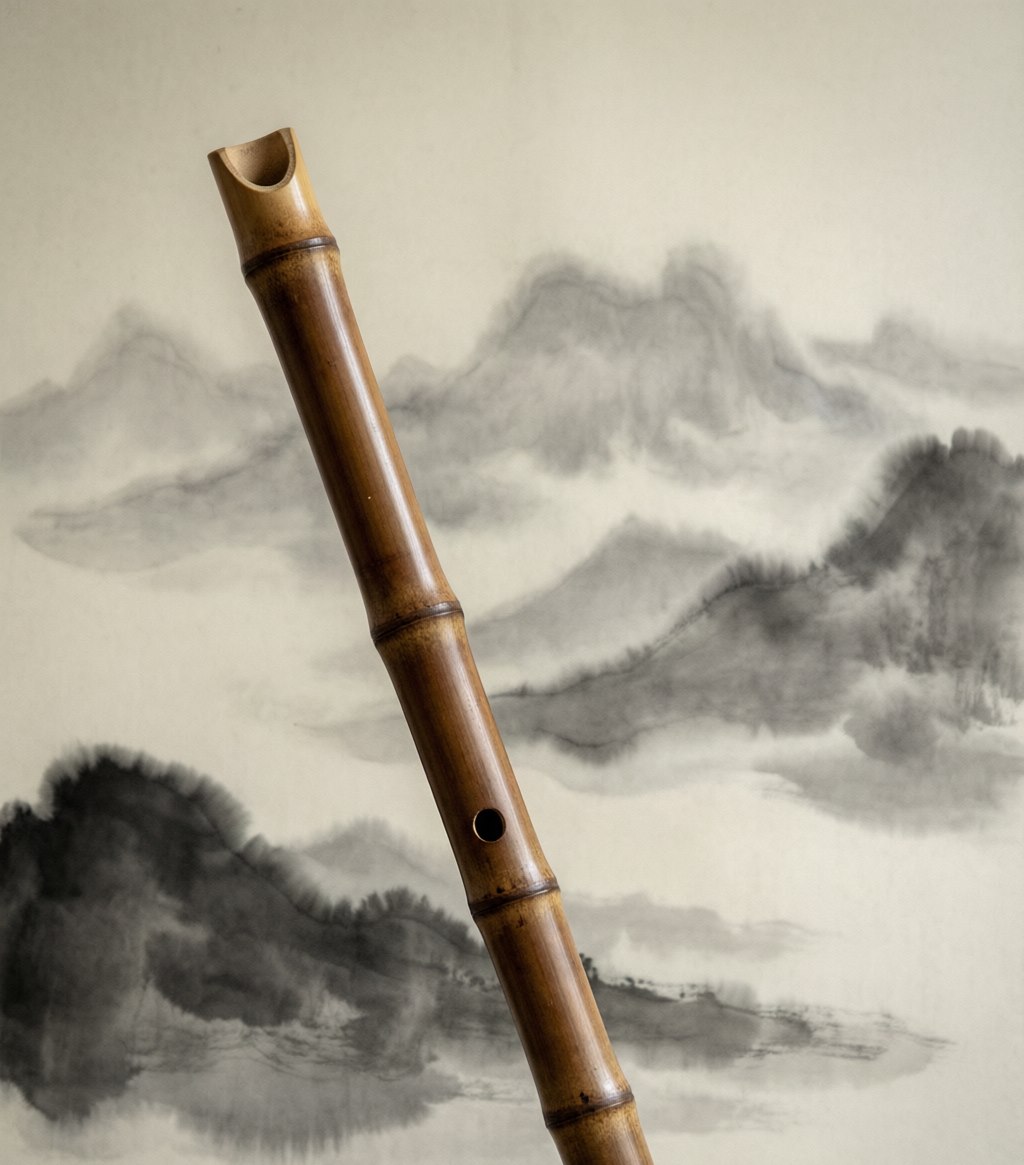
If the dizi is the flute that shouts across a courtyard, the xiao (箫) is the flute that murmurs to a single friend. It is a long tube of bamboo, often eighty centimeters or more, held vertically before the player and blown across a notched opening at the top. There is no buzzing membrane here, no bright rasp, no fireworks of double-tonguing. What the xiao offers instead is a tone so soft, so round, so steeped in breath that it seems less played than exhaled — a sound that asks the listener to lean in, to be still, to meet it halfway.
This is an instrument that has never sought a crowd. Its natural habitat is the scholar's studio, the mountain retreat, the quiet hour after the guests have gone. In Chinese painting it appears again and again in the hands of a solitary figure: a hermit on a cliff, a monk beneath a pine, a literatus gazing at the moon. The xiao is the sound of chosen solitude, and for more than a thousand years it has been the chosen companion of those who valued inwardness over display.
To play the xiao, or even to listen to it properly, is to enter a different relationship with music — one in which restraint is more eloquent than brilliance, and in which the spaces between notes matter as much as the notes themselves. It is, in the fullest sense, a meditative instrument, and understanding it means understanding the aesthetic of quietude that runs like a dark thread through the whole of Chinese high culture.
Origins: The Oldest of the Flutes
The end-blown flute is among the most ancient of human instruments, and China's claim to it runs deep. The vertical flute appears in Chinese sources under a shifting constellation of names, and for centuries the very word xiao referred not to the end-blown instrument we know today but to a raft of panpipes (排箫, paixiao). The terminology only gradually settled: over time, the single-tube end-blown flute came to be called the dongxiao (洞箫, "cave flute" or "hollow flute"), and eventually simply the xiao, while the panpipes kept the older compound name.
What is clear is that the end-blown flute has been part of Chinese musical life since antiquity, valued in court ritual and in private cultivation alike. Its long, narrow bore and gentle embouchure gave it a naturally quiet, contemplative character, and that character shaped its destiny. While louder instruments claimed the stage, the procession, and the battlefield, the xiao retreated inward. By the Tang and Song dynasties it had become firmly associated with the literati — the scholar-officials, poets, and painters who defined refined taste — and with the reclusive ideals of Daoism and Chan Buddhism.
The instrument's mythology leans on this association. Stories abound of masters whose playing could summon cranes, still the wind, or move a listener to tears without their knowing why. These are legends, but they point to a real perception: that the xiao's power lies not in volume but in intimacy, in its capacity to make a large room feel small and a solitary heart feel understood. It is the instrument of the inner life, and its history is the history of Chinese inwardness.
Construction: Length, Notch, and the Patience of Bamboo
The xiao is, in essence, a carefully chosen and carefully hollowed piece of bamboo. The finest instruments are made from the root end of a particular species, where the walls are thick and the bore naturally tapered, and where the dense grain produces a warm, focused tone. The bamboo is harvested, dried for years to prevent cracking, straightened, and then bored and tuned. A good xiao is a patient object: the material alone may be aged for a decade before a maker ever cuts a hole in it.
At the top of the tube sits the instrument's defining feature: the吹口 (chuikou), the blowing edge, cut as a notch — usually a U-shape or V-shape — into the rim. The player rests the lower lip against this notch and directs a thin, angled stream of air across it, splitting the stream to set the column inside vibrating. It is a demanding embouchure, far less forgiving than the dizi's; a beginner may spend weeks producing a steady tone at all, and the xiao is famously reluctant to yield its voice to the impatient. This difficulty is, in the tradition's view, part of the point: the instrument teaches stillness before it teaches music.
Down the length of the tube run the finger holes — most commonly six in the modern instrument, five on the front and one for the thumb at the back, though older and regional forms vary. The holes are spaced to produce a scale, and the player shapes pitch and color through a combination of fingering, breath pressure, and subtle half-covering that allows the gentle slides and bends so characteristic of xiao melody. Many xiao are tuned to a pentatonic framework, suited to the modal vocabulary of traditional Chinese music. The overall effect, in the hands of a master, is of a single unbroken breath drawn out into song — seamless, unhurried, and profoundly calm.
Qin-Xiao: The Friendship of Two Instruments
No discussion of the xiao is complete without its most celebrated partnership: the qin-xiao (琴箫), the pairing of the xiao with the guqin (古琴), the seven-stringed zither that is the supreme instrument of the Chinese literati. The guqin is quiet almost to the point of inaudibility, an instrument designed for the player's own cultivation and for one attentive listener. The xiao, with its soft, breathy sustain, is the only wind instrument that can join it without overwhelming it. Together they form a duet of equals, two thin threads of sound braided into something more spacious than either could achieve alone.
The pairing is more than acoustic; it is symbolic. The guqin represents the scholar's inner discipline, the xiao his communion with nature and with the unseen. To play qin and xiao together is to enact an ideal of friendship itself — two cultivated minds meeting in silence and sound, needing no audience, asking nothing of the world. Paintings of the qin-xiao duet almost always show the players outdoors, beneath pines or beside a stream, the human music answering the music of wind and water. It is one of the most enduring images of Chinese aesthetic life.
"The qin speaks to the self; the xiao answers from the mountains. Together they need no third ear."
— A traditional description of the qin-xiao (琴箫) duet and its ideal of intimate, audience-free music-making
This ideal of music as private communion rather than public performance sets the xiao apart from nearly every instrument in the modern concert world. It does not project. It does not compete. It is content to be overheard by the pines, and to be played for the sake of the playing. In an age of amplification, the xiao remains a quiet act of resistance — a reminder that some of the deepest art is made for the smallest rooms.
Playing the Xiao: Breath as Practice
Technique on the xiao is, above all, the technique of breath. Because the instrument is quiet and its tone so dependent on a steady, controlled airstream, the player must cultivate long, even breathing and an embouchure of great delicacy. The slightest change in the angle or speed of the air alters not only pitch but color, and the tradition exploits this with care: a note may begin pure, darken as the breath warms, and fade to almost nothing at its close, all within a single sustained tone.
The left hand's ornaments are correspondingly restrained. Where the dizi dazzles with flurries of grace notes and flutter-tonguing, the xiao favors the slow slide (滑音, huayin), the gentle vibrato produced by rocking the breath, and the deliberate, expressive silence. A xiao melody breathes. It pauses. It lets a phrase hang in the air and decay naturally rather than cutting it off. This aesthetic of decay — of allowing a sound to die its own death — is central to the instrument's character and to the meditative tradition it serves.
Learning the xiao is therefore as much a discipline of the body and the mind as of the fingers. Teachers often speak of it in terms borrowed from meditation and from qigong: the breath must sink to the dantian (丹田), the lower abdomen; the body must be relaxed yet aligned; the mind must be emptied of hurry. To play the xiao well is, in a real sense, to have learned to be still. The instrument does not reward ambition; it rewards presence. This is why it has so often been the instrument of monks and recluses, for whom music was never entertainment but a form of cultivation.
Famous Repertoire: Moonlight on a Calm Lake
The piece that best captures the xiao's spirit is Pinghu Qiuyue (平湖秋月, "Autumn Moon over the Calm Lake"). Originally associated with the Cantonese musical tradition and often performed on plucked strings, it has become a beloved vehicle for the xiao, whose breathy tone lends the melody an unmatched serenity. The music paints West Lake at Hangzhou on an autumn evening: the water smooth as silk, the moon hanging low, the world reduced to silver light and stillness. There is no drama here, no conflict — only the slow unfolding of a scene too beautiful to disturb. Played on the xiao, it sounds like the lake itself breathing.
Beyond this, the xiao draws on a repertory shared with the guqin and with the broader literati tradition. It plays arrangements of ancient qin melodies, folk songs slowed to a contemplative pace, and the melodic patterns of regional ensemble music. Pieces such as Meihua Sannong (梅花三弄, "Three Variations on Plum Blossom") — a meditation on the plum tree's defiance of winter — appear in xiao versions that emphasize the flower's quiet endurance over any showiness. The repertory is small compared with the dizi's, but it is deep, and it rewards a lifetime of returning.
What unites the xiao's repertory is its subject matter: nature, solitude, the passage of seasons, the company of a single friend. These are not programmatic showpieces meant to depict galloping horses or chattering birds. They are states of mind rendered in sound — autumn, moonlight, distance, the plum blossom in snow. The xiao does not narrate; it inhabits. To listen is to be placed, gently, inside a mood and left there to find your own meaning.
Symbolism: Hermits, Cranes, and the Moon
The xiao is dense with symbolic meaning, almost all of it pointing toward withdrawal and refinement. In painting and poetry it is the attribute of the hermit — the cultivated person who has turned away from official life and the scramble for status to live among mountains. A figure playing the xiao on a cliff is an image of freedom from the world's demands, of a life ordered by inner rather than outer measure. The instrument thus carries a faint moral charge: to choose the xiao is, symbolically, to choose integrity over ambition.
Its companions in imagery are the crane, the pine, the moon, and flowing water — all emblems of longevity, constancy, and detachment. The crane, in particular, is said to respond to the xiao's call, and stories of players summoning cranes from the sky express the belief that this quiet music touches something beyond the human. The moon, recurring so often in xiao titles and in the poetry that surrounds it, is the emblem of solitary contemplation: distant, cool, beautiful, and content to shine without an audience.
"A single xiao on the autumn river, and the whole world grows quiet enough to hear the moon rise."
— An image drawn from the tradition of xiao poetry, in which the flute's stillness seems to still the landscape itself
This symbolism is not mere decoration. It shaped who played the instrument, where, and why. The xiao was never a professional's tool in the way the dizi was a working musician's; it was an amateur's companion, a scholar's friend, an instrument of self-cultivation rather than livelihood. Its meanings — solitude, integrity, communion with nature — were the meanings its players wished to live by. The xiao was less something they performed on than something they practiced, in the fullest sense of that word.
The Xiao in Modern Life
The xiao has survived into the modern era precisely because it never tried to be modern. While other instruments were standardized, amplified, and pressed into the service of the concert hall, the xiao largely kept its old character. It is taught in conservatories, yes, and appears in recordings and in the ensembles that perform traditional music, but its center of gravity remains the private room and the solitary player. It has found, indeed, a new audience in the contemporary hunger for calm: in meditation practice, in tea ceremony, in the slow-living movement, and in the ambient and "national style" music that soundtracks a generation's search for stillness.
Its partnership with the guqin has enjoyed a particular revival. As interest in the guqin has surged in the twenty-first century — fueled by its recognition by UNESCO and by a broad rediscovery of literati culture — the qin-xiao duet has returned to studios and gardens across China and beyond. Players gather in small rooms, brew tea, and play for one another in the old way, asking nothing of the world outside. The xiao, which never left this world, simply waited for others to remember it.
There is a lesson in the xiao's quiet persistence. In a culture that increasingly rewards the loud, the fast, and the attention-grabbing, this long bamboo tube insists on the opposite values: patience, restraint, the eloquence of the nearly inaudible. It will not fill a stadium. It will not trend. But played softly in a quiet room, for one listener who has learned to be still, it can do what few instruments can — it can make the silence around it feel like the point. The xiao endures because some part of us will always need a voice that whispers, and a friend content to listen.