Before the Melody, the Beat
Strip Chinese music down to its oldest, most elemental layer and what remains is not melody but rhythm: the strike of wood on skin, the crash of bronze on bronze, the deep commanding voice of the drum. Long before the refined tones of the guqin or the bright song of the dizi, there was percussion — the luogu (锣鼓), the drums and gongs that have driven Chinese ceremony, warfare, theater, and celebration for three thousand years. It is the foundation on which everything else is built, and it remains, to this day, the sound that most instantly signals "China" to the ear.
Think of any great Chinese spectacle and listen, in your mind, to what carries it. The dragon dance weaving through a New Year street. The lion leaping from bench to bench. The general striding across the opera stage. The procession at a temple fair. In every case, beneath and around the visual splendor, there is the percussion — the driving, syncopated, inexhaustible pattern of drums and gongs and cymbals that tells the dancers when to move, tells the audience when to feel, and tells the spirits, if any are listening, that something mighty is afoot. Chinese percussion is not accompaniment. It is the engine.
To understand the drums and gongs of China is to understand a civilization's sense of occasion. No culture has invested more meaning in the struck sound — in the idea that a single well-placed blow of a mallet or a clash of metal can order a crowd, sanctify a moment, terrify an enemy, or open a door between the human world and the divine. This is the pulse of China, and it has never stopped beating.
The Tanggu: The Barrel Drum at the Center
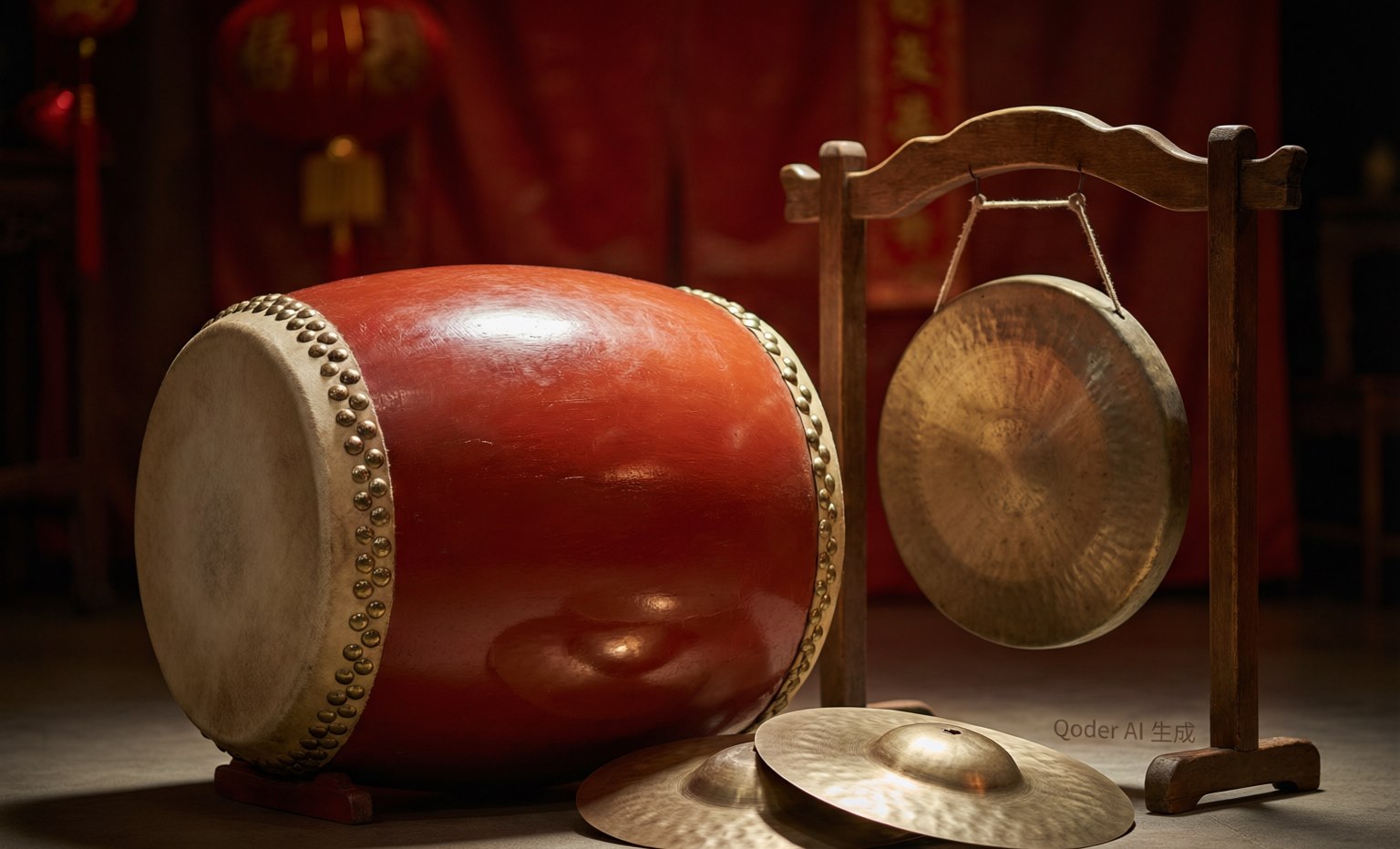
At the heart of Chinese percussion stands the tanggu (堂鼓), the "hall drum" — a barrel-shaped drum with a wooden body and two heads of animal skin, struck with a pair of wooden sticks. It is the drum most often pictured in the Chinese ensemble: a round, red-lacquered barrel standing on a frame, its twin skins taut and resonant, its voice ranging from a deep, hollow boom at the center to a sharp crack near the rim. The tanggu is the timekeeper and the commander, the instrument that sets the tempo and drives the energy of everything around it.
The drum's construction is ancient in principle. A hollowed body, a stretched skin, a beater — the design is among humanity's oldest, and Chinese drums appear in the archaeological and textual record from the earliest dynasties. Over the centuries the family proliferated: large ceremonial drums for temples and armies, small drums for opera and ensemble, the flat hand-drums of regional traditions, and the great barrel drums that anchor the percussion section. The tanggu, in its various sizes, became the workhorse — versatile enough to thunder in a festival procession and subtle enough to underscore a quiet scene on the opera stage.
What distinguishes the Chinese drum tradition is its expressiveness. A skilled tanggu player does not merely keep time; the drum speaks. Different strokes — center, rim, muted, open, single, rolled — produce a palette of colors, and the patterns (锣鼓经, luogu jing, the "percussion classics" of named rhythmic figures) form a vocabulary as codified as any melodic language. In the opera, a single drum pattern can announce an entrance, signal a battle, mark a change of scene, or convey a character's inner state. The drum, in Chinese hands, is not a metronome. It is a narrator.
Bells of Bronze: The Bianzhong and the Ancient Court
The story of Chinese percussion reaches back further than the drum, into the bronze age of Chinese civilization, where it takes the form of one of the most astonishing instruments ever made: the bianzhong (编钟), the set of tuned bronze bells. These are not the simple clappers of a village festival but a court instrument of the highest sophistication — a graduated array of bells, hung in tiers from an ornate wooden frame, each tuned to a precise pitch and struck with a mallet to produce melody and harmony.
The most famous surviving example is the set unearthed in 1978 from the tomb of Marquis Yi of Zeng (曾侯乙), a ruler who died around 433 BCE. The discovery stunned the world: sixty-five bells, arranged on a massive lacquered frame, totaling more than two and a half tons of bronze, and still playable after nearly two and a half millennia. When scholars struck them, the bells rang true, producing a chromatic scale spanning five octaves — proof that the Chinese had developed a highly advanced system of tuned percussion, and of acoustic science, centuries before the common era. Each bell, remarkably, can produce two distinct tones depending on where it is struck, a feat of metallurgical and acoustic engineering that continues to amaze.
The bianzhong belonged to the ritual music (雅乐, yayue) of the ancient court, the solemn ceremonial music that accompanied sacrifices, banquets, and state rites. In the Confucian vision, music was not entertainment but a force of moral and cosmic order, and the great bells were instruments of governance as much as of art — their proper sounding a sign that the state was in harmony with heaven. The bianzhong thus represents the most exalted end of the percussion tradition: the struck sound raised to the level of philosophy, of politics, of the sacred.
Gongs and Cymbals: The Bronze That Roars
If the bells represent percussion's courtly dignity, the gongs and cymbals represent its popular thunder. The luo (锣), the gong, is a disc of hammered bronze, struck with a padded mallet, whose voice ranges from a deep, swelling roar to a bright, shimmering crash. China has an enormous family of gongs — large and small, flat and bossed, tuned and untuned — each with its own character and its own place in the ensemble. The daluo (大锣), the large gong, provides the broad, resonant accents; the xiaoluo (小锣), the small gong, adds sharp, bright punctuation; and a host of specialized gongs fill the spaces between.
The bo (钹), the cymbals, are a pair of bronze discs, slightly domed, struck together with a crash that can cut through any ensemble. Together with the drum, the gongs and cymbals form the core of the luogu — the percussion ensemble that is the backbone of Chinese ceremonial and theatrical music. The interplay between them is the essence of the sound: the drum's driving pattern, the gong's resonant accents, the cymbals' brilliant crashes, woven into rhythmic figures of tremendous vitality and precision.
"Silk and bamboo give the music its beauty; metal and stone give it its bones."
— A traditional classification of Chinese instruments, in which strings and winds (silk and bamboo) are joined and grounded by percussion (metal and stone)
This ancient division of instruments into categories of material — silk for strings, bamboo for winds, metal and stone for percussion — reveals how central the struck sound was to the Chinese conception of music. The percussion was not an afterthought added to prettier instruments; it was the skeleton, the structure, the bones on which the flesh of melody was hung. Without the gongs and drums, the music had no frame. With them, it could stand upright and walk.
The Wu Chang: Percussion as Theater
Nowhere is the genius of Chinese percussion more fully displayed than in the opera, where the percussion section is known as the wu chang (武场), the "martial field" or martial section — a name that distinguishes it from the wen chang (文场), the "civil section" of melodic instruments. The wu chang is the orchestra's rhythmic and dramatic command center, and in traditions such as Peking Opera it is led by the bangu (板鼓), a small, high-pitched frame drum played with a single stick, whose player directs the entire ensemble and, in effect, conducts the performance.
The percussion in Chinese opera does far more than keep time. It is a dramatic language in its own right. Specific patterns — handed down through the luogu jing, the oral "percussion scriptures" of named rhythmic figures — accompany every kind of action and emotion: the entrance of a general, the flight of a fugitive, a moment of hesitation, a burst of anger, the stylized movements of combat. The actors train for years to move in precise synchronization with the percussion, so that a turn of the head, a stamp of the foot, and a crash of the cymbals arrive as one. The result is a theater in which rhythm and gesture are fused into a single expressive system.
The bangu player, perched at the head of the wu chang, is thus one of the most important figures in the troupe. With the drum and a pair of clappers (板, ban), this musician sets the tempo, cues the singers, signals the transitions, and drives the dramatic tension — all without a written score, relying instead on memory, instinct, and an intimate knowledge of the repertory. To watch a great bangu player at work is to watch a conductor, a dramatist, and a virtuoso rolled into one. The martial field, for all its noise, is governed by a single, disciplined mind.
Dragons, Lions, and the New Year
Outside the theater, the percussion finds its most spectacular expression in the great public celebrations, above all the New Year. The image is iconic: a long dragon, held aloft on poles by a team of dancers, weaving through a street to the relentless drive of drums, gongs, and cymbals; or a pair of lions, blinking and leaping, performing their acrobatic dance to the same thunderous accompaniment. The dragon dance (舞龙, wulong) and the lion dance (舞狮, wushi) are inconceivable without their percussion, which dictates every movement, every leap, every pause, and which is believed, in itself, to drive away evil spirits and summon good fortune.
The logic is ancient and symbolic. Loud noise, in Chinese tradition, frightens away malign forces — a belief enshrined in the legend of Nian (年), the monster said to emerge at the New Year and terrorize villages, which could be driven off only by the color red, by fire, and by the crash of firecrackers and drums. The percussion of the New Year is, in this reading, not merely festive but apotropaic: a wall of sound raised against misfortune, a communal act of protection. The louder the drums, the safer the year. Small wonder the celebrations are so deafening.
The same percussion marks the temple fair (庙会, miaohui), the festival procession, the opening of a business, and any occasion that calls for public energy and good luck. The luogu ensemble — portable, loud, and inexhaustible — is the sound of the crowd itself, of collective joy made audible. It is music that cannot be played alone or heard passively; it demands a procession, a dance, a gathering, a shared body moving to a shared beat. In this, it is the most communal of all Chinese musics, the sound of "we" rather than "I."
Symbolism: Order, Power, and the Sacred Strike
The struck sound carries deep symbolic weight in Chinese culture. From the bronze bells of the court to the drums of the army, percussion has long been associated with authority, order, and the power to command. The drum summoned troops and set the pace of battle; the gong announced the arrival of an official and cleared the street before him; the bell marked the hours and called the faithful to prayer. To strike was to assert, to order, to make the world attend. The percussion instruments were, in a sense, the instruments of power itself.
At the same time, the struck sound was sacred. In the Confucian ritual tradition, the proper sounding of bells and drums was inseparable from the proper ordering of the state and the cosmos; music that was out of tune or out of place was a symptom of disorder in the world. In Buddhist and Daoist practice, the drum and the bell (the great temple drum, the great temple bell) mark the rhythm of devotion and are said to awaken the faithful from the sleep of ignorance. The single deep note of a temple bell, fading slowly into silence, is among the most potent images of contemplative stillness in Chinese culture — the struck sound becoming, at last, a doorway into quiet.
"The drum summons the body; the bell summons the soul. Between them, a whole civilization keeps its time."
— A reflection on the dual role of Chinese percussion, from the martial energy of the drum to the contemplative depth of the bell
This range — from the roar of the festival to the hush of the temple, from the command of the general to the prayer of the monk — is what gives Chinese percussion its depth. It is not merely noise, though it can be gloriously noisy. It is a language of order and power, of protection and celebration, of the sacred and the communal. Every strike carries meaning, and the tradition has spent three thousand years refining what those meanings are.
The Pulse in Modern Life
The drums and gongs of China have lost none of their vitality in the modern world. They remain the heart of the New Year celebrations, in China and in Chinese communities across the globe, where the dragon and lion dances still draw crowds and the percussion still rattles the windows. They anchor the percussion sections of the modern Chinese orchestra, where composers write concertos for drum and ensemble and exploit the full coloristic range of the tradition. They appear in film scores, in popular music, and in the spectacular drum ensembles that have become a staple of televised galas and international performances.
The tradition also continues to evolve at the grassroots. Percussion troupes remain a fixture of rural festivals and temple fairs, and the regional styles of luogu — each with its own patterns, its own repertory, its own character — are preserved and performed by dedicated practitioners. The discovery and reconstruction of the bianzhong, meanwhile, has inspired a renewed interest in ancient Chinese music and in the extraordinary acoustic achievements of the bronze age, with replica bell sets now performed in concerts that bring a sound two and a half millennia old to modern ears.
In the end, the drums and gongs endure because they answer to something fundamental: the human need to mark the moment, to gather, to move together, to make noise against the silence and the dark. They are the oldest music and the most immediate, the sound that requires no training to feel and no translation to understand. Long after the last note of the most delicate melody has faded, the beat remains — in the chest, in the feet, in the memory. The pulse of China has been beating for three thousand years. It shows no sign of stopping.