Chinese social norms differ from Western ones in ways that are subtle but meaningful, and much of the difference lives beneath the surface — in a gesture, a tone, a thing left unsaid. The good news for any visitor is that nobody expects perfection. Foreigners are granted generous latitude, and a small stumble over chopsticks or a misplaced tip will be met with a smile rather than a scolding. You are not being graded.
And yet. Showing that you are aware of the local rhythms earns an immediate and disproportionate amount of goodwill. The traveler who accepts a business card with both hands, who knows not to plant chopsticks upright in the rice, who handles a disagreement quietly — that person is met with a warmth and openness that the oblivious visitor simply never sees. Etiquette here is less a list of rules than a way of reading the room. This guide covers the moments that matter most.
Tipping: Simply Don't
This is the easiest adjustment you'll make, because the answer is a clean one: don't tip. Tipping is not practiced in China, and in many settings it actively causes confusion. At a local restaurant, leaving money on the table may prompt a server to chase you into the street to return your "forgotten" change. In some establishments it can even cause mild offense, since it implies the owner is not paying staff properly and that the customer must make up the difference.
Taxi drivers, restaurant servers, and standard tour guides neither expect nor want a tip — the price quoted is the price paid, and rounding up is not a custom here. The only soft exception is at high-end international hotels, where a small tip for genuinely exceptional bellhop service will not cause any problems. But even there it is not expected, and you will never go wrong by simply paying what is asked.
Chopstick Taboos: The Ones That Matter
Chopsticks (kuàizi, 筷子) come with a handful of taboos, and a few of them carry real cultural weight. The most important: never stick your chopsticks vertically into a bowl of rice. The upright pair resembles the incense sticks burned as offerings to the dead, and the sight is deeply inauspicious — it evokes funerals and ancestor worship at the dinner table. It is the single chopstick mistake that will draw a visible reaction.
A few others are worth knowing. Don't tap your bowl with your chopsticks — the gesture is associated with beggars asking for food. Don't point at people with them, for the same reason you wouldn't point with a finger. And when you are not eating, rest your chopsticks on the chopstick rest or lay them flat across the rim of your bowl rather than leaving them speared into the food. None of this is difficult, and locals genuinely notice and appreciate it when a foreigner gets it right — it reads as respect, and respect is the currency of the whole system.
Dining and Table Manners Beyond Chopsticks
Chinese dining is communal and generous, and a few customs will help you flow with the table rather than against it. Dishes are placed in the center to be shared, often on a lazy Susan; let the eldest or the host begin first, and take modest portions from the dishes nearest you rather than reaching across the whole table. It is common for a host to place choice pieces of food into your bowl as a gesture of hospitality — accept it graciously, even if you only nibble.
You will likely be offered tea, and the pour is rarely a one-time event; watch for your cup to be refilled, and you can return the courtesy by pouring for others. A small, charming custom: when someone pours tea for you, tap two fingers lightly on the table as a silent "thank you." And leave a little food on your plate at the end — a completely clean plate can signal to a generous host that you are still hungry and they have not fed you enough. Toasts (gānbēi, 干杯, literally "dry cup") are common at celebratory meals; you are welcome to sip rather than drain, but raising your glass and meeting the gesture is what counts.
Giving and Receiving: Use Both Hands
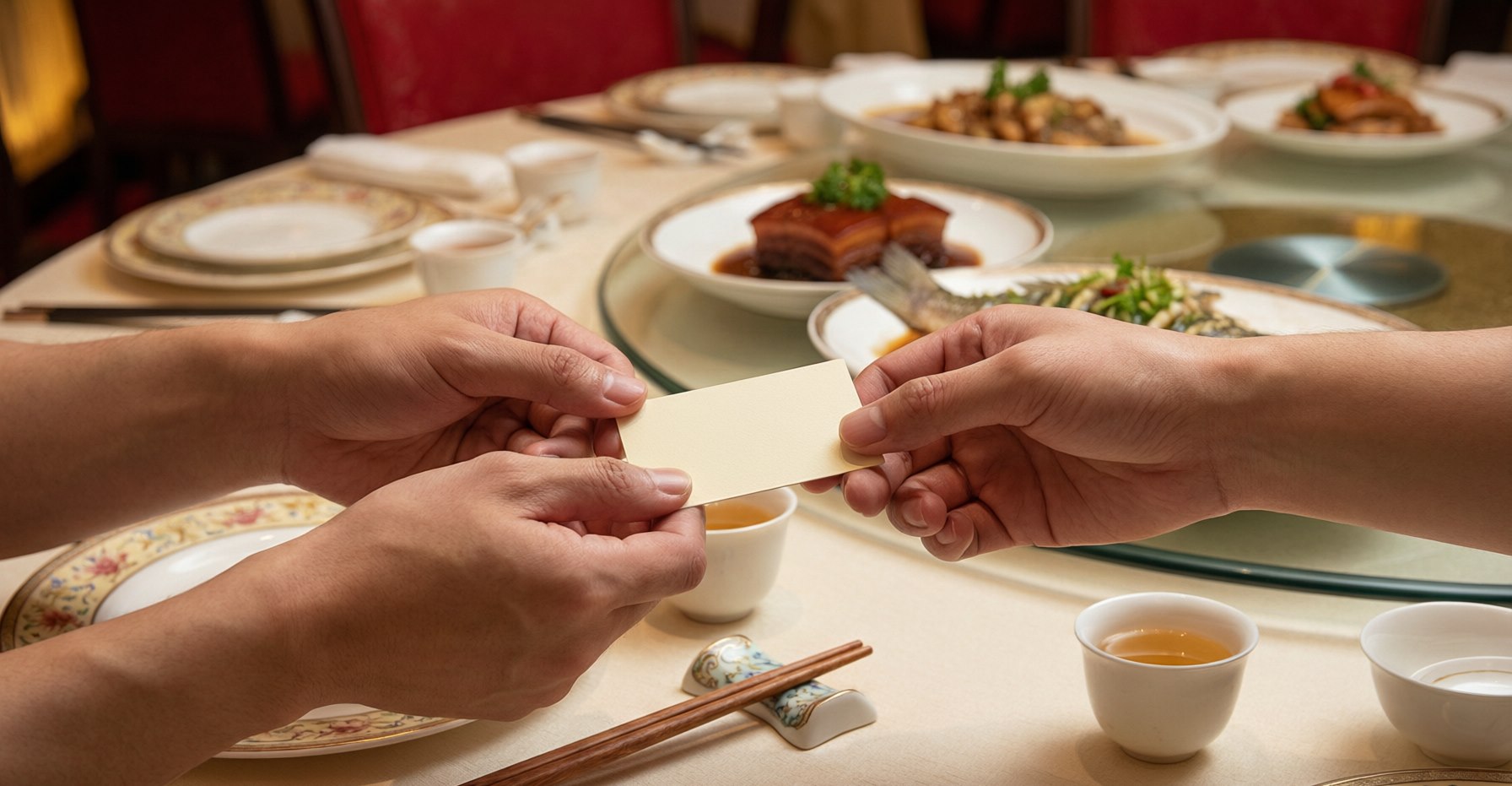
When someone hands you something — a business card, a gift, a document, even a receipt — accept it with both hands. The same applies when you are the one giving. The gesture signals respect and attentiveness, and it is one of the most universally recognized courtesies in Chinese interaction.
This matters most in business contexts. A business card received with one hand and stuffed carelessly into a back pocket is a small but real insult — it treats the person's identity, printed on that card, as disposable. The correct move is to take the card with both hands, look at it for a moment, perhaps comment on it, and set it down respectfully in front of you or place it carefully in a card holder. If you are exchanging cards, offer yours with both hands as well, ideally with the text facing your recipient so they can read it immediately. It takes two seconds and it lands.
Face (Miànzi, 面子): The Idea Underneath Everything
If there is one concept to understand about Chinese interpersonal dynamics, it is face — miànzi (面子). Face is social dignity, reputation, and respect rolled into one: a person's standing in the eyes of others. Much of Chinese social behavior is organized around giving, preserving, and protecting face, and travelers who grasp this will navigate an enormous range of situations correctly almost by instinct.
The practical rule for visitors is this: do not publicly criticize, correct, or embarrass someone, especially in front of others. If a bill is wrong or a service issue arises, address it calmly and privately rather than making a scene. Confrontation that forces someone to be corrected in public causes them to "lose face" — diū miànzi (丢面子) — and that creates a kind of lasting social damage that outlives the original grievance. A quiet word, framed as a shared problem to solve, gets you further and faster than indignation ever will.
The mirror image is just as powerful. Genuine compliments — about someone's hospitality, their cooking, their city, their command of English — "give face" and build real rapport. Praise offered sincerely and, ideally, in front of others, is a gift that people remember. Master the art of preserving face and you will find doors opening in ways that have little to do with language.
The traveler's rule of thumb: praise in public, correct in private. When something goes wrong, lower your voice and your volume together. The person who stays calm and saves everyone's face is the one who gets the problem solved — and the respect that comes with it.
Photography: Ask First, and Know the Red Lines
Photography is where good manners and outright rules overlap. As a baseline, ask before photographing people, especially in rural areas, at markets, and in religious sites. The method is universal and needs no language: smile, gesture toward your camera, and wait for a nod. Most people will happily agree, and the small exchange often becomes the warmest part of the encounter.
Some temples and museums prohibit photography entirely, either in whole or in specific halls. Look for the crossed-out camera signs and respect them — photographing sacred images where it is forbidden is taken seriously. Then there are the hard red lines: photographing military installations, government buildings, or police checkpoints is prohibited, and doing so can lead to your equipment being detained or to consequences worse than a confiscated memory card. When in doubt about a sensitive subject, simply don't shoot. No photo is worth the trouble.
Greetings and Small Gestures
Greetings in China are low-key. A nod and a smile work in nearly every situation; handshakes are common in business and may be gentler and longer than the firm Western grip, so match your counterpart's pressure. The classic greeting "nǐ hǎo" (你好, hello) is always welcome, and a slightly more formal "nín hǎo" (您好) shows extra respect toward someone older or senior. You need not bow — that is more Japanese and Korean than Chinese — though a slight inclination of the head reads as polite.
A few small gestures go a long way. Point with an open hand rather than a single finger. Avoid overly physical contact — back-slapping and hugging are reserved for close friends, not new acquaintances. And remember that public displays of anger, however justified they may feel, almost always work against you here. Composure is read as character. Bring a little patience, a little awareness, and a willingness to follow the room's lead, and you will find that Chinese hospitality is among the most generous anywhere in the world.