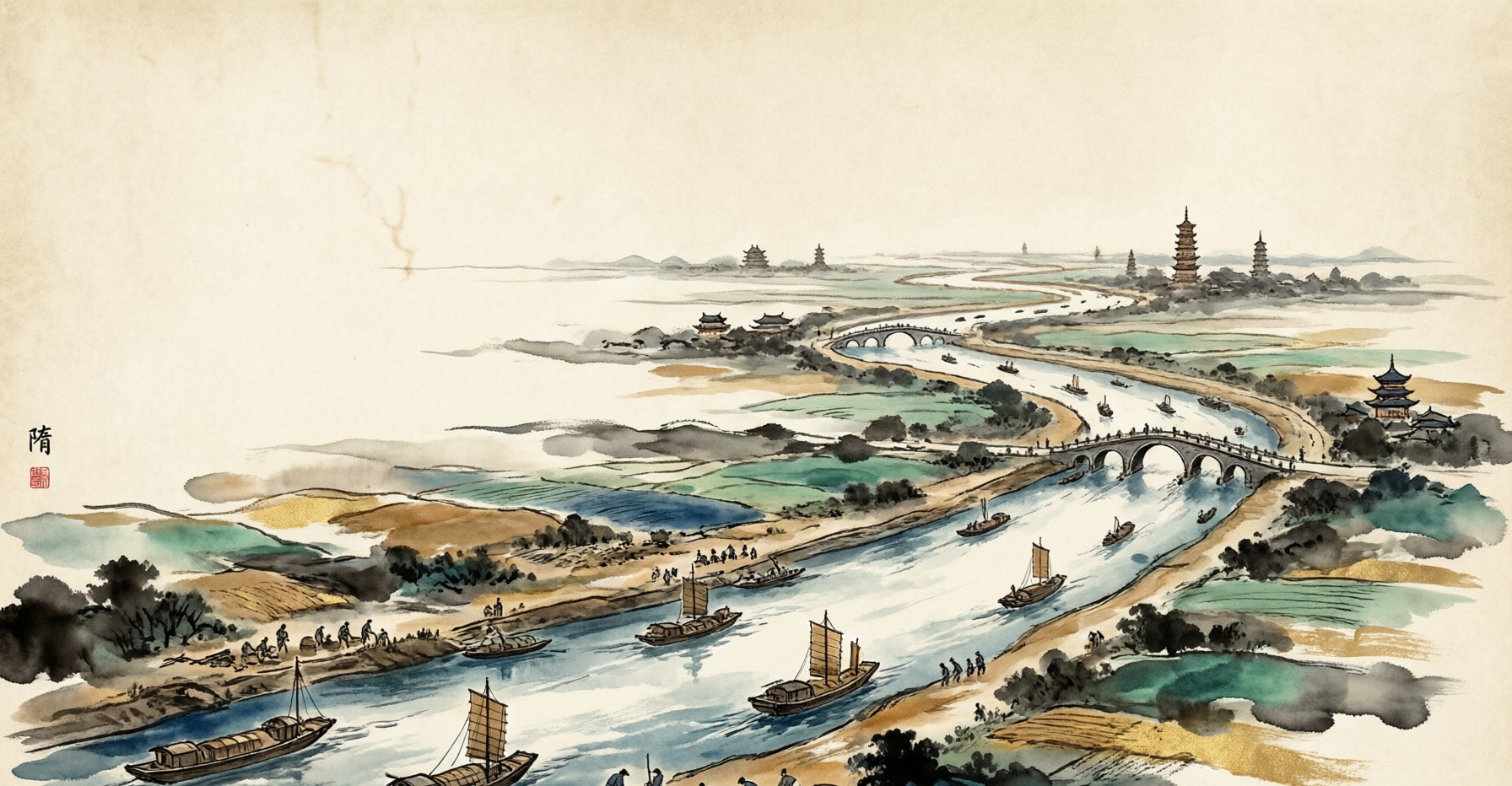
History has a way of repeating its patterns, and few are as striking as the rhyme between the Qin and the Sui. Both were short dynasties. Both ended centuries of division and made China one again. Both were ruled by driven, ruthless emperors who conscripted their people into colossal works of engineering. Both were condemned by later ages as tyrannies — and both laid the foundations on which a glorious successor dynasty would build its golden age. The Qin prepared the way for the Han; the Sui (隋), which lasted only thirty-seven years, from 581 to 618 CE, prepared the way for the Tang. Without the Sui there would have been no Tang as we know it — no great capital, no canal to feed it, no examination system to staff it. The dynasty that the Tang spent generations denouncing was the very dynasty that made the Tang possible.
To understand the Sui, you must remember what came before: nearly three centuries of division, the long age of the Northern and Southern Dynasties, in which China had been split between nomadic-founded empires in the north and a succession of Han courts in the south. By the late sixth century the north had at last been reunited under the Northern Zhou, and it was from this hardened, half-sinicized northern world that the man who would remake China emerged. His name was Yang Jian.
The Reunification
Yang Jian (杨坚) was a powerful minister at the Northern Zhou court, a man of mixed Han and steppe-connected aristocratic blood, whose daughter had married the Zhou emperor. When a weak and unstable heir took the Zhou throne in 579, Yang Jian moved with cold efficiency: he seized the regency, neutralized his rivals, and in 581 compelled the child emperor to abdicate in his favor. He took the throne as Emperor Wen of Sui (隋文帝), founding a new dynasty and naming it after the ancient fief his family had held. It was a usurpation, frankly accomplished — and it was the first step toward the greatest political achievement of the age.
Emperor Wen was no mere warlord. He was a careful, hardworking, frugal administrator, and he spent his first years consolidating the north and building the strength to strike south. In 588 he launched a vast invasion across the Yangtze against the Chen, the last of the southern dynasties. The Chen emperor, the poet-ruler Chen Shubao, had given himself over to wine and verse and trusted, fatally, to the river as a natural wall. It was not enough. In 589 Sui armies crossed the Yangtze, took the southern capital of Jiankang, and hauled the last Chen emperor from the well where he had hidden. After nearly three hundred years of division, China was one again.
What followed was a reign of genuine restoration. Emperor Wen lightened the brutal laws and crushing taxes of the previous age, opened the granaries in times of famine, and governed with a plainness that won him the loyalty of an exhausted population. He is remembered as one of the more capable and humane founders in Chinese history — a ruler who understood that a dynasty reunified by force could only be held together by relief. Under him the population, which had been scattered and depleted by centuries of war, began to recover and grow. The stage was set for the works that would define the dynasty — and for the ambitions that would destroy it.
A New Capital and a New Order
Emperor Wen knew that a reunited empire needed a capital worthy of it. The old Han city of Chang'an had silted up and grown cramped and unhealthy over the centuries. So, in 582, he commissioned an entirely new capital just to its southeast, on a grand and geometric plan. He named it Daxing (大兴, "Great Prosperity"); later ages would know it again as Chang'an. Designed by the brilliant architect Yuwen Kai, the new city was laid out on a vast grid of broad avenues and walled wards, symmetrical and immense — by some reckonings the largest planned city in the world of its time. It was a statement in brick and rammed earth: here was a single, ordered empire, governed from a center. When the Tang took over, they kept the city almost unchanged and filled it with the splendor for which it is still remembered.
The Sui rebuilt the machinery of government as thoroughly as they rebuilt the capital. They refined the system of Three Departments and Six Ministries (三省六部), a structure of checks and balances that divided the work of drafting, reviewing, and executing policy among separate offices, and that would govern Chinese administration for a thousand years. They revived and extended the equal-field system (均田制, juntian zhi), by which the state allotted land to peasant households in return for tax and labor service — an attempt to break the grip of the great landed families and bind the cultivator directly to the throne. And they took the first decisive steps toward the imperial examination system (科举, keju), the revolutionary idea that officials should be chosen by merit and learning rather than by birth and connection.
The keju would not reach its full flowering until later dynasties, and in Sui times it was still a modest supplement to older methods of recruitment. But the principle it planted — that talent, not blood, should govern — was one of the most consequential ideas in Chinese history. Together with the equal-field system and the new bureaucratic structure, it pointed toward a more centralized, more meritocratic empire. The Tang would inherit all of it and claim the credit; the Sui did the harder work of invention.
The Grand Canal
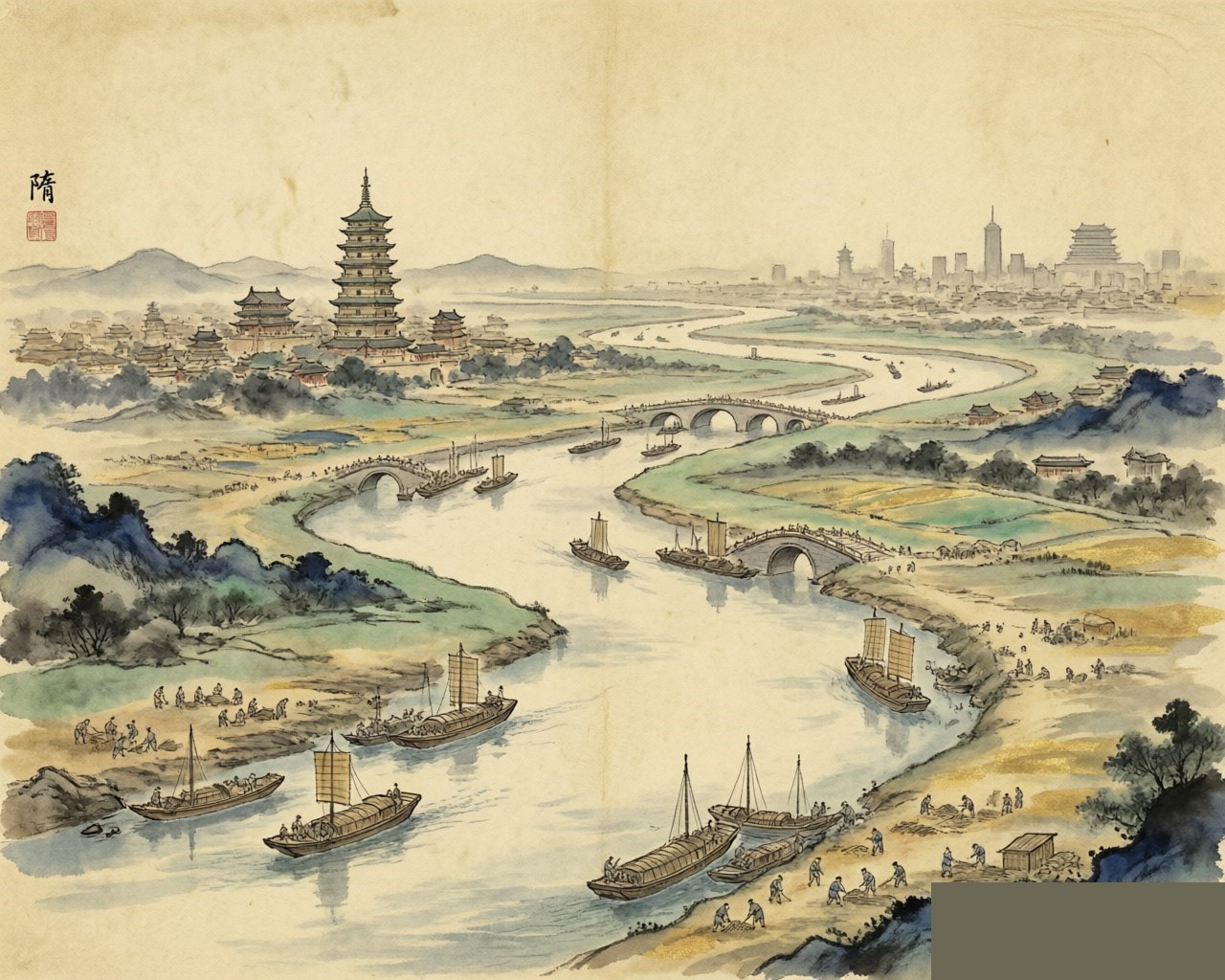
Of all the Sui's works, none was greater, and none more lasting, than the Grand Canal (大运河, Da Yunhe). China's two great rivers, the Yellow River in the north and the Yangtze in the south, flow from west to east; between them there was no natural waterway running north and south. This was a problem with strategic consequences: the political and military center of the empire lay in the north, but its richest farmland and its grain lay increasingly in the south. To bind the two together, the Sui set out to dig an artificial river that would link them.
The project was begun under Emperor Wen and driven to completion, on a staggering scale, by his son. Stretching, in its final form, across more than a thousand miles, the canal connected the Yangtze and Yellow River basins and linked the wealthy south to the northern capitals, eventually joining the region of modern Hangzhou to the plains around Luoyang and beyond. It was an engineering triumph and an economic revolution: for the first time, the grain and goods of the south could flow reliably to the north, feeding the capitals and the frontier armies and knitting the two halves of the empire into a single economic body. The canal remained a vital artery of Chinese commerce for more than a millennium, and sections of it are still in use today.
But the canal, like so much else the Sui built, was dug at a fearful human cost. Hundreds of thousands of conscripted laborers were pressed into the work, and the suffering was immense. Here was the dynasty's central contradiction, the same one that had doomed the Qin: the Sui could conceive and execute projects of lasting genius, but they pursued them with a disregard for human limits that broke the people they were meant to serve. The canal would enrich every dynasty that came after; the men who dug it rarely lived to see it.
"All say the Sui fell because of this canal — yet to this day a thousand li depend on its flowing waves." — Pi Rixiu, "Remembering the Past at the Bian River," Tang Dynasty
The Second Emperor and the Korean Wars
Emperor Wen died in 604, and the throne passed to his son Yang Guang, known to history as Emperor Yang of Sui (隋炀帝) — a figure who has become, in the Chinese imagination, almost a synonym for the tyrant. Where his father had been frugal and cautious, the son was extravagant and grandiose. He built a magnificent eastern capital at Luoyang, filled with palaces and gardens; he toured his empire in floating palaces along the new canal; he expanded the canal system further still. He was not without ability or vision — but he had none of his father's restraint, and he demanded of his people more than flesh could bear.
What broke the dynasty was war. To the northeast, in Manchuria and the northern Korean peninsula, lay the kingdom of Goguryeo (高句丽), a powerful and well-organized state that Emperor Yang determined to bring to heel. Beginning in 612, he launched a series of enormous invasions, mobilizing armies of a size rarely seen before. The campaigns were disasters. The first, in 612, ended in a catastrophic defeat on the banks of the Salsu River, where the Sui forces were ambushed and nearly destroyed. Renewed offensives in 613 and 614 faltered amid rebellion at home and stubborn resistance abroad. The wars drained the treasury, exhausted the conscripted armies and laborers, and turned a war-weary population to despair.
The reckoning came swiftly. As the Korean campaigns bled the empire dry, revolts erupted across the land — peasant uprisings, mutinies, and the ambitions of regional commanders who saw the throne within reach. The exact details of the final years are tangled and contested, but the outcome is not in doubt: the Sui lost control of their empire almost as quickly as they had built it. Emperor Yang, abandoned and besieged, retreated to the southern capital of Jiangdu, where in 618 he was murdered by his own guards. The dynasty was over.
Collapse and Inheritance
From the wreckage of the Sui rose the Tang. The man who took the throne was Li Yuan, a Sui general and aristocrat of mixed Han and Xianbei descent, who seized the capital and in 618 proclaimed the Tang Dynasty. His son, the brilliant and ruthless Li Shimin, would consolidate the new regime and lead it into its golden age. The Tang were, in a real sense, the Sui's heirs in everything but name — drawn from the same northern aristocracy, governing from the same capital, through the same bureaucratic structures, fed by the same canal.
And yet the Tang defined themselves, in part, by condemning the Sui. Their official histories painted Emperor Yang as a monster of extravagance and cruelty, a cautionary tale of what happens when a ruler exhausts his people. There was truth in the portrait — the human cost of the Sui's works was real and terrible — but there was also convenience: by blaming the Sui's fall on the personal wickedness of its last emperor, the Tang could inherit the dynasty's achievements while disowning its sins. The canal that the Tang depended on was the very canal they cited as proof of Sui tyranny. It is one of history's neater ironies that the dynasty which most benefited from the Sui worked hardest to ensure the Sui were remembered as villains.
Legacy: The Dynasty That Built the Future
The Sui present, in the end, the same paradox as the Qin: the things that destroyed them were also the things that endured. The forced labor, the crushing demands, the catastrophic wars — these brought the dynasty down in a single generation, and they earned it a dark reputation that has never quite lifted. But the works survived. The capital the Sui planned became the greatest city of the medieval world. The canal they dug bound China's economy together for a thousand years. The examination principle they planted grew into the system that selected China's governing elite for thirteen centuries. The bureaucratic and land systems they refined became the template for the Tang and beyond.
To read the Sui is to confront an uncomfortable truth about how civilizations are sometimes built: that lasting good can be wrought at a cost no decent person would wish to pay, and that the generations who enjoy the inheritance rarely remember the hands that paid for it. The Sui emperors dreamed of a dynasty of ten thousand generations and got barely thirty-seven years. But the China they rebuilt — reunited, reconnected, reordered — proved far more durable than their own house. They lit the fire that the Tang would tend into a blaze, and in that sense the short-lived empire that rebuilt China did not so much die as pass, whole and transformed, into the golden age it had made possible.