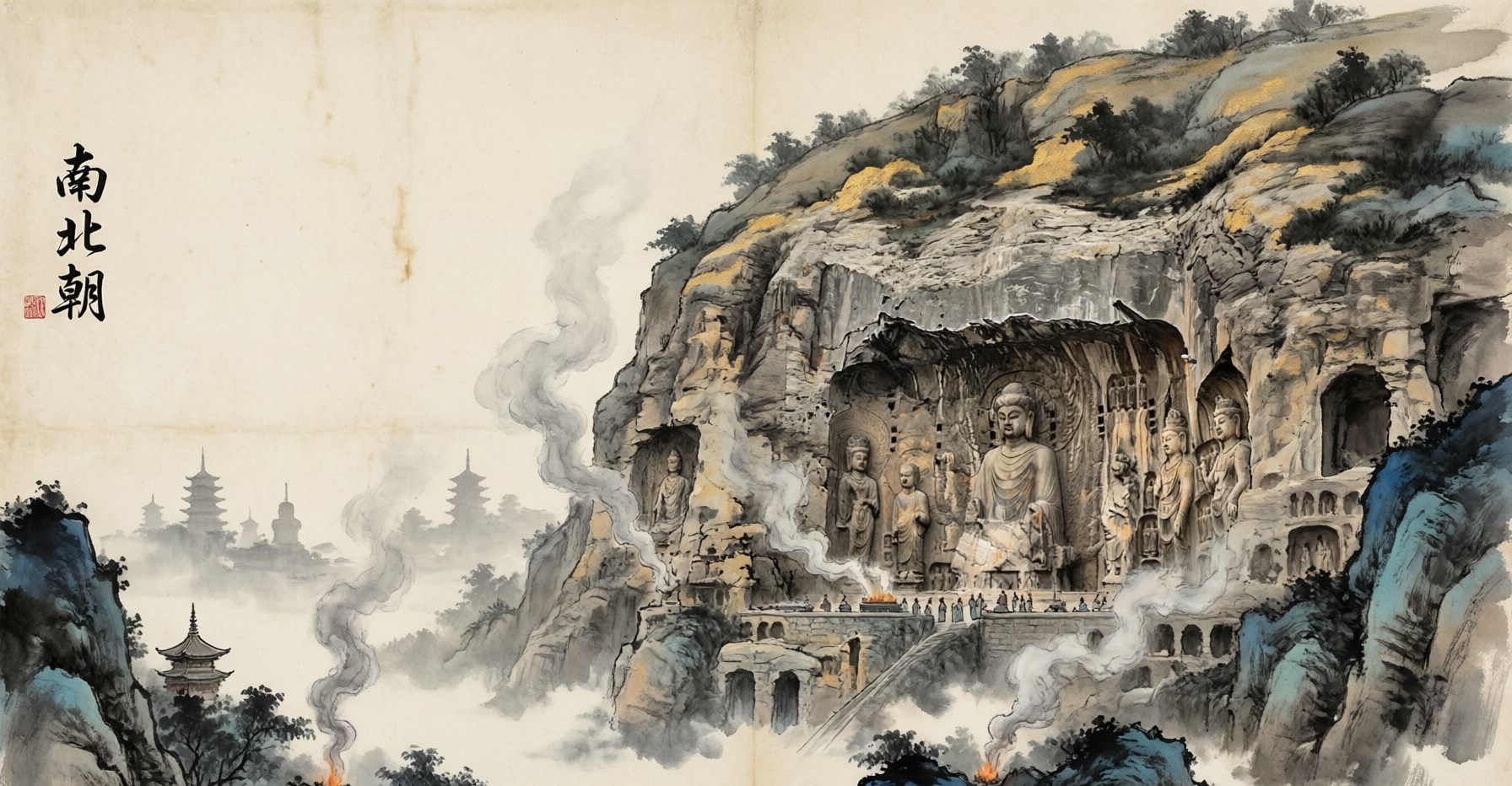
There is a stretch of Chinese history that the old textbooks used to hurry past, embarrassed. Between the fall of the Han and the rise of the Tang lies nearly four centuries in which China was not one country but many — a long age of fracture, war, and wandering thrones. The heart of it, the period historians call the Northern and Southern Dynasties (南北朝, Nanbeichao), spans from 420 to 589 CE: almost a century and three quarters in which the land lay split along the Yangtze, with a succession of nomadic-founded empires ruling the north and a procession of Han Chinese courts holding the south. It is an era of chaos, of short dynasties and violent ends. And yet it is also, quietly, one of the most creative and consequential ages in the whole Chinese story — the crucible in which a divided civilization was melted down and recast.
For this was the age when Buddhism took deep root across China and never let go. When monks and masons carved whole cliffs into cathedrals of stone. When a nomadic emperor decided that the surest way to rule China was to become Chinese. When southern poets perfected the art of the landscape verse and critics wrote the first great works of literary theory. When a mathematician pinned down the value of pi with an accuracy Europe would not match for a thousand years. And when, through war and intermarriage and the slow mingling of blood and custom, the peoples of the steppe and the sown were fused into something new — a more cosmopolitan population that would, in the generation after the reunification, build the glittering world of the Tang. The age of division, in the end, was the making of medieval China.
A World Split in Two
To understand the Northern and Southern Dynasties, you have to understand what came immediately before. When the Han Dynasty collapsed in the third century, it left behind a brief, unstable reunification under the Jin (晋), which almost at once fractured. In the north, the central authority dissolved, and a wave of peoples from the steppe and the frontier — Xiongnu, Xianbei, Jie, Di, and Qiang, grouped by later historians under the sweeping label of the "Five Barbarians" (五胡, wu hu) — pushed into the Chinese heartland. The Jin court, driven from its northern capitals, fled south across the Yangtze in 317 and set up a diminished regime at Jiankang (modern Nanjing), leaving the north to fragment into a bewildering kaleidoscope of short-lived states known collectively as the Sixteen Kingdoms (304–439).
For more than a century the north was a battlefield. Kingdoms rose and fell with dizzying speed, founded by warlords of a dozen different peoples, few of them lasting more than a generation. It was an age of displacement and suffering, but also of extraordinary encounter: for the first time on such a scale, the peoples of the inner Asian steppe and the settled farmers of the Chinese plains were living side by side, fighting, trading, intermarrying, and learning one another's ways. Out of this turmoil one power would eventually emerge supreme — but the formal period of the Northern and Southern Dynasties is usually dated from 420, the year a tough southern general named Liu Yu deposed the last Jin emperor and founded the first of the four southern dynasties, the Liu Song (刘宋). From that moment the division became official, and would endure for nearly a hundred and seventy years.
The North: From Conquerors to Emperors
The north found its master in the Tuoba (拓跋), a branch of the Xianbei people. In 386 a chieftain named Tuoba Gui re-founded the state of Wei, and over the next half century his successors — above all the formidable Emperor Taiwu — swept away the rival kingdoms and, by 439, reunited the whole of northern China under a single throne. This was the Northern Wei (北魏), the greatest and longest-lived of the northern dynasties, and the engine of the era's most dramatic transformation. The Tuoba had begun as pastoral nomads, superb horsemen with little tradition of cities or letters. Yet within a few generations they were governing the most populous and sophisticated agrarian civilization on earth — and they faced the question every conqueror of China must face: do you rule the Chinese as an occupying army, or do you join them?
No ruler answered that question more decisively than Emperor Xiaowen (孝文帝), who came to the throne as a boy in 471 and grew into one of the most remarkable reformers in Chinese history. Xiaowen concluded that the Tuoba could never securely govern China while remaining visibly foreign. So he set about turning his own people into Chinese. In 494 he moved the capital south from Pingcheng (modern Datong), on the old frontier, to Luoyang — the ancient seat of the Han and Wei emperors, heavy with the prestige of the Chinese past. There he issued a cascade of edicts that amounted to a voluntary cultural surrender: the Xianbei were to wear Chinese dress, speak Chinese at court, and adopt Chinese surnames. His own clan name, Tuoba, was changed to the Chinese Yuan (元). Intermarriage between Xianbei nobles and the great Han families was actively encouraged. The old steppe customs were discouraged; Chinese ritual, bureaucracy, and learning were embraced.
It was a gamble, and in the short term it split the Northern Wei in two. The sinicized south, around Luoyang, prospered in elegance; the garrisons of the northern frontier, who had kept their steppe ways, grew bitter and neglected, and in the 520s they rose in revolt. The dynasty broke apart, and from its fragments came a final rapid succession of northern regimes — the Eastern and Western Wei, and then the Northern Qi and Northern Zhou — until, in 581, a strongman of the Northern Zhou named Yang Jian seized the throne and founded a new dynasty that would reunite everything. But Xiaowen's revolution could not be undone. By fusing the ruling houses of steppe and sown into a single aristocracy, he had created the very class — part Chinese, part Xianbei, thoroughly at home in both worlds — that would supply the founders and generals of the Sui and Tang. The fusion he willed became the foundation of China's golden age.
"The Southern Dynasties' four hundred eighty temples — how many towers and terraces stand in the misty rain." — Du Mu, "Spring on the River" (Jiangnan Chun), Tang Dynasty, looking back on the Buddhist age of the south
The South: Refinement on the Yangtze
While the north was being remade by conquest and fusion, the south was perfecting itself in exile. The four southern dynasties — Liu Song (420–479), Southern Qi (479–502), Liang (502–557), and Chen (557–589) — ruled from Jiankang, on the Yangtze, and between them they presided over one of the great flowerings of Chinese high culture. Each was founded by a general and ended by a usurper; their politics were a grim carousel of coups and massacres. But behind the palace walls, in the gardens and studios of the aristocracy, something delicate and enduring was being made. The south, with its soft climate, its rivers and green hills, became the home of a refined, self-conscious elite who prized poetry, calligraphy, painting, and conversation above all things.
It was here that the landscape poem (山水诗, shanshui shi) came of age. The aristocrat Xie Lingyun (谢灵运), eccentric and brilliant, wandered the mountains of the south and wrote them into verse with a precision and a sensuous attention that had rarely been attempted before — turning the natural world from a backdrop for moral reflection into a subject worthy of contemplation in itself. His influence on all later Chinese poetry is hard to overstate. And it was in the south, too, that literary criticism was born as a serious art. Liu Xie (刘勰), a scholar attached to the Buddhist establishment, composed The Literary Mind and the Carving of Dragons (文心雕龙, Wenxin Diaolong) — a vast, systematic work that analyzed every form of writing, from the ode to the official memorial, and asked what made language beautiful. Alongside it, the critic Zhong Rong ranked the poets of the age in his Shipin (诗品), and the crown prince Xiao Tong compiled the Wen Xuan (文选), an anthology that would serve as the standard textbook of elegant prose for more than a millennium. The south may have lost the north to the horsemen, but it won the longer contest for the Chinese imagination.
The Triumph of Buddhism
If one faith defines the age, it is Buddhism. The religion had arrived in China centuries earlier along the Silk Road, but it was during the long centuries of division that it truly took hold — and for reasons that are not hard to fathom. In an age of endless war, of dynasties that rose and fell within a lifetime, of cities sacked and populations uprooted, the Buddhist message spoke directly to the human condition: life is suffering, all things are impermanent, and there is a path beyond the wheel of pain. It offered comfort to the dispossessed and legitimacy to the conqueror. Nomadic rulers, who had no stake in the old Confucian order, found in Buddhism a universal faith that owed nothing to Chinese ancestry and could sanctify their thrones as readily as any native creed.
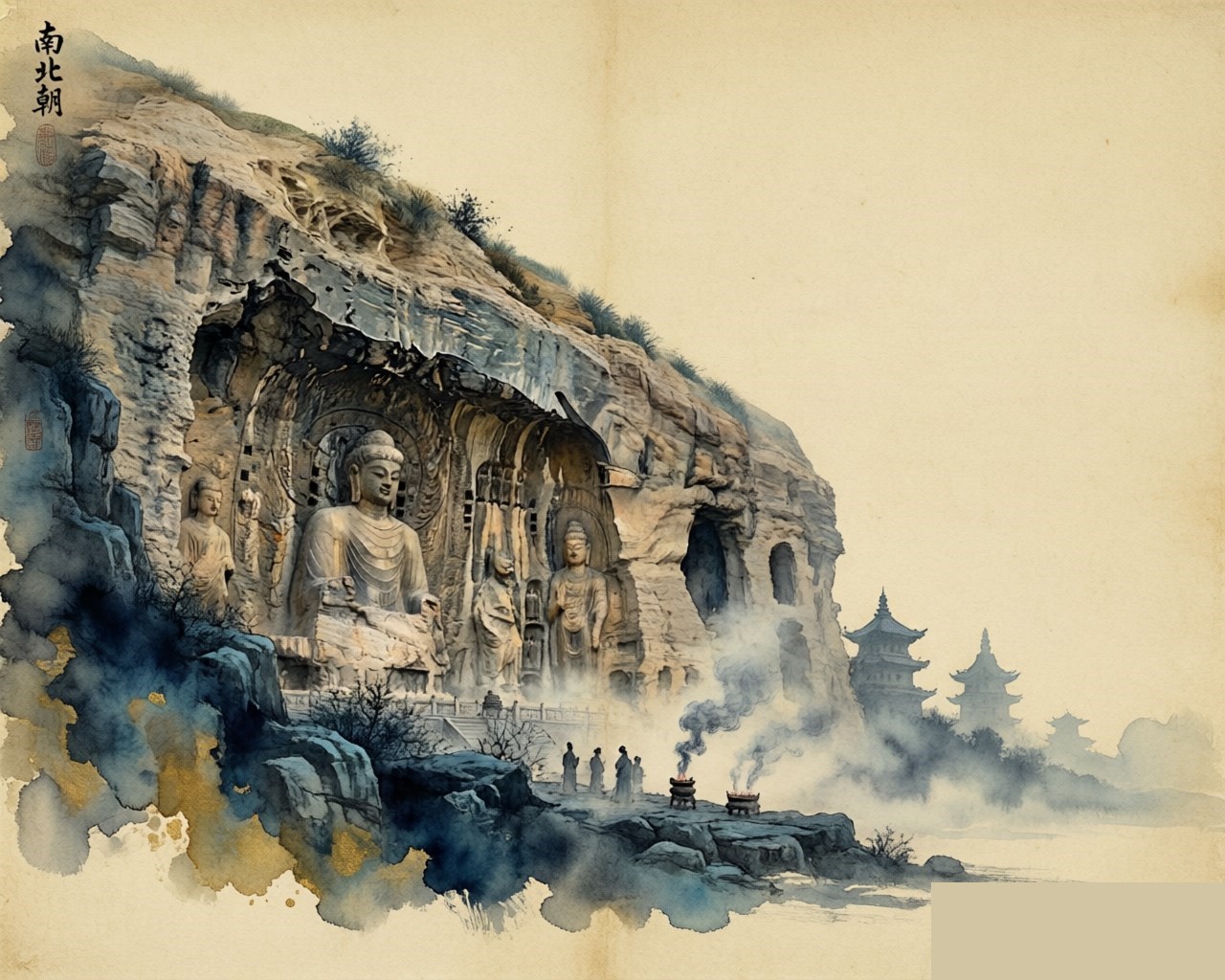
The result was an explosion of devotion and art. Monasteries multiplied across both halves of the divided land; the Tang poet Du Mu, looking back, would speak of the south's "four hundred eighty temples" wreathed in rain. In the north, the faith left its most lasting mark in stone. At Yungang, near the old Northern Wei capital of Pingcheng (modern Datong), and later at Longmen, beside the new capital at Luoyang, monks and emperors carved vast complexes of cave temples into the living rock — tens of thousands of statues, from serene Buddhas the height of a house to tiny figures in niches, paid for by emperors, generals, monks, and ordinary families alike. The colossal Buddhas of Yungang, with their broad faces and calm half-smiles, show the foreign origins of the faith still visible in their features, even as the drapery of their robes slowly turns Chinese. To walk through Longmen today is to walk through the age's deepest conviction, chiseled into a cliff and still standing after fifteen centuries.
The south had its own fervor. The most devoted of all southern rulers was Emperor Wu of Liang (梁武帝), who reigned for nearly half a century in the sixth century and became so committed to the faith that he repeatedly "donated" himself to a monastery, requiring his ministers to ransom their emperor back with vast sums of public money. His patronage helped make Jiankang one of the great Buddhist centers of Asia, drawing translators, monks, and scholars from across the continent. By the time the age of division ended, Buddhism had woven itself so deeply into Chinese life — into its art, its philosophy, its language, its funeral rites and festivals — that no later persecution could ever fully tear it out again.
Minds and Measures: Science and Thought
The age's achievements were not all spiritual or aesthetic. Behind the poetry and the cave temples, the period saw real advances in science, technology, and practical learning — often, ironically, because division itself created competition and freed talent from the grip of a single orthodox court. The southern mathematician and astronomer Zu Chongzhi (祖冲之), working in the fifth century, calculated the value of pi to lie between 3.1415926 and 3.1415927 — a degree of precision that would not be surpassed anywhere in the world for roughly a thousand years. He also reformed the calendar and, with his son, worked out the volume of the sphere. His was a mind of the first order, flourishing in the cultivated south.
Technology advanced alongside theory. This was an age of water-powered machinery, of improved agricultural implements, and of steady progress in metallurgy and ceramics — the celadon wares of the south and the robust stoneware of the north both moved toward the great porcelain traditions to come. The scholar Yan Zhitui wrote his Family Instructions (颜氏家训), a frank and worldly guide to surviving an unstable age, full of practical wisdom on education, conduct, and the management of a household in troubled times. Even the chaos had its uses: the constant movement of peoples spread crops, techniques, and ideas across regions that had once been sealed off from one another. The north learned from the south, the south from the north, and the steppe from both.
The Forging of a New People
The deepest legacy of the Northern and Southern Dynasties is invisible, and it is the most important of all. For nearly two centuries, peoples who had lived apart — Han farmers of the plains, Xianbei and other steppe herders, and a dozen smaller groups besides — had been thrown together by war, by conquest, by the deliberate policy of emperors like Xiaowen, and by the quiet, irresistible force of intermarriage. The old boundary between "Chinese" and "barbarian," which the Han world had drawn so confidently, blurred and in many places vanished. By the sixth century the great families of the north were neither purely Han nor purely Xianbei but a blend of both, equally at home with the Confucian classics and the saddle, with the brush and the bow.
This fusion is the hidden key to what came next. When Yang Jian reunified China in 589 and founded the Sui, and when the Li family — themselves of mixed Han and Xianbei blood — founded the Tang a generation later, they did not inherit the narrow, inward-looking China of the Han. They inherited a broader, tougher, more cosmopolitan civilization, one that had absorbed the energy of the steppe and the refinement of the south and was ready to reach outward. The dazzling openness of the Tang — its foreign merchants and foreign music, its women who rode horses and played polo, its eagerness to borrow from every corner of the known world — was not a sudden miracle. It was the harvest of the age of division. The centuries of fracture had been, in the end, a long education in how to be more than one thing at once.
Legacy: The Wound That Healed Stronger
It is tempting to read the Northern and Southern Dynasties as a tragedy — a long interruption of unity, a dark age of war and usurpation between two golden eras. And there is truth in that: the human cost of the centuries of division was immense, and the political record is grim. But to see only the fracture is to miss the point. What the age broke, it also rebuilt on a larger plan. It gave China a universal religion that softened its older certainties. It gave it a poetry of landscape and a vocabulary of beauty that still shape the culture. It gave it cave temples that remain among the supreme achievements of human art. It gave it advances in mathematics and technology. And, most of all, it gave it a people — fused, resilient, and broad-minded — capable of building the civilization that followed.
The Chinese have a saying that the empire, long divided, must unite, and long united, must divide. The Northern and Southern Dynasties were the longest and deepest of the divisions, and the reunification that ended them was all the more powerful for what it had to overcome. When the Sui armies crossed the Yangtze in 589 and the last southern emperor surrendered, the age of division was over — but nothing that the age had made was lost. It passed, whole and transformed, into the Sui and the Tang, and from them into everything that China would become. The wound healed, and it healed stronger than before.