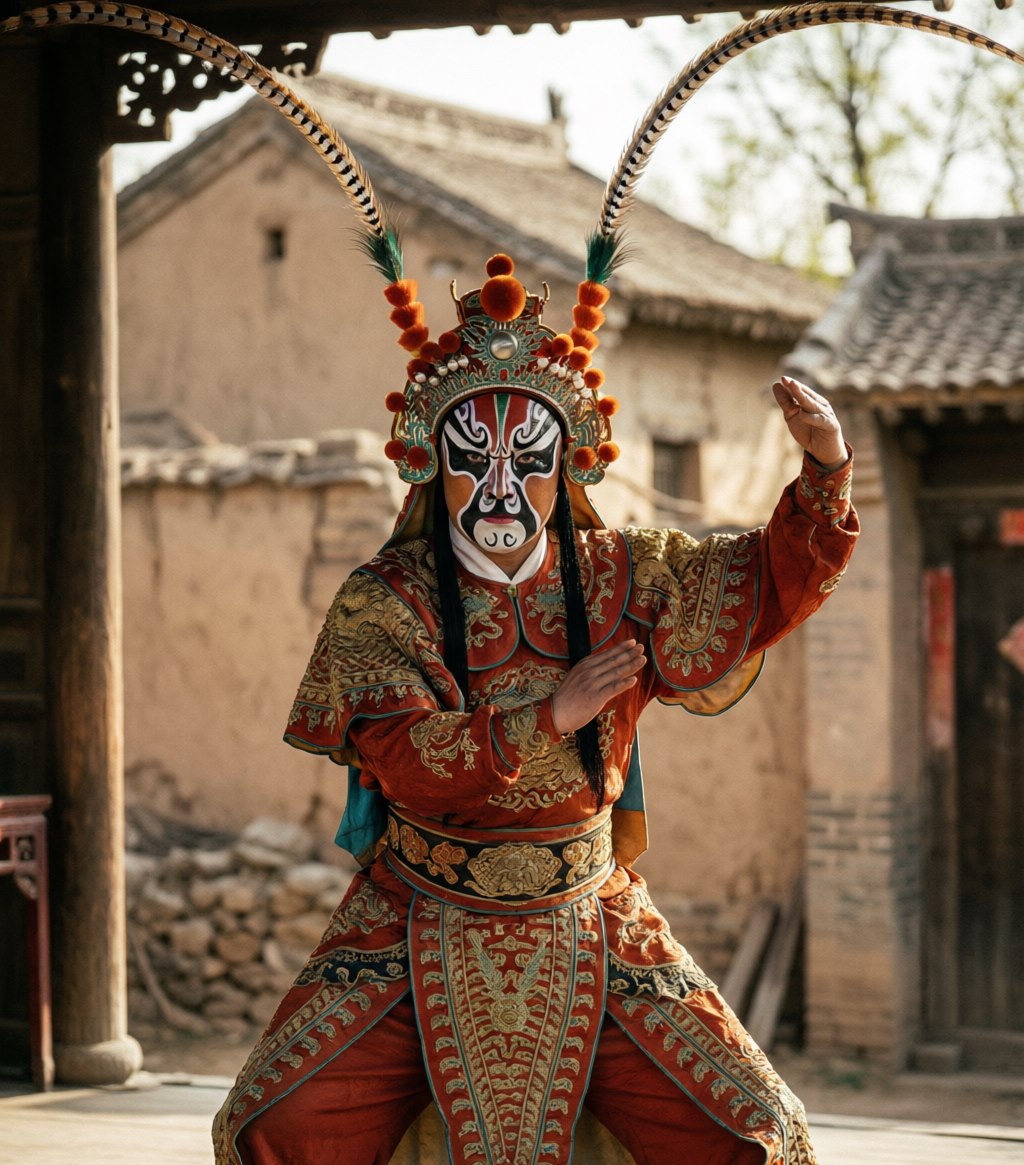
The Sound of the Plains
Stand in a village square in Henan on a festival night, and you will hear it before you see it: a sound like weather rolling across the flatlands, a high, bright, unstoppable wall of singing that carries for hundreds of meters over the heads of the crowd. This is Yuju (豫剧), the clapper opera of the Central Plains, and it is not an art form that whispers. It declares. It thunders. It pours out of the performer's throat with a force that feels less like technique than like necessity — as if the singer had something so urgent to say that no quieter manner could contain it.
Yuju is the opera of the Yellow River basin, of the broad, hard-worked plains of Henan province and the regions that surround it. It is an art of the soil, shaped by a people who have farmed this land for millennia and endured its floods, its famines, and its wars. Its singing is loud because it was born to be heard outdoors, across open ground, by audiences of thousands. Its emotion is unguarded because it speaks for people who have never had the luxury of concealment. To understand Yuju is to understand something essential about the Chinese heartland: its endurance, its directness, and its fierce, unquenchable vitality.
The landscape itself seems to have entered the music. The Central Plains are flat, immense, and exposed — a sea of wheat and millet stretching to the horizon beneath a wide sky, crossed by the Yellow River, that great, treacherous, life-giving stream that has both nourished and devastated this region for as long as people have kept records. In such a place, a quiet voice carries no weight. Communication must be broad, open, and forceful to cross the distance, and Yuju's singing answers that need as naturally as a shout answers an open field. There is nothing cramped or furtive about the form. It is the art of a people accustomed to wide spaces and hard weather, and it bears their stamp in every ringing phrase.
Henan Bangzi: The Clapper's Beat
Yuju belongs to the great family of bangzi (梆子) operas — the "clapper" traditions of northern China, so named for the hardwood percussion instrument that drives their rhythm. The clapper, a pair of struck wooden bars, gives these operas their distinctive pulse: a strong, regular, emphatic beat around which the melodies are built. Of all the bangzi forms, Yuju — long known as Henan bangzi (河南梆子) — is by far the most widespread and the most widely loved.
The form's roots reach back to the late Ming and early Qing dynasties, when traveling troupes carried clapper-opera traditions into Henan from neighboring Shanxi and Shaanxi provinces. Over generations, these imported styles merged with Henan's own folk songs, its local dialect, and its popular storytelling traditions to produce something distinctly of the region. For centuries it remained a rural, popular art — performed at temple fairs, harvest festivals, and family celebrations, staged on temporary platforms in village squares and watched by farmers who had walked for miles to attend.
The name Yuju, derived from Yu (豫), the traditional abbreviation of Henan, came into common use in the twentieth century as the form modernized and moved into the cities. But its rural origins remain written into its very sound. This is an opera that never learned to be delicate, and never wanted to. Its strength lies in its vigor, its plainness, and its refusal to soften the rough edges of feeling.
A Singing Style Built to Carry
The musical signature of Yuju is its singing — full-throated, resonant, and capable of extraordinary emotional power. The vocal style demands a strong, projecting voice, and the great Yuju singers are celebrated for the sheer force and stamina of their delivery. Melodies rise to high, ringing peaks and plunge into passages of rapid, impassioned declamation; the rhythm, anchored by the clapper, drives forward with an energy that can feel almost physical in its impact.
The accompaniment is led by the banhu (板胡), the bright, penetrating bowed fiddle that doubles and ornaments the vocal line, supported by the erhu and other strings, and by a percussion section in which the clapper, the drum, and the gongs mark the rhythm and heighten the drama. Yuju developed several distinct melodic modes — broadly grouped into styles associated with different regions of Henan — ranging from the bright and exuberant to the somber and tragic, giving performers a wide expressive palette within the form's characteristically forceful idiom.
Within this framework, Yuju singers command a set of well-defined aria types, each suited to a different dramatic purpose. The slow, expansive manban (慢板) is the vehicle for deep feeling — for grief, reflection, and solemn declaration — its broad phrases giving the voice room to swell and ornament. The livelier erba (二八板) drives the narrative forward with a brisk, flexible energy, ideal for dialogue and for passages of mounting tension. The flowing liushui (流水板) pours out in rapid, continuous lines, perfect for excitement, urgency, or outbursts of joy and fury. A skilled performer moves between these patterns within a single scene, shaping the tempo to the character's shifting emotions, so that the audience is carried from stillness to storm and back again without ever losing the thread of the story.
"Yuju does not sing to be admired. It sings to be believed."
— A saying capturing the genre's devotion to emotional truth over refinement
What distinguishes Yuju singing is its sincerity. Where some operatic traditions prize subtlety and restraint, Yuju prizes conviction. A great aria in this form is an act of total emotional commitment: the singer holds nothing back, and the audience responds in kind, erupting in applause at the climax of a passage, calling for encores, weeping openly at a tragedy. The relationship between performer and crowd is immediate, warm, and electric — closer to a shared celebration than to a formal recital.
Role Types and the Warrior Woman
Yuju employs the standard system of Chinese operatic role types — the sheng (生) male roles, the dan (旦) female roles, the jing (净) painted-face roles, and the chou (丑) clowns — but it is the female roles, and above all the martial women, that have made the form famous. Yuju has an unmatched repertoire of stories about women who take up arms, who command armies, who ride to war in place of the men who cannot or will not go.
This is no accident. The Central Plains, scarred by centuries of conflict, produced a folklore rich in heroines, and Yuju gave those heroines a voice. The form's costumes for martial roles are spectacular — embroidered armor, pheasant-tail plumes, banners strapped to the back, weapons wielded with acrobatic precision — and its staging of battle scenes is vigorous and thrilling. The painted-face roles, with their bold, colorful makeup, bring a larger-than-life grandeur to generals, judges, and gods, while the comic chou roles provide the earthy humor that has always been part of the popular tradition.
Two Heroines for the Ages
If Yuju has a defining image, it is the woman warrior, and two plays embody that image perfectly.
Mu Guiying Takes Command (穆桂英挂帅) tells the story of Mu Guiying, a legendary woman general who, in middle age and long retired from military life, answers the call to defend the nation when no man will take up the task. Donning her armor once more, she raises the banner and leads the army into battle. The play is a stirring celebration of loyalty, courage, and the refusal to let age or circumstance extinguish one's duty. Its central aria, in which Mu Guiying resolves to take command, is one of the most famous passages in all of Yuju — a torrent of resolve and patriotism that audiences have cheered for generations.
Hua Mulan (花木兰) retells the ancient ballad of the young woman who disguises herself as a man to take her aging father's place in the army, serving with distinction for years before returning home to reveal her true identity. The story, drawn from the beloved Ballad of Mulan (木兰辞), is a perfect vehicle for Yuju's strengths: its themes of filial devotion and quiet heroism, its sweeping journey from village to battlefield and back, and its triumphant final revelation. The play's arias are among the most widely sung in the Chinese-speaking world, known even to people who have never seen a full Yuju performance.
Chang Xiangyu: The Voice of Henan
The performer who carried Yuju to national prominence was Chang Xiangyu (常香玉, 1923–2004), widely regarded as the greatest artist the form has produced. Born into a poor family in Henan and trained in the grueling discipline of the old troupe system, Chang rose to become a beloved national figure whose voice was, for millions, the very sound of Yuju. Her singing combined power with surprising nuance, and her stage presence — commanding, generous, utterly committed — made her martial heroines unforgettable.
Chang Xiangyu's fame rested not only on her art but on her character. During the War to Resist US Aggression and Aid Korea in the early 1950s, she famously toured and performed to raise funds to purchase a fighter aircraft for the national effort, an act of patriotism that cemented her place in the public's affection. She founded her own performing school, trained generations of successors, and remained a tireless advocate for Yuju until her death. To this day, her recordings of Hua Mulan and Mu Guiying Takes Command are the standard against which other performers are measured.
"Wherever there are Henan people, there is Yuju; and wherever there is Yuju, there is the sound of home."
— A testament to the opera's deep bond with the people of the Central Plains
The Largest Opera in China
By one measure, Yuju is the most successful regional opera in the country: it is the largest opera genre in China by number of performers and professional troupes. Its reach extends far beyond Henan, with thriving companies and devoted audiences across the neighboring provinces and wherever Henan migrants have settled. This vastness is a reflection of its accessibility. Yuju's melodies are easy to learn and to sing along to; its stories are clear and emotionally direct; its dialect, while distinctly Henan, is close enough to standard Mandarin to be widely understood.
The form's rural roots gave it a resilience that more refined, urban traditions sometimes lack. Yuju survived because it was never dependent on a small elite audience; it belonged to the villages, the market towns, the festival crowds, the millions of ordinary people who made it part of the rhythm of their lives. In an era of rapid change, that broad base of popular love remains its greatest asset.
The traditional performance context illuminates this bond. For generations, Yuju was inseparable from the temple fair (庙会, miaohui) and the festival stage — occasions when a whole community pooled its resources to hire a troupe, erect a temporary platform, and celebrate together over several days of singing. To stage an opera was an act of collective devotion and communal pride, a way of honoring the gods, marking a harvest, or consecrating a family occasion. The audience did not sit in reverent silence; it ate, talked, moved about, and erupted in loud, immediate approval when a singer delivered. This was theater as social ritual, and Yuju's robust, projecting style was perfectly adapted to it. Even as the form moved into modern theaters, it retained something of that festival energy — a warmth and directness between stage and crowd that more formal traditions can struggle to achieve.
Thunder That Endures
Yuju today faces the same challenges as every traditional art: aging audiences, competition from modern entertainment, and the difficulty of drawing young people into a form that demands attention and presence. Yet it meets these challenges from a position of strength. Its troupes remain numerous, its classic plays continue to fill theaters and village squares, and new works keep the repertoire alive. Television and online video have carried Yuju singing to audiences far beyond the Central Plains, and its most famous arias circulate widely, sung by amateurs and professionals alike.
There is a reason Yuju has endured where more delicate forms have faded. It speaks in a voice that does not tire, does not falter, and does not pretend. It is the voice of a people who have weathered the worst the world could send them and who still, on a festival night, gather in their thousands to hear a story told with everything the singer has. The clapper strikes, the banhu rises, and the singing rolls out across the plain like thunder that has no intention of stopping. That sound — loud, passionate, and utterly alive — is the sound of the Chinese heartland itself, and it shows no sign of falling silent.