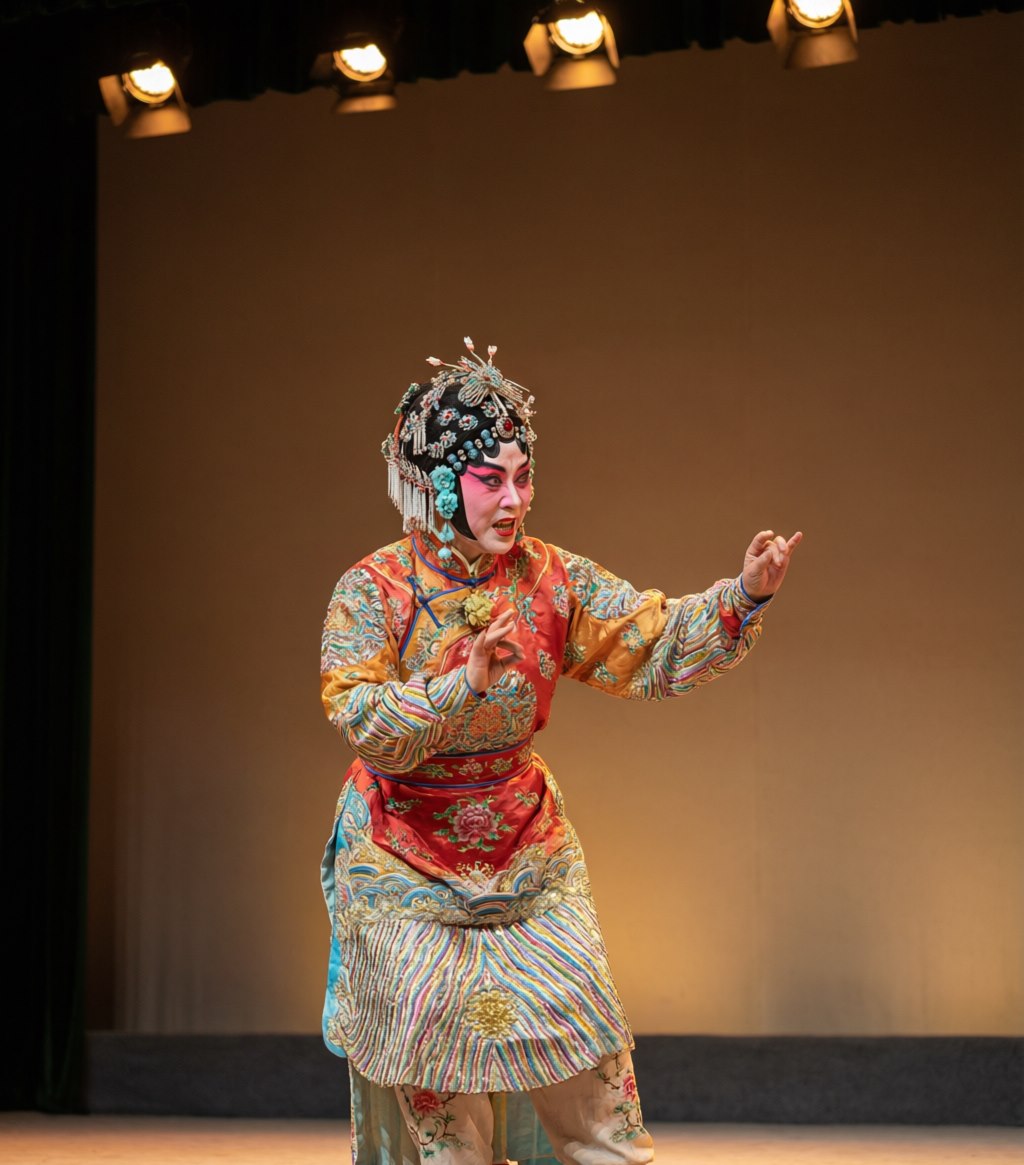
The Opera That Spoke Like You
Of all the regional operas of China, few are as immediately approachable as Pingju (评剧). Where Peking Opera stylizes speech into a heightened, musical declamation and Kunqu Opera sets poetry to slow, ornamental melody, Pingju does something almost radical in its simplicity: it sings the way people talk. Its melodies rise and fall close to the natural contours of the northern Mandarin dialect, so that a first-time listener can follow the words without a libretto, catch the joke before the punchline lands, and feel the grief before the singer has finished the phrase. It is an opera built not for connoisseurs but for everyone — and for more than a century, that has been precisely the secret of its power.
Pingju is the theater of the northern cities and their surrounding plains: of Tianjin and Tangshan, of Shenyang and the market towns of Hebei. Its stories are rarely about emperors or generals. They are about a young woman who refuses an arranged marriage, a daughter-in-law mistreated by her husband's family, a farmer cheated by a landlord, a mother who sacrifices everything and is rewarded too late. It is, in the truest sense, a people's theater — born from the songs of the poor, refined in the teahouses of the working city, and carried to its golden age by performers who understood that the most dramatic subject in the world is an ordinary life lived under pressure.
From the Lotus-Flower Fall
Pingju's origins are humble, and the form has never been ashamed of them. It grew out of a folk performing tradition called lianhualuo (莲花落), the "lotus-flower fall" — a style of narrative singing once associated with beggars and itinerant performers who traveled the villages of Hebei and the area around Tangshan, telling stories to the rhythm of clappers and collecting coins in return. The name itself evokes a falling refrain, a recurring melodic phrase that punctuated the tale and invited the crowd to sing along.
In the late nineteenth century, these street performers began to absorb elements from neighboring forms — the shadow plays, the yangge (秧歌) festival dances, and especially the clapper operas (bangzi 梆子) of the north. Around the turn of the twentieth century, in the industrializing city of Tangshan, the tradition began to coalesce into something new. Performers added stringed accompaniment, expanded the cast beyond a single storyteller, and staged scenes with costumes and movement. By the 1910s and 1920s, the form had acquired the name Pingju — a word whose first character, ping (评), suggests "to comment" or "to evaluate," hinting at the genre's fondness for stories that pass moral judgment on the world.
The new opera spread with extraordinary speed along the railways and trade routes of the north. Tangshan's coal mines and factories had created a large working-class audience hungry for entertainment that spoke their language — literally and figuratively. Pingju traveled to Tianjin, then to the great northeastern cities of Manchuria, and finally to Beijing itself, where it competed with the capital's more established forms and won a devoted following among ordinary citizens who found Peking Opera magnificent but distant.
A Voice Close to Speech
The musical heart of Pingju is its singing style, known for its directness and emotional immediacy. The melodies are built on a small number of flexible modal patterns that the performer shapes around the words, bending pitch and rhythm to follow the meaning of the text rather than forcing the text to fit a rigid tune. The result is a vocal line that feels less like singing than like heightened, impassioned speech — a quality that makes Pingju unusually effective at conveying raw feeling.
The accompaniment is led by the banhu (板胡), a high-pitched, bright-toned bowed fiddle with a wooden resonator, whose cutting, expressive sound mirrors the human voice and doubles the singer's line with ornamental flourishes. It is supported by the erhu, the plucked pipa and sanxian lutes, and a percussion section of clappers (ban 板) and drums that drives the rhythm and punctuates the drama. The clappers, inherited from the lianhualuo tradition, remain central: their steady, woody beat is the spine around which the flexible melodies move.
"Pingju does not ask you to admire its art from a distance. It takes your hand and tells you a story, and before you know it, you are weeping for someone you have never met."
— A common description of the genre's appeal among northern audiences
This accessibility was a deliberate artistic achievement, not an accident of simplicity. The great Pingju composers and performers learned to make sophistication sound effortless, to hide craft behind the illusion of naturalness. A skilled singer can shift from conversational ease to soaring intensity within a single aria, lifting the audience from the familiar ground of everyday speech into a moment of pure, unguarded emotion — and then setting them gently back down again.
The World of Role Types
Pingju inherited the broad system of role types common to Chinese opera, but it weighted that system toward the domestic and the contemporary. The most celebrated roles are the female parts — the qingyi (青衣), the dignified young or middle-aged woman of virtue, and the huadan (花旦), the lively, quick-witted maiden. Because so many Pingju stories center on women's experience, the form became, more than any other major opera, a vehicle for great female performers and for narratives of female resilience.
The male roles include the xiaosheng (小生), the young scholar or suitor, often gentle and somewhat passive beside the stronger women around him, and the laosheng (老生), the older man of authority. Comic roles, the chou (丑), are essential to Pingju's texture: the form has a gift for humor, and its villains and busybodies are frequently drawn with a satirical edge that draws laughter even in serious plots. Unlike the painted faces of Peking Opera, Pingju makeup tends toward a cleaner, more natural appearance, especially for the female roles, whose beauty is presented with relatively little stylization — another expression of the genre's commitment to lifelike immediacy.
Costumes follow the same principle. While historical plays use the embroidered robes and headdresses of the operatic wardrobe, Pingju's signature modern-dress plays (时装戏) feature the plain clothing of the recent past — the cotton jackets, the simple gowns, the everyday garments of farmers, workers, and city families. Seeing ordinary clothes on an operatic stage was, in its time, a quietly revolutionary act: it declared that these lives, too, were worthy of drama.
Stories of Women and Justice
The Pingju repertoire is vast, but its most beloved works share a preoccupation with the lives of ordinary people — and, above all, with the struggles and triumphs of women. Two plays in particular define the genre's modern golden age.
Liu Qiao'er (刘巧儿) tells the story of a young woman in the rural north who refuses the marriage her father has arranged for her and fights, successfully, to wed the man she loves. Based on a real legal case from the 1940s and popularized in a 1956 film, the play became an anthem of the new marriage law that abolished arranged marriages and gave women the right to choose their own partners. Its heroine is spirited, articulate, and unafraid — a perfect vehicle for the form's naturalistic style, and a figure who resonated deeply with audiences for whom the story was not history but living memory.
Hua Wei Mei (花为媒), "Flowers as Matchmaker," is a lighter, more romantic work: a comedy of mistaken identities, clever go-betweens, and two strong-willed young women who outmaneuver the adults around them to secure their own happiness. Its famous duets and its sparkling dialogue show Pingju at its most charming, and its heroines — quick, funny, and self-possessed — embody the genre's enduring affection for women who refuse to be passive.
Beyond these, the repertoire includes Qin Xianglian (秦香莲), the heartbreaking tale of a faithful wife abandoned by her husband after he rises to power, and Yang Sanjie Gaozhuang (杨三姐告状), the true story of a young woman who pursues her sister's murderer through the courts against every obstacle. Again and again, Pingju returns to the same moral territory: the powerless seeking justice, the virtuous enduring suffering, the stubborn demanding what is rightfully theirs.
Xin Fengxia and the Golden Voice
No account of Pingju is complete without Xin Fengxia (新凤霞, 1927–1998), the performer who more than any other defined the sound and spirit of the form in its mid-twentieth-century flowering. Born into poverty and trained from childhood in the harsh discipline of the old theater, Xin possessed a voice of extraordinary clarity and sweetness, capable of the most delicate lyrical nuance and of sudden, overwhelming emotional force. Her recordings of Liu Qiao'er and Hua Wei Mei remain touchstones; generations of listeners learned the arias by heart and sang them in courtyards and on factory floors across the north.
Xin Fengxia's art lay in making difficulty disappear. Her singing sounded spontaneous, conversational, effortless — yet it was the product of relentless technical control. She refined the female vocal style of Pingju, expanding its expressive range and establishing a school of performance that countless singers have followed. Her life, too, became part of the genre's mythology: a self-made artist from the lowest rung of society who rose to national fame, only to endure persecution during the upheavals of the mid-century, and who returned, after years of silence, to teach and to write.
"When Xin Fengxia sang, you forgot it was opera. You thought a woman was simply telling you the truth about her life."
— A tribute to the naturalism that defined Xin Fengxia's art
Why the North Loved It
Pingju's dominance across northern China was not merely a matter of taste; it was a matter of recognition. In a country where many operatic forms drew their audiences from elites and connoisseurs, Pingju spoke to and for the urban working class and the rural population of the north. Its language was their language. Its concerns were their concerns. Its heroines were the women they knew — and, often, the women they wished they could be.
The form thrived in the teahouses and theaters of Tianjin and the northeastern cities, where audiences were vocal, demanding, and quick to reward sincerity. Pingju learned to meet that audience on its own terms: to be direct where other forms were allusive, to be warm where others were formal, to value a good cry and a good laugh above technical display. This did not make it lesser. It made it, in its own domain, unsurpassed — a theater that measured its success not by the admiration of experts but by the tears and applause of ordinary people.
The venues in which Pingju flourished tell their own story. In Tianjin and the northeastern cities, the form found its home in the teahouses and small commercial theaters where working people gathered after long days — places where the audience sat close to the stage, drank tea, cracked seeds, and made its approval or displeasure known without ceremony. This was not the hushed, connoisseur's atmosphere of the elite opera salon. It was lively, democratic, and demanding. A performer who could move such an audience to tears, or hold it in breathless silence, had achieved something real, and the great Pingju artists were forged in exactly this environment. The intimacy of the space suited the intimacy of the style: here was an opera designed not to be admired from a distance but to be felt up close, neighbor to neighbor, in the warm noise of the city.
Pingju Today
Like all traditional operas, Pingju faces the pressures of a changed world. Audiences have aged; younger generations raised on film, television, and the endless scroll of digital media are harder to reach with a form that asks for patience and presence. Troupes are fewer than in the genre's mid-century peak, and the economics of live theater are unforgiving. Yet Pingju endures, sustained by the very qualities that made it popular in the first place.
Its accessibility is, in the modern era, an asset rather than a liability. New audiences find Pingju easier to enter than more stylized forms; its stories translate readily to the screen, and its melodies have a way of lodging in the memory. Revival productions of the classic plays draw loyal crowds, and efforts to record, teach, and digitize the repertoire have preserved the work of the great masters for future listeners. In Tangshan, the city of its birth, Pingju remains a point of civic pride, performed and celebrated as a living inheritance rather than a museum piece.
What secures Pingju's future, ultimately, is the timelessness of its subject. So long as there are families and marriages, injustices and hard-won victories, so long as the powerless continue to demand their due and the virtuous continue to endure, Pingju will have stories to tell. It will tell them, as it always has, in a voice that sounds like your own — close, warm, and impossible to ignore. That is the gift the lotus-flower fall left to the people of the north: an opera that never forgot who it belonged to.