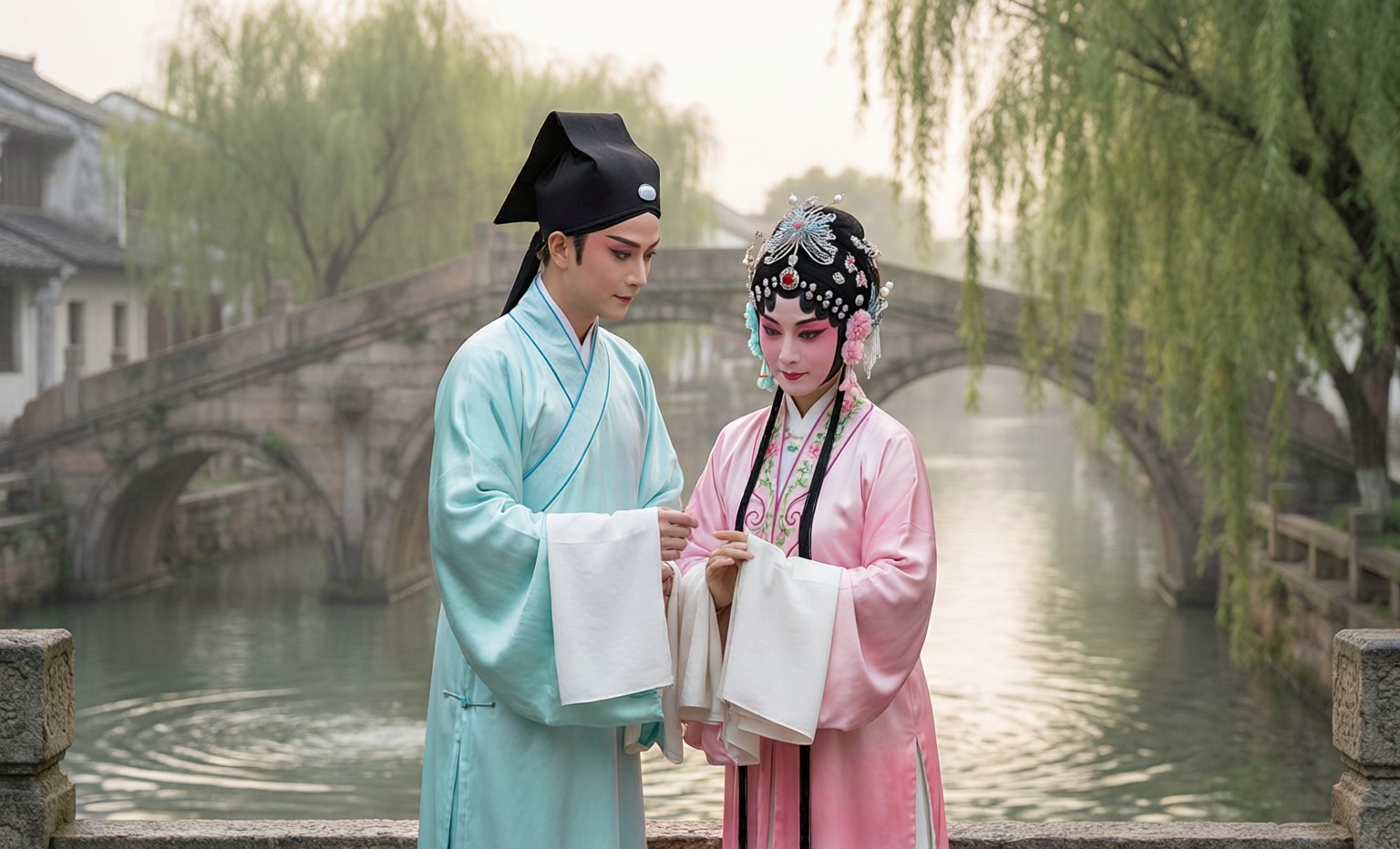
A Soft Voice From the South
Of all China's great operas, Yue Opera (Yueju, 越剧) is the most unashamedly tender. Where Peking Opera thrills with martial spectacle and Kunqu enchants with aristocratic refinement, Yue Opera wins the heart outright. Its melodies are soft, sweet, and flowing. Its stories are, above all, love stories — tales of young scholars and gifted women, of partings and reunions, of loyalty tested and devotion rewarded. Its stage, for most of the past century, has belonged almost entirely to women, who perform every role, male and female alike, with a grace that has made Yue Opera the most popular opera genre in southern China and the second-largest in the country by audience and reach.
The form carries the character of its homeland. Yue Opera was born in the Jiangnan (江南) region — the "south of the river," the misty, canal-threaded landscape of Zhejiang and Jiangsu where rice paddies shimmer, stone bridges arch over quiet water, and the air itself seems to soften the voice. The very name Yue (越) is an ancient word for this region, the old kingdom of Yue. To listen to Yue Opera is to hear that landscape translated into song: gentle, lyrical, unhurried, and shot through with a delicate melancholy that the Chinese associate with the south and its long, rainy springs.
It is a young art by the standards of Chinese opera — barely a century old, an infant beside the six-hundred-year-old Kunqu. Yet in that short life it has achieved a popularity and a cultural presence that many older traditions envy. Its rise from a humble rural singing style to a national treasure is one of the most remarkable stories in modern Chinese theatre.
From Rice-Field Songs to the Shanghai Stage
Yue Opera's origins are modest. It grew out of the folk songs and storytelling traditions of Shengzhou (嵊州), a county in Zhejiang province, in the early twentieth century. The earliest form was a simple rural singing called luodi chang shu (落地唱书, "storytelling sung on the ground") — performed by peasant singers, often accompanied only by the clatter of a wooden clapper. Around 1906, these singers began to act out their stories on small stages, and a primitive form of opera was born, known at first as xiaoge ban (小歌班, the "little song troupe").
The young form migrated, as so many ambitious things do, to the great city. In the 1920s and 1930s, the troupes moved to Shanghai — then the glittering, cosmopolitan capital of Chinese popular culture — and there they transformed themselves. They absorbed the sophistication of the urban stage, refined their music, improved their costumes, and, most consequentially, made a decision that would define the art: they became an all-female tradition. Female performers had appeared in the form from its early years, but in Shanghai the all-female troupe (nüzi yueju, 女子越剧) became the norm and then the ideal. Women played the male roles — the handsome young scholars, the gallant heroes — with such conviction and charm that the female xiaosheng (小生) became one of Yue Opera's signature glories. The form found its voice, and its voice was feminine.
The 1940s were Yue Opera's golden age in Shanghai. Star performers drew enormous, devoted followings — many of them women, who saw in the form's romantic heroines and its female-dominated stage a rare space of feminine expression. The great names of the era — Yuan Xuefen (袁雪芬), Yin Guifang (尹桂芳), Fan Ruijuan (范瑞娟), Fu Quanxiang (傅全香) — became household figures, each founding a vocal school or "style" (liupai, 流派) that students still study and imitate today. By the middle of the century, Yue Opera had completed its astonishing journey from rice-field storytelling to one of China's most beloved and sophisticated stage arts.
The Sound: Gentle, Lyrical, Unhurried
The music of Yue Opera is built for intimacy. Its principal melodic system, the chidiao (尺调), and its companion, the xia gong diao, produce a sound that is smooth, warm, and song-like, closer in spirit to a lyrical ballad than to the declamatory intensity of the northern operas. The singing prizes a natural, flowing vocal quality — sweet and clear, without the piercing edge that Peking Opera demands. The melodies are tuneful and memorable, easy on the ear, which is one reason Yue Opera has always attracted such a wide and loyal popular audience.
The leading instrument is the erhu (二胡), the two-stringed fiddle, whose mellow, vocal tone perfectly suits the form's lyrical character — a deliberate contrast to the bright, sharp jinghu that leads Peking Opera. The erhu is supported by the pipa (琵琶) lute, the yangqin (扬琴) hammered dulcimer, the bamboo flute, and a light percussion section. In the modern era, Yue Opera orchestras have sometimes incorporated Western instruments and richer harmonies, giving the music a fuller, almost cinematic quality that sets it apart from the more austere traditional ensembles. The overall effect is one of warmth and emotional directness: Yue Opera does not ask the listener to decode a complex symbolic system so much as to feel, immediately and fully, the joy or sorrow of the moment.
Women Playing Men, and the Art of the Xiaosheng
Yue Opera uses the familiar four role types — sheng (生), dan (旦), jing (净), and chou (丑) — but its all-female casting gives them a distinctive character. The form's supreme achievement is the female xiaosheng, the young male scholar played by a woman. Far from attempting a literal imitation of masculinity, the great xiaosheng performers created an idealized, poetic image of the young man — graceful, refined, ardent, and beautiful. The result is a kind of double stylization: a woman performing a man performing the conventions of opera, producing a figure of androgynous elegance that audiences find irresistibly romantic.
The dan roles, the young women, are sung and acted with equal refinement, and the chemistry between a great xiaosheng and a great huadan (花旦) is the emotional engine of the form. The painted-face jing and clown chou roles exist but are far less prominent than in the northern operas; Yue Opera's imagination is dominated by lovers, not warriors or clowns. The makeup is delicate and the costumes are notably beautiful — soft colors, flowing lines, and elegant embroidery that emphasize grace and femininity over spectacle. The water sleeves, fans, and handkerchiefs of the tradition are wielded with a subtlety that has become a hallmark of the art.
"Yue Opera does not shout. It leans close, and tells you the thing you most needed to hear."
— A contemporary critic on the form's emotional directness and lyrical intimacy
Butterfly Lovers: China's Romeo and Juliet
No work is more central to Yue Opera than Butterfly Lovers (梁山伯与祝英台, Liang Shanbo yu Zhu Yingtai), the legend often called "China's Romeo and Juliet." The story is ancient and beloved. Zhu Yingtai (祝英台), a brilliant young woman, disguises herself as a man to attend school — a privilege denied to girls — and there forms a deep bond with her classmate Liang Shanbo (梁山伯). For three years they study together, and Liang never suspects his companion's true sex. When Zhu is at last called home and Liang discovers the truth, he realizes he loves her — but it is too late: Zhu's father has betrothed her to another. Liang dies of grief. On her wedding day, Zhu passes Liang's grave; the earth opens; she leaps in. The two rise from the tomb as a pair of butterflies, inseparable at last.
The legend has been told in every Chinese art form, but it is in Yue Opera that it has found its most celebrated expression. The 1953 Yue Opera film of Butterfly Lovers, starring Yuan Xuefen and Fan Ruijuan, was a landmark — the first major Chinese color opera film — and it carried the story to audiences across the country and around the world. The form's soft lyricism is perfectly matched to the tale's mixture of tenderness, longing, and transcendent sorrow. The final transformation, in which the lovers become butterflies, is staged with a beauty that has moved generations to tears. The story's themes — the hunger for education, the cruelty of arranged marriage, the triumph of love over death — have kept it vital for a century, and the "Butterfly Lovers" violin concerto, drawn from the same Yue Opera melodies, has become one of the most recognizable pieces of Chinese music ever written.
Dream of the Red Chamber on Stage
If Butterfly Lovers is Yue Opera's most famous legend, its most ambitious literary adaptation is Dream of the Red Chamber (红楼梦, Honglou Meng), drawn from Cao Xueqin's towering eighteenth-century novel. Condensing China's greatest and most complex novel into a stage work is a daunting task, but the 1958 Yue Opera adaptation — and especially the beloved 1962 film version starring Xu Yulan (徐玉兰) as the wayward heir Jia Baoyu (贾宝玉) and Wang Wenjuan (王文娟) as the brilliant, doomed Lin Daiyu (林黛玉) — became a classic in its own right.
The adaptation succeeds because Yue Opera's strengths align so naturally with the novel's. The story of Baoyu and Daiyu — a love of exquisite sensitivity, conducted in poetry and doomed by the rigidities of family and fate — is precisely the kind of romantic tragedy at which the form excels. The female xiaosheng tradition made the casting of the sensitive, feminine young heir almost inevitable, and the great Daiyu arias — above all the famous "Burying the Flowers" (葬花, Zang Hua), in which the heroine weeps over fallen blossoms and foresees her own early death — have become some of the most cherished moments in the entire Yue Opera repertoire. For many Chinese audiences, the Yue Opera version is the way they first met, and most vividly remember, the characters of Dream of the Red Chamber.
The People's Romance
Yue Opera's cultural significance lies in its peculiar combination of refinement and accessibility. It is a sophisticated art — its vocal schools are demanding, its choreography precise, its literary adaptations intelligent — yet it has never lost its popular touch. Its melodies are easy to hum, its stories easy to love, and its emotional appeal is immediate. For much of the twentieth century, it was the opera of choice for ordinary urban audiences in the south, and especially for women, who found in its romantic heroines and its female performers a mirror rarely offered by the more male-dominated traditions.
The form also carries a quiet cultural weight as a guardian of the Jiangnan aesthetic — the soft, elegant, melancholy beauty associated with the south of the Yangtze. In its music, its costumes, and its sensibility, Yue Opera preserves and transmits an entire regional temperament. To love Yue Opera is to love a particular vision of China: rainy gardens, parting lovers, the ache of beauty that cannot last.
A Beloved Art in the Modern World
Today Yue Opera remains one of China's most vital and popular operatic traditions. It is the second-largest opera genre in the country, with professional troupes across Zhejiang, Shanghai, Jiangsu, and beyond, and a devoted audience that spans generations. The great vocal schools founded by the Shanghai stars of the 1940s continue to be transmitted, and new performers are trained in dedicated academies. The form has embraced modern stagecraft — richer orchestration, sophisticated lighting and set design, and new works alongside the classics — while preserving the lyrical singing and graceful movement that define it.
Challenges remain, as they do for every traditional art in the age of digital entertainment. Younger audiences must be courted, and the form competes for attention with a thousand newer amusements. Yet Yue Opera has always survived on the strength of its emotional truth — its ability to make an audience feel, with unguarded directness, the joy and sorrow of love. In a world that moves ever faster, there is something almost radical about an art that asks only that you slow down, listen to a soft voice, and let a tender story break your heart a little. After a century, the water towns still sing, and the butterflies still rise from the grave, together at last.