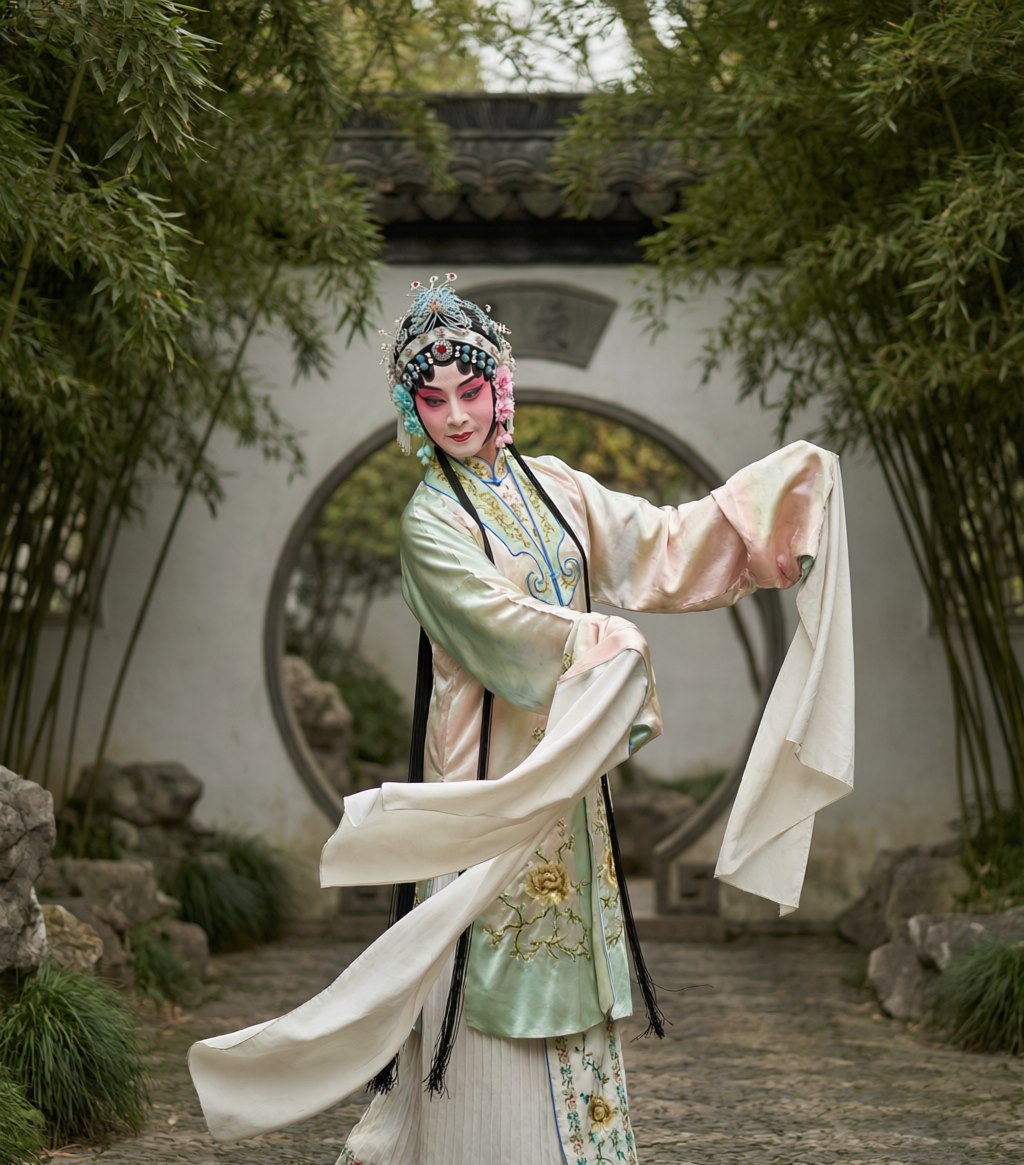
The Oldest Song Still Being Sung
If Peking Opera is the spectacular public face of Chinese theatre, Kunqu (Kunqu, 昆曲) is its refined, private soul. It is the oldest of the major operatic traditions still performed today — more than six hundred years old — and it is the form from which nearly every other Chinese opera, Peking Opera included, descended. The Chinese call it the "mother of a hundred operas" (百戏之祖, baixi zhi zu) and the "ancestor of teachers" (百戏之师). The titles are not flattery; they are genealogy. The role system, the stage vocabulary, the choreography of the sleeve and the fan, the very idea of a fully integrated sung drama — much of it was codified in Kunqu before spreading outward to the livelier, more popular forms that would follow.
To encounter Kunqu for the first time is to enter a slower world. Where Peking Opera dazzles with acrobatics and crashing gongs, Kunqu seduces with restraint. Its melodies are long, sinuous, and exquisitely ornamented. Its movements are soft, deliberate, and precise. Its language is literary, drawn from the poetry and prose of the educated elite. A single aria may unfold over many minutes, the singer shaping each syllable with a care that borders on the devotional. The effect, to a receptive listener, is hypnotic — a kind of sung calligraphy, in which the line of the melody curves and lingers like ink on paper.
For most of its history, Kunqu was the art of the literati — the scholar-officials, poets, and connoisseurs who shaped China's high culture. It was never a folk entertainment. It was composed, debated, and savored by some of the finest minds of the Ming and Qing dynasties, and it carries their values: elegance, allusion, emotional subtlety, and an abiding love of beauty tinged with melancholy. That it survives at all, after centuries of decline and a near-death experience in the twentieth century, is one of the quiet triumphs of Chinese cultural life.
From Kunshan, A Water-Mill Melody
Kunqu takes its name from Kunshan (昆山), a town near Suzhou in the Jiangnan region — the lush, canal-laced south of the Yangtze River that has long been China's heartland of wealth, scholarship, and refinement. The local singing style of this region, known as Kunshan qiang (昆山腔, the "Kunshan melody"), existed as early as the late Yuan dynasty, in the fourteenth century. But the art that we recognize as Kunqu was born in the middle of the sixteenth century, through the work of a single, obsessive musician.
His name was Wei Liangfu (魏良辅), and around the 1540s and 1550s he undertook a radical reform of the local Kunshan style. Drawing on the strengths of several rival southern singing traditions, Wei spent a decade refining the melody until it achieved an unprecedented smoothness and delicacy. The result was called the "water-mill melody" (shimo qiang, 水磨腔) — a name that captures its essence perfectly. Just as a water mill grinds grain slowly and patiently into the finest flour, Wei's reformed style ground the raw material of song into something silky, polished, and free of every rough edge. The water-mill melody is characterized by its slow, flowing tempo, its subtle ornamentation, its soft consonants, and its long, unbroken legato lines. It is, in the words of one admirer, "as smooth as if poured from a single breath."
The reform was a sensation. Kunqu spread from Kunshan to Suzhou, then to Nanjing and Beijing, and within a generation it had become the dominant theatrical form among China's educated classes. For roughly two centuries — from the late Ming through the early and middle Qing — Kunqu reigned supreme. It was the opera of the imperial court and the scholar's garden, the form performed at banquets and private gatherings, the standard against which all other theatre was measured.
The Flute Leads, The Voice Follows
The sound of Kunqu is defined by a single instrument: the bamboo flute, the dizi (笛子), and more specifically the curved qudi (曲笛) used to accompany singing. Where Peking Opera is driven by the piercing jinghu fiddle and the percussion, Kunqu is led by the mellow, breathy tone of the flute, which carries the melodic line and supports the singer with a warmth that strings alone cannot provide. The flute is joined by a small ensemble — the sheng (笙, a mouth organ of bamboo pipes), the sanxian (三弦) and pipa (琵琶) plucked lutes, and a discreet percussion section that includes the ban (clapper), which marks the beat, and small drums and gongs used with far greater restraint than in the northern operas.
The relationship between voice and flute is intimate and demanding. Kunqu singing is governed by an elaborate science of pronunciation and tonal contour. Each character is shaped according to strict rules governing its initial consonant, its vowel, and its tonal glide; the singer must articulate every syllable with a precision that preserves both its meaning and its music. The melodies themselves are organized into fixed tune patterns called qupai (曲牌, "tune labels") — hundreds of named melodic templates, each with its own mood, meter, and emotional color, into which the poet fits his words. To compose a Kunqu aria is to choose the right qupai and then to set language to it with the care of a jeweler setting stones. The result is a marriage of poetry and music so close that the two become inseparable.
Refinement in Every Gesture
Kunqu uses the same four great role types as the operas that descended from it — the male sheng (生), the female dan (旦), the painted-face jing (净), and the clown chou (丑) — but it refined them to an unusual degree of specialization. The guimendan (闺门旦), the role of the sheltered young lady of a good family, is perhaps the form's most celebrated creation: a part demanding the utmost delicacy of voice, movement, and expression, since so much of Kunqu's greatest literature turns on the inner lives of young women. The xiaosheng (小生), the young scholar, is sung in a high, clear voice that blends with the flute. The painted-face and clown roles exist, but Kunqu's genius lies elsewhere — in the lyrical, the romantic, and the psychologically subtle rather than the martial or the grotesque.
The makeup and costume of Kunqu are softer and more delicate than those of the northern operas. The painted faces are less flamboyant; the costumes, while still beautiful, favor grace over spectacle. The true ornament of Kunqu is movement itself. The form developed a highly codified system of dance and gesture in which every emotion has its physical vocabulary — the flutter of a fan, the turn of a sleeve, the lowered gaze, the measured step. In Kunqu, singing and dancing are not separate accomplishments but one continuous art: to sing an aria is to dance it, the body tracing the meaning of the words as the voice traces their melody.
"The song is the voice of the heart; the dance is the body of the song."
— A traditional Kunqu maxim on the unity of singing and movement, echoing the ancient Confucian idea that music arises from the emotions within
The Peony Pavilion: A Dream of Love
The supreme masterpiece of the Kunqu repertoire — and one of the greatest works in all of Chinese literature — is The Peony Pavilion (牡丹亭, Mudan Ting), written in 1598 by Tang Xianzu (汤显祖), the dramatist often called "the Shakespeare of the East." (The comparison is more than convenient: Tang and Shakespeare died in the same year, 1616.) The play tells the story of Du Liniang (杜丽娘), the sheltered daughter of a high official, who falls asleep in her family's garden and dreams of a young scholar she has never met. She falls so deeply in love with the dream that, on waking, she sickens and dies of longing. Her portrait, hidden in the garden, is later discovered by a real young man, Liu Mengmei (柳梦梅), who falls in love with the image — and whose devotion, in the play's most famous turn, literally brings Du Liniang back from the dead.
The Peony Pavilion is, on its surface, a love story. But it is also a philosophical argument about the power of feeling (qing, 情) — a radical claim, in the rigidly moral climate of late Ming Neo-Confucianism, that authentic emotion is a force strong enough to cross the boundary between life and death. "Love," Tang Xianzu wrote in his preface, "of which one knows not the cause, yet which goes deep — the living may die of it, and the dead may be brought back to life." The play's most celebrated scene, "The Interrupted Dream" (惊梦, Jing Meng), in which Du Liniang wanders the garden and meets her lover in sleep, is a set piece of lyrical beauty that has been performed, sung, and wept over for more than four centuries.
The Peach Blossom Fan: History as Tragedy
If The Peony Pavilion is Kunqu's great romance, The Peach Blossom Fan (桃花扇, Taohua Shan) is its great historical tragedy. Written in 1699 by Kong Shangren (孔尚任), a descendant of Confucius, the play is set during the collapse of the Ming dynasty in the 1640s. It tells the doomed love of the scholar Hou Fangyu (侯方域) and the courtesan Li Xiangjun (李香君) against the backdrop of political corruption, military defeat, and the fall of a dynasty. The fan of the title is a love token splattered with Li Xiangjun's blood — blood shed in resistance to a forced marriage — which an artist later paints into a spray of peach blossoms.
The play is remarkable for its ambition: it uses a private love story to anatomize a public catastrophe, asking how a great civilization could destroy itself from within. Its famous final image — the lovers, reunited at last, choosing to renounce the world and enter religious life rather than resume a romance stained by history — is one of the most haunting conclusions in Chinese drama. Together, The Peony Pavilion and The Peach Blossom Fan are often cited as the twin peaks of the Kunqu canon, the one a triumph of lyric imagination, the other of historical intelligence.
The Long Decline, and a Phoenix
Kunqu's reign could not last. By the eighteenth century, audiences — even educated ones — had begun to tire of its slowness and its literary difficulty. The livelier, more accessible "flowery" or "disorderly" operas (huabu, 花部), including the Anhui and Hubei troupes that would give birth to Peking Opera, drew the crowds that Kunqu, the refined "elegant" department (yabu, 雅部), was losing. The phrase "the battle of the flowery and the elegant" (花雅之争) describes this long contest, which the elegant side gradually lost. Through the nineteenth and early twentieth centuries, Kunqu contracted into a small, embattled tradition, kept alive by a handful of devoted performers and connoisseurs while the popular stage moved on.
The twentieth century nearly finished it. War, revolution, and the upheavals of the Cultural Revolution reduced Kunqu to the brink of extinction. By the 1990s, only a few hundred professional performers remained, and the art was widely regarded as a museum piece — beautiful, venerable, and dying. Then came a turning point. In 2001, UNESCO proclaimed Kunqu a Masterpiece of the Oral and Intangible Heritage of Humanity — the very first Chinese art form to receive the honor, and a moment of enormous national pride. The recognition sparked renewed government support, new funding, and a wave of public interest.
"Kunqu is not old. It is merely patient — waiting for an audience willing to slow down and listen."
— A contemporary Kunqu performer, on the art's modern revival
A Youthful Revival
The most visible symbol of Kunqu's renewal is the work of the writer and cultural patron Pai Hsien-yung (Bai Xianyong, 白先勇). In 2004, Pai produced a landmark "youth edition" (青春版) of The Peony Pavilion, staging the full fifty-five-scene play (in a condensed form) with young, beautiful performers and modern stagecraft, while insisting on absolute fidelity to the traditional singing and movement. The production was a sensation. It toured China, the United States, and Europe, and — crucially — it drew vast young audiences, many of them university students encountering Kunqu for the first time. Pai's gamble was that the art's problem was not its beauty but its accessibility: that young people, given a chance to see Kunqu performed with vitality and presented with care, would fall in love with it as readily as the scholars of the Ming had done. The packed houses and standing ovations suggested he was right.
Today Kunqu occupies a curious and hopeful position. It is no longer a mass entertainment, and it never will be again — its difficulty and its slowness guarantee that. But it is no longer dying, either. It is taught in conservatories, performed by dedicated troupes in Suzhou, Nanjing, Shanghai, and Beijing, and cherished by a growing circle of devotees who regard it as the purest expression of the Chinese aesthetic ideal. To watch Kunqu today is to participate in an act of continuity stretching back six centuries — to hear the same water-mill melody that Wei Liangfu polished in the 1550s, to watch the same garden dream that Tang Xianzu set down in 1598, to feel the same slow, aching beauty that has moved audiences across the entire span of the modern world. The mother of Chinese opera is old. She is also, against all odds, still singing.