A Different River: The Poetry of the South
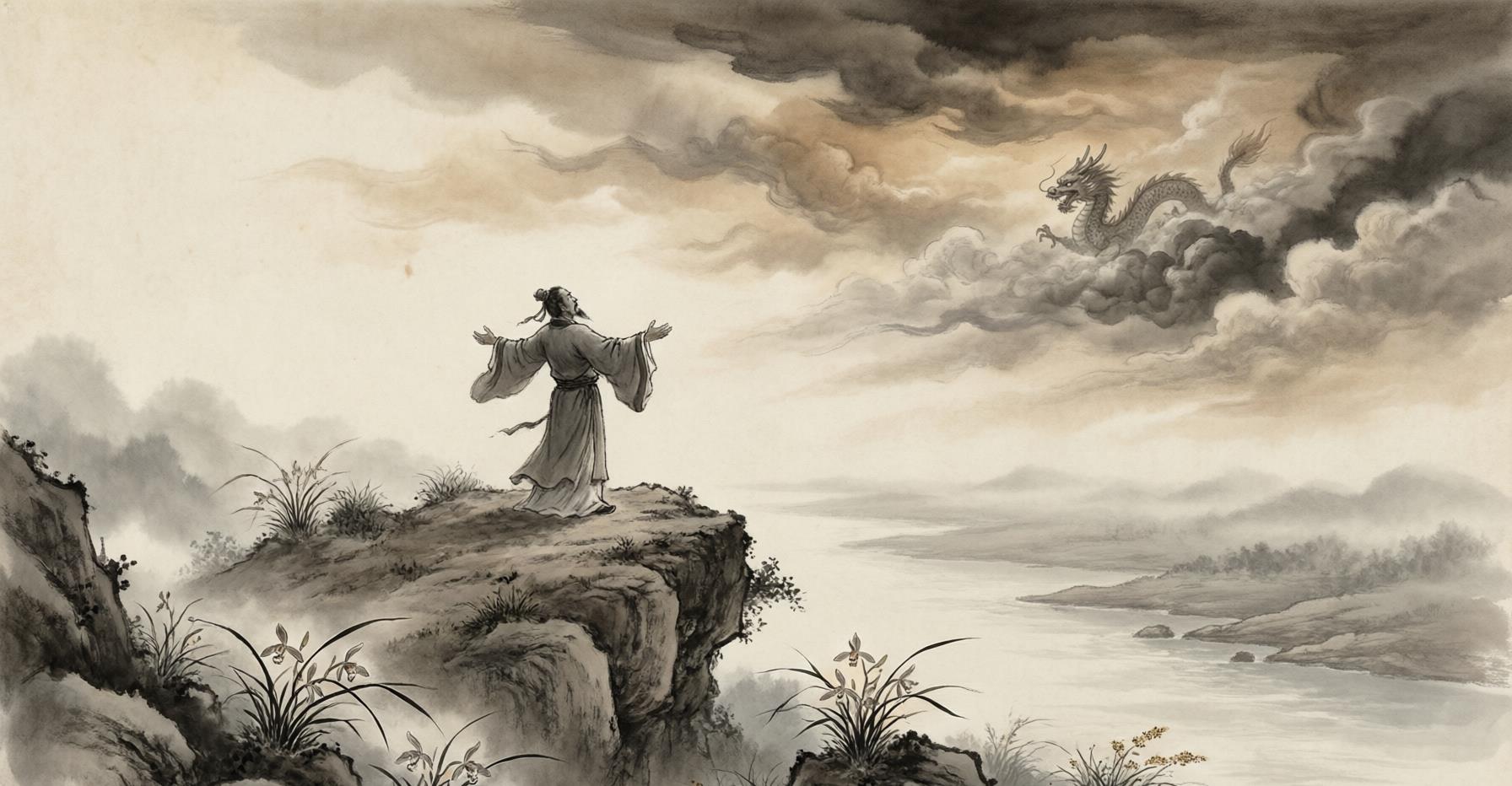
If the Book of Songs (Shijing, 诗经) is the poetry of the northern plain — millet, mulberry, riverbanks, four-square stanzas sung in chorus — then the Songs of Chu (Chu ci, 楚辞) are the poetry of the southern wilderness: jungle, marsh, orchid, and incense, chanted by a single voice working itself toward ecstasy. The two traditions are the twin sources of Chinese poetry, and they could hardly be more different. Where the northern songs are communal, restrained, and grounded in daily labor, the southern songs are individual, extravagant, and drunk on mythology. Where the Book of Songs gives you a girl waiting by the city wall, the Songs of Chu give you a poet riding a chariot of dragons to the gates of heaven, only to look down, see his homeland, and weep.
The state of Chu occupied the middle Yangtze region — roughly modern Hubei and Hunan — and to the northern states it was half-barbarian, exotic, and faintly uncanny. Chu culture was saturated with shamanism (wu, 巫): mediums who danced, sang, and entered trances to summon spirits, heal the sick, and escort souls. Its art — lacquerware swirling with dragons and phoenixes, silk paintings of otherworldly processions — has a hallucinatory quality quite unlike the sober bronzes of the north. Into this world of incense and possession was born the man who would become China's first great individual poet: Qu Yuan (屈原, c. 340–278 BCE).
Even the verse form announces the difference. The Book of Songs moves in compact four-character lines. Chu poetry stretches into long, rolling, irregular lines broken by the haunting particle xi (兮) — a kind of sung caesura, a drawn-out breath or cry that gives the lines their incantatory rhythm. Read aloud, a Chu poem does not march; it sways, like a boat on the Xiang River, or a shaman beginning to dance.
Qu Yuan: The Minister Who Would Not Bend
The life of Qu Yuan comes to us chiefly through the historian Sima Qian, who gave him a biography in the Records of the Grand Historian (Shiji, 史记) — a rare honor for a poet, and a sign of how deeply Qu Yuan's story had lodged in the Chinese imagination. According to that account, Qu Yuan was a kinsman of the royal house of Chu, a man of exceptional talent who served King Huai of Chu (楚怀王) as a trusted minister, drafting edicts and shaping policy. He was eloquent, learned, and — fatally — incorruptible.
His rivals at court, jealous of his influence, slandered him before the king. Tradition names the courtier Shangguan among them. The king, swayed, gradually estranged Qu Yuan and eventually dismissed him from office. What followed was a slow catastrophe for Chu itself. Against Qu Yuan's urgent advice, King Huai accepted an invitation to a diplomatic conference with the rival state of Qin — a trap. The Qin detained him, and he died a captive in a foreign land. Decades later, in 278 BCE, the Qin general Bai Qi captured Ying (郢), the capital of Chu. The state Qu Yuan had loved and warned was breaking apart.
Sima Qian tells us that Qu Yuan, wandering in exile by the marshes, haggard and gaunt, was asked by a fisherman why he had let himself come to such a pass. The poet's reply became one of the most quoted lines in Chinese literature: "All the world is muddy, and I alone am clean; all men are drunk, and I alone am sober" (jushi jie zhuo wo du qing, 举世皆浊我独清). He could not, he said, wash his clean body in the filth of the age. Shortly afterward — tradition places it around the time Ying fell — Qu Yuan waded into the Miluo River (汨罗江, in present-day Hunan), clasped a stone to his chest, and drowned. He had chosen, in the Chinese moral vocabulary, to be a loyal minister to the end: rejected, exiled, and unable to save his country, but unwilling to outlive its disgrace.
Li Sao: The First Great Individual Poem in Chinese
Qu Yuan's masterwork is "Encountering Sorrow" (Li Sao, 离骚) — a title Sima Qian glossed simply as "encountering grief." At 373 lines and nearly 2,500 characters, it is by far the longest single lyric of early China, and it marks a genuine watershed: the moment Chinese poetry acquires a named, individual, unmistakable self. The Book of Songs speaks with many anonymous voices; "Li Sao" speaks with one, and that voice is tormented, proud, and utterly particular.
The poem opens with a genealogy — the poet declares himself a descendant of the legendary emperor Gaoyang, born on an auspicious day, given an auspicious name — and then moves into an autobiographical allegory of rejection. The poet adorns himself with fragrant plants: orchids, angelica, autumn chrysanthemums. These are not decoration. They are emblems of cultivated virtue, and the poem's central device — what later critics would call the tradition of "fragrant plants and the beautiful woman" (xiangcao meiren, 香草美人) — reads the whole natural world as moral symbolism. To wear orchids is to be good; to be surrounded by foul weeds is to be besieged by sycophants. The fickle lord who discards the poet stands, transparently, for the king who listened to slander.
What lifts "Li Sao" beyond political complaint is its restless, searching movement. Rejected on earth, the poet takes to the sky. He harnesses dragons and phoenixes, commands the winds and the driver of the sun's chariot, and ascends toward the gates of heaven in search of a worthy mate — that is, a ruler who will recognize his worth. Again and again the quest fails. And then comes the ending, one of the most celebrated passages in the tradition: having resolved to leave the world behind, the poet looks down and sees his old country. His charioteer grieves; his horses turn homesick, curling their necks and refusing to go on.
The road is long, and far, and without end —
— Qu Yuan, "Li Sao" (路漫漫其修远兮,吾将上下而求索)
I shall search for her, high and low.
That searching line — "I shall search for her, high and low" — has been quoted by reformers, exiles, and revolutionaries for more than two thousand years. It is the cry of the principled man who will not stop looking for a world worthy of his principles, even though he knows he will not find it.
Shamans, Spirits, and the Grammar of Ecstasy
The mythological machinery of "Li Sao" is not mere literary ornament. It grows directly out of Chu shamanism, and to feel the poem's strangeness properly, you have to remember that for its first audiences these were not "images" but powers. The shaman (wu) of Chu was believed to travel in trance between the human world and the spirit world, ascending to heaven, descending to the underworld, negotiating with gods on behalf of the living. Qu Yuan's sky-journey is a literary transformation of that ritual flight: the shaman's ecstatic voyage turned into the exiled minister's allegorical quest.
The spirit world of the Songs of Chu is crowded and vivid. There is Xi He, who drives the chariot of the sun; Fei Lian, the wind god; the Thunder Lord; the Queen Mother of the West in her mountain palace. There are river gods and mountain spirits, cloud deities and the paired divinities of the Xiang. The landscape itself is alive: orchids grow on the banks, cassia perfumes the air, and the whole southern world shimmers with the presence of beings just out of sight. This is a poetry of enchantment in the literal sense — a world under a spell, where the boundary between the human and the divine is thin and constantly crossed.
The Han-dynasty commentator Wang Yi (王逸), whose edition we will meet shortly, codified the allegorical reading with almost bureaucratic thoroughness: every orchid a loyal minister, every foul weed a corrupt courtier, every beautiful woman the poet's abandoned virtue. Modern readers sometimes chafe at this system, and rightly so — it can flatten the poems' wildness into a moral code. But the allegory is genuinely there, and it is what gives the Songs of Chu their peculiar emotional charge: the sense that a very personal grief — a man's ruin — has been projected onto the entire cosmos, so that the whole mythological universe becomes the theater of one man's rejection.
The Nine Songs and the Heavenly Questions
"Li Sao" is the summit, but it is not alone. Wang Yi's anthology attributes several other major works to Qu Yuan, and together they form a small library of moods. The "Nine Songs" (Jiu Ge, 九歌) — actually eleven pieces — are the most directly shamanic. Wang Yi claims they began as crude rustic hymns sung at Chu religious festivals, which Qu Yuan, in exile, refined and rewrote. Whether or not that is literally true, they read like liturgies for a religion of extraordinary beauty. There are songs to the supreme god Dong Huang Tai Yi (东皇太一), to the cloud goddess, to the lords of fate. The two Xiang poems — "Lord of the Xiang" (Xiang Jun, 湘君) and "Lady of the Xiang" (Xiang Furen, 湘夫人) — are love songs between river deities who keep missing each other, aching with longing across the water. "The Mountain Spirit" (Shan Gui, 山鬼) paints a lonely goddess waiting in the rain for a lover who never comes. And "Hymn to the Fallen" (Guo Shang, 国殇) is a stark, drumming elegy for soldiers killed in battle — "their bodies abandoned on the plain, the road home long" — that reads like nothing else in the collection and anticipates two thousand years of Chinese war poetry.
Then there is the "Heavenly Questions" (Tian Wen, 天问), perhaps the strangest early Chinese poem of all: more than 170 questions fired at the sky, one after another, with no answers given. Who passed down the story of the ancient beginning? How was the world built? What holds up the nine layers of heaven? Why did the sage-king Yu's father fail to control the flood, and why was Yu himself transformed? The poem moves from cosmogony to myth to dynastic history, interrogating everything, and its relentless questioning has made it a favorite of modern scholars, who see in it something almost scientific — or at least profoundly skeptical — in the heart of the ancient world.
One more work deserves mention: "Summoning the Soul" (Zhao Hun, 招魂), a ritual incantation calling a wandering soul back to the body by describing the terrors of every direction of the compass and the pleasures awaiting it at home. Its authorship is disputed — some attribute it to Qu Yuan, others to his follower Song Yu (宋玉) — but its gorgeous catalogs of food, music, and beauty make it one of the great sensual poems of antiquity.
Wang Yi and the Making of the Chu Ci
The Songs of Chu did not circulate as a single book in Qu Yuan's own time. The anthology we know as the Chu ci (楚辞) was assembled centuries later, in the second century CE, by the Eastern Han scholar Wang Yi, who gathered the poems attributed to Qu Yuan and Song Yu, added Han-dynasty imitations — including pieces by the statesman Jia Yi (贾谊), whose "Lament for Qu Yuan" (Diao Qu Yuan fu, 吊屈原赋) had already enshrined the poet as the archetype of the wronged loyalist — and appended his own commentary, the Chu ci zhangju (楚辞章句, "Chapter and Verse Commentary on the Songs of Chu"). Wang Yi's edition, in seventeen chapters, is the foundation of all subsequent study. Without him, much of this literature might have scattered and been lost.
The influence began long before Wang Yi. Already in the Han dynasty, the dominant literary form — the rhapsody or "fu" (赋) — was understood to descend directly from the Songs of Chu. The historian Ban Gu traced the fu's lineage to the Book of Songs but credited Qu Yuan with expanding and transforming it. The grand descriptive rhapsodies of Sima Xiangru and others, with their catalogs of marvels and their rhetorical abundance, are inconceivable without the example of "Li Sao" and "Summoning the Soul." Indeed, "sao" (骚) became the name of a verse style in its own right — the "sao body" (sao ti, 骚体) — and for centuries critics spoke of Chinese poetry's two ancestral streams as "the Winds and the Sao" (feng sao, 风骚): the Book of Songs and the Songs of Chu, the north and the south, the chorus and the soloist.
Dragon Boats, Sticky Rice, and the Memory of a Poet
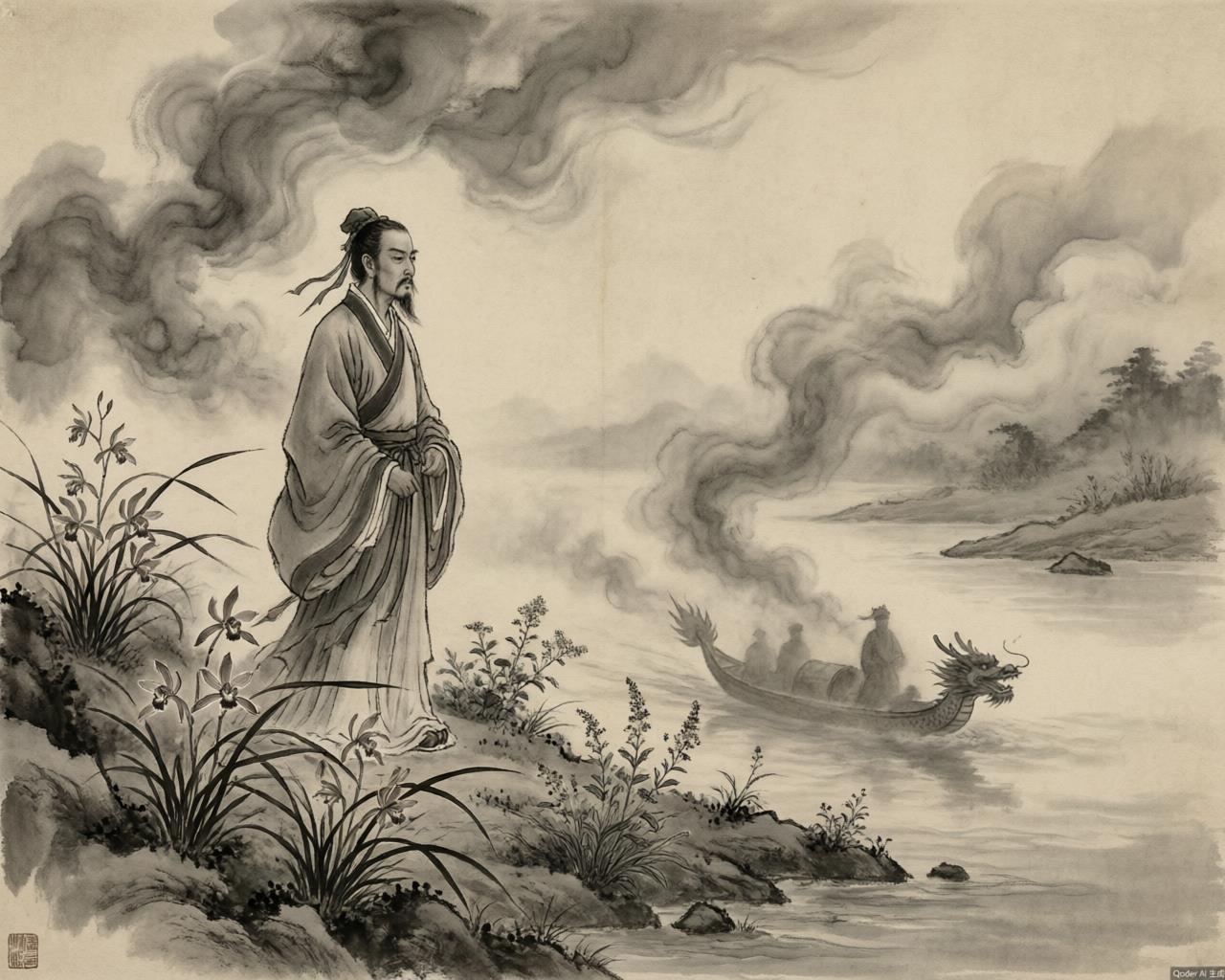
Qu Yuan's death gave China one of its most beloved festivals. The Dragon Boat Festival (Duanwu Jie, 端午节), held on the fifth day of the fifth lunar month, is popularly understood as a commemoration of the drowned poet. The legend, recorded in sources such as the sixth-century Xu Qi Xie Ji (续齐谐记) by Wu Jun, tells how the riverside villagers, hearing of Qu Yuan's suicide, raced out in their boats to save him or recover his body — the origin of dragon boat racing (sai longzhou, 赛龙舟) — and threw rice into the river to feed the fish so they would not devour him. Over time the rice was wrapped in bamboo or reed leaves, becoming the sticky-rice dumplings (zongzi, 粽子) eaten across China and the Chinese diaspora to this day.
Scholars are careful to note that the festival almost certainly predates Qu Yuan: the fifth of the fifth was already an important summer date associated with warding off illness and evil, and dragon imagery has deep roots in southern Chinese culture. The association with Qu Yuan likely attached itself to older customs. But the attachment stuck, and it is telling that it did. Of all the possible meanings a festival could carry, Chinese culture chose to anchor this one to the memory of a poet who loved his country too much to survive its fall. In 2009, the Duanwu Festival was inscribed on UNESCO's Representative List of the Intangible Cultural Heritage of Humanity — a global recognition of a tradition that began, in popular memory, with villagers rowing desperately after a drowning man.
Every year, when teams strain over the drums and families unwrap the leaves from warm, glutinous rice, the story is retold. It is one of the most remarkable afterlives in literary history: a third-century-BCE minister, failed in politics and victorious in art, commemorated not by a statue or a tomb but by a nation racing boats and eating together. Few poets have been so thoroughly absorbed into the calendar of a civilization.
The Long Echo: From the Fu to the Modern Age
The Songs of Chu never stopped echoing. Through the Han fu and the lyric poetry of the Six Dynasties, the tradition of "fragrant plants and the beautiful woman" remained the standard vocabulary for writing about loyalty, rejection, and the search for an understanding patron. The Tang poet Li He, with his demon-haunted imagination and shamanic intensity, is often read as a direct heir of the Chu sensibility; Li Bai's journey poems and his sense of the solitary, heaven-seeking self owe an obvious debt to "Li Sao." The image of the poet as exile — principled, misunderstood, wandering, singing — is essentially Qu Yuan's invention, and it became one of the central self-portraits available to Chinese writers for the next two millennia.
Sima Qian, who first told Qu Yuan's story, closed his biography with a judgment that has itself become canonical. Assessing the poet's refusal to compromise, the historian wrote that such a spirit "might vie for brilliance with the sun and moon" (tui ci zhi ye, sui yu ri yue zheng guang ke ye, 推此志也,虽与日月争光可也). It is a measure of Qu Yuan's stature that the father of Chinese history reached for the sun and the moon and found them an adequate comparison.
Judging by such a spirit, he might well vie for brilliance with the sun and the moon.
— Sima Qian, Records of the Grand Historian, on Qu Yuan
The echo reaches into modernity. When Lu Xun (鲁迅), the great twentieth-century writer, published his second story collection Wandering (Panghuang, 彷徨) in 1926, he set lines from "Li Sao" as its epigraph: "The road is long, and far, and without end — I shall search for her, high and low." A reformer writing in a broken, modernizing China reached across two thousand years to the voice of an exiled minister and found it exactly adequate to his own moment. That is the test of a classic, and the Songs of Chu pass it. The Book of Songs gave Chinese poetry its chorus, its ethics, and its habit of grounding feeling in the physical world. The Songs of Chu gave it the solitary self, the mythic imagination, and the figure of the poet as the conscience that will not bend. Between those two rivers — the Yellow River of the north and the Yangtze of the south — the whole of Chinese literature has flowed ever since.