Three Thousand Years, Three Hundred Poems
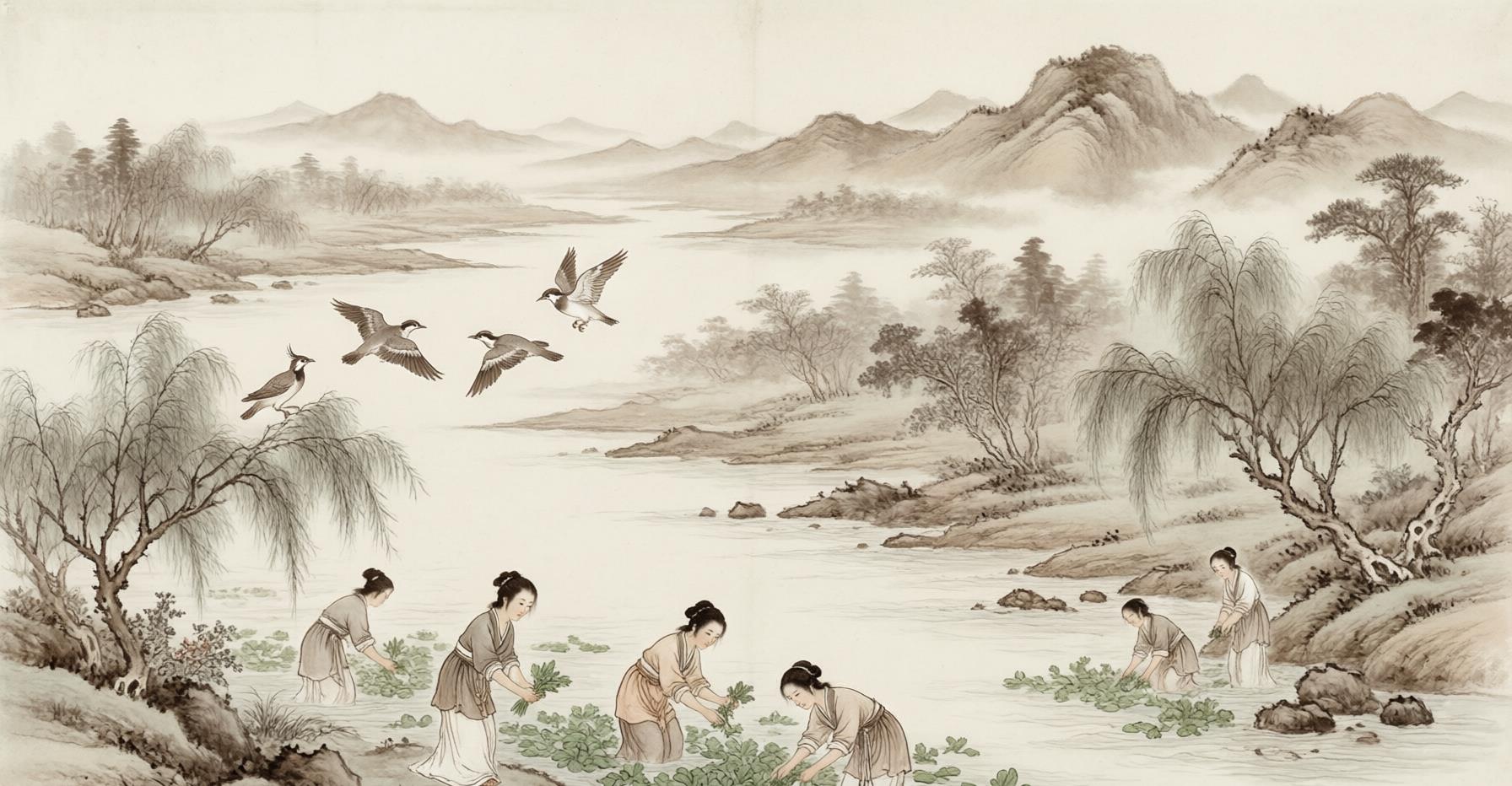
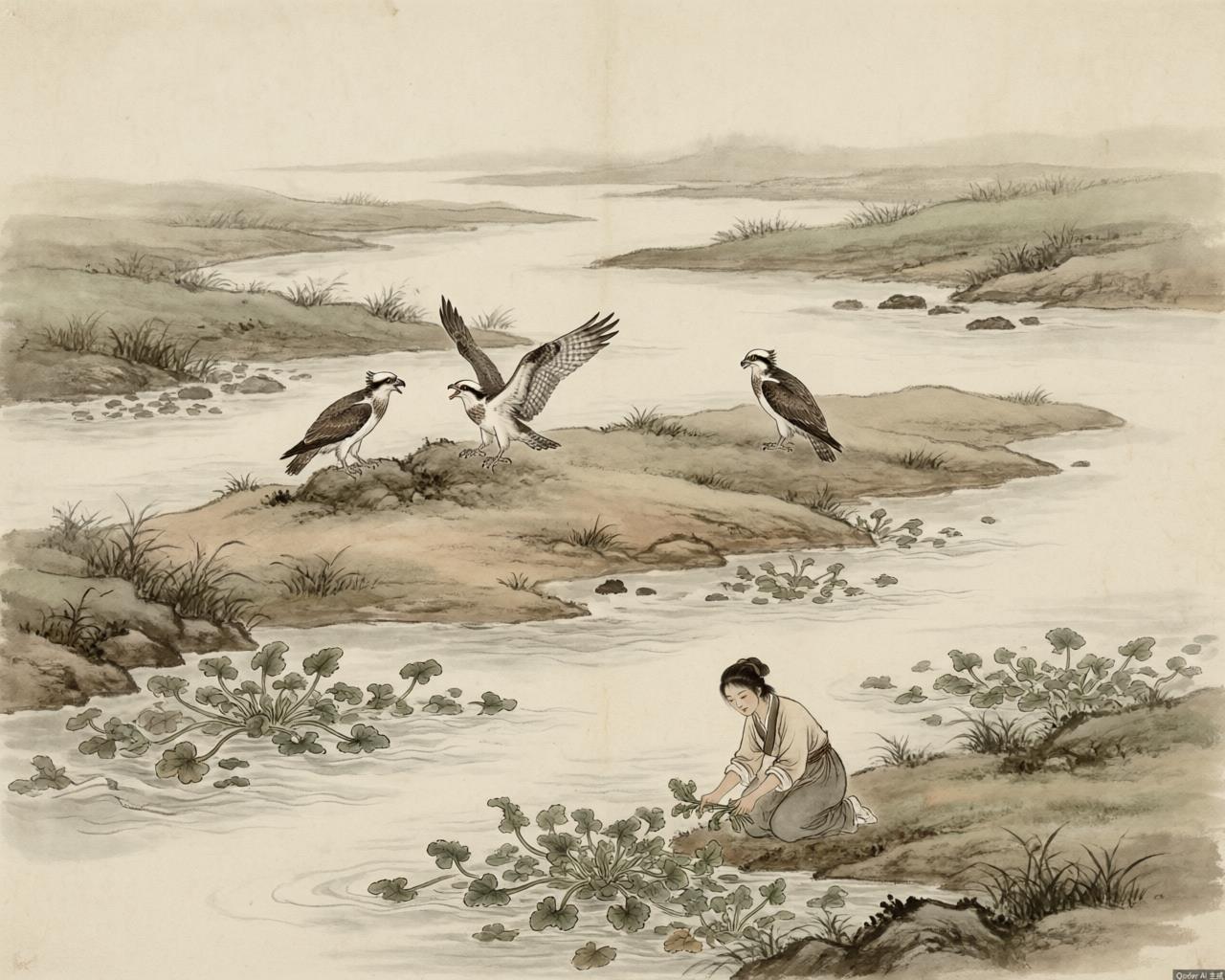
Somewhere in northern China, roughly twenty-seven centuries ago, a young man stood on a riverbank watching a pair of fish hawks call to one another from a sandbar. He was thinking about a girl. The short song he made from that idle afternoon — four stanzas, a refrain of bird cries, an ache of unrequited longing — still opens every edition of the oldest surviving poetry anthology in China, and one of the oldest anywhere in the world. It is a charming thing to reflect on: the front door of an entire literary civilization is a love poem.
That anthology is the Book of Songs (Shijing, 诗经), a collection of 305 poems composed, in their earliest forms, between roughly the eleventh and the seventh centuries BCE — spanning the Western Zhou dynasty and bleeding into the Spring and Autumn period. For most of its life it was not called a "classic" at all. People referred to it simply as "the Poetry" (Shi, 诗) or, affectionately, "the Three Hundred" (Shi san bai, 诗三百). The honorific jing (经) — "classic," "scripture," "warp-thread of the canon" — was stitched onto its name only later, once Confucianism had adopted the book as one of its foundational texts. By then the poems had already been sung, quoted, argued over, and diplomatically weaponized for half a millennium.
What strikes a first-time reader is how un-ancient the best of these poems feel. There is very little that feels carved-in-stone about a young woman cursing a lover who has stopped writing, or a conscripted soldier counting the seasons away from home, or a farmer watching the first frost and calculating how much millet is left to cut. The Book of Songs survives because it was preserved by scholars, but it lives because it was made by ordinary voices: men and women working, wanting, complaining, and celebrating in a world of millet fields, mulberry groves, and slow rivers. Everything that comes after in Chinese poetry — the regulated verse of the Tang, the song lyrics of the Song, the rhapsodies of the Han — grows out of this soil.
What the Anthology Contains: Airs, Odes, and Hymns
The 305 poems are sorted into three broad categories, and understanding the sorting is half the battle. The largest section is the "Airs of the States" (Guofeng, 国风): 160 poems grouped under the names of fifteen regions, the so-called "Airs of the Fifteen States" (Shiwu Guofeng, 十五国风). These are the folk songs and regional lyrics — the section where the love poems, the field songs, and the bitter complaints live. Tradition holds that Zhou officials were sent out to collect these songs from the countryside as a kind of intelligence-gathering on popular morale: let the people sing, and you will know how they are governed.
The second category is the "Odes" (Ya, 雅), divided into the "Lesser Odes" (Xiaoya, 小雅, 74 poems) and the "Greater Odes" (Daya, 大雅, 31 poems). These are court poems — pieces for aristocratic banquets, assemblies, and campaigns, many of them recounting the founding legends of the Zhou house. The Greater Odes in particular contain some of the dynasty's foundation mythology, hymns to kings Wen and Wu and the long labor of building a civilization out of the Wei River valley.
The third and smallest category is the "Hymns" (Song, 颂): 40 solemn ritual pieces — 31 "Hymns of Zhou," 4 "Hymns of Lu," and 5 "Hymns of Shang." These accompanied sacrificial dances in ancestral temples, honoring the dynastic founders and the spirits of the royal dead. They are the oldest layer of the collection, some likely dating to the early Western Zhou, and also the most opaque to modern readers: short, dense, ritualistic, and originally inseparable from music and choreography that have been lost for more than two thousand years.
Read in this order — Airs, Odes, Hymns — the anthology moves from the intimate to the imperial, from a girl waiting for her lover by the city wall to the king making offerings to his ancestors. That arc, from the personal to the cosmic, is not accidental. It is, in miniature, the whole moral argument of Confucianism: good government begins with well-ordered feeling.
The Six Principles: How the Songs Work
Chinese critics eventually developed a vocabulary for what the Book of Songs actually does. The famous formulation is the "Six Principles" (liu yi, 六义), laid out in the "Great Preface" (Daxu, 大序) attached to the Han-dynasty Mao commentary on the text. Three of the principles are the categories we have just met — feng (风, airs), ya (雅, odes), and song (颂, hymns). The other three are techniques, and they became the basic toolkit of Chinese poetics for the next two millennia.
The first technique is fu (赋), "exposition" or "direct narration" — simply saying the thing, laying out events and feelings plainly. The second is bi (比), "comparison" — explicit metaphor, as when the poem "Big Rat" (Shuo Shu, 硕鼠) addresses a grasping landlord as a rodent gobbling millet. The third, and the most characteristically Chinese, is xing (兴), usually translated as "evocation" or "stimulus." Xing is the opening image that triggers the poem without quite explaining it: the ospreys cry on the sandbar, and somehow this opens the door to a young man's longing. The connection is felt rather than argued. Western poetry has its analogues, but xing as a named, theorized device — the art of beginning with the natural world and letting it set the emotional key — is one of the great distinctive contributions of the Book of Songs to world literature.
These three techniques are not trivia for exam candidates. They describe a genuine fork in the road. A poet can state ("I am lonely"), compare ("my loneliness is a locked gate"), or evoke ("the wild geese pass south, crying"). The Book of Songs prefers the third path, and Chinese poetry never entirely abandoned it. When a Tang poet opens with a scene of moonlight on an empty courtyard before confessing homesickness, he is working in the tradition of xing — whether he knows the term or not.
Confucius and the Making of a Classic
No account of the Book of Songs gets far without Confucius (Kongzi, 孔子, 551–479 BCE). The traditional story, recorded by the historian Sima Qian some four centuries later, is that Confucius personally winnowed the poems down from an original corpus of more than three thousand to the canonical 305, discarding duplicates and keeping only what was morally sound. Modern scholars debate this vigorously. The number "three thousand" is suspiciously round, and the Zuo Commentary (Zuo Zhuan, 左传) suggests that a repertoire close to our present collection was already in circulation during Confucius's own lifetime. It is safer to say that Confucius did not so much compile the Songs as consecrate them.
What is beyond dispute is that he loved the book and taught from it constantly. In the Analects (Lunyu, 论语) he sums up the entire anthology in a single verdict: "The Songs number three hundred, but one phrase can cover them all — 'having no depraved thoughts'" (si wu xie, 思无邪). Elsewhere he insists that his students study the poems, because poetry "can stimulate, can help you observe, can bring people together, and can give voice to resentment" (xing, guan, qun, yuan, 兴观群怨) — a four-part defense of literature that is still quoted in Chinese classrooms today. He even claimed a personal hand in the text's musical order: "After I returned from Wei to Lu, the music was set right, and the Odes and Hymns each found their proper place."
"The Master said: The Songs number three hundred, but one phrase can cover them all — having no depraved thoughts."
— Confucius, Analects 2.2
This Confucian embrace was a double-edged gift. It guaranteed the book's survival — the Songs became one of the Five Classics (Wu Jing, 五经) of the Confucian canon — but it also buried many of the poems under mountains of moral interpretation. The Han-dynasty Mao commentary (Mao Shi, 毛诗), whose prefaces were traditionally attributed to Confucius's disciple Zixia, read innocent love songs as allegories of ministerial loyalty and wifely virtue. For two thousand years, readers met the Book of Songs through these interpretive filters. Part of the modern pleasure of the text is peeling them back and hearing the original voices again.
Love on the Riverbank: The Poems of the Heart
That the anthology opens with "Guan Ju" (关雎, "Guan Guan Cry the Ospreys") is no accident of arrangement. Whoever ordered the collection placed a love poem first, and the choice has been debated ever since. The Mao preface insists it celebrates the non-jealous virtue of Queen Taisi, consort of King Wen — a model of harmonious marriage on which good government depends. Most modern readers, unburdened by Han exegesis, simply read it as what it appears to be: a young man's restless longing for a woman he cannot stop thinking about, tossing and turning through the night, imagining their wedding with bells and drums.
Guan guan cry the ospreys,
— "Guan Ju," opening of the Book of Songs (trans. James Legge)
On the islet in the river.
The modest, retiring, virtuous young lady —
For our prince a good mate she.
The love poems of the Airs are remarkably frank, especially those attributed to the states of Zheng and Wei. In "The Quiet Girl" (Jing Nü, 静女), a young woman arranges to meet her lover by the city wall, then hides and watches him scratch his head in confusion; she gives him a blade of red grass, which he treasures absurdly because it came from her. In "The Plums Are Falling" (Biao You Mei, 摽有梅), a woman watches fruit drop from the trees and counts her own passing youth, urging her suitors to come now, before the basket is empty. There is no Victorian prudery here, and very little of the Confucian moralizing later readers tried to impose. Confucius himself is said to have disliked the "licentious music of Zheng," yet the Zheng airs remain in the collection — evidence, perhaps, that even the editor's taste could not override the anthology's honesty.
What unites these poems is their concreteness. Feelings arrive attached to things: ospreys, duckweed, a jade pendant, a gate tower, the third month when the mulberry leaves are thick enough to hide a rendezvous. This fusion of emotion and landscape — feeling through the physical world rather than in abstraction from it — is arguably the single most important inheritance the Book of Songs bequeathed to Chinese lyric poetry.
Millet, Mulberry, and Complaint: The Poems of the Field
Love is only half the anthology. The other half is work — and the injustice of work. The longest poem in the Airs, "The Seventh Month" (Qi Yue, 七月, from the Airs of Bin), is a farmer's almanac rendered into verse, moving month by month through a year of unrelenting labor: cracking ice in the first month, tending silkworms in the third, harvesting in the eighth, hunting foxes in the eleventh for the lord's fur coat, and ending the year by raising horns of wine and crying, "Ten thousand years! Long life without end!" (wan shou wu jiang, 万寿无疆). It is one of the oldest sustained pictures of agricultural life anywhere in world literature, and its quiet detail — the women afraid their lord's sons will carry them off, the farmer mending his roof at year's end before starting all over again — carries more weight than any sermon.
Then there are the poems of open complaint, which are more startling still. "Cutting the Sandalwood" (Fa Tan, 伐檀) shows men hewing timber by the river and asking, with magnificent bluntness, why their lord reaps what he has not sown and eats what he has not hunted. "Big Rat" (Shuo Shu, 硕鼠) goes further, addressing the landlord as a parasite and declaring the tenants' intention to leave for a "happy land" (le tu, 乐土) where they will be treated as human beings. These are among the earliest poems of social protest in any literary tradition, and they established a precedent — poetry as the voice of the wronged — that Chinese writers have invoked ever since. The "Great Preface" gave the theory its classic formulation: when good government fails, the people's suffering finds voice in song, and wise rulers listen.
Reciting Songs to Speak Your Mind
To understand what the Book of Songs meant in its own age, you have to grasp that it was not, primarily, a book to be read silently. It was a repertoire to be sung, performed, and — most remarkably — quoted as a form of speech. Every one of the 305 poems was originally set to music; the loss of those musical settings is a large part of why the ritual Hymns feel so remote today. But even as the melodies faded, the words kept a strange social power.
The Zuo Commentary, the great chronicle of the Spring and Autumn period, records envoy after envoy at diplomatic banquets "reciting songs to express their intent" (fu shi yan zhi, 赋诗言志). A visiting minister could quote a stanza from the Airs and everyone in the hall would understand the proposal — an alliance offered, a rebuke administered, a refusal delivered with perfect courtesy — without a direct word being spoken. To misquote, or to quote ineptly, was a diplomatic disaster. This was literature as a shared code among the educated elite, a common currency of allusion that bound the warring states into a single cultural world even as their armies fought.
Confucius understood this social function perfectly. "Without learning the Songs," he told his son, "one has nothing to stand on" — or, in another rendering, "one cannot speak" (bu xue shi, wu yi yan, 不学诗,无以言). The Songs were not decoration for a gentleman; they were the medium in which a gentleman conducted his life. It is difficult to think of another literary collection in world history that carried quite this weight: part scripture, part songbook, part diplomatic handbook, part moral compass.
The Long Shadow: How the Shijing Made Chinese Poetry
The Book of Songs did not merely precede Chinese poetry; it defined the terms on which all later poetry would be judged. The "Great Preface" offered the formulation that became the foundation of Chinese poetics: "Poetry is where the intent goes — in the heart it is intent, expressed in words it becomes poetry" (shi zhe, zhi zhi suo zhi ye, 诗者,志之所之也). The idea that poetry "expresses the intent" (shi yan zhi, 诗言志) — a phrase older still, traced to the Book of Documents — remains the default Chinese account of what a poem is for, and it descends directly from the way the Songs were used.
Every subsequent movement defined itself in relation to the anthology. The Han-dynasty Music Bureau (Yuefu, 乐府) collected folk songs in conscious imitation of the old Zhou practice, and its ballads claim the Airs as their ancestors. When the Six Dynasties and early Tang courts grew drunk on ornate, decorative verse, reformers called for a return to "wind and bone" (feng gu, 风骨) — the moral seriousness and structural strength they associated with the Airs. The Tang poet Chen Zi'ang lamented that the true tradition had gone silent; Li Bai opened his great "Ancient Style" (Gufeng, 古风) sequence with the mournful line, "Long have the Greater Odes ceased to be made" (Daya jiu bu zuo, 大雅久不作). Even Du Fu's compassion for the conscripted and the starving is, in spirit, an heir of "Big Rat" and "Cutting the Sandalwood."
Today the Book of Songs sits in an unusual position: a Confucian scripture that is also a book of songs, a ritual classic that is also a collection of gossip and heartbreak. Schoolchildren in China still memorize "Guan Ju" as their first encounter with the tradition. Scholars still argue about whether the Mao commentators were guardians or jailers of the text. And the poems themselves, unbothered by any of it, go on doing what they have done for twenty-seven centuries — making a riverbank, a rat, a falling plum, or a cry of ospreys carry the full weight of a human heart. Every Chinese poem written since has been, in some sense, a reply.