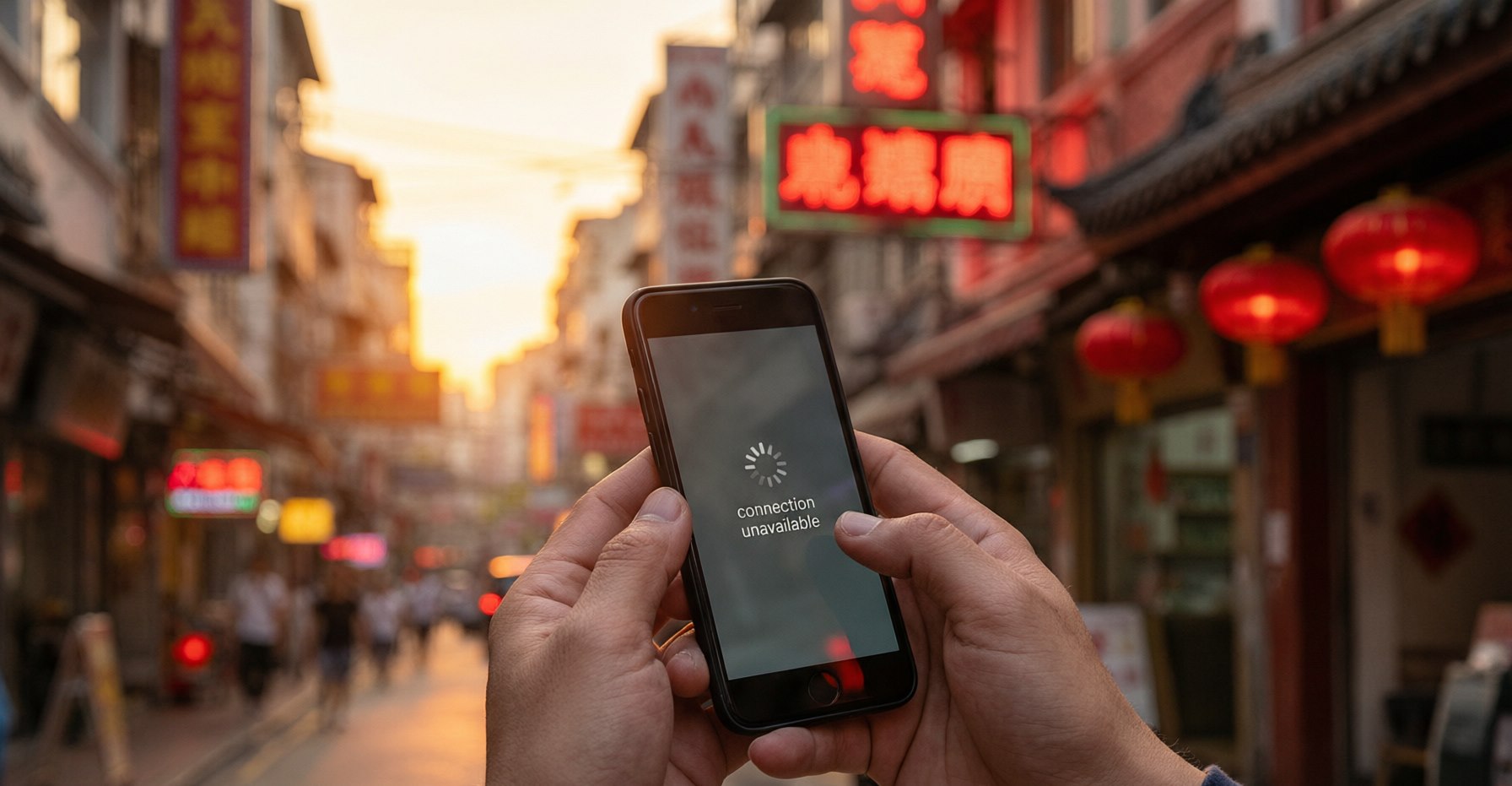
The first thing most travelers notice when they land in China is not the skyline, the food, or the bullet trains. It's the silence where Google used to be. You connect to the airport WiFi, open your phone out of habit, and discover that Gmail won't load, Maps spins forever, and WhatsApp simply refuses to connect. This is your introduction to the Great Firewall — and it is not a glitch, not a temporary outage, and not something that will fix itself if you wait. It is the defining fact of digital life in China, and understanding it before you arrive is the difference between a smooth trip and a week of quiet frustration.
Here's the reassuring part: millions of foreigners travel, work, and live in China every year, and they stay connected just fine. The trick is not to fight the local internet but to understand it and lean into the remarkably capable ecosystem that has grown up in its place. This guide explains what's blocked, what still works, and the three practical options for keeping your phone useful from the moment you step off the plane.
What the Great Firewall Actually Is
The Great Firewall (known in Chinese as the Jīnqiáng, 金墙, or more commonly the GFW) is the informal name for China's system of internet censorship and filtering. It operates at the level of the country's international network gateways, which means the filtering happens before traffic ever reaches your device. The result is that blocked services don't load slowly or intermittently — they simply do not load at all, on any network, in any city, at any hour.
This is not a hotel problem. A common misconception is that censorship is patchy — that switching from WiFi to a local SIM, or moving from a hotel to a café, will somehow get around it. It won't. The filtering is applied uniformly across hotel WiFi, airport lounges, café networks, and the cellular data of all three major carriers. There is no "unfiltered" Chinese network to find.
What Is Blocked vs. What Works
Knowing the lay of the land lets you plan around it rather than discover each gap the hard way. Here is a practical overview of what you can and cannot reach on a standard Chinese connection.
Blocked entirely: Google and its entire family of services — Search, Maps, Gmail, Drive, YouTube, and the Play Store. Also blocked: Facebook, Instagram, WhatsApp, Twitter/X, Telegram, and most major Western social media and news outlets. If a service is your daily driver back home, assume it is blocked until you confirm otherwise.
Works without issue: The entire Chinese internet, which is vast and mature. Apple services (iCloud, the App Store, Apple Maps) generally function, and international airline and hotel booking sites usually load. Critically, the domestic apps that replace the blocked Western ones work flawlessly — they were built for this environment from the ground up.
Option 1: Embrace the Chinese Ecosystem (Recommended for Most)
The single most effective strategy is also the least discussed in Western travel forums: stop trying to use the apps you know, and adopt the Chinese equivalents. They are not consolation prizes. In many cases they are genuinely better, more deeply integrated into daily life than anything you use at home.
Baidu Maps (百度地图) replaces Google Maps, and for navigating China it is the superior tool. Its local data is more current, its transit routing more precise, and its points of interest far more complete than anything Google offered for Chinese cities. The interface is in Chinese, but the icons and map logic are intuitive, and you can search by pasting Chinese addresses saved in advance.
WeChat (微信) replaces WhatsApp, Messenger, and roughly half a dozen other apps besides. It is how Chinese people message, call, pay, book, and share — and you will need it for an enormous range of everyday tasks, from scanning QR-code menus to paying street vendors. Bilibili (哔哩哔哩) fills the role YouTube plays elsewhere, while Dianping (大众点评) is the definitive restaurant and business review platform, doing the job of Yelp and TripAdvisor combined. You will end up installing these regardless; installing them deliberately, before you need them, simply removes the friction.
Option 2: A Local SIM Card or eSIM
Data connectivity is a separate question from censorship — even with the GFW in place, you still need a working data connection to use the Chinese apps at all. The cleanest solution is a local SIM.
Buying at the airport: At the major international airports — Beijing, Shanghai, Guangzhou, and Shenzhen — you'll find service counters for China's three carriers, China Mobile (中国移动), China Unicom (中国联通), and China Telecom (中国电信), in the arrivals hall. A tourist SIM typically offers 20 to 40 GB of data over 30 days for roughly 100 to 200 RMB, and you'll need your passport to register it. The process takes about fifteen minutes.
Why the local number matters: Beyond data, a Chinese phone number is quietly essential. App registrations, public WiFi logins, and verification codes often require a domestic number, and a foreign number frequently won't receive the SMS code you need — locking you out at the worst moment. The SIM solves this in one stroke.
The eSIM alternative: Providers such as Airalo and Holafly sell China data plans you can purchase and activate before leaving home, which is convenient and skips the airport queue. Because these plans often route through international roaming, they may partially bypass the Great Firewall for some services — but this is inconsistent and never guaranteed. Treat an eSIM as a convenient way to get data quickly, not as a reliable censorship workaround.
Option 3: The VPN Question
A Virtual Private Network encrypts your traffic and routes it through a server outside China, which in principle lets you reach blocked services like Gmail and WhatsApp. In practice, it is the least dependable of the three options, and it deserves an honest assessment.
The legal landscape: Chinese regulations require VPN services to be government-approved, and unapproved ones are periodically blocked. Enforcement against ordinary tourists, however, is virtually nonexistent — authorities are not interested in a visitor checking email. The real concern is not legal risk but reliability: connections are unstable, speeds drop noticeably, and access can disappear entirely during sensitive periods.
Set it up before you arrive. This is the single most important piece of VPN advice. You generally cannot download VPN apps from Chinese app stores once you're in the country, and the providers' own websites are often blocked. Install and test it at home, while you still can, and bring two different services as backups — when one stops connecting, the other often still works. Keep expectations modest: a VPN is best understood as an occasional lifeline for a quick Gmail check, not a primary way to stay online.
Recommended setup: Buy a local SIM on arrival for reliable data and a Chinese number. Before your trip, at home, install WeChat, Alipay, Baidu Maps, and Pleco. Set up a VPN as a backup for the occasional Gmail session, and bring a second one just in case. Then plan, genuinely, to live inside the Chinese app ecosystem. Most travelers find they've fully adapted within 48 hours — and many never miss the apps they left behind.
A Realistic First-Day Connectivity Plan
Pull the threads together and the ideal first day looks like this. You land, clear immigration, and walk to the carrier counter in arrivals, where you present your passport and leave fifteen minutes later with a working SIM and a Chinese number. You open WeChat and message your hotel that you're on the way, then check Baidu Maps on the train into the city. That evening, you scan a QR-code menu at a neighborhood restaurant, order with a few taps, and pay through Alipay without speaking a word of Mandarin.
Notice what's absent from that day: any attempt to load Google, any frustration, any sense of being cut off. The Great Firewall is real and non-negotiable. But it stops being an obstacle the moment you stop measuring China's internet against the one you left behind and start using the one in front of you. Prepare at home, buy a SIM on arrival, and let the local ecosystem carry you — you'll be surprised how quickly it feels like second nature.