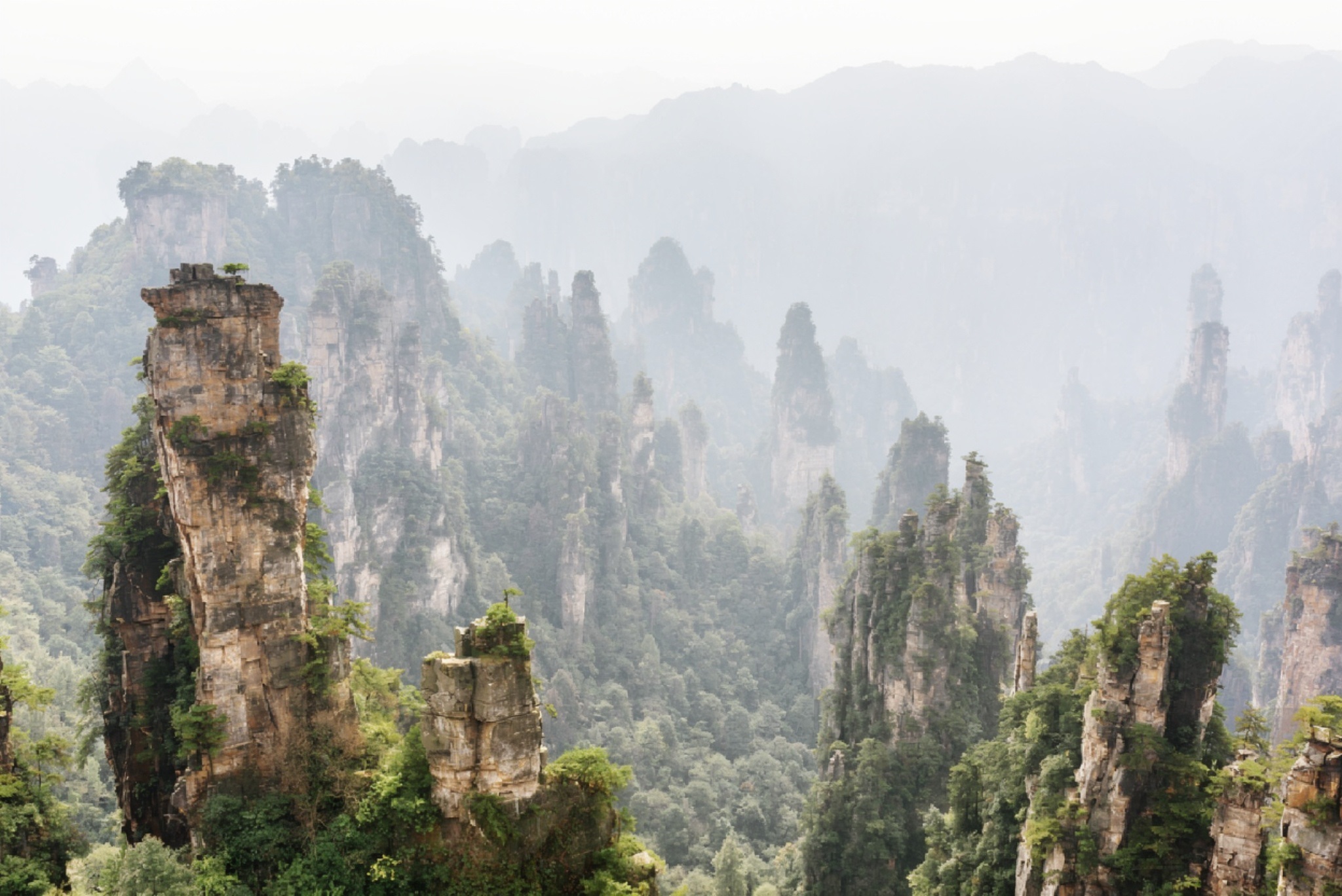
Dawn arrives in Zhangjiajie not as a breaking of light but as a slow exhalation. The mist rises from the valley floor like breath from sleeping giants, curling around the bases of three thousand stone pillars until the entire forest appears to float, untethered from the earth. You stand at the edge of a cliff, your fingers cold on the railing, and watch as the first pale suggestion of sun ignites the cloud layer from beneath — and suddenly the pillars are islands, suspended in a luminous white sea, their crowns of ancient pine dark against the brightening sky. The silence is absolute except for the distant cry of a macaque and the soft percussion of water somewhere far below, carving stone as it has done for longer than memory.
This is the moment that undoes you. This is the moment when the landscape stops being scenery and becomes something closer to a spiritual encounter — when you understand, viscerally, why Chinese painters spent a thousand years trying to capture exactly this arrangement of void and form, mist and stone, the seen and the withheld. Zhangjiajie does not resemble the world you know. It resembles the world as imagined by a poet who has glimpsed the architecture of heaven and returned, breathless, to describe what he saw.
A Landscape 380 Million Years in the Making
To comprehend what you are looking at, you must first abandon human timescales. The quartz sandstone that forms Zhangjiajie's pillars was laid down during the Devonian period, roughly 380 million years ago, when this region of what is now Hunan Province lay beneath a shallow tropical sea. Layers of quartz-rich sediment accumulated over millions of years, compressed and cemented into a rock of extraordinary hardness and purity — over ninety percent quartz in many formations, giving the stone its pale, almost luminous quality in certain light.
Then the sea retreated. Tectonic forces lifted the seabed into a plateau, and the slow patient work of erosion began. Water found fractures in the rock. Ice expanded within those fractures during countless winter cycles, prying the stone apart grain by grain, crack by crack. Rivers carved the valleys deeper. Rain dissolved the weaker cementing material between the quartz grains. Over tens of millions of years, a continuous plateau was dissected into more than three thousand individual pillars and peaks, some rising over two hundred meters from the valley floor — slender, vertical, impossibly narrow, crowned with vegetation that clings to bare rock with roots that have been gripping stone for centuries.
What makes Zhangjiajie geologically singular is the combination of factors: the exceptional hardness and vertical jointing of the quartz sandstone, the humid subtropical climate that sustains both chemical and physical weathering, and the dense network of streams that continue to undercut and isolate the pillars. Nowhere else on Earth does this particular convergence produce so many freestanding columns of such height and slenderness. The result is a landscape that appears to defy gravity — stone trunks rising like the columns of a drowned cathedral, their bases lost in cloud, their summits hosting entire miniature ecosystems of moss, fern, and wind-shaped pine.
"The mountains are not merely high; they are alive. The clouds do not merely pass; they dwell. In the space between stone and sky, the spirit finds its true dwelling place."
— Attributed to Wang Wei (王维), Tang Dynasty poet and painter
The Avatar Connection
In 2008, a team of production designers working for director James Cameron traveled to Zhangjiajie as part of the visual research for what would become the highest-grossing film in history. They photographed the pillars of the Yuanjiajie scenic area extensively — the narrow spires wrapped in cloud, the way the formations seemed to hover disconnected from the ground when mist filled the valleys below. When Avatar premiered in December 2009, audiences worldwide gasped at the floating Hallelujah Mountains of Pandora. What many did not realize was that they were looking at Zhangjiajie, translated into light and pixels but unmistakable in its essential geometry.
The connection was made official in January 2010, when local authorities renamed the park's most iconic formation — the 1,080-meter Southern Sky Column (南天一柱) — as "Avatar Hallelujah Mountain." The rebranding was shrewd. International tourism to Zhangjiajie surged. Visitors who had never heard of Hunan Province, who could not have found it on a map, suddenly wanted to stand where Cameron's artists had stood and look out at the same impossible skyline. The film gave the world a vocabulary for what Chinese poets and painters had known for centuries: that this landscape belongs more to dreams than to geography.
Walking Among Giants: The Forest Park Experience
Zhangjiajie National Forest Park — China's first national forest park, established in 1982 — sprawls across 4,810 hectares and contains several distinct scenic areas, each with its own character. Yuanjiajie, the area most associated with Avatar, offers the most dramatic concentration of pillars: a forest of stone viewed from cliff-edge platforms that seem to project into empty air. The First Bridge Under Heaven, a natural stone arch spanning two peaks, feels like a crossing between worlds.
Tianzi Mountain (天子山), the "Son of Heaven Mountain," provides broader panoramas — vast amphitheaters of peaks stretching to the horizon, their forms shifting with every change in light and weather. In the early morning, when cloud fills the valleys and only the upper portions of the pillars remain visible, the effect is of an archipelago in a white ocean, and the old name for the phenomenon — yunhai, the sea of clouds — feels entirely literal.
Below the peaks, the Golden Whip Stream (金鞭溪) traces a seven-kilometer course through a narrow gorge, its waters so clear that every pebble on the bed is visible, its banks shaded by maple and metasequoia. Walking its flat trail, looking up at the pillars from below, you feel the full vertigo of their height — two hundred meters of vertical stone rising on either side, striped with the green of clinging vegetation, streaked with the dark lines of water seepage.
To ascend, visitors have options that would have seemed fantastical a generation ago. The Bailong Elevator (百龙天梯), bolted to the face of a cliff, rises 326 meters in under two minutes — the world's tallest outdoor lift, its glass walls offering a vertiginous panorama as the valley floor drops away. Cable cars glide silently above the canopy. Cliff-hugging walkways, carved into the rock face and fitted with steel railings, allow you to traverse the mountainsides at heights that make the stomach clench and the spirit soar in equal measure.
The Glass Bridge and Canyon Thrills
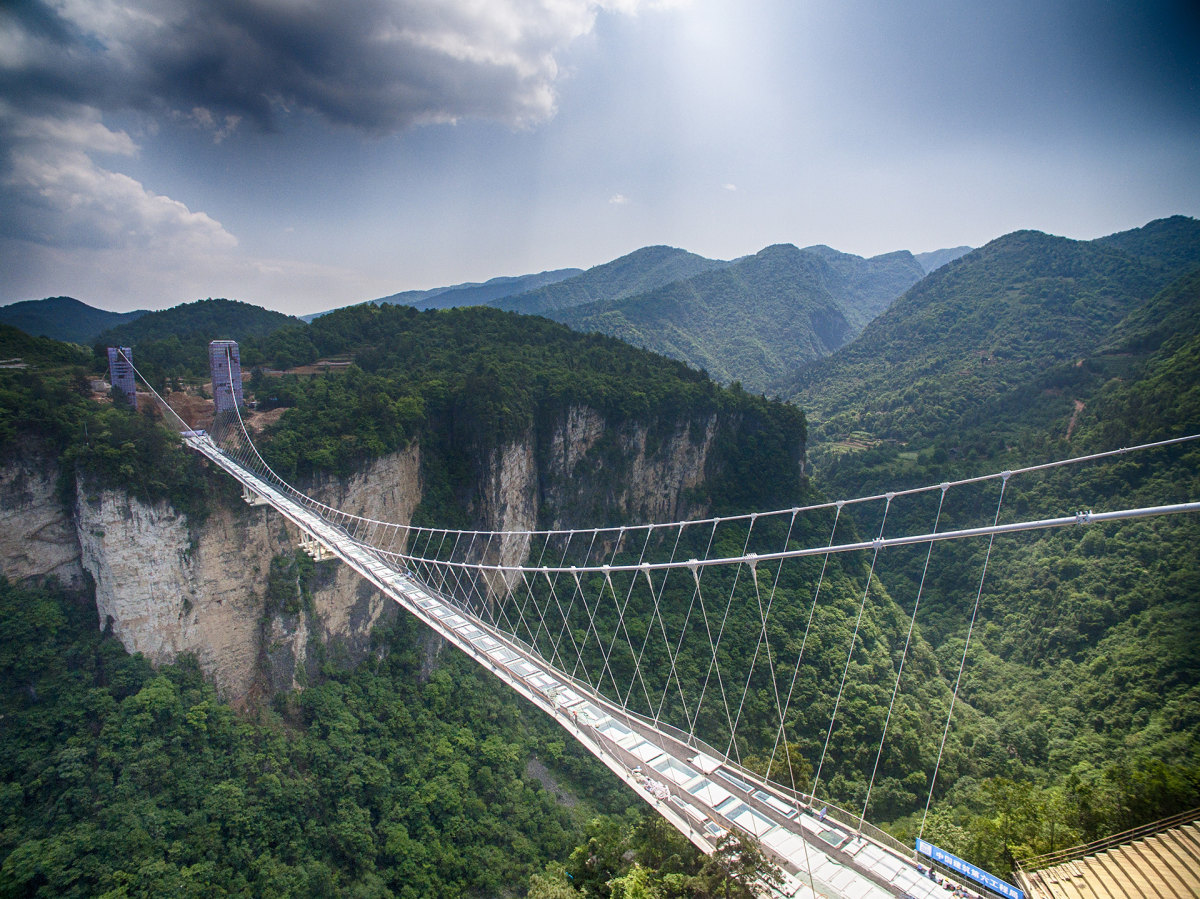
If the forest park appeals to the contemplative soul, the Zhangjiajie Grand Canyon speaks to the adrenaline seeker. Its centerpiece is the Glass Bridge: 430 meters long, suspended 300 meters above the canyon floor, its transparent deck constructed from panels of layered glass that render the structure nearly invisible against the sky. Walking across it — feeling the slight flex beneath your feet, looking down through three hundred meters of empty air to the stream below — is an exercise in controlled terror. On clear days, the bridge seems to float. On misty days, it vanishes entirely, and you walk into whiteness with nothing visible but the far cliff emerging slowly from the grey.
The canyon complex extends the thrill: a bungee jump from the bridge's center, the world's highest at this elevation; a zipline that screams across the gorge; and below, a network of trails through the canyon's narrowest slots where waterfalls plunge from the rim above. For those who prefer their heights with more stone beneath them, Tianmen Mountain (天门山) offers the famous 999 steps — a near-vertical staircase climbing to a natural arch in the mountainside, the "Heaven's Gate," through which clouds pour like smoke through a doorway. The cliff-side skywalk there, a glass-floored path affixed to a vertical face 1,400 meters above the valley, has reduced grown travelers to a careful, white-knuckled shuffle.
Beyond the Pillars: Tujia Culture and the Living Landscape
Zhangjiajie is not merely geology. For centuries, the Tujia people (土家族) have inhabited these mountains, building their villages in the valleys between the pillars, constructing stilted wooden houses — diaojiaolou — that perch on the hillsides like birds' nests, their dark timber weathered to silver, their eaves curving against the rain. The Tujia are one of China's fifty-five recognized ethnic minorities, and their culture permeates the region with a vitality that no amount of tourism development has fully domesticated.
Their performing traditions are extraordinary. The Baishou dance (摆手舞), performed in large circles during festivals, involves hundreds of dancers moving in synchronized waves, their arms sweeping like the branches of trees in wind. The Maogusi dance (毛古斯), far older and more primal, features performers wrapped in straw and leaves, enacting scenes of hunting and gathering that scholars believe preserve memories of pre-agricultural life. In the evenings, in the small towns at the park's edges, you may hear Tujia folk songs drifting from open windows — high, keening melodies that seem designed to carry across valleys, to bridge the distance between one pillar and the next.
The local cuisine rewards the hungry traveler. Sanxiaguo (三下锅), a sizzling dry-pot stew combining cured pork, tofu, and radish, is the region's signature dish — hearty, smoky, deeply savory. Smoked meats hang in every farmhouse kitchen, cured over weeks above slow fires of pine and cypress. Rice wine, brewed in clay jars, arrives at the table warm and faintly sweet, and the conversation that follows it tends toward the philosophical, as it does in all mountain places where the weather dictates the rhythm of life.
Planning Your Journey
Zhangjiajie rewards those who time their visit well. Spring (April to May) brings clear air, blooming azaleas on the pillar slopes, and manageable crowds. Autumn (September to October) offers the most reliable visibility — the humidity drops, the mist thins, and the full architecture of the landscape reveals itself in crystalline detail. Winter transforms the park into a monochrome ink painting: snow caps the pillars, ice glazes the walkways, and the few visitors who brave the cold are rewarded with an almost private audience with the stone forest. Summer, while lush and green, brings heavy rain and dense fog that can obscure the views entirely — though a clearing storm produces some of the most dramatic cloud formations of the year.
Zhangjiajie Hehua Airport (DYG) receives direct flights from Beijing, Shanghai, Guangzhou, and Chengdu. Alternatively, the high-speed rail link from Changsha — Hunan's capital — takes approximately three hours and deposits you in the city of Zhangjiajie, from which the forest park is a forty-minute drive.
A three-day itinerary allows a thorough experience: Day One for Yuanjiajie and the Bailong Elevator, arriving early to beat the tour groups; Day Two for Tianzi Mountain and the Golden Whip Stream; Day Three for the Grand Canyon Glass Bridge and Tianmen Mountain. The park operates a multi-day entrance ticket system — a single purchase covers four days of access — and internal shuttle buses connect the major trailheads. To avoid the worst crowds, enter at opening time (typically 7:00 AM), visit the most popular viewpoints before 9:00 AM, and save the quieter trails for midday when the tour groups are at lunch.
Bring layers. The temperature at the summit platforms can be ten degrees cooler than the valley floor, and weather shifts rapidly — a clear morning can become a whiteout by noon, then clear again by three. Bring patience, too. The pillars do not perform on schedule. Some days they hide entirely behind curtains of cloud, revealing nothing. But then, in an instant, the wind shifts, the mist tears open, and three thousand stone giants stand before you in the golden afternoon light, ancient and indifferent and utterly magnificent — and you understand that you have been permitted to see something that was here long before you and will remain long after, and that the seeing is a gift you did not earn and cannot keep, only carry home in the fragile vessel of memory.