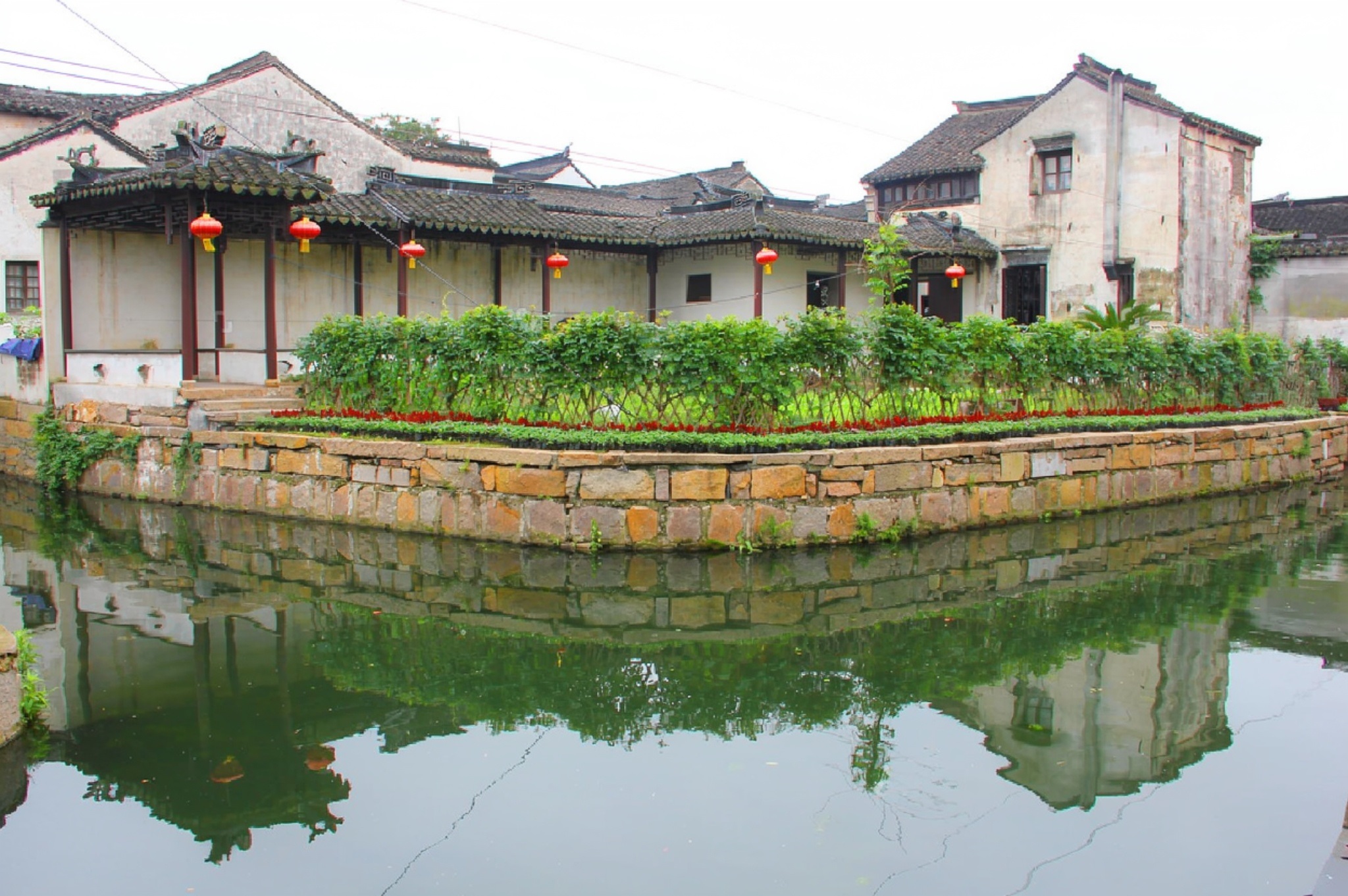
South of the Yangtze, where the river's great delta flattens into a landscape of almost aggressive fertility, the land and water have long since ceased to be separate things. Here, in the region the Chinese call Jiangnan — "south of the river" — canals replace roads, boats replace carts, and entire towns are built not beside water but upon it, within it, as extensions of it. The water towns of Jiangnan are not settlements that happen to have canals. They are canals that happen to have settlements. The water came first. The architecture followed.
To enter a water town by boat — as one should, as the Chinese have done for a thousand years — is to experience a fundamental shift in temporal perception. The engine of modern life stops. The pace becomes the pace of the pole against the canal bottom, of the current against the hull, of mist forming and dissolving over the water's surface. Time here is not measured in minutes but in the distance between bridges, in the rhythm of washing women's paddles, in the slow revolution of a fisherman's net opening above the canal like a dark flower.
The Geography of Abundance
Jiangnan's water towns exist because of a specific convergence of geography, climate, and human ingenuity. The Yangtze Delta is one of the flattest, most water-rich landscapes in China. Rainfall exceeds 1,200 millimeters annually. The water table sits mere centimeters below the surface. Rivers, streams, and natural waterways form a network so dense that, historically, it was easier to build a town around the water than to fight it.
The Grand Canal — that seventeen-hundred-kilometer artificial waterway connecting Beijing to Hangzhou — passes through this region, and its construction during the Sui Dynasty (581–618 CE) transformed local waterways from natural features into commercial arteries. Towns that sat at canal intersections became nodes in a continental trade network. Silk, tea, rice, salt, and ceramics flowed through their channels. Wealth accumulated. And wealth, in the Chinese tradition, demands expression in architecture.
The result is a landscape unlike anywhere else on Earth: a network of small towns, each perhaps a few thousand residents at their historical peak, connected by water, defined by water, and preserved by water. The canals that once carried commerce now carry memory. The towns that once traded silk now trade in something equally delicate: the experience of a China that modernization has elsewhere erased.
Four Towns, Four Temperaments
Among the dozens of surviving water towns, four have achieved particular renown, each offering a distinct character within the shared vocabulary of canal, bridge, and whitewashed wall.
Zhouzhuang, in Jiangsu Province, is the eldest and most celebrated — often called "China's Number One Water Town." Its twin bridges (shuangqiao), where a stone arch bridge and a smaller beam bridge meet at a right angle over intersecting canals, became internationally famous when the painter Chen Yifei depicted them in his 1984 oil painting Memory of Hometown. The painting was later selected as the cover of a UN postage stamp, and Zhouzhuang's quiet canals were suddenly visible to the world. The town's Shen House, built in 1742 by a descendant of the legendary Ming Dynasty merchant Shen Wansan, contains over a hundred rooms arranged in seven courtyards — a monument to the commercial wealth that water made possible.
Wuzhen, in Zhejiang, has been most aggressively restored and curated, its ancient buildings preserved with museum-grade precision. Divided into East and West scenic zones, Wuzhen offers the most complete immersion in water-town life: indigo-dyeing workshops where cloth hangs in long blue curtains, traditional wine distilleries, shadow puppet theaters, and the former residence of the novelist Mao Dun. At night, the West Zone illuminates its canal-side buildings in warm amber light, and the reflections in the black water create a second town, inverted and luminous.
Xitang is distinguished by its covered corridors — over a kilometer of roofed walkways along the canal banks, protecting pedestrians from rain and sun alike. These langpeng (covered sheds) give Xitang a particular intimacy, a sense of sheltered enclosure. The town is also known for its numerous narrow alleys, some barely wide enough for one person, threading between high walls in a labyrinth that rewards deliberate disorientation.
Tongli, the quietest of the four, is built around a network of fifteen canals crossed by forty-nine bridges. Its Tuisi Garden, a private scholar's garden from the Qing Dynasty, is a UNESCO-listed masterpiece of miniature landscape design — mountains reduced to rocks, oceans reduced to ponds, the entire cosmos compressed into a space one can cross in thirty steps.
The Architecture of Reflection
The visual grammar of a Jiangnan water town is remarkably consistent, and its consistency is not accidental. Whitewashed walls (bai qiang). Black clay tiles (hei wa). Upturned eaves. Horse-head walls (matou qiang) — the stepped gable walls that rise above the roofline in angular profiles, originally designed as firebreaks between adjacent buildings but long since elevated to pure aesthetic statement. The palette is deliberately restrained: white, black, grey, with the occasional accent of a red lantern or a green vine.
"In Jiangnan, the houses do not face the water. They are the water's other face."
— Lu Wenfu (陆文夫), Suzhou novelist, from "The Gourmet" (1983)
The key architectural insight of the water town is the relationship between building and reflection. Houses are designed not merely to be seen directly but to be seen doubled — their white walls and black roofs mirrored in the still canal water below. The composition is always vertical and symmetrical: the building above, its reflection below, and between them, the dark line of the water's surface. In mist, when the upper portions of buildings dissolve into grey and only the lower walls and their reflections remain distinct, the effect is of a world suspended between substance and void — a three-dimensional ink painting.
Bridges complete the composition. The stone arch bridges of Jiangnan — some dating to the Song Dynasty — are not merely functional crossings. They are compositional devices, their arched openings framing views of canal and building beyond, their reflections completing perfect circles or ellipses in the water. A boat passing beneath a bridge completes the scene: the dark hull, the figure of the boatman, the ripple that briefly dissolves the reflection before it reforms.
Silk, Salt, and the Commerce of Beauty
The water towns were not built by poets. They were built by merchants. The Jiangnan region was, from the Song Dynasty onward, the economic engine of China — the source of its finest silk, its most delicate tea, its most refined handicrafts. The canals that give the towns their character were, first and foremost, commercial infrastructure. Silk bales traveled by boat from rural workshops to urban markets. Salt barges moved government monopoly goods. Rice from the paddies surrounding each town fed the cities downstream.
This commercial wealth funded the architecture that visitors admire today. The great merchant houses of Zhouzhuang and Tongli — with their multiple courtyards, their carved wooden screens, their private gardens — were built with silk money. The merchants who built them were not merely rich; they were culturally ambitious. In the Chinese social hierarchy, merchants ranked below scholars, and the nouveau riche compensated by building houses that demonstrated not just wealth but taste. The result is an architecture of extraordinary refinement: every beam carved, every window lattice a geometric puzzle, every garden a philosophical argument rendered in stone and water.
The silk trade also shaped the towns' cultural life. Weaving communities developed their own traditions, festivals, and folk arts. The indigo-dyed cloth (lan yin hua bu) of Wuzhen, produced by a resist-dyeing technique using fermented plant paste, is both a commercial product and an aesthetic tradition. The blue-and-white patterns — fish, flowers, geometric borders — are a visual language as specific to Jiangnan as the whitewashed walls and black tiles.
Literary Waters: The Town as Text
Jiangnan's water towns have generated a literary tradition as rich as their architectural one. The region produced more jinshi (successful candidates in the imperial examinations) per capita than any other part of China, and its towns are saturated with literary association. Wuzhen claims Mao Dun, author of the seminal realist novel Midnight. Tongli produced numerous Qing Dynasty scholars. Xitang's covered corridors appear in countless poems as metaphors for sheltered passage through life's storms.
The water town functions in Chinese literature as a space of nostalgia — a place where the past persists, where time moves differently, where the modern world's velocity is held at bay by the simple physics of water and stone. To write about a water town is always, in some sense, to write about loss: the loss of a slower China, a quieter China, a China in which a man could spend an afternoon watching mist form over a canal and consider that time well spent.
"Everyone says Jiangnan is good. The traveler should only grow old in Jiangnan. In spring, the water is greener than the sky. On the painted boat, one listens to rain and sleeps."
— Wei Zhuang (韦庄), Tang Dynasty poet, "Pusa Man"
Wei Zhuang wrote these lines in the ninth century, and they remain the most accurate description of the water-town experience available in any language. The green water. The painted boat. The sound of rain on tiles. The permission to sleep, to stop, to let the world continue without you. In a civilization that has always valued relentless forward motion — economic growth, technological progress, the bullet train's three-hundred-kilometer-per-hour urgency — the water town offers something radical: the right to be still.
Preserving the Unrepeatable
The water towns face the central paradox of cultural preservation: to survive, they must change; to remain authentic, they must not. Tourism brings the revenue necessary for maintenance, but it also transforms the thing maintained. Zhouzhuang, which received fewer than ten thousand visitors annually in 1988, now receives over three million. The canals are the same. The bridges are the same. But the silence that once defined them has been replaced by the sound of ten thousand simultaneous conversations.
Yet the alternative — abandonment, decay, the slow collapse of wooden structures into the canals that built them — is worse. The Chinese government's approach, particularly at Wuzhen, has been comprehensive restoration: dismantling buildings, replacing rotted timbers, rebuilding walls, and then reassembling the town as a functioning whole. Critics call it Disneyland. Defenders note that the alternative is rubble, and that a restored building, even one with new timbers, preserves something essential: the spatial relationships, the proportions, the dialogue between architecture and water that constitutes the town's true identity.
The best time to visit is early morning, before the tour buses arrive, or late evening, after they have departed. In those hours, the water towns return to something approaching their original character. Mist forms. A single boat moves through the canal. An old woman hangs washing from a second-floor window, the cloth dripping into the water below. A cat watches from a bridge. The town breathes. And for a few minutes, the past is not a performance. It is simply what is happening.