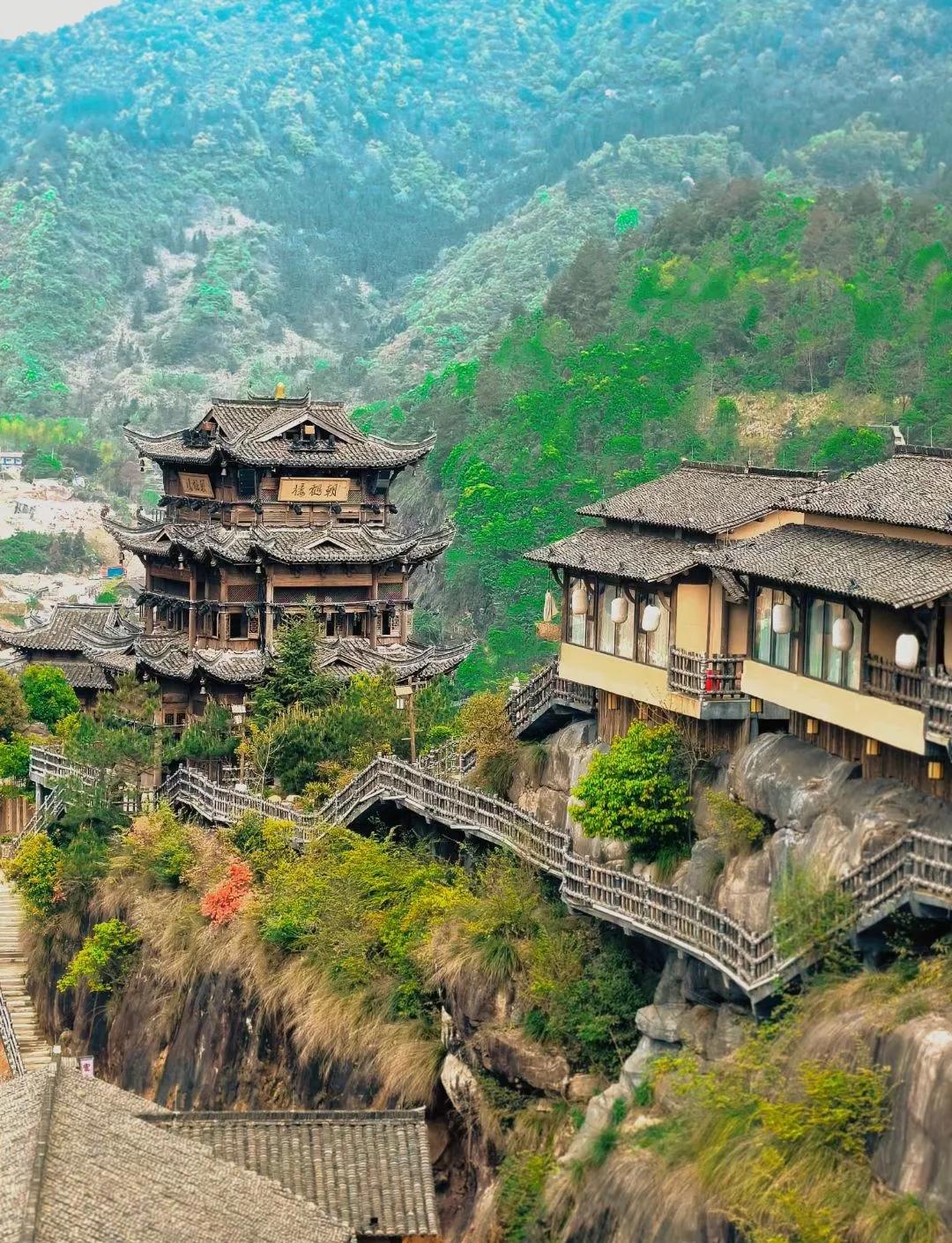
There is a moment, somewhere along the winding mountain road south of Shangrao, when the world you thought you knew quietly falls away. The bus rounds a bend, the trees part like a curtain, and suddenly the gorge is there — a great wound in the earth, two hundred meters deep, its walls sheered clean as though a celestial sword had split the mountain in a single stroke. And clinging to those walls, impossibly, defiantly, are buildings. Dozens of them. White-walled pavilions with upturned eaves, wooden balconies jutting over nothing, stone bridges arcing across the void, and everywhere — everywhere — the soft amber glow of lanterns beginning to wake in the gathering dusk. Mist curls between the rooftops like incense smoke in a temple. A waterfall threads silver down the far cliff face. For a long, disorienting moment, you are certain you have stumbled onto a film set, or wandered into a painting, or perhaps driven off the road entirely and landed in some fever dream of ancient China.
It is real. All of it. And it is only the beginning.
Where Is Wangxian Valley?
Wangxian Valley — 望仙谷, the "Valley of Gazing at Immortals" — sits in the foothills of the Wuyi Mountains, within the administrative bounds of Shangrao (上饶) in northeastern Jiangxi Province. The name itself is a promise: this is a place where, if the old stories are to be believed, one might look up from the gorge floor and catch sight of a xian — an immortal — drifting between the peaks on a wisp of cloud.
The scenic area opened to the public in 2020, though the gorge itself has been here for rather longer. The landscape is defined by a dramatic V-shaped canyon whose walls rise over two hundred meters, carved over millennia by a stream that still runs along the bottom, cold and clear as melted jade. Before its transformation, this was an abandoned mining village — a hollowed-out place of collapsed tunnels and rusted machinery, the kind of forgotten scar that dots the Chinese countryside where resource extraction moved on and left nothing behind. What happened next is one of the more remarkable acts of landscape reclamation in modern China: developers and architects looked at those sheer, useless cliff faces and saw not a problem but a canvas. Over several years, they built a village that appears to have grown organically from the rock itself, a place that looks centuries old but is, in truth, barely half a decade into its life.
Architecture on the Edge of the World
The buildings of Wangxian Valley are not ancient. This must be said plainly, because every instinct will tell you otherwise. They are meticulous, loving recreations of traditional Jiangxi architecture — the local ganpai (赣派) style characterized by whitewashed walls, grey ceramic tiles, sharply upturned eaves, and elaborate wooden bracket sets (dougong) that distribute the weight of sweeping roofs without a single nail. The effect is of a Song or Ming dynasty village frozen in amber, except that no Song dynasty builder ever had to contend with the engineering challenges presented here.
Behind every weathered wooden facade, behind every hand-carved window lattice and moss-streaked stone foundation, there is steel. Reinforced concrete anchors driven deep into the cliff face. Load-bearing frameworks calculated to the millimeter by structural engineers who spent years figuring out how to hang a three-story teahouse off a vertical rock wall and make it look as though it had simply sprouted there. The multi-level walkways that switchback up the gorge walls are cantilevered masterpieces. The bridges that connect buildings on opposite cliffs — some spanning thirty meters of empty air — are engineered to sway slightly in the wind, lending them the organic, rope-and-plank feel of ancient mountain crossings while being perfectly safe.
It is, in the truest sense, an engineering marvel disguised as a village. And the disguise is so complete that visitors routinely touch the walls, peer under the eaves, and shake their heads in disbelief. The patina is applied with an artist's patience: deliberate weathering on the timber, lichen cultivated on north-facing stones, roof tiles laid with studied irregularity. Nothing is too perfect. Nothing looks new. The whole composition reads as found, not built — as though the valley simply dreamed these structures into existence one foggy morning.
The Xianxia Aesthetic: When Fantasy Meets Reality
To understand why Wangxian Valley has seized the Chinese imagination with such force, you must understand xianxia (仙侠) — the vast, sprawling genre of Chinese fantasy that translates roughly as "immortal heroes." Xianxia novels and their television adaptations populate a world of cultivation practitioners who refine their spiritual energy across centuries, eventually achieving immortality and the ability to fly on swords through clouds. Their homes are celestial palaces perched on impossible peaks, their sects hidden in mist-shrouded valleys accessible only by crossing chasms on chains of light. It is China's most beloved escapist mythology, drawing on Daoist cosmology, Buddhist reincarnation, and a thousand years of literary tradition.
"The immortal's dwelling is not on the flat earth, but where the clouds cannot decide whether to rise or fall — there, between heaven and the mortal dust, the enlightened build their halls."
— attributed to Ge Hong, Baopuzi (抱朴子), 4th century
Wangxian Valley is, to an almost uncanny degree, the physical manifestation of this literary landscape. The verticality of the gorge, the buildings stacked impossibly above one another, the mist that rolls through at unpredictable intervals, the waterfalls, the narrow paths carved into cliff faces — it is the establishing shot of every xianxia drama rendered in stone and timber. Visitors who grew up reading A Record of a Mortal's Journey to Immortality (凡人修仙传) or watching The Untamed (陈情令) find themselves speechless, pointing at the gorge and whispering, "I've entered the novel." The comment sections of travel videos are flooded with variations of this phrase. It is not irony. It is recognition — the shock of seeing an interior landscape, one built from years of reading and watching and dreaming, suddenly externalized in three dimensions.
And so they come in their thousands wearing hanfu — the flowing, wide-sleeved robes of pre-modern China — to photograph themselves on the cliff walkways and misty bridges. A girl in pale blue silk leans against a railing above two hundred meters of empty air, her ribbons catching the updraft, and for one frame she is not a university student from Hangzhou but a sword immortal surveying her domain. The valley does not discourage this. It leans into it. Costume rental shops line the approach road. The architecture was designed, in part, to be photographed from below, from across the gorge, from every angle that maximizes the sense of vertical drama. Wangxian Valley understands that it is not merely a scenic area. It is a stage set for the collective Chinese fantasy of transcendence.
Night Falls: The Valley Transforms
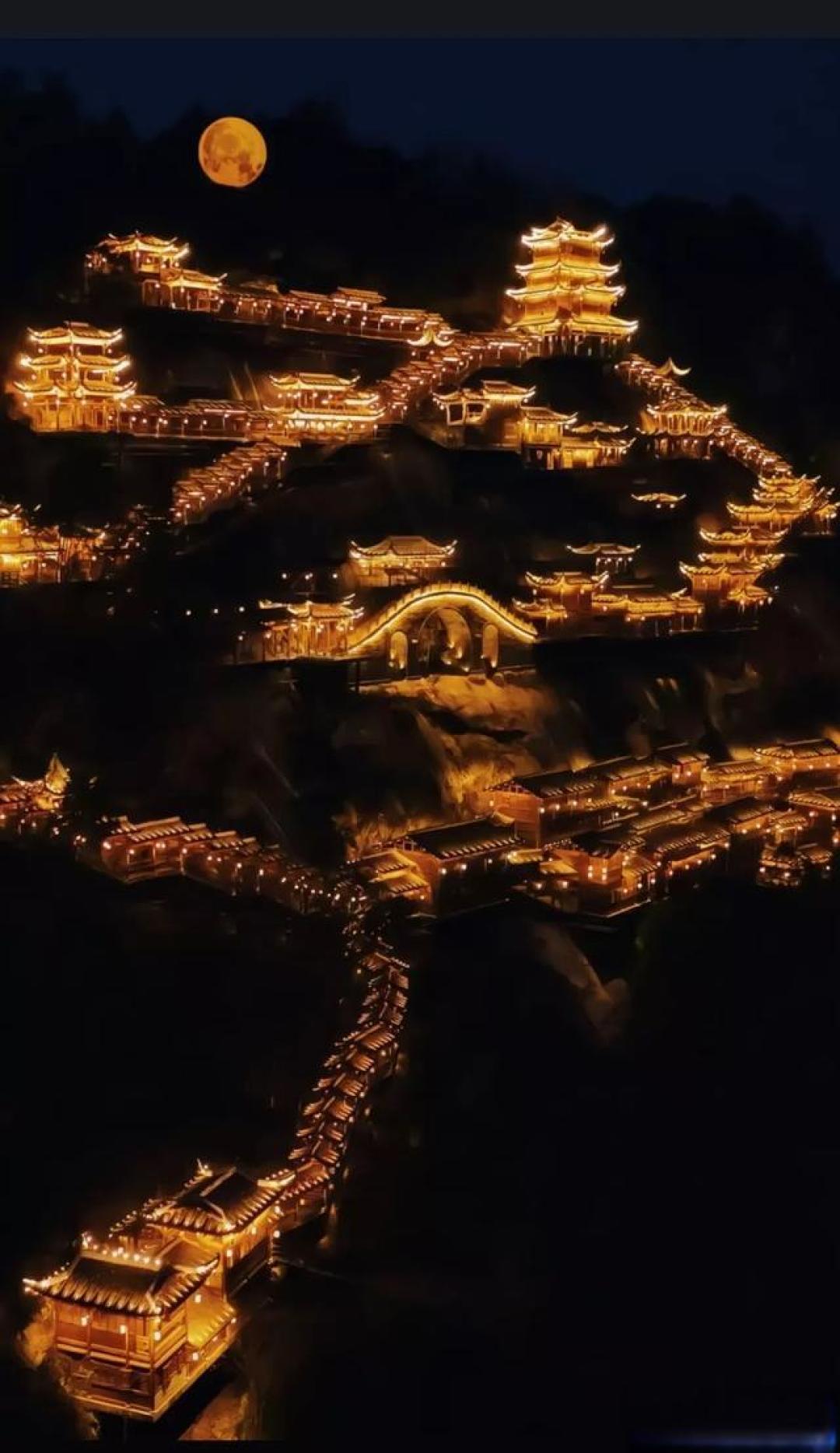
Daytime in Wangxian Valley is beautiful. Nighttime is something else entirely. As the sun drops behind the western rim of the gorge and the sky bruises into violet, a transformation begins that has made this place one of the most photographed locations in China. Thousands of warm-toned lanterns ignite along every eave, every walkway, every bridge. Hidden LED strips trace the rooflines in soft gold. The cliff faces themselves are washed in carefully calibrated light that makes the rock glow amber and rose. The effect is of a vertical city catching fire in slow motion — not destructive fire, but the contained, welcoming fire of a hearth, multiplied a thousand times and stacked against the dark.
Below, the stream at the gorge bottom becomes a mirror. Every lantern, every glowing window, every arched bridge is doubled in the black water, so that the valley appears to extend downward as far as it rises up. Fog machines positioned along the cliff faces release slow plumes of artificial mist that drift through the light beams, catching them, softening them, turning the whole scene into something liquid and dreamlike. On performance nights, traditional musicians play guzheng and xiao from balconies above the void, the notes falling down into the gorge like water. Dancers in long-sleeved costumes perform on platforms lit from below. Occasionally, fire performers send arcs of flame spinning against the dark cliff face, and the crowd on the viewing platform below gasps as one.
It photographs impossibly well. This is not an accident. The lighting design was calibrated for the dynamic range of modern phone cameras — warm tones that do not blow out, contrast ratios that preserve detail in both the glowing buildings and the dark rock behind them. Every visitor becomes, inadvertently, a producer of the very imagery that drew them here. The feedback loop is perfect and self-sustaining.
Beyond the Views: What to Experience
The gorge is the headline, but Wangxian Valley offers more than a single dramatic vista. A glass-bottomed walkway traces the upper cliff edge, pressing your nerves against two hundred meters of transparent nothing. At the gorge floor, the original stream still runs, feeding a series of small waterfalls and clear pools where the temperature drops noticeably and the sound of the crowd above fades to a murmur. It is cooler down here, greener, older-feeling — the one part of the valley that genuinely predates the construction.
Scattered through the village levels are traditional craft workshops where visitors can try their hands at Jiangxi's heritage arts: handmade paper-making using local bamboo pulp, wheel-thrown pottery in the style of nearby Jingdezhen, and plant-based fabric dyeing that produces the deep indigos and rust-reds of rural Chinese textile tradition. These are not perfunctory tourist traps; the artisans are local, the materials are genuine, and the workshops double as working studios.
The food deserves its own paragraph. Jiangxi cuisine is among China's most underrated — hotter than Cantonese, more rustic than Sichuan, deeply savory and unpretentious. In the valley's restaurants, perched on wooden platforms over the gorge, you can eat whole steamed river fish with ginger and scallion, silken tofu braised in chili oil, stir-fried mountain vegetables picked that morning, and clay-pot rice with cured pork. Pair it with local green tea, served in the traditional tall glass, and eat slowly. The view demands it.
For those who wish to stay, a handful of cliff-side guesthouses offer overnight rooms with balconies that open directly onto the void. Waking at dawn, before the day-trippers arrive, to find the gorge filled with natural mist and the first light catching the upper eaves — this is the valley at its most genuinely transcendent. The xianxia dream, minus the crowds.
Planning Your Visit
Wangxian Valley is located approximately one hour's drive south of Shangrao city in Jiangxi Province. The most practical approach is high-speed rail: Shangrao station (上饶站) sits on the major Shanghai–Kunming line, making it reachable from Shanghai in under three hours or from Hangzhou in roughly ninety minutes. From the station, taxis and ride-hailing services cover the remaining distance in about an hour along well-maintained mountain roads.
Timing is everything. Arrive in the late afternoon — around three or four o'clock — so that you can explore the gorge in daylight, watch the transition at dusk, and stay for the full night illumination. The valley is comfortably explored in three to four hours at a leisurely pace, though photography enthusiasts and hanfu devotees regularly stretch this to six or more. The night show typically begins around seven in summer, later in winter; check the official schedule on arrival.
Entry tickets run approximately 100–120 yuan, with the night illumination included in the standard admission. The valley can be combined beautifully with nearby Sanqingshan (三清山), a UNESCO-listed granite mountain range roughly ninety minutes to the east, or with the Wuyi Mountains proper, which straddle the Jiangxi-Fujian border to the south. A three-day itinerary pairing Wangxian Valley's engineered drama with Wuyishan's ancient, tea-scented wilderness makes for a complete study in contrasts.
A few practical notes: weekdays are dramatically less crowded than weekends and holidays — if your schedule allows any flexibility, use it. The gorge is several degrees cooler than the surrounding lowlands, and the evening temperature drops noticeably once the sun clears the rim; bring a light jacket even in summer. Wear shoes with grip — the stone paths can be slick with mist. And charge your phone fully. You will take more photographs than you expect, and the night scenes will drain your battery faster than you think.
The immortals, the old texts tell us, dwell where the human world grows thin — at the edges of maps, in the folds of mountains, in places where the geometry of the ordinary breaks down and something older asserts itself. Wangxian Valley is not ancient. It is not the product of centuries of organic growth. But standing on a mist-wet bridge at nightfall, watching lantern-light cascade down a cliff face into darkness, listening to a guzheng melody drift down from somewhere above the clouds — in that moment, the distinction hardly matters. The dream is the thing. And the dream, here, is very good indeed.