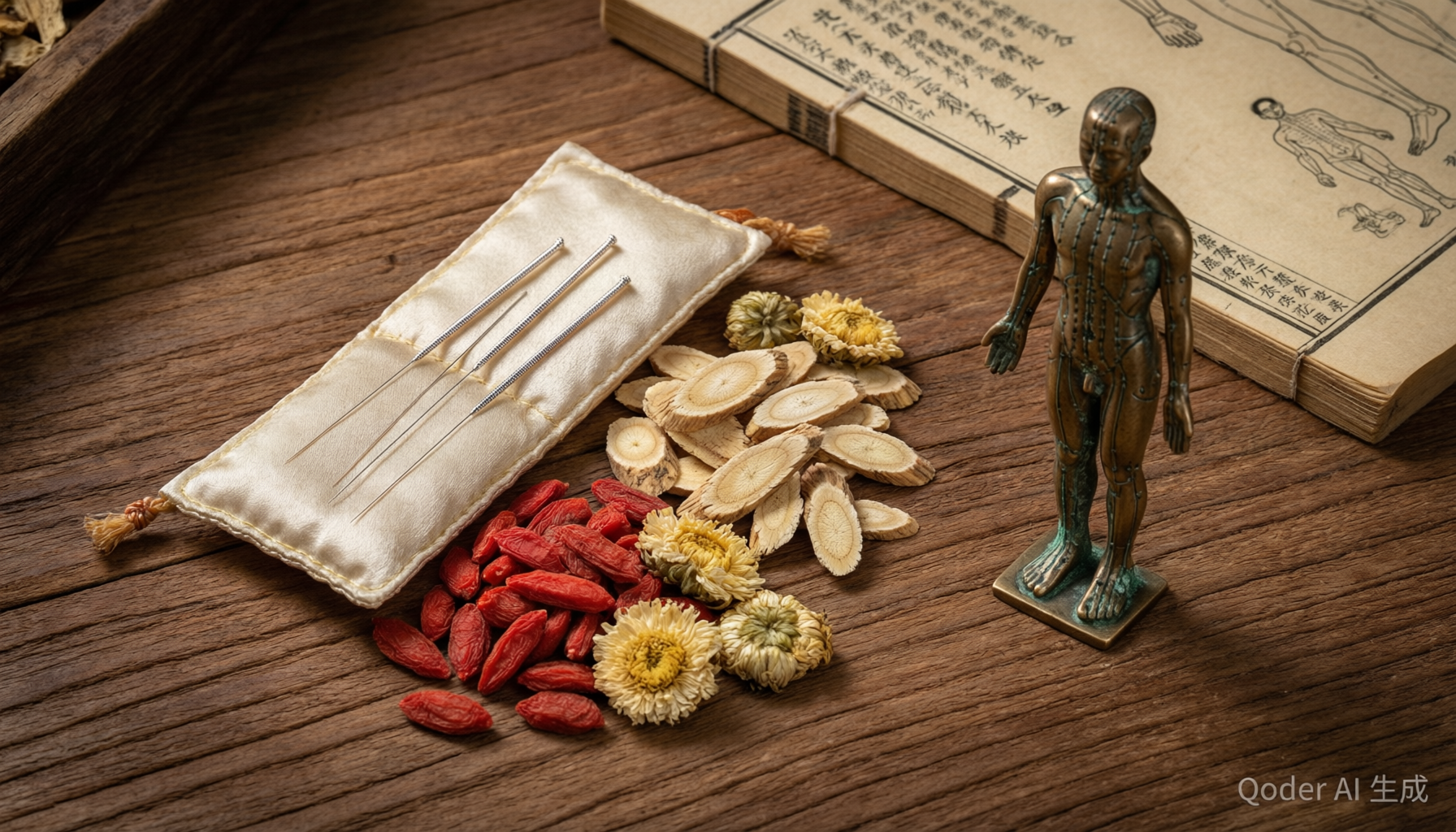
Western medicine looks at the body and sees a machine — a magnificent assembly of parts, each with a function, each repairable in isolation. Traditional Chinese Medicine looks at the same body and sees a landscape — a living terrain of rivers and mountains, seasons and climates, where health is not the correct functioning of individual components but the harmonious flow of energy through an interconnected whole. This is not primitive science struggling toward modernity; it is a different science entirely, one that has sustained a civilization of billions for over two millennia and that continues, today, to treat hundreds of millions of patients across China and the world.
Origins: From Shaman to System
The roots of Chinese medicine reach into the Neolithic period, when healing was inseparable from ritual and the boundary between the physical and spiritual worlds was permeable. The earliest medical practices — bone divination, exorcism, herbal experimentation — gradually gave way to a rational, naturalistic framework during the Warring States and Han periods (475 BCE–220 CE). The pivotal text is the Huangdi Neijing (Yellow Emperor's Classic of Internal Medicine), compiled around the second century BCE, which presents medicine as a dialogue between the legendary Yellow Emperor and his physician Qi Bo. In this text, disease is no longer the punishment of angry spirits but the result of imbalance within the body's own ecology — a revolution as profound as anything in the history of human thought.
Subsequent centuries produced an extraordinary lineage of medical scholars. Zhang Zhongjing (c. 150–219 CE) codified the treatment of febrile diseases in his Shanghan Lun. Sun Simiao (581–682 CE), the "King of Medicine," compiled the Qianjin Yaofang (Essential Prescriptions Worth a Thousand Gold) and established ethical principles for physicians centuries before the Hippocratic Oath gained its modern authority. Li Shizhen (1518–1593) spent twenty-seven years compiling the Bencao Gangmu (Compendium of Materia Medica), cataloguing 1,892 medicinal substances with a taxonomic rigor that impressed Darwin two centuries later.
"The sage physician treats the country; the great physician treats the person. Both require the same principle: understanding the flow and restoring what is blocked."
— Sun Simiao, "Essential Prescriptions Worth a Thousand Gold," 652 CE
Yin, Yang, and the Logic of Opposites
At the foundation of TCM theory lies the dynamic interplay of yin (阴) and yang (阳). These are not moral categories — not good and evil, not light and dark in a value-laden sense — but complementary qualities that describe the rhythm of all phenomena. Yang is warm, active, rising, exterior, functional. Yin is cool, receptive, descending, interior, material. The body is a constant negotiation between these poles: the yang of metabolic fire warming the yin of bodily fluids; the yang of daytime activity giving way to the yin of nighttime rest.
Disease, in this framework, is any sustained deviation from dynamic balance. Too much yang produces heat symptoms — fever, redness, agitation, dryness. Too much yin produces cold symptoms — pallor, fatigue, cold limbs, water retention. The physician's task is not to destroy a pathogen but to restore the equilibrium that allows the body to heal itself. This is a fundamentally ecological model of medicine: the body is not a battlefield but a garden, and the physician is a gardener adjusting light, water, and soil.
The Five Elements: A Map of Relationships
The five-phase theory (五行, wuxing) — wood, fire, earth, metal, water — provides TCM with a relational map connecting the body's organs, emotions, seasons, flavors, and sensory organs into a single coherent system. Each element corresponds to a pair of organs (one yin, one yang), an emotion, a season, a flavor, and a sense organ. The liver and gallbladder belong to wood, associated with spring, anger, the sour taste, and the eyes. The heart and small intestine belong to fire, associated with summer, joy, the bitter taste, and the tongue.
The power of this system lies not in the individual correspondences but in the dynamic relationships between them. The "generating cycle" (相生) describes how one element nourishes the next: wood feeds fire, fire creates earth (ash), earth bears metal, metal collects water, water nourishes wood. The "controlling cycle" (相克) describes how each element restrains another: wood parts earth, earth dams water, water quenches fire, fire melts metal, metal chops wood. When these cycles flow in balance, health prevails. When one element becomes excessive or deficient, the disturbance propagates through the entire network — a liver imbalance may eventually manifest as digestive trouble (wood overacting on earth) or emotional volatility affecting the heart (wood feeding fire excessively).
Qi, Blood, and the Meridian Rivers
If yin-yang and the five elements provide TCM's philosophical grammar, then qi (气) and the meridian system (经络, jingluo) provide its anatomy. Qi — often translated as "vital energy" or "life force" — is the fundamental substance and activity of the body. It warms, defends, transforms, transports, and holds. It exists in multiple forms: wei qi (defensive qi) circulates at the body's surface like an immune shield; ying qi (nutritive qi) flows within the vessels, nourishing the organs; zong qi (gathering qi) resides in the chest, governing breath and voice.
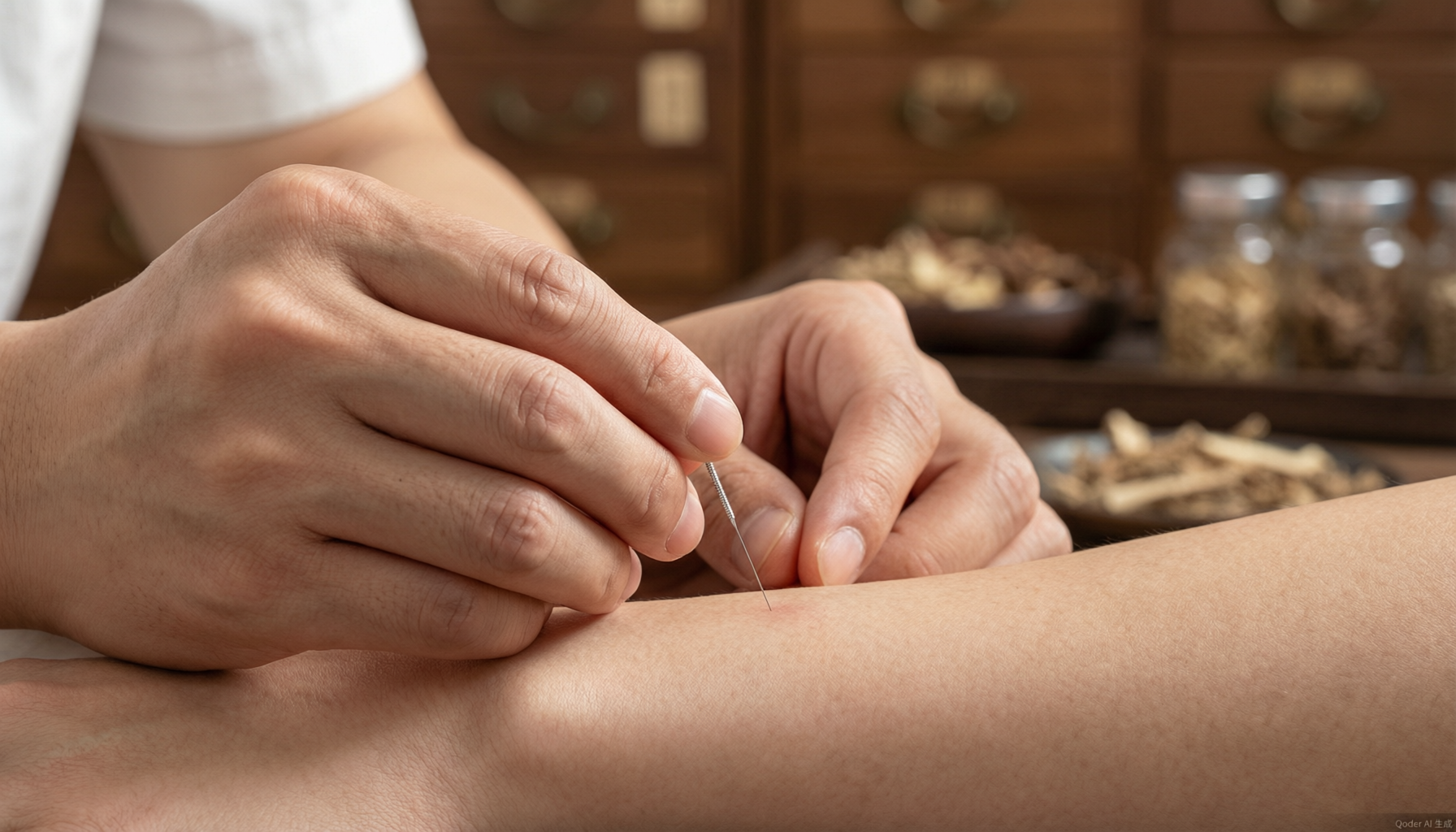
The meridians are the rivers through which qi flows — twelve primary channels, each associated with a specific organ, running from the torso to the extremities in a continuous circuit. Along these channels lie the acupuncture points (穴位, xuewei), over three hundred and sixty classical sites where the flow of qi can be accessed and adjusted with needles, heat (moxibustion), or pressure. The meridian system is not a crude approximation of the nervous or circulatory systems; it is a functional map of energetic relationships that has no exact equivalent in Western anatomy — and yet, when a skilled acupuncturist inserts a needle at Zusanli (ST-36) below the knee and the patient's chronic nausea resolves, the map proves its validity on its own terms.
The Zang-Fu Organs: Function Over Form
TCM's organ system (脏腑, zang-fu) shares names with Western anatomy but operates on different logic. The TCM "spleen" is not merely the anatomical organ but an entire functional system governing digestion, nutrient transformation, and the "holding" of blood within vessels. The TCM "kidney" encompasses not only filtration but reproductive essence, bone health, brain function, and the body's constitutional vitality. The "liver" governs the smooth flow of qi and emotions, stores blood, and opens into the eyes and tendons.
This functional approach means that a TCM diagnosis of "liver qi stagnation" does not imply a diseased anatomical liver. It describes a pattern of constrained energy manifesting as irritability, sighing, rib-side distension, and menstrual irregularity — a pattern that may have no correlate in Western blood tests or imaging, yet is undeniably real to the patient and responsive to treatment. This is the genius and the frustration of TCM in cross-cultural dialogue: it describes a different layer of reality, one that resists reduction to structural anatomy but reveals itself clearly in the clinic.
Pattern Diagnosis: Reading the Whole Person
Western medicine diagnoses diseases; TCM diagnoses patterns (证, zheng). A patient presenting with chronic fatigue, poor appetite, loose stools, a pale tongue with teeth marks, and a weak pulse might receive the pattern diagnosis "spleen qi deficiency" — regardless of whether Western tests reveal anemia, hypothyroidism, or nothing at all. The pattern is the functional story the body is telling, and the treatment addresses that story directly: tonify the spleen, strengthen qi, warm the middle burner.
The diagnostic method is the "four examinations" (四诊): inspection (望, wang) — observing complexion, body shape, and especially the tongue's color, coating, and shape; auscultation and olfaction (闻, wen) — listening to voice quality, breathing, and coughing; inquiry (问, wen) — a systematic interview covering sleep, appetite, emotions, temperature preferences, and the "ten questions"; and palpation (切, qie) — reading the pulse at three positions on each wrist, detecting up to twenty-eight distinct pulse qualities from "wiry" to "slippery" to "thready." Together, these four methods construct a portrait of the patient's internal landscape that no single blood test could provide.
The Therapeutic Arsenal: Needles, Herbs, and Hands
TCM treatment modalities form a rich arsenal, each suited to different patterns and conditions. Acupuncture (针灸) adjusts qi flow through the meridians, treating pain, insomnia, digestive disorders, fertility issues, and emotional conditions. Herbal medicine (中药) employs thousands of plant, mineral, and animal substances combined into classical formulas — each formula a carefully balanced "team" of herbs with designated roles: the emperor herb addresses the primary pattern, the minister supports it, the assistant manages side effects, and the envoy directs the formula to the target area.
Beyond these, TCM includes moxibustion (灸, burning mugwort near the skin to warm and stimulate points), cupping (拔罐, creating suction to move stagnant blood and qi), tuina (推拿, therapeutic massage following meridian pathways), and dietary therapy (食疗, prescribing foods by their energetic properties). The choice of modality depends on the pattern: a cold, deficient condition calls for warming moxa and tonifying herbs; a hot, excess condition calls for cooling needles and clearing formulas. The physician selects not a protocol but a strategy, tailored to the individual before them.
"In the upper physician's practice, there is no fixed formula — only fixed principles. The formula changes with the person, the season, and the moment."
— Ye Tianshi, "Treatise on Warm Diseases," 1746 CE
TCM in the Modern World: Integration and Tension
Today, Traditional Chinese Medicine exists in a state of creative tension with biomedicine. In China, TCM hospitals operate alongside Western facilities, and most patients move fluidly between both systems — seeing a Western doctor for acute infection and a TCM practitioner for chronic fatigue, or combining acupuncture with physiotherapy for back pain. The Chinese government has invested heavily in TCM research, and several Chinese herbal compounds have undergone rigorous clinical trials, yielding results published in international journals.
The philosophical gap remains real. TCM's strength — its holistic, pattern-based, individualized approach — is also what makes it difficult to validate through randomized controlled trials designed for single-molecule drugs. Yet the growing global interest in integrative medicine, functional medicine, and systems biology suggests that the Western scientific framework may be evolving toward questions that TCM has been answering for two thousand years. The body as landscape, not machine. Health as flow, not structure. The patient as a whole person in a whole environment, not a collection of symptoms to be isolated and suppressed.
Whether one accepts every theoretical claim of TCM or not, its clinical legacy is undeniable: a continuous, refined, empirically tested medical tradition that has cared for the world's largest population for longer than any other system in human history. To understand Chinese culture is to understand this medicine — not as quaint folklore, but as a sophisticated, living science of human flourishing.