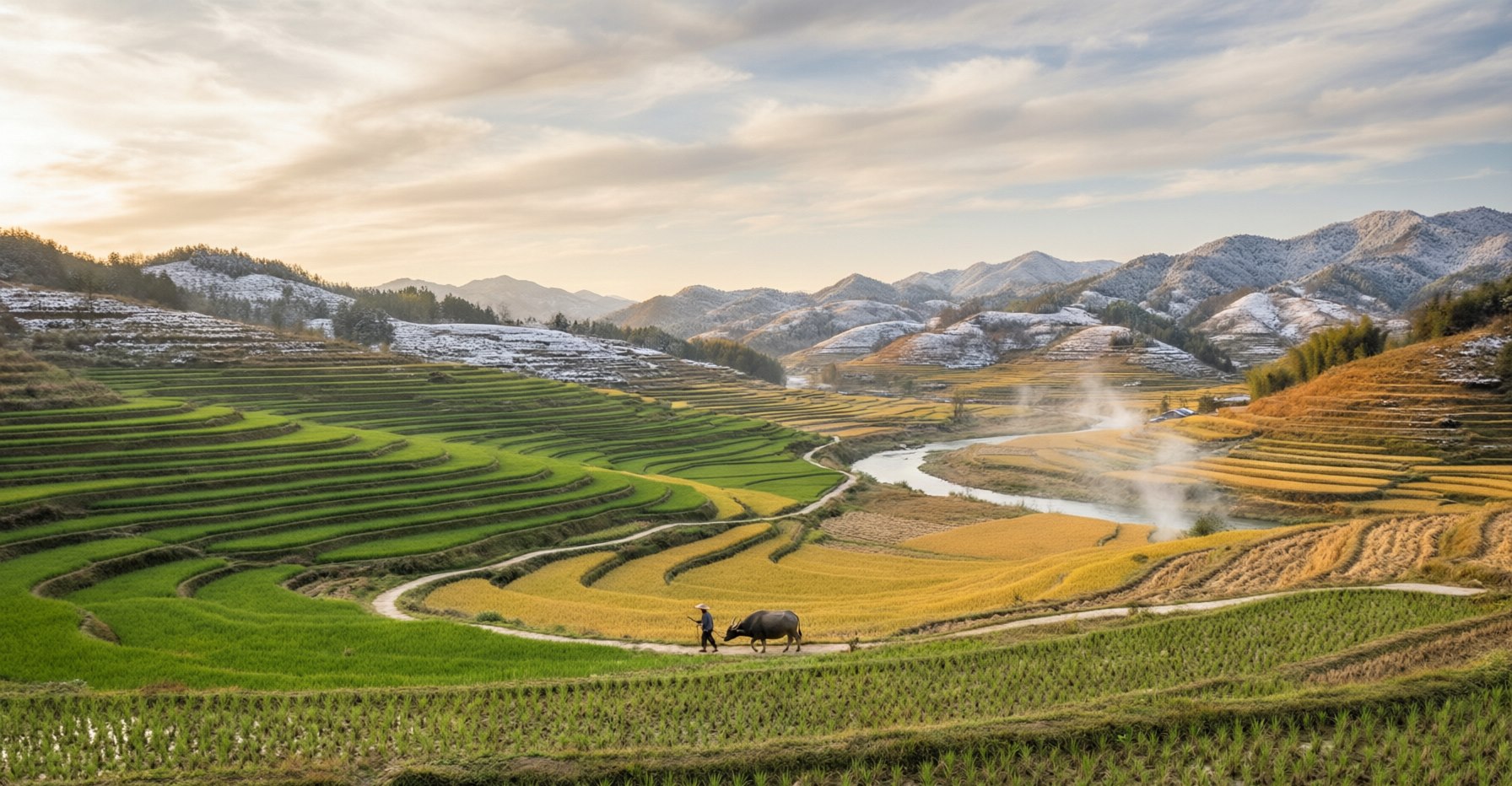
Long before satellites tracked weather patterns and smartphones delivered forecasts, Chinese farmers looked to the sky and read the year like a poem. They divided the sun's annual journey into twenty-four verses, each one a precise moment when the earth tilted, the light shifted, and the world whispered its next instruction. This is the system of the Twenty-Four Solar Terms (二十四节气, Èrshísì Jiéqì) — a calendar of the heavens written in the language of soil, water, and wind, and a guide for living that has shaped Chinese civilization for more than two thousand years.
Ancient Origins: Reading the Shadow of the Sun
The solar terms trace their origins to the Zhou Dynasty (1046–256 BCE), when astronomers used a gnomon — a simple upright pole — to measure the length of the sun's shadow at noon. The shortest shadow marked the summer solstice; the longest, the winter solstice. These two anchor points were the first terms established. Over subsequent centuries, particularly during the Qin and Han dynasties, the system expanded to its full complement of twenty-four, each term representing the sun's position advancing fifteen degrees along the ecliptic.
The completed system was codified in the Huainanzi (淮南子), a philosophical text compiled around 139 BCE under the patronage of Liu An, Prince of Huainan. What makes the solar terms remarkable is their precision: they are based not on the moon's phases but on the earth's actual position in its orbit around the sun, making them a genuinely solar calendar embedded within the broader lunisolar system. This astronomical accuracy allowed them to serve as an indispensable agricultural almanac across China's vast and climatically diverse territory.
"Heaven has its seasons; Earth has its resources. When humanity acts in accordance with both, there is abundance."
— Xunzi (荀子), "On the Regulations of a King," c. 3rd century BCE
The Architecture of the Year: Four Seasons, Twenty-Four Verses
The twenty-four terms divide evenly into four seasons of six terms each. Their names are poetry compressed to two characters — evocations of temperature, precipitation, phenology, and the felt quality of passing time.
Spring opens with Lìchūn (立春, Beginning of Spring), followed by Yǔshuǐ (雨水, Rain Water), Jīngzhé (惊蛰, Awakening of Insects), Chūnfēn (春分, Vernal Equinox), Qīngmíng (清明, Pure Brightness), and Gǔyǔ (谷雨, Grain Rain). The progression is a narrative: the earth stirs, rains soften the soil, thunderstartles hibernating creatures into movement, day and night achieve balance, the air clears to crystalline brightness, and finally the rains nourish the grain.
Summer begins with Lìxià (立夏, Beginning of Summer) and builds through Xiǎomǎn (小满, Grain Buds), Mángzhòng (芒种, Grain in Ear), Xiàzhì (夏至, Summer Solstice), Xiǎoshǔ (小暑, Minor Heat), and Dàshǔ (大暑, Major Heat). Here the language intensifies: fullness, ripeness, the sun at its zenith, heat ascending from minor to major, the air thick and heavy with growth.
Autumn descends through Lìqiū (立秋, Beginning of Autumn), Chùshǔ (处暑, End of Heat), Báilù (白露, White Dew), Qiūfēn (秋分, Autumnal Equinox), Hánlù (寒露, Cold Dew), and Shuāngjiàng (霜降, Frost's Descent). The poetry turns elegiac: heat releases its grip, dew whitens the grass at dawn, cold deepens, and the first frost arrives like a quiet verdict.
Winter closes the circle with Lìdōng (立冬, Beginning of Winter), Xiǎoxuě (小雪, Minor Snow), Dàxuě (大雪, Major Snow), Dōngzhì (冬至, Winter Solstice), Xiǎohán (小寒, Minor Cold), and Dàhán (大寒, Major Cold). The world contracts. Snow falls, the solstice marks the longest night, and cold reaches its apex — but within Dàhán lies the seed of Lìchūn, for the wheel turns always.
Seasonal Foods and the Wisdom of the Table
Each solar term carries its own dietary prescriptions, rooted in traditional Chinese medicine's principle that one should eat in accord with the season to maintain balance within the body. During Jīngzhé, when insects awaken and the liver is said to be most active, pears are eaten to moisten the throat and calm the lungs. At Qīngmíng, families prepare qingtuan — green rice balls colored with mugwort or barley grass — for ancestral tomb-sweeping picnics.
The summer terms call for cooling foods: mung bean soup, watermelon, lotus root, and bitter melon to counteract the oppressive heat of Dàshǔ. Winter demands the opposite — warming, nourishing dishes. Dōngzhì is marked across China by the eating of dumplings in the north (their shape recalling ears, which the cold threatens to freeze) and tangyuan in the south. The period between Xiǎohán and Dàhán is considered ideal for brewing rice wine and preparing preserved meats, as the deep cold inhibits spoilage and concentrates flavor.
Guiding the Plow: Solar Terms and Agriculture
The solar terms were, above all, a farmer's calendar. In a civilization built on rice, wheat, and millet, knowing precisely when to plant, irrigate, and harvest was a matter of survival. The term Mángzhòng (Grain in Ear) signals that wheat is ready for harvest and rice seedlings must be transplanted — a window of mere days in which an entire region mobilizes. Gǔyǔ (Grain Rain) tells the farmer that the final spring rains have arrived and it is time to plant tea, cotton, and late-season grains.
Proverbs crystallized centuries of observation into memorable instruction: "At Qīngmíng, plant melons and beans" (清明前后,种瓜点豆). "If it thunders at Jīngzhé, the fields will be fertile all year" (惊蛰闻雷,谷米成堆). These sayings were not superstition but compressed data — the accumulated weather wisdom of generations, encoded in rhythm and rhyme for easy transmission among a largely non-literate peasantry.
UNESCO Recognition and Living Heritage
In 2016, UNESCO inscribed the Twenty-Four Solar Terms on its Representative List of the Intangible Cultural Heritage of Humanity, recognizing them as "a knowledge system and social practice through which the Chinese have observed the sun's annual motion, cognized the rhythm of seasons, and developed related traditional knowledge and practices." The inscription acknowledged what practitioners had always known: that the solar terms are not a relic but a living framework, actively shaping festivals, farming, cuisine, medicine, and aesthetic sensibility.
The recognition brought renewed attention to customs that had been fading in urban life. Qīngmíng, once primarily a rural observance, has seen a resurgence as a national holiday for tomb-sweeping and spring outings. Dōngzhì gatherings have become occasions for families to make dumplings together, an act of cultural transmission as much as culinary preparation. Television programs and social media now mark each term with poetry, seasonal recipes, and reflections on nature, weaving the ancient calendar back into the rhythm of modern consciousness.
Modern Relevance: An Antidote to Disconnection
In an age of climate-controlled apartments, global supply chains, and perpetual digital stimulation, the solar terms offer something increasingly rare: a structured invitation to notice the world outside. To register that the dew has turned cold, that the first frost has silvered the garden, that the days are stretching toward summer. They insist that human life is not separate from natural life but embedded within it, subject to the same rhythms of emergence, fullness, decline, and rest.
This is not nostalgia. It is orientation. The twenty-four terms provide a vocabulary for paying attention — a reminder that the year is not an undifferentiated stream of productivity but a shaped narrative with its own arc, its own music, its own demands and gifts. To live by the solar terms, even loosely, is to accept that one is a creature of the earth, answerable to the sun, and that there is wisdom in moving when the world moves, and resting when it rests.
"The wise ruler does not exhaust the resources of heaven above, nor drain the wealth of earth below. He acts in season, and the people prosper."
— Liji (Book of Rites), "Monthly Ordinances"