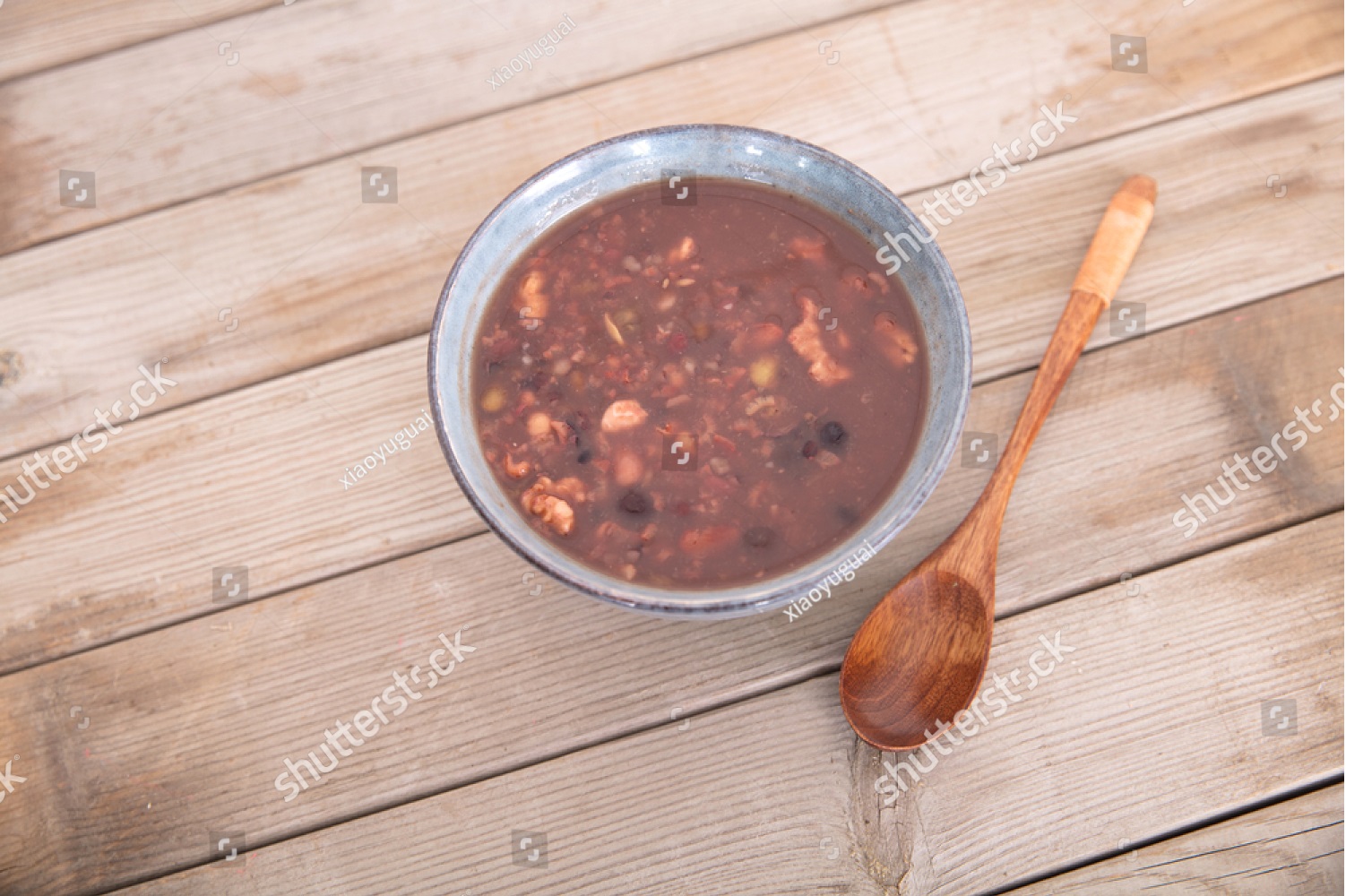
In the dead of the Chinese winter, when the fields lie frozen and the year has worn itself to a stub, a smell rises from every kitchen in the land: the thick, sweet, grainy perfume of porridge simmering low and slow. It is the eighth day of the twelfth lunar month — the Laba Festival (腊八节, Làbā Jié) — and the entire country is eating the same bowl. Rice and millet, red beans and mung beans, peanuts and lotus seeds, dried dates and longan, all softened into a single golden-brown mass, ladled into chipped bowls, and eaten hunched over the table while the window frosts over outside. It is humble food. It is ancient food. And it is, for hundreds of millions of Chinese people, the first note of a song whose finale is the Spring Festival, three weeks away. As the old northern rhyme says: "小孩小孩你别馋,过了腊八就是年" — "Children, children, don't be greedy; after Laba, it's almost New Year."
The La Sacrifices: A Festival Older Than Buddhism
The name "Laba" encodes two histories. The first is agricultural. The twelfth lunar month is called the La month (腊月, Làyuè), and the word "La" (腊) originally referred to the great year-end sacrifices (腊祭, Làjì) performed in the Zhou Dynasty (1046–256 BCE) and earlier. These were not gentle ceremonies. The La sacrifice was a communal offering to eight categories of recipients: the ancestors, the gods of the soil and grain, the spirits of rivers and mountains, the gods of the four directions, the spirits of insects (appeased so they would not plague the next harvest), and the spirits of the roads and bridges. An entire village would gather, slaughter animals, pour wine on the earth, and give thanks — or make propitiation — for the harvest now safely stored.
The timing was significant. The twelfth month marked the absolute end of the agricultural year. The crops were in. The fields were bare. The animals were penned. There was nothing left to do but eat what had been stored, honor the powers that had provided it, and prepare for the long dormancy of winter. The La sacrifice was, in essence, a civilization's annual exhale: the moment when labor ceased and gratitude began. The Liji (Book of Rites) records that during the La festival, the entire population rested — "one day of rest for every hundred days of toil" — and even slaves were granted a reprieve. It was a festival of exhaustion earned and release deserved.
The second history is Buddhist. When Buddhism entered China during the Han Dynasty, it encountered the existing La festival and grafted onto it a new narrative. The eighth day of the twelfth month was identified as the date of Siddhartha Gautama's enlightenment beneath the Bodhi tree — the moment the prince became the Buddha. Chinese Buddhist monasteries began preparing a special porridge on this day and distributing it free to the poor, the sick, and any passerby who held out a bowl. The act was both charitable and doctrinal: the porridge recalled the story that Siddhartha, weakened by years of extreme asceticism, accepted a bowl of rice porridge (or milk rice, in some tellings) from a village girl named Sujata shortly before his enlightenment. Without that humble meal, there would have been no awakening. The porridge, therefore, is not merely food; it is the precondition of wisdom itself.
Laba Porridge: Eight Grains, a Thousand Recipes
Laba porridge (腊八粥, Làbā zhōu) is, in its simplest form, a congee of mixed grains and legumes. But "simple" is a misleading word for a dish whose preparation begins the night before, whose ingredient list reads like an inventory of the Chinese pantry, and whose regional variations are so numerous that two families in the same city may produce bowls that look and taste entirely different.
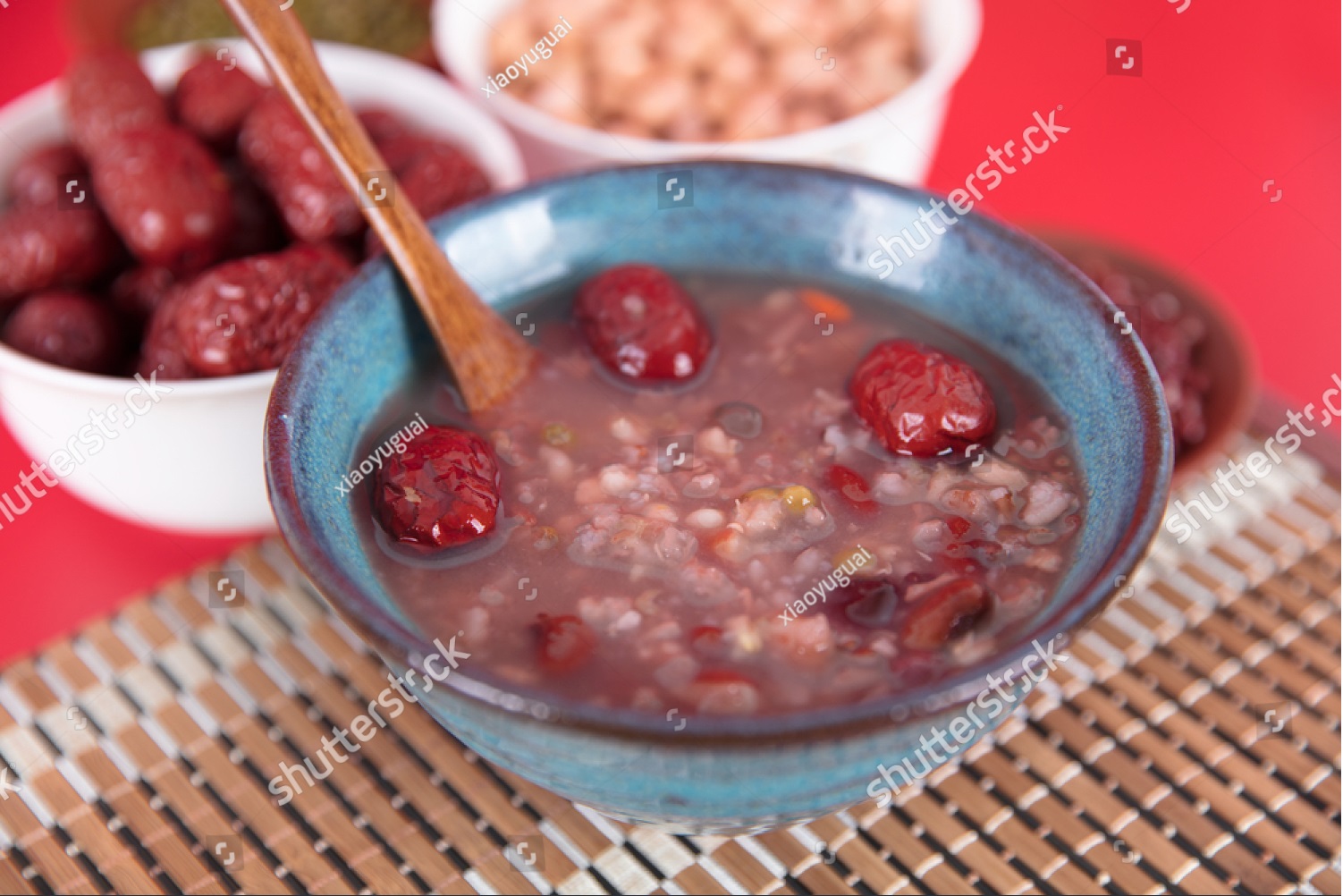
The traditional recipe calls for at least eight ingredients — the number eight echoing the "ba" (八) in Laba — though many families use twelve, sixteen, or more. A classic northern combination includes: glutinous rice (糯米) for body and sweetness; millet (小米) for golden color and earthy depth; red beans (红豆) and mung beans (绿豆) for substance and a faint vegetal bitterness; peanuts (花生) for richness; lotus seeds (莲子) for a delicate, starchy sweetness; dried red dates (红枣) for caramel warmth; and dried longan (桂圆) for a musky, honeyed note. Some versions add chestnuts, walnuts, pine nuts, sesame seeds, or dried lily bulbs. The result, after hours of slow simmering, is a porridge that is simultaneously sweet and savory, smooth and textured, a single bowl that contains the entire harvest in miniature.
Beijing-style Laba porridge tends toward richness: thick, sweet, loaded with dried fruits and nuts, often finished with a spoonful of osmanthus syrup or a scattering of candied hawthorn. It is a porridge that aspires to dessert. Jiangnan-style (the Shanghai-Suzhou-Hangzhou region) is more restrained: lighter in body, less sweet, with a greater proportion of plain rice and a subtle saltiness that makes it closer to a meal than a treat. Shaanxi-style Laba porridge is the most savory of all, sometimes incorporating noodles, tofu, and vegetables into the pot, producing something closer to a thick soup than a sweet congee. In Gansu and Ningxia, the porridge is made with wheat kernels and mutton broth, reflecting the northwestern palate's preference for heartiness over delicacy.
Laba Garlic: The Green Treasure in the Vinegar Jar
If Laba porridge is the festival's public face — communal, warm, immediately gratifying — then Laba garlic (腊八蒜, Làbā suàn) is its private mystery. On the eighth day of the twelfth month, families across northern China peel heads of fresh garlic, pack the cloves into glass jars, pour in aged black vinegar (老陈醋), seal the lids, and set the jars in a cold place — a windowsill, a balcony, an unheated cellar. Then they wait.
What happens over the next three weeks is a small chemical miracle. The acetic acid in the vinegar reacts with the sulfur compounds in the garlic, and the cloves slowly, dramatically turn green — first pale jade, then deep emerald, then a vivid, almost artificial-looking green that startles anyone encountering it for the first time. The transformation is entirely natural, entirely safe, and entirely dependent on timing: garlic pickled on any other day of the year will not turn green with the same intensity. The cold of the twelfth month and the specific enzymatic state of the garlic at that season are both required. It is a transformation that cannot be rushed or replicated out of season — which is, perhaps, why it feels magical.
The garlic is ready by Chinese New Year's Eve, when the jars are opened and the emerald cloves are served alongside dumplings. The vinegar, now infused with garlic's sharp sweetness, is used as a dipping sauce. The contrast is perfect: the hot, fatty richness of the dumpling against the cold, sharp, acidic bite of the green garlic. In Beijing, no New Year's Eve table is considered complete without a small dish of Laba garlic, its color startling against the white porcelain like a fragment of summer preserved in winter's depths.
The Temple Tradition: Porridge as Sacred Charity
The Buddhist connection to Laba is not merely historical; it is a living practice. Across China, major Buddhist monasteries still prepare and distribute Laba porridge on the eighth of the twelfth month, continuing a tradition that dates to the Song Dynasty (960–1279). The most famous of these distributions takes place at Yonghe Temple (雍和宫) in Beijing, the former residence of the Yongzheng Emperor and one of the largest Tibetan Buddhist monasteries outside Tibet. Each year, monks begin preparing the porridge days in advance, using enormous iron woks that have been in service for generations. On Laba morning, thousands of people queue in the freezing dawn, holding bowls and thermoses, waiting for their share of the consecrated porridge. The line can stretch for blocks. The wait can exceed two hours. People come not merely for the food but for the blessing — the belief that porridge prepared with sutras chanted over it carries a spiritual potency that no home kitchen can replicate.
Similar distributions occur at Lingyin Temple in Hangzhou, Daci'en Temple in Xi'an, and hundreds of smaller monasteries across the country. In some temples, the porridge is prepared according to recipes that have not changed in centuries — specific proportions of specific grains, stirred in a specific direction, ladled with a specific prayer. The act of giving porridge is understood as an expression of dana (布施, bùshī) — the Buddhist virtue of generosity — and of the recognition that enlightenment, like nourishment, is not meant to be hoarded. It is meant to be ladled out, freely, to whoever holds up a bowl.
Beyond Porridge: The Wider Laba Table
While porridge and garlic dominate the festival's culinary identity, Laba's table extends further in many regions. Laba tofu (腊八豆腐) is a specialty of Anhui province, particularly the Huizhou region: firm tofu is salted, pressed, and sun-dried in the winter air until it becomes dense, golden, and intensely savory — a preserved protein that will last through the New Year period. Laba noodles (腊八面) are traditional in Shaanxi and Gansu, where the porridge tradition yields to the wheat culture of the northwest: hand-pulled noodles are served in a broth thick with beans, vegetables, and diced meat, a warming alternative to the rice-based congee of the south.
In some areas of Hunan and Hubei, families prepare Laba meat (腊八肉) — pork belly cured with salt, star anise, and Sichuan pepper, then hung to dry in the cold winter wind. In parts of Zhejiang, Laba wine (腊八酒) is brewed: a sweet rice wine started on the eighth day and sealed until New Year, when it is opened and shared. Each of these preparations shares a common logic: Laba is the day when raw ingredients begin their transformation into preserved, intensified, festival-ready forms. The garlic enters the vinegar. The tofu enters the salt. The meat enters the wind. The grain enters the pot. Everything begins its journey toward the New Year table on the eighth of the twelfth month.
The Gateway to Spring Festival: Laba's Structural Role
To understand Laba's place in the Chinese year, one must see it not as an isolated event but as the opening measure of a month-long crescendo. The traditional New Year season does not begin on the first day of the first lunar month. It begins on Laba. From the eighth of the twelfth month forward, the pace of preparation accelerates in a rhythm codified by another folk rhyme, the "Busy Year Song" (忙年歌): "After Laba, it's a few days; on the twenty-third, sacrifice to the Kitchen God; on the twenty-fourth, sweep the house; on the twenty-fifth, grind tofu; on the twenty-sixth, buy meat; on the twenty-seventh, slaughter the chicken; on the twenty-eighth, make dough; on the twenty-ninth, steam mantou; on New Year's Eve, stay up all night; on New Year's Day, bow and congratulate."
Laba is the starting gun. Before it, the twelfth month is merely cold. After it, every day has a task, a food, a ritual attached. The porridge is the first communal act of the New Year season — the moment when the household collectively acknowledges that the old year is ending and the work of renewal has begun. Children understand this intuitively, which is why the rhyme addresses them directly: "Don't be greedy." The treats are coming. The dumplings, the candies, the firecrackers, the red envelopes — all of it is three weeks away. But first, the porridge. First, the slow, patient, communal act of turning raw grain into something warm. First, the reminder that abundance is built from small ingredients, gathered one by one, and that the best things require time.
"腊七腊八,冻死寒鸦。"
— Northern Chinese folk saying: "On the seventh and eighth of the La month, even the crows freeze to death."
The saying acknowledges the brutal cold in which Laba falls — and the porridge is the answer to it. Not a grand answer. Not a feast or a banquet or a spectacle. Just a bowl of grain, simmered soft, sweetened with dates, shared around a table while the crows huddle on the bare branches outside. It is enough. It has always been enough. For three thousand years, in the coldest week of the coldest month, China has ladled out this bowl and said: the year is turning. The harvest is remembered. The ancestors are honored. The Buddha is awake. And spring, though invisible, though still eight nines away, has already begun its long walk north. Eat. Be warm. The New Year is coming.
A Bowl That Holds the Year
There is something profoundly democratic about Laba porridge. It requires no skill beyond patience. It demands no expensive ingredients — a handful of rice, a few beans, two or three dates will suffice. It can be made in a palace kitchen or over a campfire. Emperors ate it. Beggars ate it. Monks ate it. Farmers ate it. Children ate it while counting the days to firecrackers. The elderly ate it while counting the years they had left. Everyone ate the same thing, from the same pot, on the same morning, in the same cold. In a culture that otherwise observes elaborate hierarchies of rank, region, and ritual propriety, Laba porridge is the great leveler: a single bowl that says, whatever else divides us, we are all hungry, we are all cold, and we are all waiting for the year to turn. Ladle it out. Pass it around. The New Year begins with this.