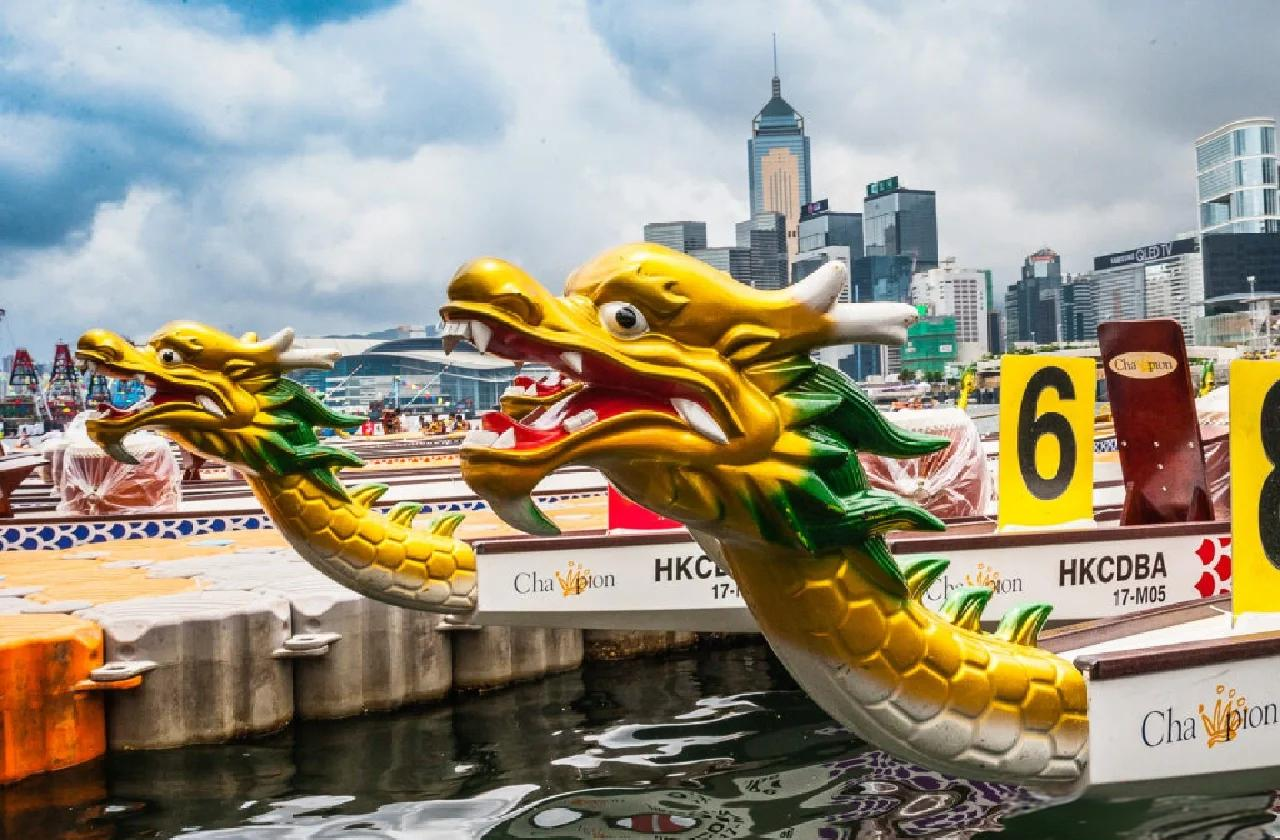
The drums begin before dawn. Along the riverbanks of a hundred Chinese cities — from the misty gorges of the Yangtze tributaries to the broad Pearl River delta, from the ancient canals of Suzhou to the reservoirs of suburban Beijing — teams of paddlers gather in the half-light, their boats painted in fierce dragon livery, their muscles oiled and ready. The air smells of mugwort and calamus, of freshly steamed glutinous rice wrapped in bamboo leaves, of the sharp mineral tang of realgar wine. Children wear embroidered sachets around their necks and five-colored threads around their wrists. Something ancient is stirring. The fifth day of the fifth lunar month has arrived, and with it, the Dragon Boat Festival — Duānwǔ Jié (端午节) — the most vigorous, most visceral, most physically exhilarating of all Chinese celebrations.
Where other festivals emphasize quiet reverence or domestic warmth, the Dragon Boat Festival is spectacle and exertion. It is the thunder of drums, the spray of paddles, the roar of crowds. It is also, beneath the adrenaline, a festival of protection — a day when the Chinese traditionally guarded themselves against the diseases, poisons, and evil spirits believed to proliferate in the dangerous heat of early summer. To celebrate Duānwǔ is to race, to feast, to ward, and to remember — all at once, all with full force.
The Legend of Qu Yuan: A Poet's Final Protest
The Dragon Boat Festival's most enduring story belongs to Qu Yuan (屈原, c. 340–278 BCE), a minister and poet of the state of Chu during the Warring States period. Qu Yuan was brilliant, passionate, and politically doomed. He advocated an alliance with the state of Qi against the aggressive expansion of Qin, but his counsel was rejected by a corrupt court that preferred appeasement. Slandered by jealous rivals, he was exiled by his own king — an act of betrayal that shattered him.
During his years of wandering exile, Qu Yuan composed some of Chinese literature's most powerful poetry: the "Li Sao" (离骚, "Encountering Sorrow"), the "Nine Songs" (九歌), the "Heavenly Questions" (天问) — works of extraordinary emotional intensity, rich with shamanic imagery, mythical allusions, and anguished loyalty to a state that had cast him out. When word reached him in 278 BCE that Qin's armies had finally conquered Chu's capital, Ying, Qu Yuan's grief became absolute. On the fifth day of the fifth month, he walked to the banks of the Miluo River in present-day Hunan province, clasped a heavy stone to his chest, and drowned himself.
The legend continues: local fishermen, who loved and admired Qu Yuan, raced out in their boats to search for his body, beating drums and splashing their oars to drive away fish and water dragons. They threw lumps of rice into the river to feed the creatures so they would not devour the poet's remains. When the rice was eaten by a river dragon rather than the fish, Qu Yuan's spirit appeared in a dream and suggested wrapping the rice in silk (later bamboo leaves) and binding it with five-colored thread — colors the dragon feared. Thus were born the twin traditions of dragon boat racing and eating zongzi.
Other Origins: Wu Zixu, Cao E, and the Evil Month
While Qu Yuan's story dominates popular memory, scholars note that the Dragon Boat Festival likely predates him by centuries and has multiple origin strands. In the Wu region (around modern Suzhou), the festival commemorates Wu Zixu (伍子胥), a loyal minister who was forced to commit suicide by the King of Wu after warning against the state's complacency. His body was thrown into the river on the fifth of the fifth month, and locals raced boats to honor his memory — a tradition that may predate the Qu Yuan association.
In Zhejiang, the festival honors Cao E (曹娥), a fourteen-year-old girl who drowned herself in the Shun River in 143 CE while searching for her father's body. Her filial devotion so moved the community that a temple was built in her honor, and the river was renamed the Cao'e River. Her story adds the dimension of filial piety to the festival's already rich symbolic palette.
Beneath these narrative origins lies an older, more fundamental layer: the folk belief that the fifth lunar month is an "evil month" (恶月). The number five is the most yang of numbers, and the fifth day of the fifth month represents a dangerous concentration of yang energy. As summer heat intensifies, insects multiply, diseases spread, and the boundary between the human and spirit worlds thins. The festival's protective customs — hanging aromatic herbs, drinking realgar wine, bathing in herbal waters — are essentially a community-wide health ritual, an ancient public health campaign dressed in the language of exorcism.
Customs of Protection: Mugwort, Realgar, and Five Colors
Every doorway on Duānwǔ morning is adorned with bundles of mugwort (艾草, àicǎo) and calamus (菖蒲, chāngpú), their pungent aromas believed to repel insects, purify the air, and drive away evil spirits. The sword-shaped leaves of calamus are sometimes arranged to resemble a warrior's blade, symbolically cutting through negative influences. In some regions, the herbs are shaped into small figures of tigers — the tiger being the ultimate yang creature and guardian against evil.
Realgar wine (雄黄酒, xiónghuáng jiǔ) — rice wine infused with the mineral realgar (arsenic sulfide) — was traditionally drunk by adults and dabbed on children's foreheads, ears, and palms as a protective charm. The practice appears in the famous legend of the White Snake (白蛇传), in which the serpent spirit Bai Suzhen is forced to reveal her true form after drinking realgar wine on Duānwǔ. While modern health awareness has largely replaced realgar consumption with ordinary rice wine or herbal teas, the symbolic gesture persists in folk memory.
Children wear perfume pouches (香囊, xiāngnáng) — small embroidered silk bags filled with aromatic herbs like lavender, mint, and cloves — pinned to their clothing or hung around their necks. The five-color silk threads (五色丝线) tied around wrists and ankles represent the five elements (wood, fire, earth, metal, water) and the five directions, creating a complete protective circle around the child's body. These threads are not removed until the first summer rain, when they are thrown into the river to carry misfortune away.
Zongzi: The Festival's Edible Heart
If the dragon boat race is the festival's body, zongzi (粽子) are its soul. These parcels of glutinous rice, wrapped in bamboo or reed leaves and tied with string, are the single most iconic food of the Dragon Boat Festival — and the subject of one of Chinese cuisine's great regional debates. The north-south divide in zongzi is passionate, playful, and essentially unresolvable.
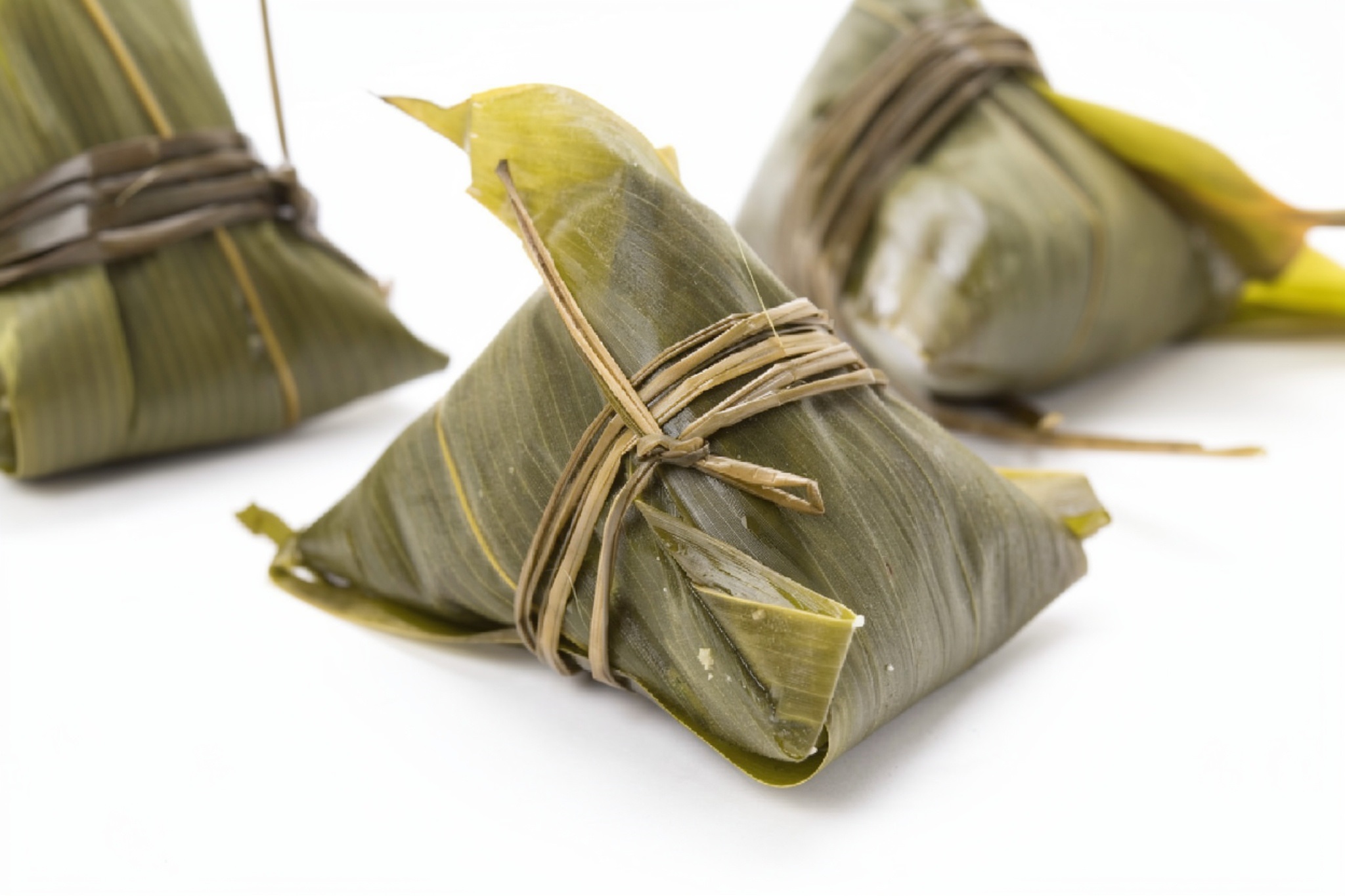
In northern China, zongzi tend toward sweetness: glutinous rice studded with red dates (jujubes), sweetened bean paste, or simply plain rice dipped in sugar. The shape is typically a compact tetrahedron, tightly wrapped, dense and chewy. In the south — particularly in Guangdong, Fujian, and Zhejiang — zongzi are savory and lavish: glutinous rice enriched with soy sauce and wrapped around fillings of braised pork belly, salted duck egg yolk, shiitake mushrooms, chestnuts, dried shrimp, and mung beans. A single southern zongzi can be a complete meal, rich and complex, its bamboo-leaf wrapping infusing the rice with a subtle vegetal fragrance that no other cooking method replicates.
The preparation of zongzi is itself a ritual. Families gather in the days before the festival to soak rice, prepare fillings, and wrap the parcels together — a communal activity that reinforces family bonds and passes culinary knowledge between generations. The wrapped zongzi are then boiled or steamed for hours, filling the house with the green, grassy scent of heated bamboo leaves. To unwrap a zongzi at the table, peeling back the leaf to reveal the glistening rice within, is to perform a small act of revelation that has been repeated, in essentially the same form, for over two thousand years.
The Dragon Boat Race: From River Ritual to World Sport
The dragon boat race (赛龙舟, sài lóngzhōu) is among the most thrilling spectacles in Chinese culture. Traditional boats are long, narrow vessels — up to thirty meters in length — carved and painted to resemble dragons, with an ornate dragon head at the prow and a tail at the stern. A crew of twenty paddlers sits in pairs, driving their blades through the water in perfect synchronization, guided by a drummer at the bow whose beats set the rhythm and a steersman at the stern who reads the current. Races are short — typically 200 to 500 meters — and explosively intense, decided by fractions of a second.
What began as a local river ritual has become a global competitive sport. The International Dragon Boat Federation, founded in 1991, now includes over eighty member nations. Races take place on the Thames in London, the Charles River in Boston, Sydney Harbour, and the canals of Amsterdam. University teams, corporate crews, and community clubs train year-round, and the sport has become a vehicle for cross-cultural exchange and Chinese diaspora pride. In China itself, major races in cities like Yueyang (on Dongting Lake, near Qu Yuan's Miluo River), Guangzhou, and Hong Kong draw hundreds of thousands of spectators and are broadcast nationally.
Yet for all its modern sporting gloss, the race retains its sacred undertone. Before competition, teams perform ceremonies to "awaken" the dragon — painting the eyes of the dragon head in a ritual called 点睛 (diǎn jīng), "dotting the pupils," which transforms the carved wood into a living spirit. Offerings are made to the river. The drum that sets the paddlers' rhythm is the same drum that, in legend, frightened away the water creatures that threatened Qu Yuan's body. The race is sport, yes — but it is also prayer, also memorial, also the community's collective body moving in unison toward a shared purpose.
UNESCO Recognition and the Festival's Global Future
In 2009, the Dragon Boat Festival was inscribed on UNESCO's Representative List of the Intangible Cultural Heritage of Humanity — the first Chinese festival to receive this distinction. The recognition affirmed what practitioners had always known: that Duānwǔ is not merely a holiday but a living cultural system encompassing oral traditions (the legends of Qu Yuan, Wu Zixu, and Cao E), performing arts (dragon boat racing, folk songs sung during zongzi preparation), traditional craftsmanship (zongzi-making, sachet embroidery, boat carving), and social practices (community feasting, protective rituals, family gathering).
The UNESCO inscription also brought challenges. As the festival gains international visibility, questions arise about authenticity and commercialization. Mass-produced zongzi from factories compete with handmade family recipes. Tourism-driven dragon boat events sometimes prioritize spectacle over meaning. Yet the festival's history suggests resilience: it has absorbed Buddhism, Confucianism, regional variation, revolution, and modernization over two millennia, adapting its forms while preserving its core. The fifth of the fifth month still arrives. The drums still sound. The rice is still wrapped in leaves.
"路漫漫其修远兮,吾将上下而求索。"
"The road ahead is long and without end; yet high and low, I shall search with all my will."
— Qu Yuan (屈原), "Li Sao" (离骚), c. 300 BCE
These lines, written by the poet whose death the festival commemorates, have become a motto for perseverance in Chinese culture. They are recited by students before examinations, quoted by leaders in times of national challenge, and whispered by anyone who has ever faced a long, uncertain road and chosen to walk it anyway. That Qu Yuan's words still live, still inspire, still echo in the hearts of those who race their boats each fifth month — this is the festival's deepest miracle. Not the rice, not the drums, not the silk threads or the realgar wine, but the persistence of a voice across twenty-three centuries, still urgent, still searching, still refusing to be silent.
The Fifth Month and the Triumph of Yang
To understand the Dragon Boat Festival fully, one must understand the Chinese cosmological framework in which it sits. The number five occupies a central position in Chinese numerology: five elements, five directions, five colors, five tastes. As an odd number, five belongs to yang — the active, masculine, solar principle. The fifth month, containing the fifth day, represents a doubling of this yang energy, a moment when the life force reaches a peak so intense it becomes dangerous, like a fire that must be carefully tended lest it consume the house.
The festival's customs are, in this reading, a technology for managing excess yang. The dragon boat race channels aggressive energy into disciplined competition. The aromatic herbs purify and balance. The five-color threads create a microcosmic circuit of elemental harmony around the vulnerable body. Even the zongzi, with their wrapping of yin (the cool, green leaf) around yang (the warm, dense rice), enact a small cosmological balance in every bite. The festival is, at its philosophical core, an act of cosmic maintenance — humanity's annual contribution to keeping the universe in equilibrium during its most volatile season.
The ChinaMaxxing philosophy sees in the Dragon Boat Festival a model of engaged, embodied culture. This is not a festival of passive observation but of full physical participation — paddling, wrapping, climbing, tying, drinking, racing. The body is not separate from the meaning; the body is the meaning. To wrap a zongzi with your own hands, to feel the drum's vibration in your chest as the boat surges forward, to tie a five-color thread around a child's wrist and whisper a blessing — these are not quaint survivals. They are acts of cultural creation, performed anew each year by a civilization that understands, in its bones, that tradition lives only in the doing.