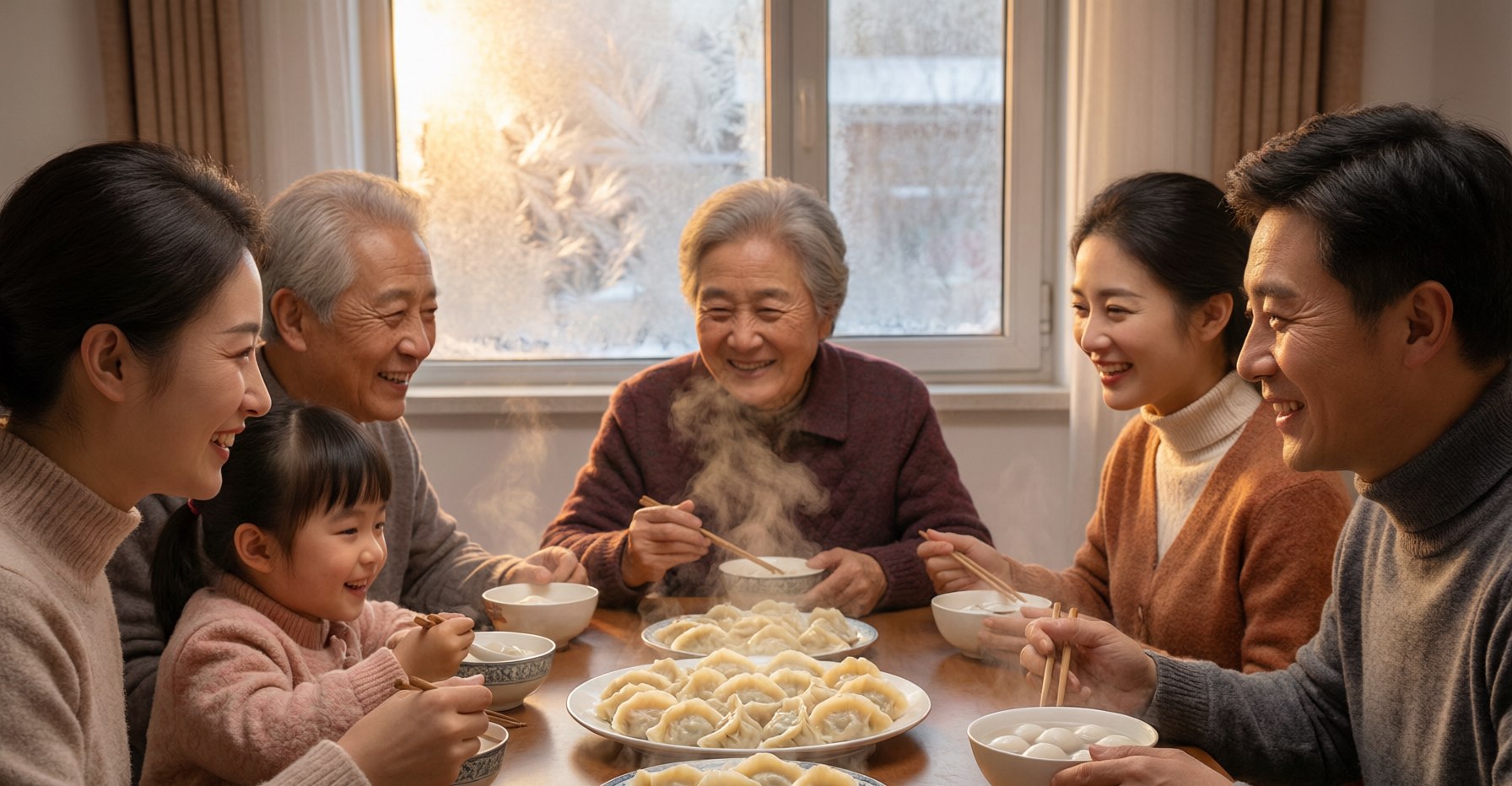
There is a single day each year when the darkness wins. The sun traces its shortest arc across the sky, the shadows stretch to their annual maximum, and night holds the earth longer than at any other moment. In the Northern Hemisphere, this occurs between December 21 and 23. In China, the day is called Dongzhi (冬至, Dōngzhì) — "Winter's Arrival" or "Winter's Extreme" — and it is, paradoxically, a celebration. Not of darkness, but of the precise instant at which darkness exhausts itself and begins, imperceptibly, to yield. The solstice is not the bottom of the year. It is the turning point. And for over three thousand years, Chinese civilization has marked it as one of the most significant days on the calendar — a day when, in the words of the old proverb, "冬至大如年": Winter Solstice is as great as New Year.
The Cosmology of Return: One Yang Line Beneath Five Yin
To grasp why the Chinese solstice is a festival of hope rather than despair, one must enter the symbolic logic of the Yijing (Book of Changes). In its system of sixty-four hexagrams, each composed of six stacked lines (broken for yin, unbroken for yang), the solstice corresponds to the hexagram Fu (复, "Return"). Its structure is striking: five broken yin lines stacked above a single unbroken yang line at the very bottom. Maximum darkness above. But beneath it — at the foundation, in the deepest place — one unbroken line of light has reappeared.
This is the philosophical heart of Dongzhi. Yin — cold, darkness, contraction, stillness, death — has reached its absolute peak. It cannot grow further. And so, by the inescapable logic of Chinese dialectical thought, its opposite is already being born. The single yang line at the bottom of hexagram Fu is the first spark of returning warmth, the first lengthening of the day, the first whisper of spring in the depths of winter. It is invisible to the eye — the weather will grow colder for weeks yet — but it is real, structural, cosmically guaranteed. The solstice is the moment the universe changes its mind.
This reading gave Dongzhi its emotional character: not the bleak midwinter of Northern European tradition, huddled against the dark, but a day of quiet confidence. The worst is not ahead. The worst is now, and it is already passing. Every day from here forward, the light returns. The ancients expressed this astronomically: on the solstice, the sun reaches its southernmost point and begins its northward journey. The gnomon — the upright stick used in ancient Chinese astronomy — casts its longest shadow at noon, and from the next day, the shadow shortens. The sun is coming back. It always comes back.
Older Than the Empire: Dongzhi in Chinese History
Dongzhi is among the oldest festivals in Chinese civilization — older than the imperial system itself. Archaeological evidence from the Shang Dynasty (c. 1600–1046 BCE) suggests that solstice observations were already being recorded. The Zhou Dynasty (1046–256 BCE) went further: it used the winter solstice as its New Year. The first month of the Zhou calendar began at Dongzhi, making the solstice not merely a festival but the hinge of the entire year. Officials received congratulations. Markets closed. Families gathered. The emperor performed grand sacrifices to Heaven.
When the Han Dynasty (206 BCE–220 CE) reformed the calendar and moved New Year to the first lunar month, Dongzhi lost its status as the year's beginning but retained enormous prestige. The Hou Hanshu (Book of the Later Han) records that on the solstice, the emperor received no official business, and all government offices closed for five days. Officials exchanged gifts. The day was treated with the same ceremonial gravity as the New Year itself — hence the proverb "冬至大如年," which survives to this day.
Through the Tang, Song, Ming, and Qing dynasties, Dongzhi remained a major state occasion. The Ming and Qing emperors performed the grand Sacrifice to Heaven (祭天) at the Temple of Heaven in Beijing on the solstice — the most solemn ritual in the imperial liturgical calendar, conducted in the freezing pre-dawn darkness at the circular open-air altar, where the emperor, as Son of Heaven, renewed the cosmic contract between the human and celestial realms.
Zhang Zhongjing and the Frostbitten Ears: The Dumpling Legend
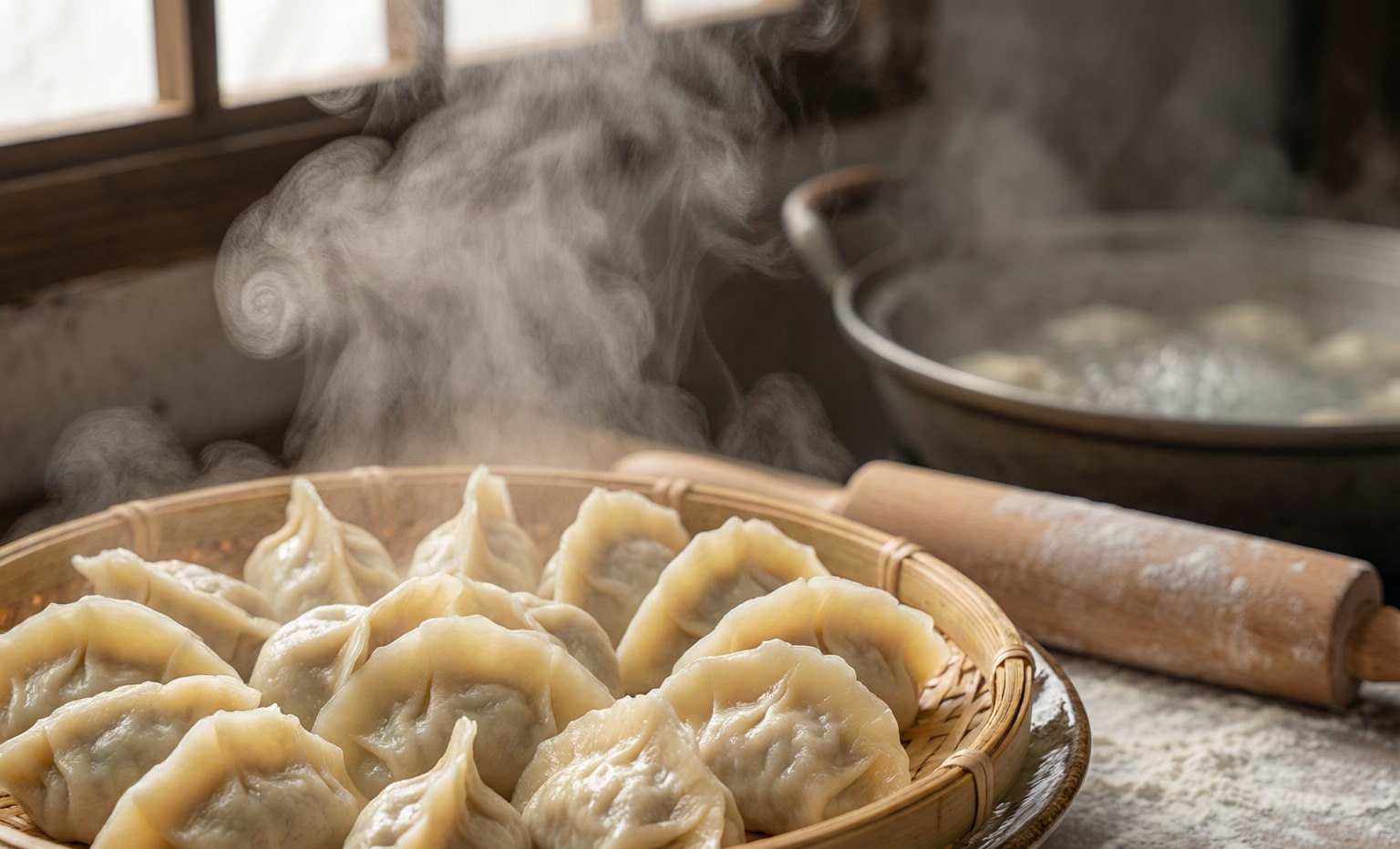
In northern China, Dongzhi means dumplings (饺子, jiǎozi). The association is explained by one of Chinese culture's most beloved origin legends, centered on Zhang Zhongjing (张仲景, c. 150–219 CE), the "Sage of Medicine" (医圣) whose treatise Shanghan Zabing Lun remains a foundational text of traditional Chinese medicine.
The story is set in the chaos of the late Eastern Han Dynasty. Zhang Zhongjing, having served as prefect of Changsha, retired to his home village in Nanyang, Henan. He arrived in the depths of winter to find his neighbors starving and sick. The cold had ravaged the poor: their ears were frostbitten, blackened, peeling. They had no medicine, no warm clothing, no adequate food. Zhang Zhongjing set up a great cauldron in the village square and prepared a remedy he called "Quhan Jiao'er Tang" (祛寒娇耳汤) — "Soup to Dispel Cold and Protect Tender Ears." He boiled mutton, chili peppers, and warming herbs, chopped them fine, wrapped them in small pieces of dough shaped like ears, and boiled the parcels in the broth. He distributed them free to every villager. The "jiao'er" (娇耳, "tender ears") — the ancestors of today's jiaozi — warmed the blood, drove out the cold, and healed the frostbitten ears.
Zhang Zhongjing continued distributing the soup from Dongzhi through New Year. He died on the twenty-second day of the twelfth lunar month, and the people of Nanyang, grieving, continued making "jiao'er" on the solstice in his memory. The legend may be apocryphal — food historians debate whether wrapped dumplings truly date to the Han Dynasty — but its emotional truth is undisputed. In the north, to eat dumplings on Dongzhi is to remember that medicine and food were once the same thing, and that the purpose of knowledge is to feed the hungry and warm the cold.
Tangyuan and the Southern Table: Reunion in a Bowl
South of the Yangtze, the solstice table looks different. Here, the signature food is tangyuan (汤圆, tāngyuán) — small, round dumplings of glutinous rice flour, filled with sesame, peanut, or red bean paste, boiled in a sweet syrup or plain broth. Their name is a pun: tangyuan sounds like tuanyuan (团圆, "reunion"), and their round shape echoes the fullness of family gathered together. Eating tangyuan on Dongzhi is an act of symbolic reunion — a declaration that the family circle is unbroken, that no one is missing from the table.
In some southern regions, particularly Fujian and Guangdong, tangyuan-making is a communal family event. Grandmothers roll the dough; children shape the balls, making some comically oversized, some tiny as peas. A superstition holds that the number of tangyuan you eat determines how many years older you become — "吃了汤圆大一岁" ("eat tangyuan, grow a year older") — so children eagerly count their bowls while elders laugh and warn them against greed.
Regional solstice foods extend far beyond dumplings and tangyuan. In Shandong and Hebei, families eat mutton soup (羊肉汤) — rich, milky-white broths simmered for hours with ginger, scallion, and white pepper, designed to flood the body with warmth. In Jiangnan, people eat rice cakes (年糕, niángāo) and red-bean congee. In Sichuan, the solstice calls for a communal hot pot, its bubbling red broth a small sun on the table. In parts of Guangdong, families roast a whole pig or prepare a banquet of "nine dishes" (九菜) to honor the number of the solstice's cosmic significance.
Counting the Nines: Eighty-One Days to Spring
One of Dongzhi's most charming customs is Shu Jiu (数九, "Counting the Nines") — the practice of counting the eighty-one days from the solstice to the arrival of spring. The period is divided into nine segments of nine days each. The first nine days (一九) are merely cold. The third and fourth nines (三九, 四九) are the bitterest cold of the year — "三九四九冰上走" ("in the third and fourth nines, you can walk on the ice"). By the seventh nine (七九), the rivers thaw. By the ninth nine (九九), geese fly north and the farmers return to the fields.
The "Nine Nines Song" (九九歌) is a folk rhyme, varying by region, that narrates this progression. A common northern version runs:
"一九二九不出手,三九四九冰上走,五九六九沿河看柳,七九河开,八九燕来,九九加一九,耕牛遍地走。"
— Traditional Northern Chinese "Nine Nines Song" (九九歌)
In translation: "In the first and second nines, keep your hands in your sleeves. In the third and fourth nines, walk upon the ice. In the fifth and sixth nines, watch the willows along the river. In the seventh nine, the river opens. In the eighth nine, the swallows return. In the ninth nine, plus one more nine, oxen plow every field." The song transforms the long wait of winter into a narrative with a known ending — a countdown that makes endurance bearable by giving it structure and direction.
A related custom is the "Nine Nines Cold-Dispelling Chart" (九九消寒图): a drawing of a plum branch with exactly eighty-one petals (nine blossoms of nine petals each), or eighty-one circles arranged in a grid. Beginning on Dongzhi, one petal or circle is colored in each day. When the last is filled, winter is over. In some versions, the color chosen for each day records the weather — red for sun, blue for wind, black for rain, white for snow — creating, by spring, a folk meteorological chart that is also a work of art.
Ancestor Worship and the Winter Table
Dongzhi has always been a day for the dead as well as the living. Ancestor worship (祭祖, jìzǔ) on the solstice dates to the Zhou Dynasty and persists across China. Families set places at the table for departed relatives, pour wine on the ground, burn incense and paper money, and speak the names of those who are no longer present. In some regions, entire clans gather at ancestral halls to perform collective rites, reading genealogies aloud and reaffirming the bonds of lineage. The logic is cosmological: at the moment when yang energy is reborn, when life reasserts itself against entropy, it is proper to remember those from whom one's own life descended. The returning light illuminates the past as well as the future.
In southern China, particularly among Hakka and Cantonese communities, Dongzhi ancestor worship can be as elaborate as Qingming (Tomb-Sweeping Day). Whole roasted pigs, fruits, rice wines, and incense are carried to gravesites. Families clean the tombs, repair the earth, and share a meal in the cemetery — the living and the dead eating together under the winter sun, which is lower and gentler than in summer, as though the sky itself is leaning closer to the ground to listen.
Nourishing Yang: Dongzhi in Traditional Medicine
Traditional Chinese medicine (TCM) regards Dongzhi as the most important day of the year for health cultivation (养生, yǎngshēng). The logic follows directly from the cosmology: if this is the day when yang energy is reborn, then the body must be supported in nurturing that fragile new spark. The solstice marks the beginning of a period of intensive tonification — eating warming, nourishing foods; avoiding excessive exertion; sleeping early and rising late; protecting the kidneys (the organ associated with winter and with the body's deepest reserves of vital energy).
The classic solstice prescription is "冬令进补" (dōnglìng jìnbǔ) — "winter tonification." Families prepare medicinal soups with astragalus (黄芪), angelica root (当归), goji berries (枸杞), and red dates (红枣). Lamb, venison, and black-bone chicken are favored proteins for their warming properties. Ginger, cinnamon, and star anise appear in every pot. The elderly, in particular, are urged to "store essence" (藏精) during the winter months, building reserves that will carry them through the depletions of spring and summer. A common saying advises: "今年冬令补,明年可打虎" — "Tonify well this winter, and next year you could fight a tiger." The hyperbole is affectionate, but the principle is sincere: rest now, nourish now, and the body will repay the debt with interest when the world demands energy again.
The Longest Night, Gathered Close
In the end, Dongzhi is a festival about the domestic sacred. It does not require fireworks or parades or the manic commerce of the lunar New Year. It asks only that you come home, sit down, and eat something warm with the people who matter. In northern apartments, families fold dumplings together — the pleating a skill passed from grandmother to grandchild, the filling a recipe argued over every year. In southern kitchens, the sweet smell of sesame tangyuan fills the air while children press their noses to the window, watching the early dark descend. The television murmurs. The broth simmers. Outside, the longest night of the year settles over the land like a held breath.
And somewhere beneath all that darkness, invisible but certain, the single yang line stirs. The sun has already begun its journey north. The plum branch chart has one more petal to color. The geese are eight nines away. The light is coming back. It is, in fact, already here — in the steam rising from the bowl, in the laughter across the table, in the ancient, stubborn Chinese insistence that the darkest day is not a day for mourning but for celebration. Pour the wine. Fold the dumpling. Roll the tangyuan. The year is turning. Eat, and be warm.