Ask an educated Chinese person to name the most fascinating era in four thousand years of history, and there is a very good chance the answer will be the same: the Three Kingdoms. It is a strange choice, on the surface. The period lasted barely sixty years, was drenched in blood, and ended not in glory but in exhaustion and conquest. By any measure of human welfare it was a catastrophe — census figures from the era suggest a population reduced to a fraction of what it had been under the Han. And yet no other age has so thoroughly colonized the Chinese imagination. Its heroes are worshipped as gods. Its stratagems are quoted in boardrooms and classrooms. Its story has been told and retold in opera, in novels, in film, and now in video games played by hundreds of millions. The Three Kingdoms is the period China loves most — and to understand why is to understand something essential about how the Chinese remember their own past.
The Long Fall of the Han
The Three Kingdoms did not begin with three kingdoms. It began with the slow, agonizing death of one empire. The Han Dynasty, which had ruled China for four centuries and given the Chinese people the name they still use for themselves, did not collapse in a day. It rotted from within. In its final decades the throne was occupied by a succession of child emperors, each a puppet in the hands of competing factions — eunuchs, imperial in-laws, and scholar-officials — who tore one another apart in the capital while the provinces slipped beyond control. A vast peasant uprising, the Yellow Turban Rebellion of 184 CE, named for the yellow cloths its followers tied around their heads, shook the dynasty to its foundations. It was suppressed, but only by arming regional governors and local strongmen, who never gave the power back.
What followed was the warlord era — a generation of chaos in which the empire fractured into the private domains of military adventurers. The emperor himself became a prize to be seized and paraded, a living symbol whose possession lent a warlord's ambitions a veneer of legitimacy. The most gifted of these strongmen was Cao Cao (曹操), a brilliant, ruthless, and — in the popular telling — gloriously villainous commander from the north. Cao Cao understood the value of symbols: he took the helpless Han emperor under his "protection" and ruled in his name, expanding his territory across the northern plains while his rivals squabbled. He was a poet as well as a general, and his verses — somber meditations on the brevity of life and the hunger for talent — still appear in Chinese schoolbooks. History has not been kind to him, but it has never quite been able to look away.
Three States, Three Visions
By the 220s, the chaos had sorted itself into three durable powers, each claiming to be the true heir of the Han. In the north, Cao Cao's son Cao Pi (曹丕) forced the last Han emperor to abdicate and proclaimed a new dynasty, Cao Wei (曹魏). It was the wealthiest and most populous of the three, controlling the ancient heartland of Chinese civilization. In the mountainous southwest, a warlord named Liu Bei (刘备) — who claimed, plausibly or not, descent from the Han imperial house — founded the state of Shu Han (蜀汉), styling himself the restorer of the fallen dynasty. And in the southeast, behind the natural moat of the Yangtze River, the young lord Sun Quan (孙权) consolidated the state of Eastern Wu (东吴), a maritime power of rivers, lakes, and rice paddies whose strength lay in its navy.
The three states embodied three different ideas of legitimacy. Wei had power and the trappings of the old capital. Shu had blood — the claim of dynastic continuity, the righteous cause of a fallen house. Wu had geography — the unassailable south. Around each court gathered a constellation of generals and strategists whose names would become household words: the fearless warriors Guan Yu and Zhang Fei at Liu Bei's side, the dashing young commander Zhou Yu in Wu, and — towering above them all in later legend — the strategist Zhuge Liang (诸葛亮), the "Sleeping Dragon," whom Liu Bei is said to have visited three times in his thatched cottage to persuade him to enter the world. Zhuge Liang would become, in the Chinese mind, the very archetype of the brilliant counselor: the man who could borrow arrows from the enemy in a fog, summon the east wind, and outthink any army ever fielded against him. How much of this is history and how much is invention we will come to shortly.
"The empire, long divided, must unite; long united, must divide. Thus it has ever been." — opening line of Romance of the Three Kingdoms, attributed to Luo Guanzhong (14th century)
Fire on the River: The Battle of Red Cliffs
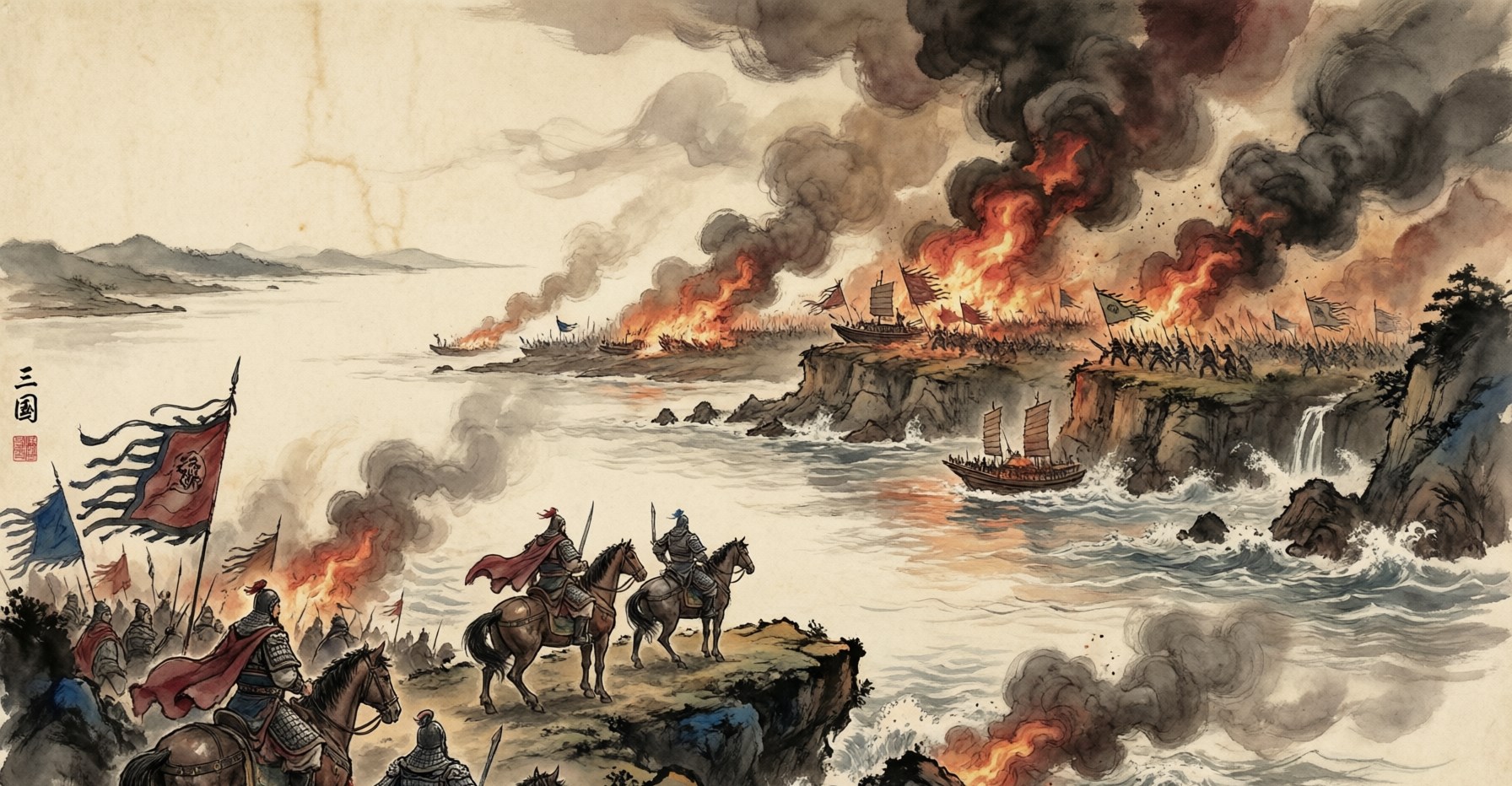
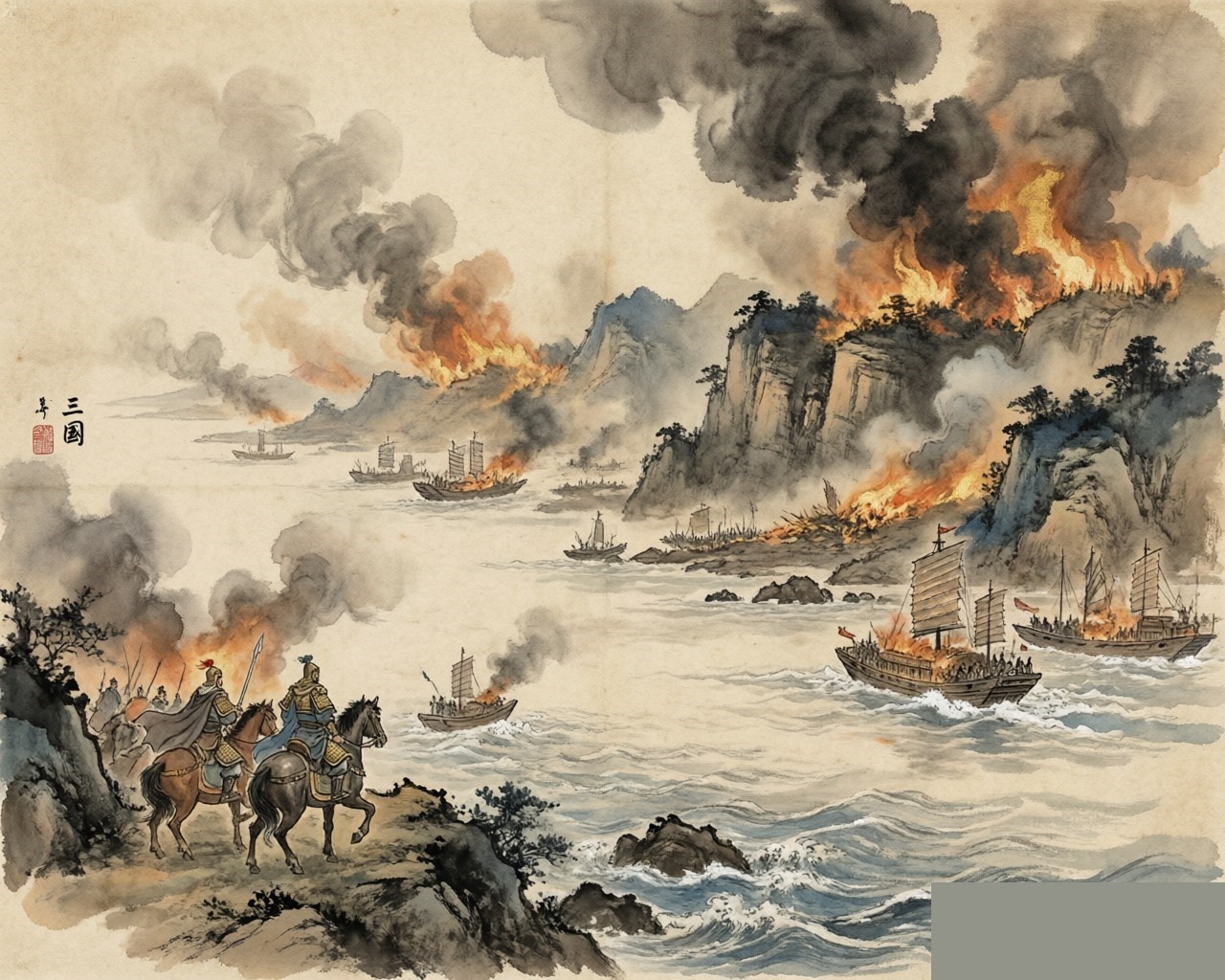
If the Three Kingdoms has a single defining moment, it is the Battle of Red Cliffs (赤壁之战, Chibi zhi zhan), fought on the Yangtze in the winter of 208 CE. Cao Cao, having swept through the north, marched south at the head of a vast army — the novel claims eight hundred thousand men, a figure historians treat as a dramatic exaggeration, though it was certainly the largest force the age had seen. His aim was nothing less than the reunification of China under his own hand. Against him stood the desperate alliance of Liu Bei and Sun Quan, outnumbered and outgunned, their only advantages the river itself and the counsel of brilliant men.
What happened next is the founding myth of the era. Cao Cao's northern soldiers, unused to warfare on water and ravaged by disease, chained their ships together to steady them. The allied commanders saw their chance. In the most celebrated ruse in Chinese military lore, the Wu general Huang Gai feigned defection and sailed toward the enemy fleet with ships loaded not with surrendering troops but with kindling and oil. When the wind shifted to the southeast, the fire ships were loosed. The chained Wei fleet, unable to scatter, burned. Cao Cao's grand invasion collapsed in a single night of flame on the water, and he fled north with the remnants of his army. China would not be reunited in his lifetime — nor for another generation. The battle fixed the three-way division of the empire, and it lodged in the memory of the culture as the supreme example of how intelligence, timing, and a favorable wind can defeat overwhelming force.
Romance and History: Two Versions of the Past
To speak of the Three Kingdoms is to confront an unusual problem: there are, in effect, two of them. The first is the historical period, recorded in the sober official chronicle, the Sanguozhi (Records of the Three Kingdoms), compiled by the historian Chen Shou in the third century. The second is the legendary one, immortalized more than a thousand years later in the Ming Dynasty novel Sanguo Yanyi — the Romance of the Three Kingdoms, attributed to Luo Guanzhong in the fourteenth century. It is the second version that most people, in China and beyond, actually know.
The novel is one of the Four Great Classical Novels of Chinese literature and arguably the most influential work of fiction in the Chinese language. It took the dry bones of the official histories and clothed them in drama, moral clarity, and unforgettable character. In its telling, Liu Bei is the virtuous underdog, the benevolent hero fighting to restore a stolen dynasty; Cao Cao is the magnificent villain, the "hero of chaos" who famously declares that he would rather betray the whole world than let the world betray him; and Zhuge Liang is elevated from a capable administrator into something close to a wizard of war. The novel's famous verdict — that the story is "seven parts fact, three parts fiction" — is itself a generous estimate of the fiction. Whole episodes beloved by readers, from the borrowing of arrows in the fog to the summoning of the wind at Red Cliffs to Zhuge Liang's empty-city bluff, are inventions or embellishments with little basis in the historical record.
And yet the romance did something the histories never could: it gave the Chinese a shared moral vocabulary. Generations learned from it what loyalty looked like, what treachery looked like, and what it meant to serve a righteous cause one knew might fail. The novel's tragic arc — the heroes strive, the heroes fall, and the prize goes not to the virtuous but to the patient — resonated with a culture deeply schooled in the impermanence of all things. It is no accident that the book opens with a meditation on division and unity. It speaks to something the Chinese have always understood: that empires rise and fall, and that what endures is the story told about them.
The Cult of Loyalty and the God of War
Of all the figures the era produced, none was more transformed by later memory than Guan Yu (关羽), the red-faced warrior with the long beard and the great blade, sworn brother of Liu Bei. In the histories he was a formidable but flawed general, proud and ultimately defeated. In the romance and in popular religion he became something far greater: the embodiment of yi (义) — loyalty, righteousness, the sacred bond between sworn brothers that no temptation could break. The famous episode of the Peach Garden Oath, in which Liu Bei, Guan Yu, and Zhang Fei swear brotherhood beneath the blossoming trees and pledge to die on the same day, became the foundational myth of fraternal loyalty in Chinese culture, invoked by secret societies, merchants, and friends ever since.
The transformation reached its peak in the centuries after the dynasty fell. Successive emperors, eager to promote a model of unshakeable loyalty, heaped posthumous honors upon Guan Yu until, by the Ming and Qing, he had been elevated to the status of a god — Guandi (关帝), the "Lord Guan," co-equal in the popular pantheon with Confucius himself. Temples to Guandi sprang up across China and the Chinese diaspora; to this day he is worshipped as a god of war, a protector of the righteous, and — in a twist the historical general might have found bewildering — a patron saint of merchants and police officers alike. Few figures in world history have traveled so far from the battlefield to the altar. That a warrior of the third century is still offered incense in the twenty-first is perhaps the purest measure of the era's hold on the Chinese soul.
The Quiet Reunification
For all its heroism, the Three Kingdoms ended not with a bang but with a quiet, almost anticlimactic takeover. The great houses that had founded the three states did not, in the end, inherit them. In Wei, real power slipped from the Cao family into the hands of another clan of patient, brilliant schemers — the Sima (司马) family, led by the formidable Sima Yi (司马懿), Cao Cao's own chief strategist and, in the novel, Zhuge Liang's great rival. Generation by generation the Sima consolidated their grip, until in 266 CE Sima Yi's grandson Sima Yan (司马炎) did to the Wei what Cao Pi had done to the Han: he accepted the abdication of a puppet emperor and founded a new dynasty, the Jin. The state of Shu had already fallen to Wei armies in 263, its dream of restoring the Han extinguished at last. In 280, the Jin conquered Wu, and China — after nearly a century of division and war — was whole again.
It is a melancholy ending, and the culture has never quite forgiven it. The heroes of the romance — Liu Bei, Zhuge Liang, Guan Yu — all died with their great work unfinished, and the prize they bled for was gathered up by the cautious, calculating Sima, who appear in the story less as heroes than as the patient inheritors of other men's sacrifices. There is a bitter poetry in it that the Chinese have always appreciated: that the age of high romance should end not in triumph but in the triumph of the unromantic. The reunification brought little relief. Within a generation the Jin Dynasty itself would tear apart in a catastrophic civil war, and the north would fall into centuries of chaos. The unity the Three Kingdoms had fought for proved as fragile as the heroes had feared.
Why the Age Will Not Let Go
The Three Kingdoms period was short, violent, and — by the standards of Chinese civilization — largely barren of the achievements that define a golden age. It built no Great Wall, opened no Silk Road, produced no great school of philosophy. And yet it refuses to release its grip on the imagination. The reason, perhaps, is that it offered something rarer than monuments: a perfect cast of characters and a perfect story. It had the virtuous underdog and the magnificent villain, the unmatched warrior and the peerless strategist, sworn brotherhood and bitter betrayal, dazzling victories and heartbreaking defeats — all set against the highest of stakes, the fate of all under heaven. It is, in the words often applied to it, a story about everything that matters in human affairs: loyalty, ambition, friendship, strategy, and the sorrow of time.
That story has proven inexhaustible. It lives in Beijing opera, where painted-face actors still enact the stratagems of Red Cliffs. It lives in idioms that Chinese speakers use every day without thinking of their origin — to "borrow arrows with a straw boat," to "lose at one stage and win at the next," to speak of "three visits to a thatched cottage" when courting a talented person. It lives in the strategy video games and television dramas that introduce the era to each new generation, in China and across East Asia and now the world. And it lives in the temples where Guan Yu still receives the prayers of the faithful. The men of the Three Kingdoms failed, almost all of them, in what they set out to do. But they achieved a kind of immortality that no emperor could command: they became a story that would not die. In a civilization that has always believed that to be remembered is to endure, that is no small thing.