The Theater of Astonishment
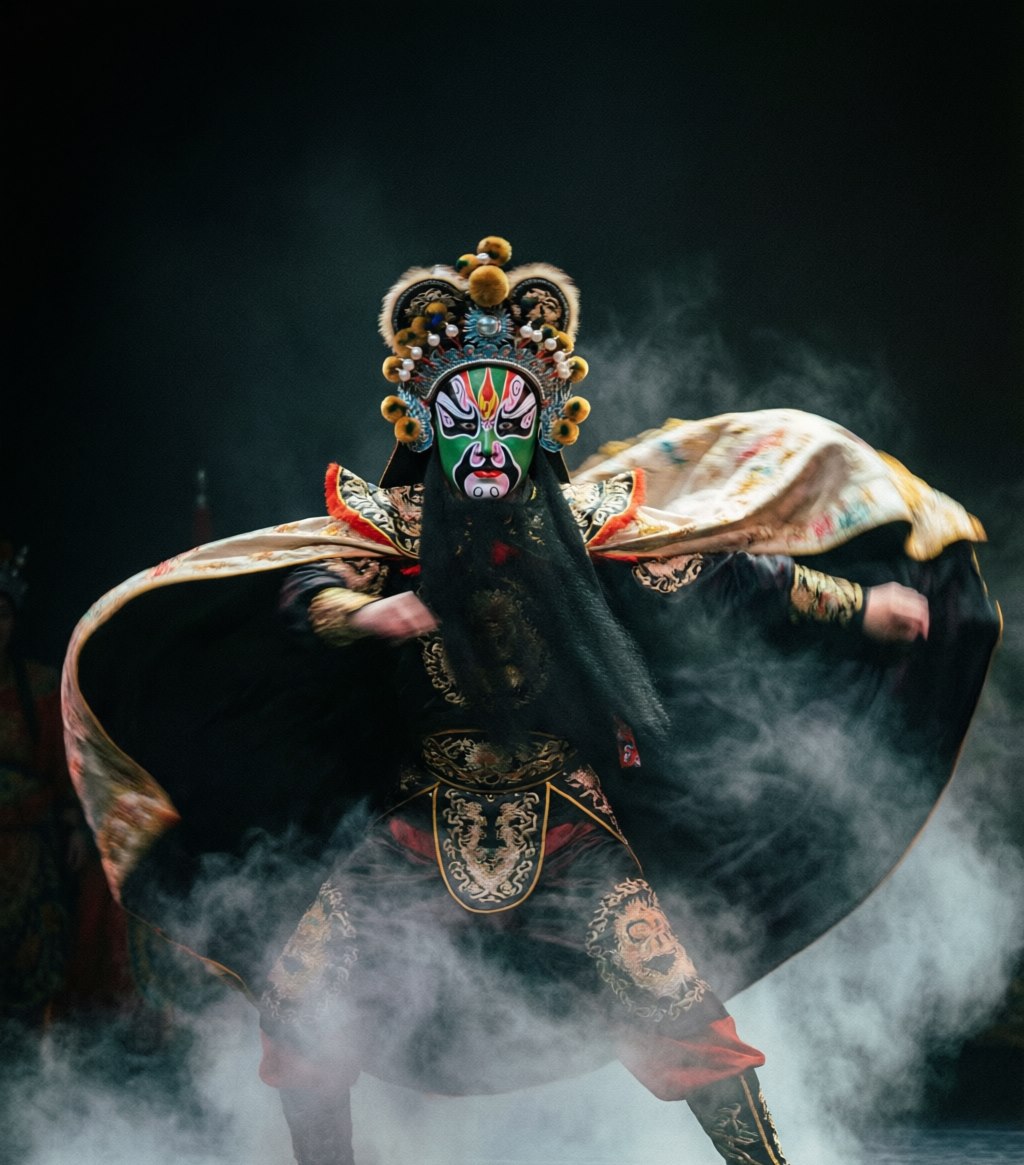
There is a moment in a Sichuan Opera performance that no first-time viewer ever forgets. A performer stands center stage, his face painted in vivid colors. He turns his head, sweeps a hand across his features, and in the space of a blink his face has changed — a new mask, a new color, a new expression, as if a different person now inhabits the same body. He turns again, and again, and the faces keep coming, one after another, faster than the eye can follow, each revealed and discarded in an instant. The audience gasps, then erupts. This is bian lian (变脸), the art of face-changing, and it is the most famous of the many marvels that Sichuan Opera — Chuanju (川剧) — holds in store.
But to reduce Chuanju to its magic tricks would be to mistake the conjurer's flourish for the whole of his art. Sichuan Opera is one of China's oldest, richest, and most distinctive regional traditions, a form that unites five separate melodic styles into a single repertoire and that ranges freely from high tragedy to knockabout farce. It is an opera of fire and tenderness, of acrobatic daring and literary refinement, of sharp comic wit and deep feeling. Born in the fertile, mountain-ringed basin of Sichuan, it carries the flavor of its region: bold, spicy, irreverent, and utterly unwilling to be dull.
Five Melodies, One Stage
Sichuan Opera's history is, in a sense, a history of convergence. The form as it exists today crystallized during the Qing dynasty, when a wave of migration into Sichuan brought with it a variety of regional operatic traditions. Over time, five distinct melodic styles — known collectively as the five melodic systems — merged onto a single stage, each contributing its own musical character and repertoire. These include the high-pitched, drum-accompanied gaoqiang (高腔) style, descended from the old Yiyang qiang (弋阳腔) tradition and prized for its expressive, unaccompanied-style singing and its vigorous percussion; the kunqiang style, related to the refined Kunqu tradition; and several others drawn from local and imported sources.
This synthesis is one of Chuanju's defining features. A single troupe, and even a single program, can move between melodic styles, choosing the musical idiom best suited to each play. The result is a repertoire of unusual breadth and flexibility, capable of the most delicate lyricism and the most thunderous drama. The gaoqiang style, with its distinctive technique of offstage vocal accompaniment — a chorus that sings behind the performer, echoing and commenting on the action — gives Sichuan Opera a texture found nowhere else in quite the same form.
That offstage chorus, known as bangqiang (帮腔), deserves particular attention, for it is one of the most striking devices in all of Chinese theater. While the performer acts and sings onstage, a hidden chorus takes up the melody, echoing phrases, voicing a character's unspoken thoughts, commenting on the action, or swelling into a collective cry at moments of high emotion. The effect is at once intimate and vast: the inner life of a single character seems suddenly to be shared by an invisible multitude. The bangqiang can narrate, can sympathize, can warn, can mourn. It frees the solo performer to concentrate on movement and expression while the chorus carries the musical and emotional weight, and it gives Chuanju a layered, almost cinematic quality — a sense of multiple perspectives unfolding at once — that audiences find uniquely compelling.
Performed in the Sichuan dialect, the opera is steeped in the rhythms and flavors of its region. The language is vivid, colloquial, and full of local color, and the form has always prized a certain earthy directness alongside its literary ambitions. It is, in character as in cuisine, unmistakably Sichuanese.
The Magic of Bian Lian
No feature of Sichuan Opera has captured the world's imagination like bian lian, the art of face-changing. In a tradition where painted faces symbolize a character's nature — red for loyalty, white for treachery, black for integrity — face-changing literalizes the transformation of the inner self. A character's rage, terror, or cunning becomes visible in an instant, as one painted mask gives way to another before the audience's disbelieving eyes.
The technique is a closely guarded secret, passed from master to student within the tradition. Performers use a variety of methods — masks of thin, painted silk layered and pulled away in a flash, powder blown across the face, swift changes concealed by a turn of the head or a sweep of the sleeve — to produce the illusion of instantaneous transformation. A virtuoso can change faces a dozen times or more in rapid succession, each mask vividly distinct, the transitions so swift they seem to defy the laws of physics. The effect is pure theatrical magic, and it has made Sichuan Opera a sensation far beyond China, dazzling audiences worldwide who may know nothing else of the tradition but never forget the sight of a face remade in a heartbeat.
"You watch the hands, you watch the sleeves, you watch for the trick — and still the face has already changed. That is the art."
— On the irresistible illusion of bian lian, the face-changing art
Yet face-changing is never mere spectacle in the best Chuanju. At its finest, it serves the drama, externalizing a character's shifting emotions or revealing a hidden nature at the story's climax. The magic is in service of meaning — a principle that distinguishes the tradition's greatest performers from mere technicians of astonishment.
Fire, Lamps, and the Body's daring
Face-changing is only the most famous of Sichuan Opera's special arts. The form is renowned for a whole vocabulary of theatrical marvels, among them fire-spitting, in which performers send plumes of flame leaping from their lips to conjure demons, dragons, and moments of supernatural terror. The effect, staged in the right dramatic context, is genuinely thrilling — a burst of real fire that makes the audience recoil and then roar.
Equally celebrated is gun deng (滚灯), the art of the rolling lamp, a feat of comic acrobatics in which a performer balances a lit lamp — traditionally an oil lamp — on his head or body while executing a series of astonishing contortions, rolls, and balances, never letting the flame go out. The routine is usually performed by a chou (clown) character, often in the role of a henpecked husband being punished by his formidable wife, and it combines genuine physical virtuosity with broad, crowd-pleasing humor. It is a perfect example of Chuanju's genius: the fusion of breathtaking skill with irresistible comedy.
These special skills — along with stylized beard manipulation, acrobatic tumbles, and elaborate stage movement — give Sichuan Opera a physical exuberance that sets it apart. The body, in Chuanju, is an instrument of wonder, and the tradition has spent centuries perfecting the arts of astonishment.
These feats belong to a wider category that Sichuan Opera calls juehuo (绝活) — "matchless skills," the signature stunts that a troupe or a performer guards as a mark of distinction. Beyond face-changing, fire, and the rolling lamp, the repertoire of juehuo includes the dazzling manipulation of the long artificial beard, or rankou (髯口), which a skilled actor can fling, twirl, and toss to express rage, panic, or defiance; the hidden-knife technique (藏刀, cang dao), in which a weapon seems to appear and vanish by sorcery; and a host of acrobatic falls, balances, and contortions. Each of these skills is the product of years of grueling training, and each is meant to be deployed at the precise dramatic moment when ordinary acting is not enough — when a character's emotion is so extreme that only a miracle of the body can express it. This philosophy, that technical virtuosity exists in the service of dramatic truth, is what lifts Chuanju's spectacle above mere circus and into the realm of genuine theater.
The Wit of the Basin
For all its spectacle, Sichuan Opera's most enduring quality may be its wit. The form has an unmatched gift for comedy, and its comic roles — the chou, in all their many varieties — are among the most fully developed in Chinese opera. Chuanju comedy is sharp, sly, and deeply rooted in the observation of everyday life: the pompous official deflated, the clever servant who outwits his master, the coward braggart exposed, the busybody hoist by her own meddling.
This humor reflects the temperament of Sichuan itself, a region famous for its love of pleasure, its leisurely teahouse culture, and its irreverent, quick-tongued people. The opera's comic scenes are performed in a lively, colloquial Sichuan dialect that crackles with wordplay and local idiom, and they have always been a favorite of popular audiences. Even in its most serious works, Chuanju rarely loses this grounding in the human and the humorous; it understands, as the best comedians do, that laughter and feeling are not opposites but companions.
This comic spirit is inseparable from the teahouse culture for which Sichuan is famous. In the cities and towns of the basin, the teahouse has long been the living room of public life — a place to drink jasmine tea, gossip, settle disputes, play mahjong, and, on the right afternoon, watch a bit of opera. Chuanju grew up alongside this easy, sociable, pleasure-loving world, and it absorbed the teahouse's fondness for sharp observation and good-natured mockery. The opera's clowns speak the way witty teahouse regulars talk: quick, sly, and unafraid to puncture pretension. To watch a great Chuanju comic scene is to overhear the humor of an entire region, distilled and raised to the level of art.
A Repertoire of Legend and Love
The Sichuan Opera repertoire is vast, numbering in the thousands of traditional plays, and it spans the full range of Chinese story — historical epics, ghost tales, romances, and moral fables. Among its most celebrated works is The Jade Hairpin (玉簪记, Yuzan Ji), a tender love story of a young scholar and a Daoist nun whose forbidden romance unfolds through some of the form's most beautiful lyrical scenes. Its famous river-farewell scene, in which the lovers part, is a masterpiece of restrained emotion and graceful movement.
Equally beloved is the Sichuan treatment of the White Snake (白蛇传, Baishe Zhuan) legend, the tale of a powerful snake spirit who takes human form to marry the man she loves, only to be opposed by a monk who sees only the demon beneath her beauty. Sichuan Opera's version is renowned for its spectacular staging — the flooding of Jinshan Temple, the martial combat, the supernatural transformations — and for the pathos of its heroine, a figure of devotion and suffering who has moved audiences for generations. These literary works sit alongside the comic farces and the martial showpieces, giving Chuanju a range that few traditions can match.
"Sichuan Opera can make you gasp with fire, laugh until you weep, and then break your heart — all in a single evening."
— On the extraordinary emotional range of the Chuanju repertoire
Regional Flavor, Lasting Magic
Sichuan Opera today occupies a distinctive place in Chinese cultural life. Its special skills — above all face-changing — have made it an international ambassador for Chinese theater, a crowd-pleasing wonder performed on stages around the world and a fixture of cultural exchange. Within China, it remains a source of deep regional pride, performed in the teahouses and theaters of Chengdu and Chongqing and sustained by dedicated troupes and training programs.
The challenges facing Chuanju are those of every traditional art: an aging audience, the competition of modern entertainment, and the difficulty of transmitting demanding skills to a new generation. The very fame of face-changing presents its own risk — the danger that the tradition becomes known for a single trick rather than for the depth of its music, its drama, and its comedy. Yet the form's inherent vitality works in its favor. An opera built on astonishment, on laughter, and on the sheer pleasure of performance is well suited to win new audiences, and efforts to preserve the full repertoire — not only the spectacle but the singing, the wit, and the literary plays — continue to gather support.
What endures, in the end, is the spirit of the basin: bold, playful, generous, and unafraid of excess. Sichuan Opera asks its audience to marvel, to laugh, to feel, and to surrender to the impossible — and then it delivers, in a flash of painted silk and a burst of flame. The faces change, the fire leaps, the lamp stays lit, and the theater fills with the sound of delighted disbelief. That magic, refined over centuries and rooted in one unforgettable corner of China, shows no sign of fading. It simply changes its face, and goes on.