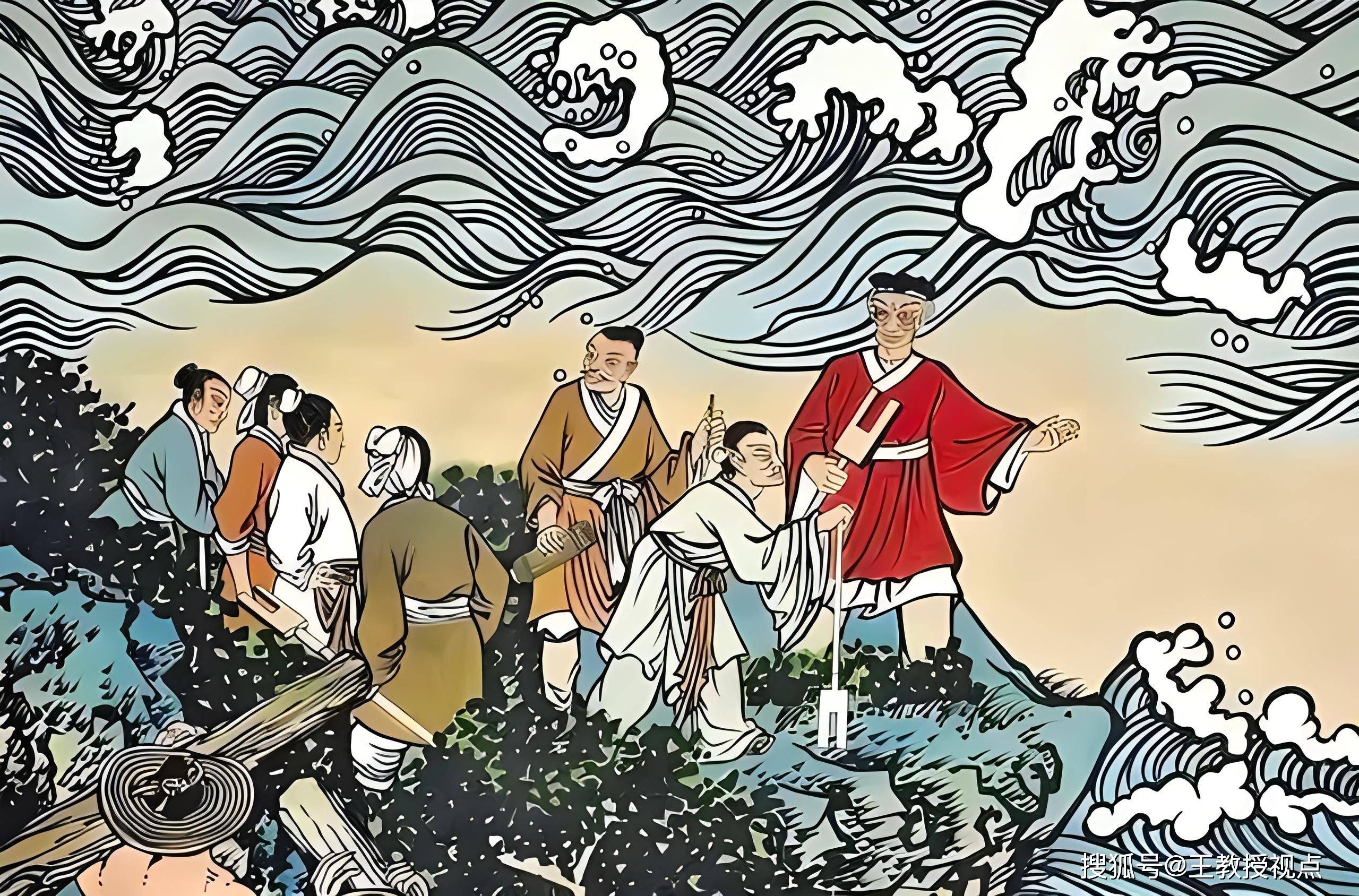
When the Sky Broke Open: The Great Flood
In the age before history had learned to write itself down, when the Yellow River was less a river than a wandering, wrathful god, the waters rose. They rose past the banks, past the fields, past the thatched roofs of villages that had stood for generations. They swallowed the millet stores and the ancestral shrines. They turned the Central Plains into an inland sea where farmers had once argued over property lines. The Shujing, the Book of Documents, records the catastrophe in language stripped to the bone: "The flood raged. Its waters rose to the heavens. Vast and boundless, it enveloped the mountains and overtopped the hills. The people groaned in their suffering."
This was not a seasonal inundation. This was an unraveling of the world's order. In the Chinese cosmological imagination, flood and chaos are synonyms. When the waters refuse their channels, it means heaven has lost confidence in earth's stewards. The emperor's virtue has thinned. The social contract has cracked. And so the Great Flood was not merely a hydraulic problem. It was a theological crisis, a political emergency, and a test of whether humanity possessed the wisdom — not merely the strength — to restore balance to a broken world. The man who answered that test would not be a warrior or a priest. He would be an engineer. And his name would echo for four thousand years.
Gun's Folly: The Man Who Stole Heaven's Soil
Before Yu, there was Gun. Yu's father was chosen by the tribal council to tame the flood, and he attacked the problem with the only logic he knew: force. The waters rose, so he would build walls higher. The rivers swelled, so he would dam them thicker. For nine years, Gun labored, and for nine years, the waters laughed at him. Every levee burst. Every dam crumbled. The flood simply went around, over, through. Gun was fighting the ocean with his bare hands, and the ocean was not impressed.
Desperate, Gun committed the ultimate transgression. He stole xirang — the self-expanding soil of heaven, a magical earth that grew and multiplied endlessly, the divine substance the gods used to build the firmament itself. With xirang, Gun built barriers that could not be breached, walls that grew faster than the waters could rise. For a brief, shining moment, it seemed to work. The flood retreated. The people cheered.
But heaven does not forgive theft. The Jade Emperor, enraged that a mortal had stolen the substance of creation, sent the fire god Zhurong to execute Gun on the slopes of Feather Mountain. The xirang, severed from divine will, lost its power. The walls collapsed. The flood returned with compound fury, as though it had merely been gathering its breath. Gun died on the mountainside, his life's work dissolving into mud below him, his name a byword for the arrogance of brute force. And his son, Yu, inherited both the task and the shame.
A Different Mind: Channeling Instead of Conquering
Yu studied his father's failure the way a physician studies a corpse — with grief, yes, but also with the cold determination to understand exactly where the blade went wrong. Gun had treated the flood as an enemy to be defeated. He had met water's nature — to flow, to seek the lowest ground, to yield and then overwhelm — with the opposite nature: rigidity, resistance, the stubbornness of stone. And water, given enough time, always defeats stone.
Yu's insight was revolutionary in its simplicity: do not fight the water. Help it. Study where it wants to go, and show it the way. Where the land rose, cut through it. Where the river choked, widen its throat. Where the current scattered, gather it into a single purposeful stream. This was not engineering as domination. It was engineering as collaboration — a partnership between human intelligence and natural force, each supplying what the other lacked. The river had the power. Yu had the plan. Together, they could move mountains. And so they did.
The Shiji, Sima Qian's great history, describes Yu's method with reverent precision. He surveyed the land from mountaintop to riverbed. He measured the gradients, mapped the watersheds, identified the natural channels that millennia of silt had buried. Then he set his workers to digging. Not walls. Channels. Not dams. Canals. He opened the Longmen Gorge so the Yellow River could thunder through in a single concentrated rush rather than spreading into a thousand destructive braids. He carved the Sanmenxia — the Three Gates Gorge — splitting a mountain to give the water a dignified passage to the sea. He dredged the marshes, straightened the tributaries, and connected the great rivers to the ocean in a network of controlled flow that transformed a continent-scale disaster into a continent-scale irrigation system.
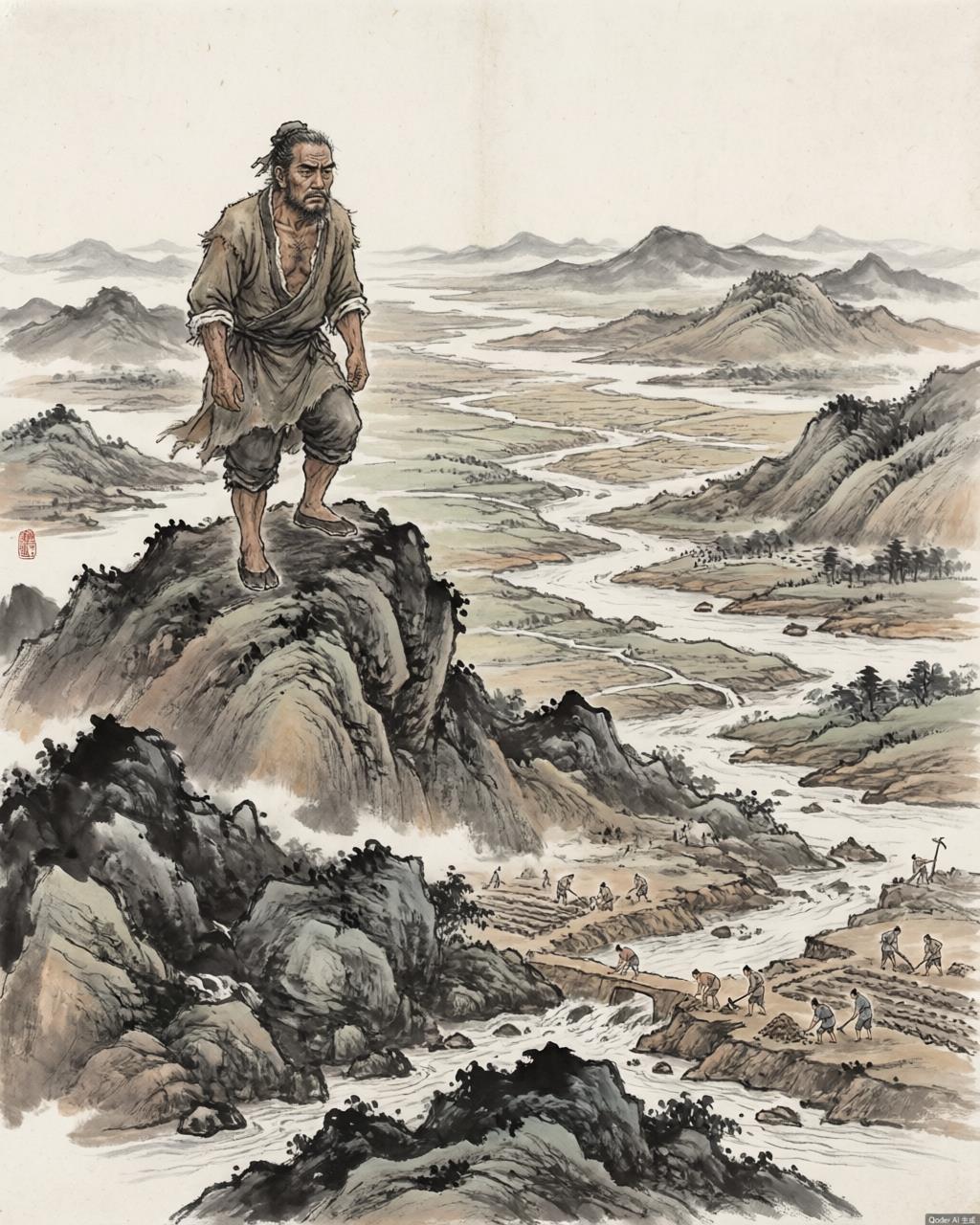
Thirteen Years: The Body as Sacrifice
The work took thirteen years. Thirteen years of wading through chest-deep current, of swinging bronze picks until the handles wore grooves into his palms, of sleeping in mud beside the work crews, of eating cold millet while the rain hammered his back. The texts are explicit about what this did to his body. The Han Feizi records that Yu's hands and feet grew so calloused they resembled bark. His legs lost their hair from constant immersion. His spine curved from years of bending over surveying tools. He developed a permanent limp — the "gait of Yu," later texts call it — a lurching, uneven walk that became, paradoxically, a mark of sanctity. Daoist priests in later centuries would imitate his limping stride in ritual dances, believing that to walk as Yu walked was to walk in the footsteps of a sage who had literally reshaped the earth.
The most famous detail of Yu's sacrifice is also the most human. Three times during those thirteen years, he passed the door of his own home. Three times, he heard his wife calling his name. The first time, their son had just been born; the infant's cries carried through the wooden door, and Yu's workers watched their leader stand frozen in the rain, hand raised to knock, for a long, terrible moment. Then he lowered his hand and walked on. The second time, the boy could call "father." Yu heard the small voice and did not stop. The third time, the boy ran to the door and tugged at his sleeve. Yu gently removed the child's fingers, one by one, and returned to the river.
This episode — "three times passing the door without entering" — is perhaps the single most referenced anecdote in Chinese political philosophy. It is invoked to define the ideal public servant: one who subordinates private happiness to collective survival, who understands that the flood will not wait for him to hold his child. It is also, read without the varnish of statecraft, a story of profound personal loss. Yu saved the world. He missed his son's childhood. The myth does not pretend these two facts do not coexist. It holds them both, and asks the audience to decide which matters more.
Nine Provinces and the Birth of the Xia
When the last channel was cut and the last tributary tamed, the waters receded. The land that emerged was not the same land that had drowned. Yu had not merely drained it; he had reorganized it. He divided the habitable world into nine provinces — Ji, Yan, Qing, Xu, Yang, Jing, Yu, Liang, and Yong — each defined by its river system, its soil type, its agricultural capacity. He assessed the tribute each province could sustainably provide. He established routes of communication and transport along the very waterways he had engineered. The flood, which had scattered humanity into isolated, terrified pockets, became the infrastructure of a unified civilization.
The grateful tribal confederation offered Yu the throne. He accepted, and in doing so, transformed Chinese governance forever. Before Yu, leadership had been passed by abdication — the sage-king Yao yielding to Shun, Shun yielding to Yu, each choosing the most virtuous successor regardless of blood. After Yu, his son Qi inherited the throne. The era of hereditary dynasty had begun. The Xia Dynasty — China's first, long dismissed as legend until archaeological evidence at Erlitou lent it material weight — was Yu's final construction. He had built a nation the way he had built a canal system: by finding the natural channels of human loyalty and giving them a direction to flow.
The Xia endured for nearly five centuries. Its founding myth was not a battle or a conquest. It was a public works project. This says something extraordinary about the civilization that chose to remember it. In the Chinese founding imagination, the first king is not a warrior who kills his rivals. He is a laborer who serves them. His throne is earned not with a sword but with a shovel, not with blood but with mud, not with the taking of life but with the patient, backbreaking preservation of it.
The Philosophy of Water: Cooperation Over Conquest
The contrast between Gun and Yu is not merely a story of failure and success. It is a philosophical argument conducted in the language of myth. Gun represents the impulse to dominate nature — to impose human will upon the world through sheer force, to build walls and demand that reality conform to their geometry. It is the logic of the tyrant applied to hydrology, and it fails because it misunderstands the fundamental character of the thing it seeks to control. Water cannot be commanded. It can only be invited.
Yu represents the opposite principle: cooperation with natural forces. He does not tell the river where it must go. He asks where it wishes to go, and removes the obstacles. He does not conquer the landscape. He negotiates with it. This philosophy — later codified in Daoist thought as wu wei, effortless action, the art of achieving by not forcing — finds its earliest and most dramatic expression in Yu's flood control. The sage does not struggle against the current. He becomes the current's ally, and in doing so, directs its enormous power toward human ends without exhausting himself or provoking the river's wrath.
This lesson reverberates far beyond hydraulics. It informs Chinese medical philosophy: do not attack the disease; restore the body's natural flow. It informs Chinese military strategy as codified by Sun Tzu: do not meet force with force; redirect the enemy's momentum until he defeats himself. It informs Chinese garden design: do not impose geometric order on the landscape; reveal the order already latent in the terrain. In every case, the principle is Yu's principle. Listen before you act. Understand before you build. Work with the grain of the world, not against it.
The Limp That Built a Civilization: Yu's Cultural Legacy
Yu's legacy in Chinese culture is so pervasive it has become invisible, like the air. Every Chinese child learns the story of the three passings. Every Chinese official, from imperial magistrates to modern cadres, is measured against Yu's standard of selfless service. The phrase "to pass the door without entering" is a living idiom, deployed to praise the dedicated and to shame the self-indulgent. When a government minister cancels a holiday to oversee disaster relief, the newspapers invoke Yu. When a doctor works a thirty-hour shift during an epidemic, the comment sections invoke Yu. The myth is not a relic. It is a rubric, a permanent standard against which public virtue is assessed.
Physically, Yu's transformed body became a symbol of sacred labor. His calloused hands, his hairless shins, his permanent limp — these were not marks of degradation but of sanctification. He had given his body to the work, and the work had remade him. In a culture that would later produce the Confucian ideal of the scholar-official — clean-handed, robe-wearing, physically unmarked by labor — Yu stands as a powerful counter-image. The greatest ruler in Chinese memory was not a man who commanded others to dig. He was a man who dug until his own hands bled, and then dug some more.
Temples to Yu dot the Chinese landscape to this day. The most famous stands at the foot of Kuaiji Mountain in Shaoxing, where tradition holds he was buried. Pilgrims have climbed its steps for three millennia. They come not to pray for miracles but to pay respect to a man who solved a problem. In the Chinese pantheon, Yu occupies a unique position: he is worshipped not as a god who dispenses favors, but as an ancestor who did the work. He is the patron saint of engineers, of civil servants, of anyone who has ever looked at an impossible task and decided that the only response was to pick up a tool and begin.
The Flood Never Ends: Why Yu Still Speaks
The Great Flood is not merely a historical event or a mythological episode. It is a metaphor that renews itself with every generation. Every era has its flood — its overwhelming, seemingly unmanageable crisis that threatens to dissolve the structures of civilization. Climate change is a flood. Pandemic is a flood. Economic collapse is a flood. The specific waters change; the essential challenge does not. And Yu's response remains the template: do not panic. Do not rage. Do not build walls and pretend the problem will respect them. Study the water. Understand its nature. Find the channels. Then dig.
There is a final, quiet lesson in the Yu myth that deserves emphasis. Yu did not work alone. He commanded thousands of laborers, coordinated multiple tribes, negotiated with local leaders, and maintained morale across thirteen years of exhausting, dangerous, seemingly endless work. His genius was not merely technical. It was organizational, political, human. He understood that taming a flood requires not just canals but cooperation — not just engineering but trust. The nine provinces he created were not arbitrary administrative units. They were communities of shared water, bound together by the rivers that flowed through them. Yu did not merely drain the land. He gave it a social architecture. He turned survivors into citizens.
This is why the story endures. Not because it is old, but because it is true. The flood is always coming. The walls will always fail. And somewhere, in the mud and the rain, someone will be wading chest-deep through the current, limping, calloused, too exhausted to go home, refusing to stop. That someone is Yu. That someone is everyone who has ever chosen the work over the comfort, the many over the one, the future over the present. The door is right there. The child is crying. And the river is rising. Yu lowers his hand. He turns. He walks back to the water. And the water, at last, begins to listen.