The Age Before the Breaking
In the earliest days of the world, when heaven and earth were still young and the boundaries between the divine and the mortal had not yet fully hardened, the cosmos existed in a state of precarious harmony. The sky was a vast dome of jade-blue silk stretched over the four quarters of the earth, held aloft by four great pillars that stood at the cardinal points like the legs of an celestial table. Among these pillars, none was more mighty than Mount Buzhou — the Pillar of Heaven — which rose in the northwest where the world's edge grew thin and the winds of the void howled ceaselessly against the firmament.
The gods walked freely in those days. They governed the elements, commanded the seasons, and warred amongst themselves with a ferocity that shook the foundations of creation. Among the most powerful of these primordial deities were two whose enmity would nearly unmake the world: Gong Gong, the God of Water, a serpentine titan with the body of a dragon and the head of a man, whose rage could summon tsunamis from a clear sky; and Zhuan Xu, grandson of the Yellow Emperor, a stern and ambitious deity who had seized the throne of heaven and declared himself sovereign over all the realms between earth and the highest stars.
Their conflict was not merely political. It was elemental — a collision of philosophies as old as existence itself. Zhuan Xu represented order, hierarchy, the imposition of structure upon chaos. Gong Gong embodied the untamable, the fluid, the force that refuses all constraint. Water, by its nature, cannot be commanded. And so their war was inevitable, and its consequences would be catastrophic beyond all reckoning.
The War of Water and Throne
The battle between Gong Gong and Zhuan Xu raged across the heavens for an age that mortal minds cannot fathom. Rivers reversed their courses. Mountains were ground to powder. The stars themselves flickered and dimmed as the shockwaves of divine combat rippled through the celestial vault. Gong Gong summoned the waters of the four seas and hurled them skyward; Zhuan Xu answered with walls of frozen wind and barriers of condensed starlight.
But Gong Gong, for all his terrible power, was losing. Zhuan Xu had rallied the lesser gods to his banner, and their combined might pressed the Water God back, league by league, toward the northwestern edge of the world. Gong Gong's armies scattered. His generals fell. His serpentine coils bled ichor that poisoned the lands it touched. And as retreat became rout, something in the ancient water god shattered — not his body, but his pride. That pride, which had sustained him through eons of conflict, broke like ice beneath a hammer, and in its place rose a fury so absolute, so all-consuming, that it transcended reason entirely.
If he could not rule the world, Gong Gong decided, then the world would cease to exist. If Zhuan Xu would deny him his throne, then there would be no throne left to sit upon. With a roar that split the firmament and sent every living creature on earth pressing its belly to the ground in terror, Gong Gong turned his vast body toward Mount Buzhou — the Pillar of Heaven — and charged.
The Pillar Falls
The impact was beyond description. Gong Gong struck the mountain with the full weight of his divine form, with all the momentum of his rage and despair, and the Pillar of Heaven — that ancient axis upon which the sky had rested since the first dawn of creation — cracked. The sound it made was not a sound at all, but an un-sound: a silence so profound that it swallowed every other noise in the world. Birds fell from the sky, their hearts stopped by the sheer wrongness of what they had heard. Fish sank to the bottoms of rivers. Even the wind held its breath.
Then the sky tore open.
The rupture began at the northwest, where Buzhou had stood, and spread like a crack in thin ice across the dome of heaven. Through the wound poured the waters of the celestial void — not rain, not flood, but the raw, undifferentiated chaos that had existed before the world was shaped. It fell upon the earth in sheets of black and silver, and where it struck, the land dissolved. Mountains melted. Forests were erased. The great rivers — the Yangtze, the Yellow River, the Pearl — swelled beyond their banks and swallowed the plains whole.
And it was not only water that poured through the broken sky. The fires of heaven — the celestial flames that burned behind the stars — leaked through the cracks and rained down upon the mortal world. Forests ignited. The earth itself caught fire in places, and pillars of flame rose to meet the falling waters, creating clouds of scalding steam that choked every living thing. The four pillars, weakened by the loss of their greatest companion, groaned and tilted. The earth, no longer properly supported, began to sink in the southeast, and all the waters of the world rushed toward that low place in an endless, roaring tide.
Humanity — that fragile species shaped from yellow clay by Nüwa herself in the world's first morning — huddled in caves and on the highest peaks and watched the apocalypse unfold. They had no gods to call upon. The gods were fleeing, scattering to the far corners of the cosmos, abandoning their creation to its fate. All except one.
The Goddess Who Would Not Flee
Nüwa had made them. That was the simple, irrefutable truth that separated her from every other deity who watched the world burn from safe distance. She had knelt beside the Yellow River in the first age of the world, scooped the golden clay from its banks, and shaped each human form with her own hands. She had breathed life into their nostrils. She had watched them stumble, fall, laugh, weep, love, and die. They were hers — not as a ruler possesses subjects, but as a mother possesses the children of her body and will.
And so, while the other gods retreated to their celestial palaces and barred their gates against the chaos, Nüwa descended. She walked into the flooded world with the black rain hammering against her shoulders and the fires of heaven reflecting in her ancient eyes, and she began to work. There was no time for grief. There was no time for anger at Gong Gong's madness or Zhuan Xu's ambition. There was only the work, and the desperate, furious love that drove it.
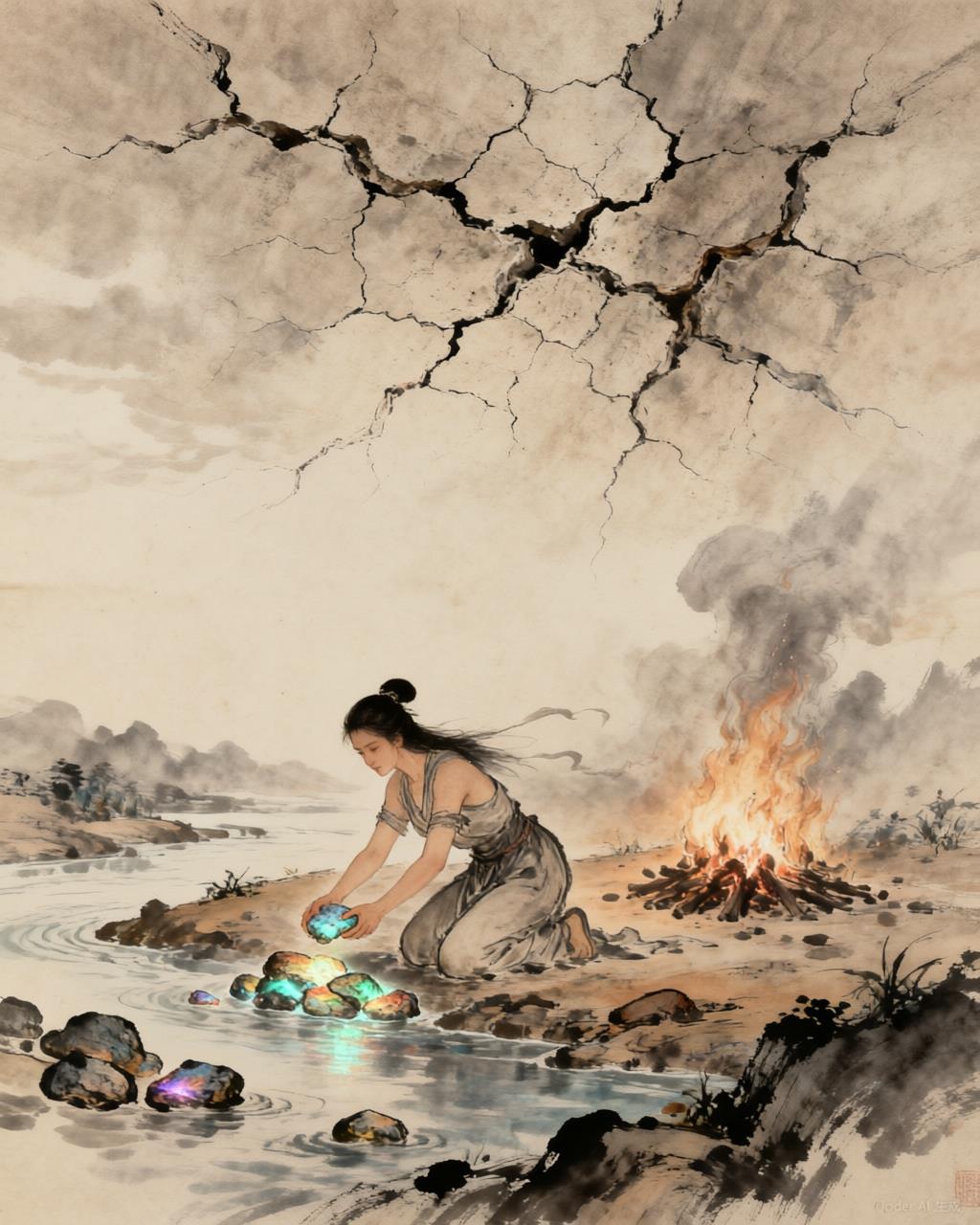
First, she needed material. The sky could not be mended with ordinary substance — it required something that contained within itself the essence of all creation. And so Nüwa journeyed to the four corners of the broken earth, wading through floodwaters that reached her waist, climbing peaks that crumbled beneath her feet, and gathered the five-colored stones. Azure stones from the eastern shores, where the first light of dawn had crystallized them over ten thousand years. Crimson stones from the southern volcanoes, where the earth's blood had cooled into gems of impossible red. Gold stones from the central plains, heavy with the essence of the soil itself. White stones from the western mountains, pure as the first snowfall. Black stones from the northern depths, where the void pressed close and the stones had absorbed the darkness between stars.
She carried them all — upon her back, in her arms, balanced upon her head — to the ruins of Mount Buzhou, where the sky's wound gaped widest and the chaos-waters poured through in an unending cataract. There, she built a furnace from the bones of the old world, and she lit it with the last embers of the celestial fires that still smoldered on the scorched earth.
The Mending of Heaven
For forty-nine days and forty-nine nights, Nüwa fed the furnace. The five-colored stones melted slowly, reluctantly, as though they understood the magnitude of what was being asked of them. They swirled together in the crucible — azure and crimson and gold and white and black — becoming something new, something that was all colors and no color, a luminous paste that glowed with the light of a captured galaxy.
When the molten sky-stone was ready, Nüwa lifted it in her bare hands. It seared her palms. It burned through her flesh and blackened her bones, but she did not release it. She rose — rising with the earth beneath her, rising on a column of steam and smoke — and pressed the glowing substance into the wound in heaven. It adhered like clay to a potter's wheel, spreading across the rupture, filling every crack, sealing every tear. The chaos-waters slowed, sputtered, and ceased. The celestial fires, cut off from the mortal world, retreated behind the mended firmament and resumed their proper burning.
But the sky, though patched, was weakened. The four pillars could no longer bear its weight alone — not with Buzhou destroyed and the remaining three cracked and listing. And so Nüwa turned her attention to the great turtle Ao, who had swum the cosmic seas since before the world was formed. The creature was vast beyond comprehension, its shell an island, its eyes like twin moons. Nüwa spoke to it, and what she said is recorded differently in every telling. Some say she asked permission. Some say she simply acted. All agree on what came next: she severed the turtle's four legs and set them at the four corners of the earth, and they became the new pillars of heaven — living pillars, strong as the first day of creation, that would never crack or falter.
The turtle, legless now, sank to the bottom of the sea and became the foundation upon which the world rests. In some tellings, it still moves, and when it shifts, the earth trembles. In others, it sleeps eternally, dreaming the world into continued existence.
The Slaying of the Black Dragon
The mending of the sky and the raising of the new pillars saved the world from annihilation, but the catastrophe had unleashed other horrors. In the chaos of the flooding and the burning, ancient beasts that had slumbered in the earth's deepest places had awakened and risen to prey upon the surviving remnants of humanity. Chief among these was the Black Dragon of the North — a creature of pure malice, born from the accumulated suffering of the flood, its scales the color of drowned things, its breath a miasma that withered everything it touched.
The Black Dragon had made its lair in the flooded plains of the central kingdom, and from there it ranged across the land, devouring the scattered survivors who had endured the breaking of the sky only to face this new horror. It was, in a sense, the final wound of Gong Gong's madness made flesh — the last and most venomous consequence of a god's wounded pride.
Nüwa, exhausted from her labors, her hands still scarred from the sky-stone's burning, took up her sword and went to meet the dragon. The battle lasted seven days. The Black Dragon coiled through the floodwaters, striking with fangs that could pierce divine flesh, and Nüwa answered with a grace that belied her weariness. On the seventh day, she drove her blade through the creature's skull and pinned it to the bedrock of the world, and its black blood flowed out across the plains, fertilizing the soil that would, in time, become the most fertile farmland in all of China.
With the dragon dead, the lesser beasts fled back into the earth's depths. The floods, no longer stirred by the dragon's thrashing, began to recede. The fires had long since burned themselves out. And the world — broken, scarred, diminished, but alive — began the long, slow work of healing.
The Tilt of the World
Yet the world that emerged from the catastrophe was not the world that had existed before. The mending was perfect in its function but imperfect in its form. Where the sky had been torn, the patch left a subtle asymmetry — a slight thinning of the firmament in the northwest, where Buzhou had stood and where the wound had been greatest. And the new pillars, fashioned from the legs of a turtle, were not precisely equal in length. The southeastern pillar was fractionally shorter than the others, and so the earth tilted, almost imperceptibly, toward the southeast.
This is why, the ancient texts explain, the sky tilts toward the northwest — why the stars wheel in their courses around the northern pole, why the sun and moon travel from east to west in their eternal arc. And this is why the rivers of China flow eastward and southward, gathering in the great lowlands of the southeast, emptying into the sea in an endless procession that has continued since the age of Nüwa. The Yellow River, the Yangtze, the Pearl, the Mekong — all flow toward that ancient tilt, that slight imperfection in the world's architecture that reminds us, still, that creation was not made perfect but mended. That the world we inhabit is not a pristine original but a restoration — beautiful, functional, enduring, but bearing always the scars of its breaking.
There is a profound theology in this imperfection. The Chinese cosmos, unlike the perfect geometries of certain Western traditions, is a world of elegant asymmetry. The feng shui of mountains and rivers, the deliberate irregularity of classical gardens, the appreciation of the cracked and weathered in ceramics and calligraphy — all echo Nüwa's mending. The world is beautiful not despite its wounds but because of them. The patch in the sky is not a flaw to be hidden but a testament to be honored.
The Legacy of the Mender
Nüwa's act of mending became the foundational myth of Chinese civilization's relationship with catastrophe. Where other cultures imagined their gods destroying the world in floods and fire as punishment for human sin, the Chinese tradition preserved a different memory: that when the world broke, a goddess descended not to punish but to repair. That the proper response to apocalypse is not prayer or propitiation but work — patient, agonizing, forty-nine-days-and-forty-nine-nights work. That the one who made you is obligated to mend you, and will do so at the cost of her own flesh.
The myth appears in the Huainanzi, compiled in the second century BCE, and in fragments far older. It echoes through Chinese literature, art, and philosophy in ways both explicit and subtle. The five-colored stones became symbols of cosmic harmony — the five elements, the five directions, the five phases of existence gathered and unified in service of restoration. The image of Nüwa, half-serpent and half-woman, rising from the floodwaters with molten heaven in her scarred hands, became one of the most enduring icons of Chinese visual culture, appearing on Han dynasty stone reliefs, Tang dynasty silk paintings, and countless temple murals across two millennia.
In the villages of northern China, women once gathered five-colored stones from riverbeds on the anniversary of the mending and placed them on their rooftops — a small, domestic echo of the goddess's cosmic labor. In the temples dedicated to Nüwa, pilgrims prayed not for salvation from sin but for the strength to repair what was broken: a marriage, a family, a life. The goddess who mended heaven became the patron of all who mend.
And Gong Gong? The texts are less kind to him. He became the embodiment of destructive rage — the god who would unmake the world rather than accept defeat. Yet even his story carries a certain terrible grandeur. He is the storm that clears the old growth. He is the flood that deposits new soil. He is the necessary catastrophe that precedes the necessary mending. Without his breaking, there would have been no Nüwa's healing. Without the crack in heaven, there would have been no five-colored stones, no turtle-pillars, no beautiful asymmetry of rivers flowing east. The world needed to break in order to become the world it was meant to be.
This, perhaps, is the deepest teaching of the myth: that mending is not the restoration of what was, but the creation of what will be. Nüwa did not return the sky to its original state. She made something new — something stronger in its patched places, something more beautiful in its asymmetry, something that bore within it the memory of its own breaking and the love that had healed it. The sky above China today is Nüwa's sky. The rivers that flow eastward are her rivers. And every act of mending, from the grandest cosmic repair to the smallest human kindness, participates in her eternal work.