The Loneliness of the First Goddess
After Pangu's body had dissolved into the world — after his eyes became sun and moon, his blood became rivers, his hair became stars — the earth was magnificent. Mountains rose in solemn procession toward the heavens. Forests spread their green mantles across the valleys. Birds filled the air with song, and fish silvered the streams. The world was complete in its beauty, ordered in its rhythms, abundant in its life.
And yet it was empty. Not empty of living things — the teeming multitude of creatures filled every niche and corner. But empty of something harder to name. Empty of awareness. Empty of a being who could look upon this splendor and know it, who could weep at a sunset or laugh at the absurdity of a crab walking sideways. The world had no witness. No one to gather around a fire at night and tell stories about the stars. No one to love.
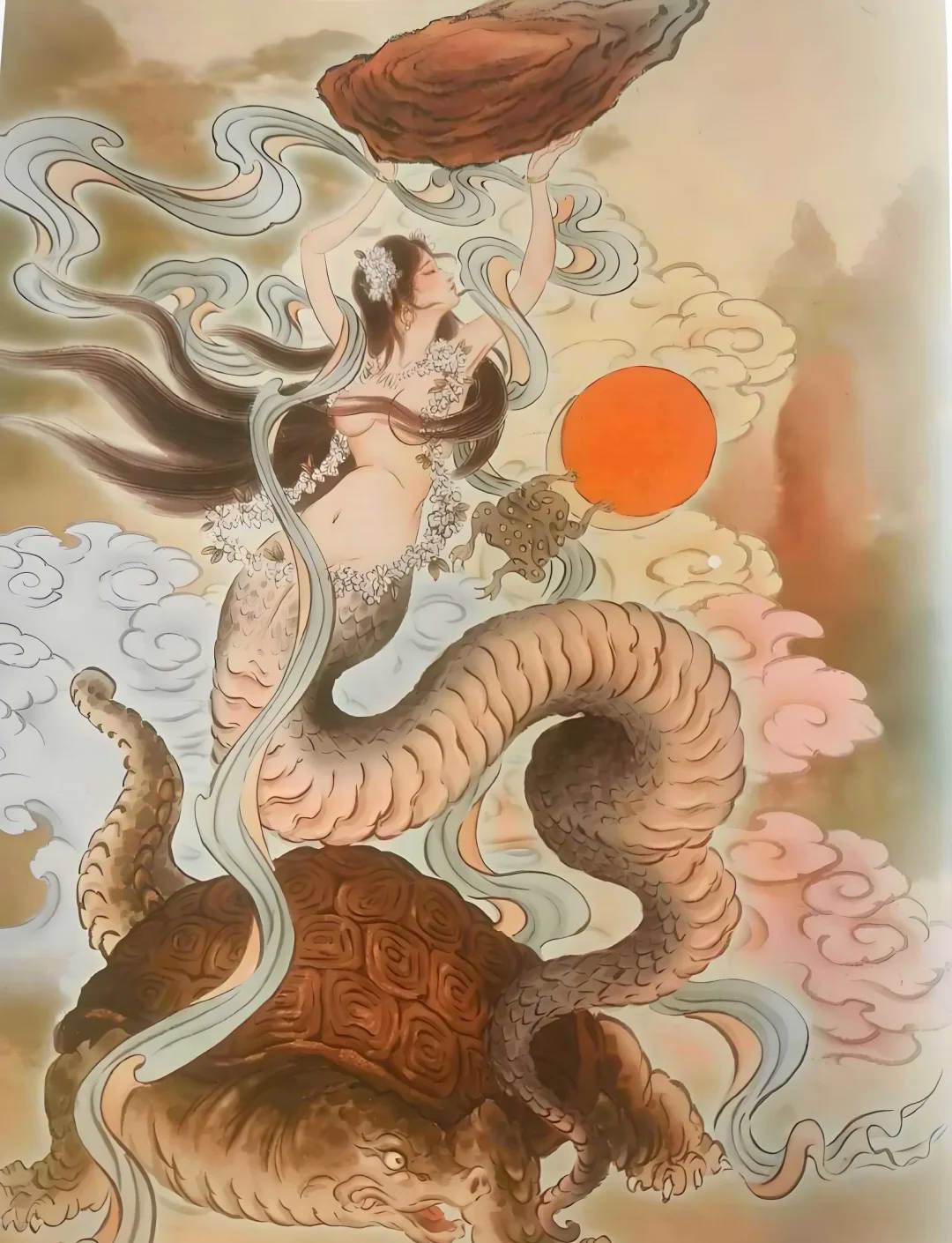
Into this beautiful desolation walked Nüwa (女娲).
She was ancient — older than the mountains, older perhaps than the separation of heaven and earth itself. The Shuowen Jiezi, the great Han Dynasty dictionary, describes her as "the ancient sacred woman who transformed all things." She had a human face and a serpent's body, coiling and luminous, and she moved through the primordial landscape with the slow grace of one who has seen all things and been surprised by none. Until now.
For as Nüwa walked beside the waters of a great river — some traditions say the Yellow River, others a nameless primordial stream — she looked down and saw her own reflection gazing back at her from the surface. And in that moment of recognition, something unprecedented stirred within her. Loneliness. A vast, aching solitude that no landscape, however sublime, could fill. She wanted companions. She wanted beings who could look back at her not as a reflection, but as others. She wanted children.
Molding Humanity from Yellow Clay
And so Nüwa knelt beside the riverbank. She reached down into the wet earth and drew up a handful of yellow clay — the fine, loess-rich soil that gives the Yellow River its color and the North China Plain its legendary fertility. In her divine hands, the clay was warm and pliable, alive with potential. She shaped it carefully, deliberately, pressing and smoothing with the patience of a master potter.
She gave the figure a head, round and thoughtful. She gave it eyes that could see beauty and weep at it. She gave it a mouth that could speak, sing, argue, and pray. She gave it hands with delicate fingers, capable of crafting and caressing. She gave it legs to walk upright beneath the sky, unlike the beasts who crawled upon their bellies. And then — this is the crucial detail — she breathed upon it. Her own breath, her own divine qi, passed from her lips into the clay figure's nostrils. And it lived.
The first human opened its eyes, looked up at Nüwa, and smiled. And Nüwa, who had known only solitude since the beginning of time, felt her heart crack open with a joy so fierce it was almost pain. She laughed — the first laughter in the world — and set the little figure down upon the earth, where it toddled uncertainly on its new legs.
She made another. And another. Each one shaped with care, each one unique. She gave them different faces, different temperaments, different gifts. Some she made bold and restless, suited for exploration. Others she made gentle and contemplative, suited for poetry. She made them to complement one another, to need one another, so that none would ever know the loneliness she had known.
These first humans, shaped by Nüwa's own hands with infinite patience and love, became the ancestors of the noble families — the aristocrats, the sages, the rulers. They carried in their clay a particular refinement, a density of divine attention. They were, the myth tells us, made with deliberation. Every feature considered. Every proportion balanced. They were artworks, and they knew it.
The Flicking of Mud: A Myth of Social Origins
But the world was vast, and Nüwa's hands, however divine, were slow. She had shaped perhaps a hundred humans, perhaps a thousand, and still the earth stretched empty in every direction. The sun set and rose, set and rose, and still there were not enough people to fill the valleys, to light the nights with fires, to fill the silence with voices. Nüwa grew weary. Her fingers ached. The clay dried in the sun before she could shape it.
And then, in a moment of inspired impatience, she seized a rope — some traditions say a vine, others a cord of woven grass — and dipped it into the wet mud beside the river. She lifted it, heavy with dripping earth, and swung it through the air. Droplets of mud flew in every direction, scattering across the landscape like seeds from a sower's hand. And wherever a droplet landed, a human being sprang up.
These mud-born humans were different from the hand-shaped ones. They were smaller, rougher, less refined. They lacked the careful proportions of the clay aristocrats. They were numerous, vigorous, practical — suited for labor rather than contemplation, for the field rather than the court. They became the common people, the farmers and workers, the vast multitude upon whose backs all civilization would be built.
The Taiping Yulan, the great Song Dynasty encyclopedia, preserves this two-tiered account explicitly: "The wealthy and noble were the yellow earth figures; the poor and common were the ones made from the rope." It is, on its surface, a myth that legitimizes social hierarchy — a divine charter for aristocratic privilege. The nobles are noble because the goddess shaped them with her own hands. The commoners are common because they were flicked from a rope in a moment of haste.
Yet the myth is more subversive than it appears. For all humans, noble and common alike, are made of the same substance — earth and divine breath. The difference is one of method, not of material. And Nüwa's love, the myth insists, extends equally to all her children. She does not favor the hand-shaped over the mud-flicked. She grieves for all of them equally when disaster comes. The hierarchy is acknowledged but not sanctified. It is a fact of the world's making, not a moral absolute.
The Institution of Marriage
Nüwa's creative work did not end with the shaping of individual humans. She looked upon her children and saw that they were mortal — that they would age, sicken, and die, returning to the clay from which they had been made. If humanity was to endure beyond a single generation, it would need a means of perpetuating itself. It would need union. It would need love made formal, made social, made enduring.
And so Nüwa established marriage. The Dushi Tongjian Gangmu Qianbian and other early sources credit her with creating the institution of matrimony — with prescribing the rites by which a man and a woman would be joined, with establishing the roles and responsibilities of husband and wife, with sanctifying the union of two beings into a single household. She became, in the language of later tradition, the first mei ren (媒人) — the first matchmaker, the divine patroness of marriage.
This was no small gift. In the Chinese understanding, marriage is not merely a private arrangement between two individuals. It is the fundamental social institution, the root from which all other relationships grow. The Yijing (Book of Changes) places the union of heaven and earth at the foundation of cosmic order, and the union of man and woman at the foundation of human order. Nüwa, in establishing marriage, was doing nothing less than giving humanity its social cosmos — its structure, its continuity, its future.
She is said to have married her brother Fuxi (伏羲), the culture-hero who taught humanity fishing, hunting, and the writing of characters. Their union — depicted in countless Han Dynasty stone reliefs as two intertwined serpent-bodied figures, compass and square in hand — represents the primordial marriage from which all human unions descend. Together, Nüwa and Fuxi are the parents of civilization itself: she gives humanity its bodies and its social bonds; he gives it its tools and its knowledge.
Mending the Broken Sky
Nüwa's role as creator was not her only act of salvation. In the most dramatic episode of her mythic cycle, she became the protector and preserver of the world she had made. The Huainanzi, the great Han Dynasty philosophical compendium, preserves the account in vivid detail.
In the age after creation, the four pillars that held up the sky — the mountains at the cardinal directions — were shattered. Some traditions blame the water god Gonggong, who in a fit of rage after losing a battle for supremacy rammed his head against Mount Buzhou, the great pillar of the northwest. Others speak of a more general cosmic catastrophe, a unraveling of the order that Pangu's sacrifice had established. Whatever the cause, the result was apocalyptic.
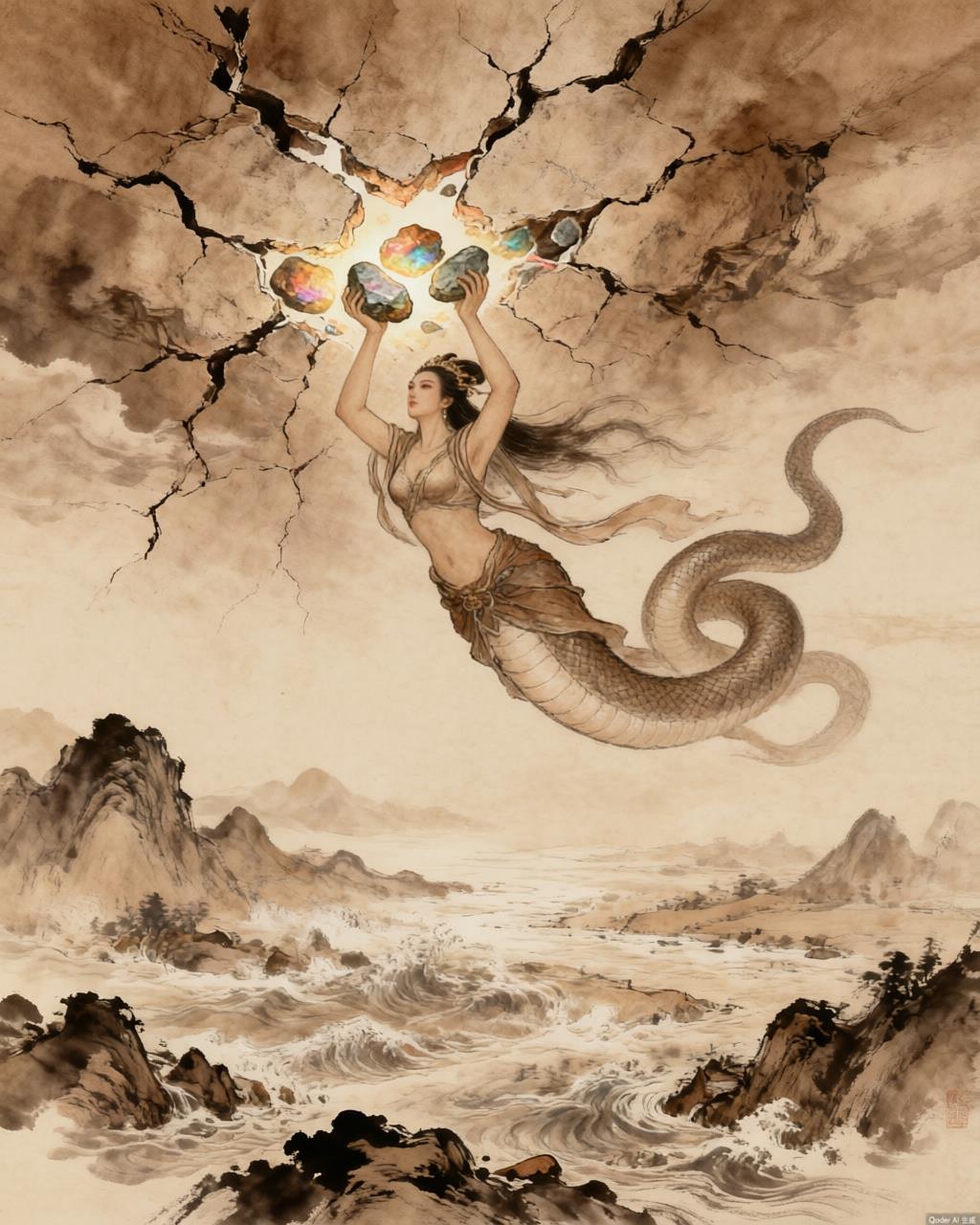
The sky cracked open. Great rents appeared in the firmament, and through them poured celestial fire. The earth split and heaved. Floods erupted from the wounded ground, swallowing villages and forests alike. The rivers overflowed their banks. Wild beasts, maddened by the chaos, preyed upon the people. Humanity — Nüwa's beloved children, shaped with such care from the yellow clay — was perishing.
Nüwa could not bear it. She gathered five-colored stones from the riverbeds — blue, yellow, red, white, and black, representing the five elements — and melted them in a great furnace until they became a luminous paste. With this molten mineral, she ascended to the broken sky and sealed the cracks, patching the firmament with her own hands. Where the pillars had fallen, she raised new supports — some traditions say she severed the legs of a great cosmic turtle and set them at the four corners of the earth. She slew the black dragon that had been terrorizing the people. She burned reeds to dam the floodwaters. And slowly, painfully, the world was made whole again.
The sky still bears the scars. It leans slightly toward the northwest, where the damage was greatest, which is why the sun, moon, and stars drift westward each day. The earth tilts toward the southeast, which is why all the rivers of China flow eastward toward the sea. These are not flaws. They are memories. They are the world remembering the day it nearly ended, and the goddess who refused to let it.
Worship and Living Traditions
Nüwa is not a figure confined to ancient texts. She is worshipped, celebrated, and invoked across China to this day, in traditions that stretch back millennia and show no sign of fading.
The most significant site of Nüwa worship is the Wa Huang Gong (娲皇宫, "Palace of Empress Wa") in She County, Hebei Province. Carved into the cliffs of Phoenix Mountain, this temple complex dates back over 1,400 years and is considered the largest and earliest surviving site dedicated to Nüwa. Each year, during the third lunar month, hundreds of thousands of pilgrims ascend the mountain to offer incense, pray for children, and seek the goddess's blessing. The temple is built into the living rock, its halls connected by narrow paths that wind along the cliff face — a physical embodiment of the mythic landscape, where the boundary between earth and sky grows thin.
In Tianshui, Gansu Province — the region traditionally associated with Fuxi and Nüwa's homeland — an annual festival honors the divine siblings with processions, theatrical performances, and elaborate ritual offerings. The local people trace their ancestry directly to Nüwa and Fuxi, and the festival is as much a family reunion as a religious observance. Children carry paper-cut figures of the serpent-bodied goddess through the streets, and elderly women recite creation hymns in dialects that preserve archaic linguistic forms.
Among the Miao people of Guizhou and Hunan, Nüwa (known in Miao languages by cognate names) is central to funeral rites and creation songs. The Miao Guge (苗族古歌, "Ancient Songs of the Miao") contains lengthy narrative poems describing Nüwa's creation of humanity and her mending of the sky, sung over multiple nights during important ceremonies. These oral traditions predate the written Chinese accounts and preserve details — including a more prominent role for Nüwa as a warrior-goddess — that the literary tradition has softened or omitted.
In folk religion across northern China, Nüwa is invoked as a protector of children and a granter of fertility. Women seeking to conceive visit her temples and leave offerings of fruit, flowers, and small clay figures. The connection is direct and unbroken: the goddess who shaped humanity from clay is asked to shape new humans still. The medium is the same. The prayer is the same. Only the centuries differ.
Nüwa and the Feminine Divine in Chinese Culture
Nüwa occupies a singular position in the Chinese mythological landscape. She is not merely a goddess among many. She is the mother — the first mother, the original mother, the one from whom all motherhood descends. And her primacy carries implications that extend far beyond mythology into the structure of Chinese thought about gender, power, and the sacred.
In the earliest strata of Chinese religion, before the Confucian codification of patriarchal hierarchy, the feminine divine held a position of unquestioned supremacy. Nüwa creates. Nüwa sustains. Nüwa saves. The male figures of the mythic age — Fuxi, Shennong, the Yellow Emperor — are culture-heroes who teach and organize, but they do not create life itself. That power belongs exclusively to the goddess. The Shanhaijing (Classic of Mountains and Seas) preserves fragments of a mythic world in which female deities are not subordinate to male ones but precede and encompass them.
The Confucian tradition, with its emphasis on patrilineal descent and male authority, never fully succeeded in displacing Nüwa. She was too deeply rooted, too beloved, too essential to the popular imagination. Instead, she was domesticated — recast as Fuxi's wife rather than his equal, her creative power subordinated to his cultural innovations. Yet the popular tradition resisted this demotion. In village temples across China, Nüwa stands alone, sovereign, her serpent tail coiled in authority, her hands still shaping clay. The people know who made them. They have not forgotten.
Contemporary scholars of Chinese feminism have reclaimed Nüwa as a figure of radical feminine power — a goddess who creates without male assistance, who acts without male permission, who saves the world through her own initiative and strength. Her myth, they argue, preserves the memory of a pre-patriarchal world in which the feminine was not the complement of the masculine but its origin and ground. Whether or not this historical reconstruction is accurate, it speaks to the myth's enduring power to generate new meanings across millennia.
The Clay Remembers
There is a passage in the Fengsu Tongyi, the Han Dynasty compendium of customs, that describes Nüwa's creation in terms that have haunted Chinese literature ever since. It says that she "kneaded yellow earth to make people" — and the verb used, tuan (抟), is the same verb used for kneading dough, for shaping pottery, for the most intimate and physical acts of making. Nüwa does not speak humanity into existence. She does not think it into being. She kneads it. Her hands are in the mud. Her fingerprints are in our skin.
This is the enduring power of the Nüwa myth. It locates the origin of humanity not in a divine decree but in a divine touch. We are not commanded into existence. We are handled into existence. Shaped by fingers. Warmed by breath. The relationship between creator and created is not one of sovereign and subject but of mother and child, potter and vessel, artist and artwork. It is intimate. It is physical. It is tender.
And it is ongoing. For Nüwa did not create humanity and then withdraw. She established marriage so that we could continue creating ourselves. She mended the sky so that we could survive our own world's violence. She remains, in the popular imagination, perpetually present — perpetually shaping, perpetually protecting, perpetually reaching down into the mud to pull up one more figure, breathe upon it, and set it walking beneath the sky she patched with her own hands.
In every potter's workshop in China, in every kiln where clay becomes vessel, Nüwa's original act is repeated. In every marriage ceremony, in every union of two lives into one household, her institution is renewed. In every act of mending — of repairing what is broken, of holding together what threatens to fall apart — her sky-patching labor continues. She is not a goddess of the past. She is a goddess of the perpetual present, working still, her hands never clean of clay.
And if you walk beside the Yellow River on a quiet evening, when the light turns the water to molten gold and the loess banks glow with the warmth of ten thousand sunsets, you may see them — the small figures playing in the mud at the water's edge. Children building castles, shaping animals, pressing their small fingers into the wet earth with fierce concentration. They do not know they are reenacting the oldest story in the world. But their hands know. The clay remembers. And somewhere, just beyond sight, Nüwa watches, and smiles, and reaches down to help.