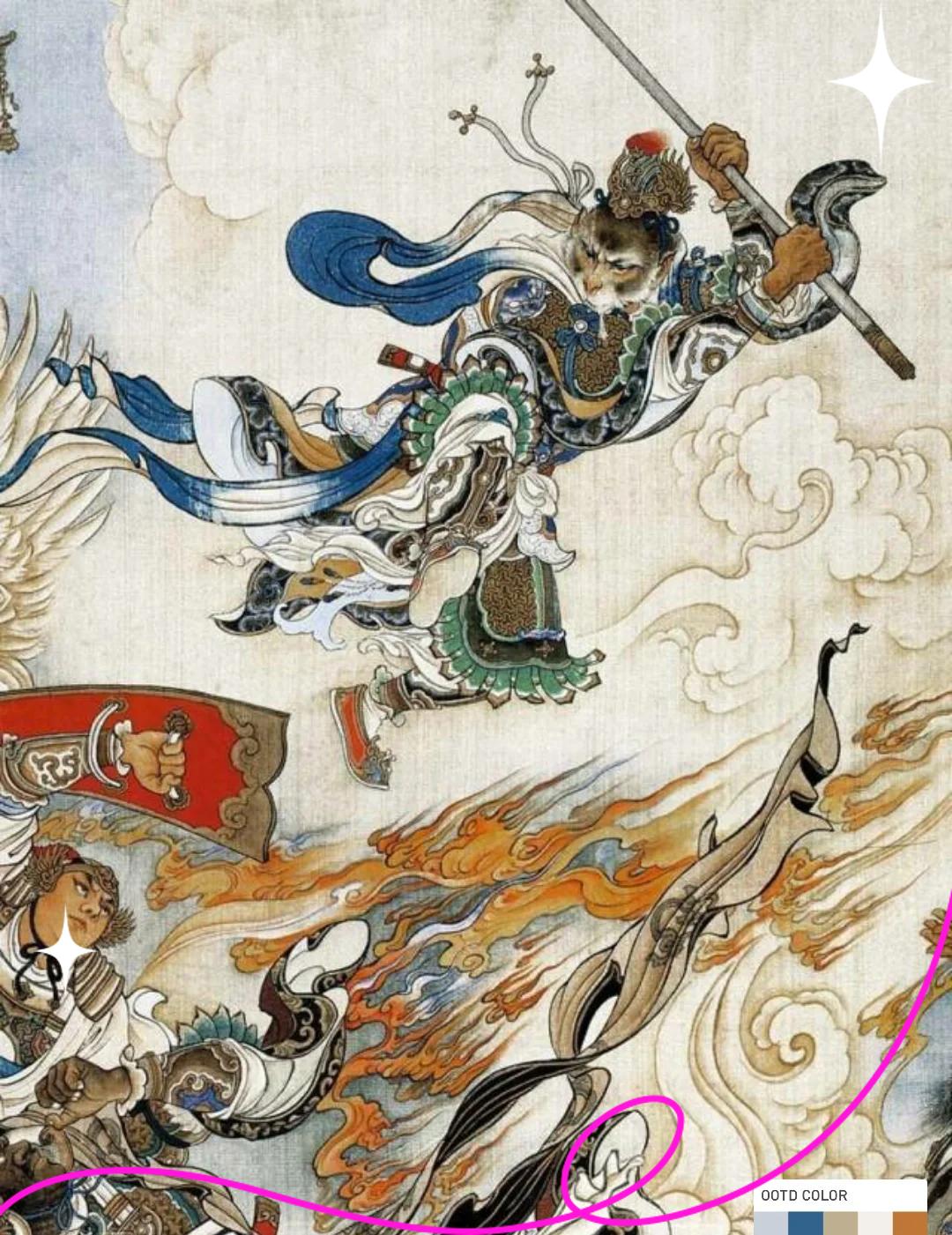
Born from the Womb of the Earth
On the eastern shore of the great ocean, where the waves have gnawed the cliffs for ten thousand ages, there stands a mountain called Huaguo Shan — the Mountain of Flowers and Fruit. Its peaks are crowned with perpetual blossom, its valleys thick with the scent of ripe peaches and the chatter of ten thousand monkeys. And at its very summit, exposed to every wind and every star, there stood a stone. Not a boulder tumbled from some ancient landslide, not a fragment of ordinary granite. This stone had been drinking the essence of heaven and earth since the dawn of creation. It had absorbed the pure yang energy of the sun, the cool yin nourishment of the moon, the breath of every season for eons uncounted. It was pregnant with purpose.
Then, on a morning when the sky was the color of hammered bronze, the stone split. Not cracked, not crumbled — split, clean as an egg breaking, as though something inside had decided it was time. From the fissure burst a column of golden light that shot upward, piercing the clouds, striking the floor of heaven itself so violently that the Jade Emperor looked up from his throne and demanded to know what manner of disturbance this was. The light faded. And where the stone had stood, there crouched a creature no larger than a child — a monkey, golden-furred and bright-eyed, already blinking at the sun with the sharp, appraising intelligence of something that had never known the luxury of ignorance.
He was small. He was naked. He was utterly alone in a vast and indifferent world. And within a week, he was king.
The King of Monkeys
The monkeys of Huaguo Shan were a simple folk — playful, quarrelsome, easily frightened. They lived in the trees and the caves, ate what the mountain gave them, and feared nothing so much as the waterfall that thundered down the cliff face into the pool below. "Whoever dares leap through that waterfall and return alive," they chattered among themselves, "we will make him our king."
The golden monkey did not hesitate. He crouched, coiled his sinewy legs beneath him, and launched himself into the white curtain of falling water. Behind the torrent, he found not death but wonder — a vast cavern, dry and warm, furnished with stone tables and stone beds, a palace carved by nature's patient hand. The Water Curtain Cave. Shuiliandong. He leaped back through the spray, dripping and grinning, and announced his discovery. The monkeys, true to their word, bowed. They called him Meihou Wang — the Handsome Monkey King. And for three hundred years, he ruled his mountain kingdom in golden contentment, feasting on peaches, wrestling with his subjects, watching the seasons wheel overhead in their endless procession.
But contentment, for a creature born of heaven and earth's concentrated essence, is a temporary state. One evening, mid-feast, the Monkey King set down his wine cup and wept. His monkeys gathered around, alarmed. "What troubles our king?" they asked. And he answered with the words that would set the entire cosmos on its ear: "I weep because one day I will grow old. My body will fail. I will die. And all this — the mountain, the cave, the feast, you — will be as though it never was. I weep because I do not know how to escape death."
An old monkey, wise with the particular wisdom of those who have watched many kings come and go, spoke up: "There are those who have escaped the wheel of birth and death. They are called Buddhas, and immortals, and holy sages. They dwell beyond the mortal world, in the lands of the west. Seek them, and you will find what you desire."
The next morning, the Monkey King built a raft of pine logs, pushed off from the shore of the eastern ocean, and sailed into the unknown.
The Patriarch of the Bodhi Cave
He wandered for ten years. Ten years of mortal lands and mortal cities, where he learned to walk upright, to wear clothes, to speak the language of men — and found in all that time not a single teacher who could show him the way beyond death. He was mocked. He was pelted with stones. He was treated as a curiosity, a performing animal, a trick of the light. But he endured, because the alternative was oblivion, and oblivion was the one enemy he refused to accept.
At last, guided by a woodcutter's cryptic song, he found the Mountain of Heart and Mind — Lingtai Fangcun Shan — and upon it, the Cave of the Slanted Moon and Three Stars. There dwelt Subhuti, the Bodhi Patriarch, an immortal of such antiquity and power that even the heavens treated his name with circumspection. He was teaching a class of disciples when the golden monkey knelt at his gate, and when Subhuti asked his name, the creature replied, "I have no name. I was born from a stone."
Subhuti smiled — the smile of a man who has been expecting a particular student for a very long time. He gave him a name: Sun Wukong. Sun, from the character for monkey, stripped of its animal radical to suggest a creature transcending its nature. Wukong — "Awakened to Emptiness" — a Buddhist name, pointing toward the ultimate truth that all form is illusion, all attachment is suffering, and all boundaries are negotiable.
For seven years, Wukong swept floors, carried water, and studied the basics. Then, in a single night of secret instruction — the Patriarch striking him three times on the head and retreating behind a closed door, a code Wukong deciphered instantly — he was taught the great arts. The Seventy-Two Transformations: the ability to become anything. A pine tree. A temple. A fly. A mountain. The Cloud Somersault — Jindou Yun — a single leap that carried him one hundred and eight thousand li, more than thirty thousand miles, in the space between one breath and the next. He learned to command the wind, to call the rain, to pluck hairs from his body and blow them into armies of clones. He learned, in essence, to refuse every limitation the universe had attempted to impose upon him.
When Subhuti finally expelled him — for Wukong's arrogance had grown as fast as his power — the Patriarch said only: "Go. And never speak my name. Whatever trouble you bring upon yourself, I will not be part of it." It was, perhaps, the wisest thing anyone ever said to the Monkey King. He did not listen.
The Staff of the Dragon King
An immortal without a weapon is a poet without a brush — technically complete, but lacking the instrument through which genius becomes manifest. Wukong needed a weapon worthy of his power, and the old monkeys of Huaguo Shan told him where to find one: beneath the eastern sea, in the crystal palace of Ao Guang, the Dragon King of the East.
Wukong descended through the waves as easily as a stone through air. The Dragon King received him with the strained politeness of a bureaucrat confronted by an armed lunatic. "I need a weapon," Wukong announced. Ao Guang produced a great sword. Too light. A nine-pronged rake. Too light. A halberd weighing seven thousand pounds. "A toothpick," Wukong sneered, and tossed it aside like a twig.
It was the Dragon King's wife who whispered the solution: "In the depths of our treasury lies the Ruyi Jingu Bang — the Compliant Golden-Hooped Rod. It was used by Yu the Great to measure the depths of the floods in the age of legends. It weighs thirteen thousand five hundred jin. No one has been able to lift it. Let the monkey try."
They led him to it. It stood in the deepest vault, a pillar of black iron banded with gold, taller than a house, thick as an ancient oak. Wukong circled it once. Twice. He placed his hands upon it and said, "Smaller." And it shrank. "Smaller still." It shrank again. He picked it up, swung it once, twice, three times, and the entire ocean palace shuddered on its foundations. When he was done, the Ruyi Jingu Bang rested behind his ear, no larger than a needle, waiting to be called forth at any size from a sewing pin to a pillar that could prop up the sky.
He also helped himself to a suit of golden armor, a phoenix-feather cap, and cloud-walking boots, extorting them from the four Dragon Kings through the simple expedient of threatening to demolish their palaces if they refused. Then he somersaulted back to his mountain, and the Dragon Kings sent a joint letter of complaint to heaven.
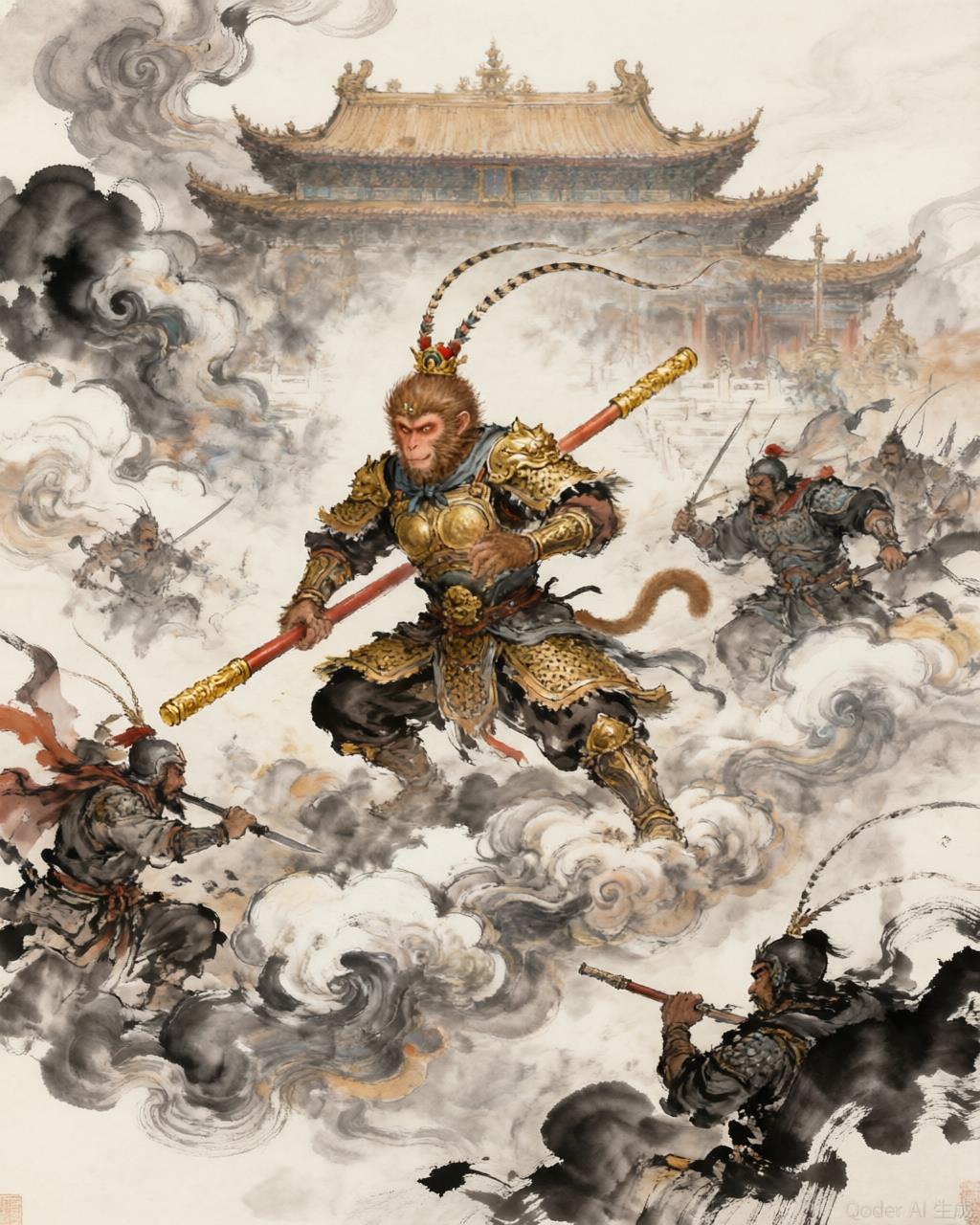
Erasing the Book of Death
But a weapon, however magnificent, addresses only the symptoms of mortality. Wukong wanted the cure. And the cure, he discovered, was administrative. In the underworld, in the lightless courts of Yama, the King of the Dead, there existed a ledger — the Book of Life and Death — in which the name and allotted lifespan of every living creature was recorded. Wukong's entry read: "Sun Wukong, born of the stone on the Mountain of Flowers and Fruit. Allotted lifespan: three hundred and forty-two years. Death by natural causes."
He was three hundred and forty-one.
When the underworld's emissaries came to collect his soul — two gaunt figures with iron chains and the patient demeanor of tax collectors — Wukong beat them senseless with his staff, descended to the courts of Yama in a fury of golden light, and demanded the book. Yama, trembling, produced it. Wukong found his own name. He found the names of every monkey on his mountain. And with a single stroke of his brush, he crossed them all out. Every one. Then he threw the book at Yama's feet and said, "From this day forward, I am beyond your jurisdiction."
He was not, of course. No one is beyond jurisdiction. But he had made his position admirably clear, and the underworld, like the Dragon Kings before it, appealed to the only authority left: the Jade Emperor, ruler of all heaven, keeper of cosmic order, the one who had felt the shock of that golden light on the morning a stone split open on a mountain in the east.
The Stable Keeper and the Peach Guardian
The Jade Emperor's court debated the monkey problem at length. Some ministers advocated annihilation — send the armies, crush the creature, make an example. But the Emperor, who had ruled for eons and understood that the most dangerous rebels are those who cannot be killed, chose a subtler approach. He would domesticate the monkey. Give him a title. A position. A stake in the system. Make him a bureaucrat.
And so Sun Wukong was summoned to heaven and appointed Bi Ma Wen — Keeper of the Heavenly Stables. It was, in the celestial hierarchy, a position of approximately zero importance. A glorified groom. The Monkey King, flattered by the summons and ignorant of the hierarchy, accepted with pride. For a time, he tended the heavenly horses with genuine enthusiasm, and they flourished under his care. Then he learned the truth — that his title was a joke, that he ranked below the lowest page boy, that the court had laughed when he was appointed.
His rage was volcanic. He smashed the stables, released the horses, fought his way back to the mortal world, and raised a banner on Huaguo Shan that read, in letters of gold: "Qi Tian Da Sheng" — The Great Sage Equal to Heaven. It was not a request. It was a declaration of war.
Heaven sent armies. Wukong defeated them. Heaven sent more. He defeated those too, scattering celestial generals like chaff, his staff growing and shrinking with bewildering speed, his seventy-two transformations making him impossible to pin down. At last, the Jade Emperor capitulated. He granted Wukong the title he demanded and a new post: Guardian of the Heavenly Peach Garden.
This was, in retrospect, a catastrophic error. The peaches of the garden ripened once every three thousand, six thousand, or nine thousand years, depending on the tree. To eat one was to gain immortality of the highest order. Wukong, left alone with the garden, ate them all. Every single ripe peach. Then, learning of the great heavenly banquet to which he had not been invited, he crashed it. He drank the Jade Emperor's wine. He ate the dragon liver and phoenix marrow. He stumbled, drunk and bloated with stolen immortality, into the laboratory of Laozi, the supreme deity of Daoism, and consumed five gourd-fulls of the elixir of life that the old sage had spent centuries refining.
He was, by this point, essentially indestructible. And he knew it.
The War Against Heaven
What followed was the most spectacular act of insubordination in the history of Chinese mythology. The Jade Emperor, humiliated beyond endurance, unleashed the full might of heaven. One hundred thousand celestial soldiers. The Four Heavenly Kings. Nezha, the three-headed child god of war. Erlang Shen, the three-eyed warrior with his celestial hound. The entire pantheon, armed with every divine weapon ever forged, descended upon a single golden monkey on a single flower-covered mountain.
Wukong fought them all. He fought them for days. He plucked hairs from his body and blew them into thousands of clones, each as strong as the original. He transformed into a sparrow to escape Erlang Shen's hound, then a fish, then a snake, then a temple — though Erlang Shen recognized the temple by its flagpole, which no real temple places at the back. He was captured, once, through the combined efforts of Laozi dropping his diamond snare from above and Erlang Shen's dog biting his ankle. He was bound in celestial chains and placed in Laozi's eight-trigram furnace to be smelted into nothing.
He sat in the furnace for forty-nine days. When Laozi opened the lid, expecting ash, Wukong leaped out stronger than before — his eyes now burning with Huoyan Jinjing, the Fiery Golden Gaze, capable of seeing through any disguise, any illusion, any lie. He was furious. He seized his staff, grew it to the size of a mountain, and began to demolish heaven. Pillar by pillar. Hall by hall. The Jade Emperor fled his throne. The celestial court scattered. The cosmos teetered on the edge of total anarchy.
And then the Buddha arrived.
The Palm and the Mountain
The Buddha did not fight. He did not raise a weapon or summon an army. He simply appeared, vast and serene, seated upon a lotus of golden light, and he spoke to the raging monkey with the gentle patience of a parent addressing a toddler who has thrown a tantrum of cosmic proportions.
"You wish to rule heaven?" the Buddha asked. "Very well. If you can somersault out of my right palm, I will cede the Jade Emperor's throne to you."
Wukong laughed. One palm. He could cross a hundred and eight thousand li in a single leap. He could cross the universe. He leaped. He soared. He tumbled through the void for what felt like eternity, past stars and nebulae, past the outermost boundaries of creation, until he came to five great pillars of flesh-colored stone, rising from the void, pink and faintly warm. "The end of the universe," he declared. He plucked a hair, transformed it into a brush, and wrote upon the central pillar: "Sun Wukong, the Great Sage Equal to Heaven, was here." Then he somersaulted back, triumphant, landing in the Buddha's palm with a flourish.
"Look," he said, pointing. "I reached the end. I left my mark."
The Buddha smiled. He turned his hand over. There, on the middle finger, in fresh golden ink, were the words: "Sun Wukong, the Great Sage Equal to Heaven, was here." And faintly, unmistakably, the smell of monkey urine. Wukong had never left the palm. The five pillars were fingers. The end of the universe was a hand. Everything he had done, everything he had been, everything he would ever be — it all existed within the span of one open palm.
Before Wukong could react, the Buddha turned his hand downward. The five fingers became five mountains — the Five Elements Mountain, Wuzhi Shan — and they pressed the Monkey King into the earth with the weight of an entire world. Gold, wood, water, fire, earth — all five elements compressed into stone and laid upon his back. He could not move. He could not transform. He could not shrink his staff or pluck his hairs or somersault away. He could only lie there, pinned beneath the mountain, his golden eyes staring at a patch of sky no larger than a dinner plate.
He lay there for five hundred years. Five centuries of rain and sun, of moss growing over his fur, of monkeys from his mountain occasionally visiting to bring him peaches and weep. Five centuries of silence, and stillness, and the slow, grinding education of a will that had never learned the meaning of the word "enough."
The Journey West and the Legacy of Rebellion
His deliverance came in the form of a monk. Xuanzang, a humble Buddhist pilgrim tasked with traveling to India to retrieve sacred scriptures, was directed to the mountain and told to peel the golden seal from its peak. The mountain crumbled. And from the rubble rose Sun Wukong — thinner, wilder, his golden eyes burning with five hundred years of imprisoned fury, but also something new. Something that looked, improbably, like gratitude.
He became Xuanzang's protector. His disciple. His most troublesome and devoted student. The journey west — fourteen years, one hundred and eight thousand li, eighty-one tribulations — is the subject of "Xi You Ji," Journey to the West, the sixteenth-century novel by Wu Cheng'en that stands as one of the four great classical novels of Chinese literature. Along the way, Wukong battles demons, outwits gods, and saves his hopelessly naive master from certain death approximately once per chapter. He is bound by a golden fillet around his head — a gift from the Bodhisattva Guanyin that tightens when Xuanzang chants a particular sutra, causing pain so exquisite that even the Monkey King, who survived the eight-trigram furnace, screams and begs for mercy.
But the fillet is more than a plot device. It is the novel's central metaphor. Wukong's power was never the problem. His power was limitless. The problem was direction. Purpose. The willingness to serve something larger than his own magnificent, raging ego. The journey west does not diminish him. It completes him. At its end, he is granted Buddhahood — named the Victorious Fighting Buddha — and the golden fillet falls away of its own accord. It was never needed. Not really. He had simply needed five hundred years under a mountain and fourteen years on a road to learn what the Buddha knew from the beginning: that the palm was always open. The cage was always unlocked. The only prison was the one he built from his own refusal to stop fighting.
And yet — and this is why the Monkey King endures, why his image adorns temple walls and opera stages and billion-dollar film franchises, why children in every Chinese city still swing sticks and shout "Ruyi Jingu Bang!" at each other in the park — he never fully submits. Even as a Buddha, there is something in his grin that suggests he could, if he chose, bring it all down again. He is China's greatest antihero: the rebel who was tamed but never broken, the anarchist who found a cause, the stone-born orphan who looked at the entire architecture of heaven and said, "No. I will not kneel." And then, after five hundred years of kneeling, stood up and walked west, staff over his shoulder, toward something that might, if he was very lucky, be called peace.
The Monkey King belongs to everyone. To the child who refuses bedtime. To the student who questions the teacher. To the worker who resents the boss. To the artist who will not paint within the lines. He is the part of us that looks at the sky — at the vast, indifferent, bureaucratic sky with its jade emperors and its peach banquets and its books of life and death — and thinks: I could take them. I could take them all.
And the beautiful, terrible truth of Sun Wukong is this: he did. He took them all. And it was not enough. It was never going to be enough. The staff can grow to prop up the sky, but it cannot make the sky care about you. The seventy-two transformations can make you anything in creation, but they cannot make you someone else. The cloud somersault can carry you to the end of the universe, but the end of the universe is only a hand, and the hand belongs to something older and vaster and more patient than rage.
So he walks west. He always walks west. Staff on his shoulder, golden eyes scanning the horizon for the next demon, the next fight, the next excuse to swing that iron pillar and feel, for one blazing moment, like the stone-born king of everything. And China watches him go, and loves him, and understands — because China has always understood — that the greatest stories are not about those who conquer heaven. They are about those who try.