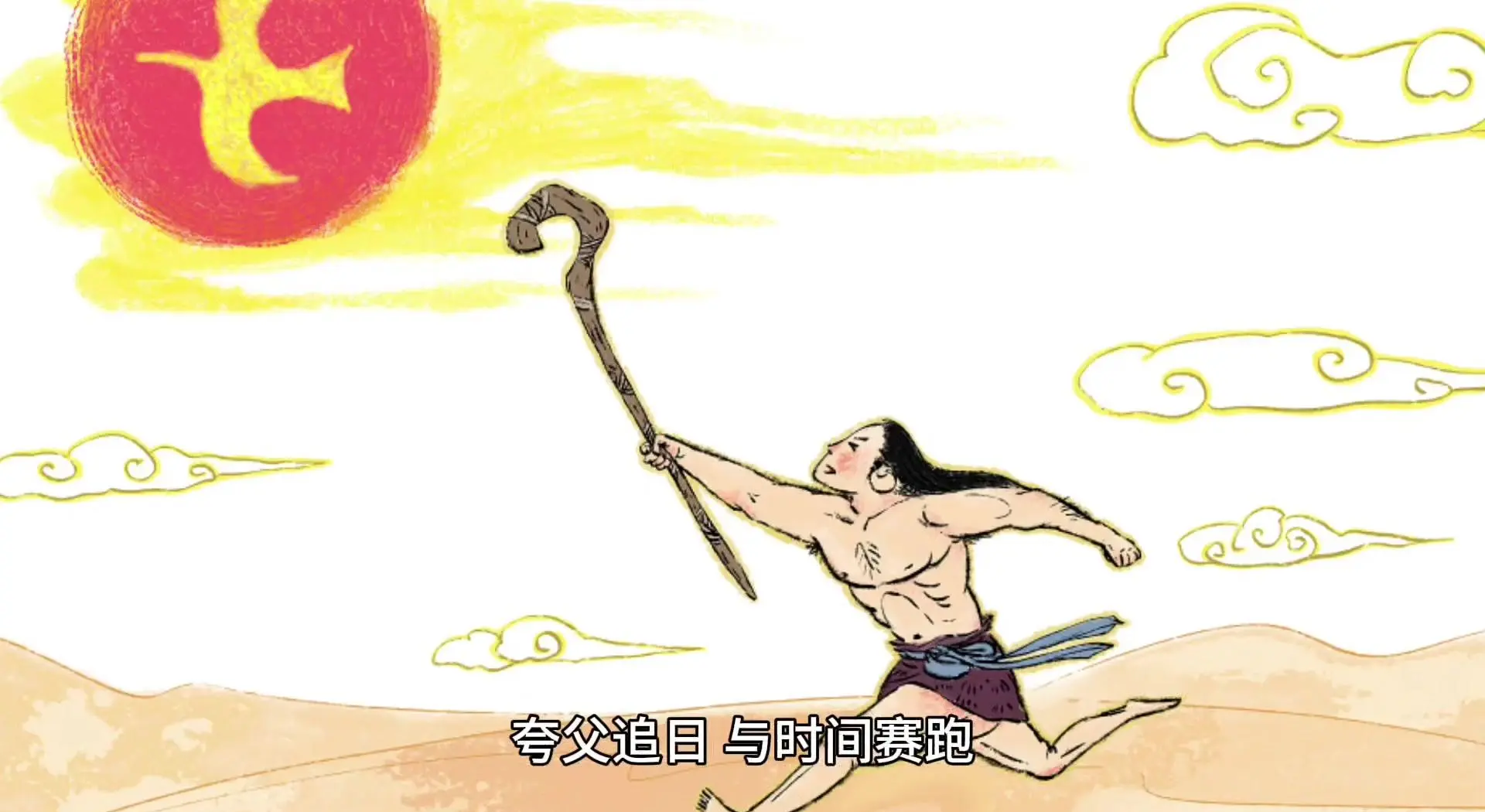
The Giant of the Northern Wilderness
In the far north, beyond the reach of cultivation, beyond the last scattered villages where the smoke of cooking fires thins to nothing, there stretches a wilderness so vast and so silent that the wind forgets its name. The Shan Hai Jing — the Classic of Mountains and Seas, that great encyclopedia of the impossible compiled in the Warring States period — calls this place the Land of Darkness, where the sun's light arrives late and leaves early, where winter lasts longer than memory. And it was here, in this realm of perpetual twilight, that Kuafu was born.
He was a giant. Not merely tall — the word "tall" belongs to the vocabulary of men, and Kuafu was not a man in any sense that the word permits. He was a landscape that had learned to walk. His shoulders were ridgelines. His stride was a valley. When he stood at his full height and raised his arms, his fingers brushed the low clouds that clung to the northern peaks like wet cloth. The earth groaned beneath him. Rivers diverted their courses to avoid his footsteps. The animals of the wilderness — the wolves, the bears, the great elk with their cathedral antlers — fled not from his malice but from the simple seismic fact of his passing.
And yet, for all his enormity, Kuafu possessed a heart that was, in its way, small and tender and full of longing. He watched the sun each day as it crossed the sky — that golden disc, that source of all warmth, all growth, all life in his frozen northern world. He watched it rise in the east, climb to its zenith, and then descend in the west, sinking below the horizon like a coin dropped into dark water. And each evening, as the cold returned, as the shadows lengthened and the frost crept back across the ground, Kuafu felt something that no giant should feel: grief. The sun was leaving. The sun was always leaving. And he could not bear it.
The Decision: To Catch the Light
The thought came to him not as madness but as clarity — sudden, absolute, and irrevocable. He would catch the sun. He would run it down, seize it in his great hands, and hold it. He would keep it from setting. He would fix it in the sky like a lantern nailed to a beam, and the north would never again know darkness, never again know the killing frost, never again watch the light retreat westward while the cold advanced from every side.
It was, by any rational measure, an impossible ambition. The sun is not a thing that can be caught. It is not a deer to be run down, not a fish to be netted, not a child to be scooped from a river. It is a god, a force, a fundamental principle of the cosmos. It moves because it is its nature to move. It sets because setting is what it does. To catch the sun is to arrest the rotation of the world, to stop time itself, to unmake the order that separates day from night and life from death.
Kuafu did not care. Or rather, he cared so much that the impossibility became irrelevant. He gripped his staff — a trunk of iron-wood, thick as a temple pillar, stripped from a tree that had stood for a thousand years — and he began to run.
The Chase Across the Earth
He ran westward, following the sun's descent. And the earth, which had endured his weight in stillness, now shuddered under the violence of his motion. Each footfall was an earthquake. Each stride carried him over a league of ground — over hills, over forests, over the frozen lakes of the north that cracked and groaned beneath the shockwave of his passing. His shadow stretched behind him for miles, a dark river flowing eastward as he flowed west, and the animals caught in that shadow looked up and saw the sky itself in motion.
The sun descended. Kuafu ran faster. The sun touched the horizon, painting the clouds in shades of blood and amber. Kuafu's arms reached forward, his fingers splayed, grasping for the light that was already slipping away. He could feel its warmth on his face — close, so close, close enough to burn. The heat blistered his skin. The air around him shimmered and warped. His breath came in great bellows-gusts that flattened the grass for a hundred yards in every direction.
But the sun was faster. It was always faster. For every league Kuafu gained, the sun sank another degree. The golden light thinned. The shadows lengthened. And still he ran, because to stop was to accept the darkness, and he had decided, in the deepest chamber of his giant's heart, that he would not accept it. Not today. Not ever.
The Thirst That Emptied Rivers
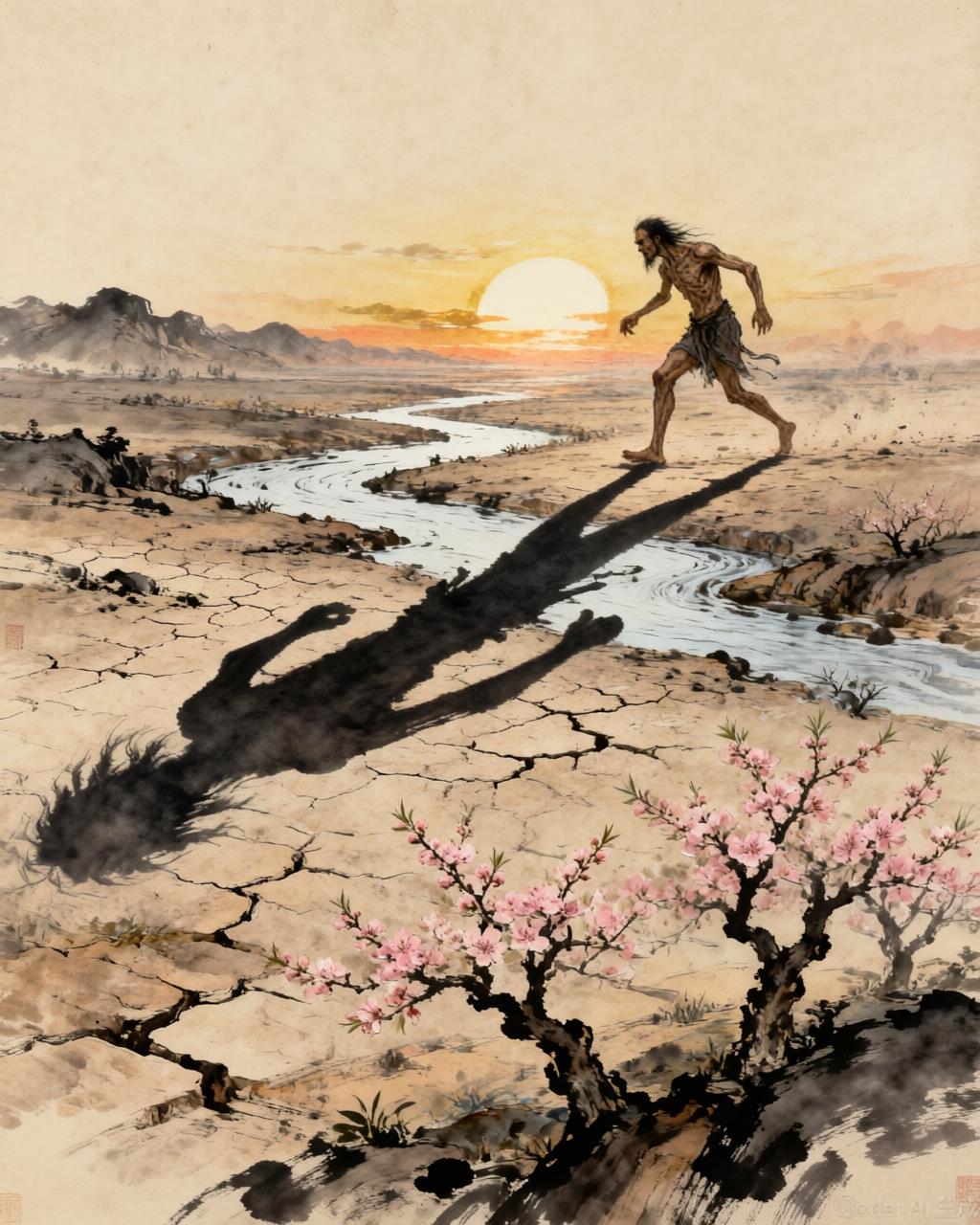
The running consumed him. Not his strength — his strength was the strength of mountains, and mountains do not tire easily. What consumed him was thirst. The heat of the sun, even in its retreat, had baked the moisture from his body. His throat was a furnace. His tongue was a stone. His blood, thick and slow, moved through his veins like mud through a cracked riverbed. He needed water. He needed water the way the earth needs rain, the way the dying need breath — totally, desperately, without reservation or restraint.
He came to the Yellow River — the great Huang He, mother of Chinese civilization, the river that carries the silt of a continent to the sea. Kuafu lowered his head and drank. He drank the way a fire drinks oxygen — completely, hungrily, without pause. The river, which had flowed for ten thousand years, which had nourished empires and drowned armies, which had been the subject of ten thousand poems — the Yellow River ran dry. Its bed lay exposed, pale and cracked, the fish flopping in the mud, the boats settling onto the bare earth like beached whales. Kuafu lifted his head. His thirst was not quenched.
He turned to the Wei River, the great tributary, the river that fed the plains of the ancient capital. He drank it too. Drank it as a man drinks a cup of tea — quickly, without ceremony, without satisfaction. The Wei River vanished. Its valley became a trench of dry stone. And still, still, Kuafu's throat burned. Still his body screamed for water. The rivers of the earth were not enough. All the rivers of the earth, combined, would not be enough. His thirst was not a physical thirst. It was the thirst of a being who had challenged a god and discovered that the cost of challenging a god is the consumption of everything you are.
The Death of Kuafu
There was one more source of water. In the far north — beyond the wilderness where he had been born, beyond the Land of Darkness, beyond the last frozen ridge where the world ended and the void began — there lay the Great Swamp, the Da Ze, a body of water so vast that it had no shores, no bottom, no name that human lips could pronounce. If Kuafu could reach it, he could drink. He could drink and live. He could rise again and resume the chase.
He turned north. He walked. But the walking was no longer the running of before. His steps were slow, uncertain, the steps of a man moving through deep water, through deep sleep, through the thick medium of approaching death. His vision dimmed. The sky above him was empty — the sun had set, had fully set, had sunk below the world and left him in the darkness he had sworn to destroy. His legs buckled. His staff struck the earth and held him upright for one more step, two more steps, three.
And then Kuafu fell. He fell the way a mountain falls — slowly at first, then all at once, with a sound like the world breaking. His body struck the earth and the earth received him, as it receives all things, without judgment, without mercy. His eyes, still open, still turned westward, saw the last faint glow of the sun on the horizon. His fingers, still extended, still grasping, closed on empty air. And the giant who had chased the sun, who had drunk rivers, who had shaken the foundations of the world with his running — the giant died. Thirsty. Reaching. Alone in the dark.
The Shan Hai Jing records his death in a single, devastating line: "Kuafu did not reach the Great Swamp. He died of thirst on the road." No elegy. No mourning. No divine intervention. Just the flat, factual grammar of a life ended mid-stride. It is, perhaps, the most honest death in all of mythology.
The Peach Forest: Death Becomes Gift
But the story does not end with the body. As Kuafu fell, his staff — that great trunk of iron-wood, soaked with the sweat of his labor, stained with the dust of his journey — struck the earth and took root. From the dead wood, green shoots erupted. From the green shoots, branches spread. From the branches, blossoms burst — pink and white, ten thousand, a hundred thousand, a million blossoms opening all at once in the darkness like a second dawn. And the blossoms became fruit. Peaches, heavy and golden, sweet with the juice of a giant's sacrifice, bending the branches to the ground.
The forest spread. It spread for hundreds of miles in every direction — a sea of peach trees where before there had been only barren wilderness. The ancients called it Denglin, the Forest of Deng, and it stood for generations, for centuries, for as long as the land remembered the name of the giant who had planted it with his dying hand. Travelers crossing the northern wastes stumbled upon it and wept with relief. They ate the peaches. They rested in the shade. They drank from the streams that the forest's roots had drawn up from deep underground. And they lived. They lived because Kuafu had died. They walked in the shade of his failure and called it mercy.
This is the myth's deepest teaching: that the giant's quest was not truly about catching the sun. It was about the road. It was about what a single life, spent in full pursuit of an impossible ideal, leaves behind for those who come after. Kuafu did not bring eternal light to the north. But he brought a forest. He brought shade, and fruit, and water, and rest. He brought, in the end, a small and mortal version of the thing he had sought — not the sun itself, but the sun's effect: growth, nourishment, life persisting in a hostile land.
The Idiom and Its Legacy: 夸父逐日
The four characters 夸父逐日 — Kuafu zhu ri, "Kuafu chases the sun" — entered the Chinese language as a chengyu of extraordinary emotional range. In its most straightforward usage, it describes a person of great ambition who overreaches, who attempts something beyond human capacity and pays the ultimate price. In this sense, it carries a note of caution: know your limits, the idiom whispers. Do not drink rivers. Do not chase gods.
But the idiom's deeper resonance is not cautionary. It is elegiac, and even celebratory. To call someone a Kuafu is not merely to call them foolish. It is to acknowledge the grandeur of their ambition, the beauty of their striving, the nobility of a life spent in full pursuit of the impossible. The poet Tao Yuanming, writing in the fifth century, placed Kuafu alongside Jingwei in his verses on the Shan Hai Jing, celebrating both as figures whose "ambitions stretch beyond a thousand autumns." The Tang dynasty monk-poet Guanxiu wrote of Kuafu with a mixture of awe and pity that suggests the giant's true sin was not hubris but love — love of light, love of warmth, love of a world he could not bear to see in darkness.
In modern Chinese, the idiom appears in contexts ranging from scientific ambition (the researcher who spends forty years on a single unsolvable theorem) to political rhetoric (the revolutionary who sacrifices everything for a future she will never see). It is the idiom of the beautiful failure, the magnificent defeat, the life that burns too brightly to last. And in every usage, the peach forest lingers in the background — the reminder that even the failed quest leaves something behind, that the staff strikes the earth even when the hand releases it.
Kuafu and Icarus: A Comparative Mythology of Overreach
The Western mind, encountering Kuafu for the first time, reaches instinctively for Icarus. The Greek boy who flew too close to the sun on wings of wax and feathers, who ignored his father's warning, who fell into the sea while the sun looked on with indifference. The parallel is obvious: both figures challenge the sun, both are destroyed by their ambition, both serve as cautionary tales about the limits of mortal aspiration.
But the parallel dissolves under scrutiny. Icarus is a child who disobeys. His flight is a gift from his father, and his fall is a punishment for ignoring paternal wisdom. The moral is conservative: stay in the middle, neither too high nor too low, and you will survive. Icarus's death teaches nothing except obedience. The sea swallows him and nothing grows from his body. He leaves no forest. He feeds no travelers. He is simply gone, and the world is unchanged.
Kuafu is different. Kuafu is not a child. He is not disobedient — there is no father, no Daedalus, no warning ignored. His quest is self-authored, self-directed, born not from youthful recklessness but from a mature and considered refusal to accept the world as it is. And his death, unlike Icarus's, is generative. The peach forest transforms his failure into a gift. His body nourishes the earth. His staff becomes a living thing. Where Icarus's myth ends in absence, Kuafu's myth ends in presence — in shade, in fruit, in the sound of wind through ten thousand leaves.
There is a further comparison to be made with Prometheus, who stole fire from the gods and was chained to a rock for eternity. But Prometheus is punished by the gods for his transgression. Kuafu is not punished. No god strikes him down. He simply runs out of water. He simply dies of the natural consequences of his own ambition. And this, perhaps, is more tragic and more honest than any divine retribution. The universe does not need to punish Kuafu. The universe simply continues, and Kuafu, who tried to stop it, is left behind.
The Giant's Shadow: Why Kuafu Endures
Four thousand years after the first tellers shaped his story around fires in the northern dark, Kuafu still runs. He runs in the Chinese language, in the idiom that bears his name, in the paintings and poems and operas that retell his chase. He runs in the hearts of those who have attempted the impossible and failed and found, in the failing, something they did not expect: meaning. Purpose. The knowledge that the attempt itself was the point, that the running was the life, that the staff would take root even if the hand let go.
Every generation produces its Kuafus. The scientist who dies before the cure is found. The explorer who vanishes into the ice. The artist who spends a lifetime on a single painting that no one will see. They are all chasing the sun. They are all dying of thirst on the road to the Great Swamp. And they are all, in their dying, planting forests. The peaches they leave behind are the students they taught, the questions they asked, the doors they opened, the paths they cleared through the wilderness so that those who come after might walk a little further, reach a little higher, grasp a little closer to the light.
The sun still sets. The darkness still comes. The north is still cold. But there is a forest there now — vast, green, alive with birdsong and the sweet smell of ripe fruit. And if you walk beneath its branches on a summer evening, as the light fades and the first stars appear, you can almost hear it: the sound of footsteps, distant and enormous, shaking the earth. The giant is still running. He will always be running. And the peaches are always ripe, and the shade is always cool, and the road always leads west, toward the light, toward the light, toward the light.