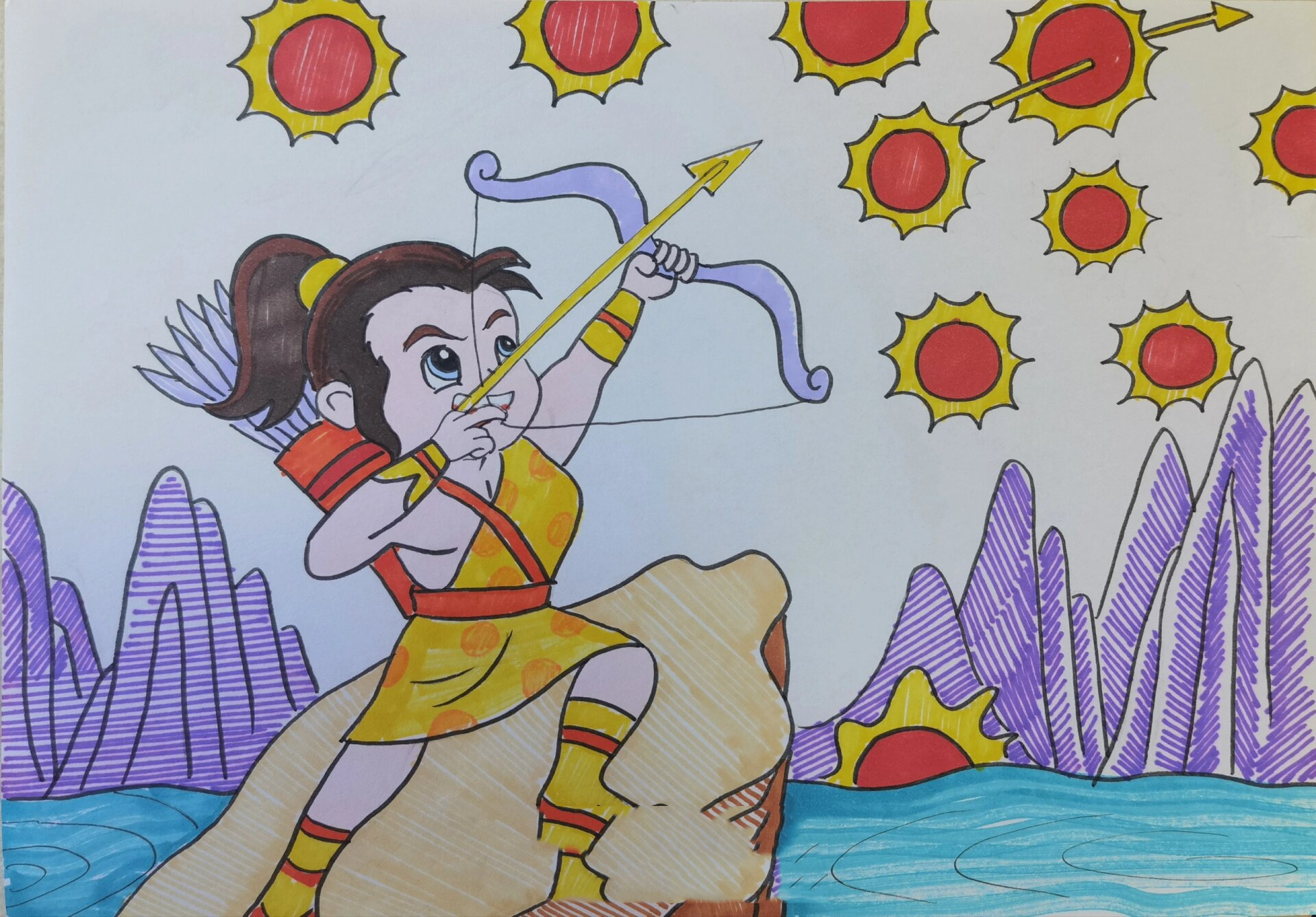
Ten Sons of the Eastern Sky
In the age when the world was still close to its making, beyond the easternmost edge of the mortal realm, there grew a tree of impossible magnitude. It was called the Fusang — the Mulberry of the Void — and its roots drank from the waters of the cosmic ocean while its highest branches scraped the floor of heaven. Its trunk was so vast that a hundred men linking arms could not encircle it. Its leaves were the color of molten gold, and they chimed in winds that blew from nowhere and everywhere at once. This was the dwelling place of the ten suns.
For the ten suns were not mere celestial fires. They were living beings — the sons of Di Jun, the supreme god of the eastern heavens, and his consort Xi He, the goddess who bathed them each morning in the sweet waters of the Gan Yuan pool before sending them on their daily journey across the sky. Each sun was a golden crow with three legs, blazing with the light of a thousand furnaces, and each perched upon a separate branch of the Fusang tree, waiting for its appointed day.
The system was ancient and elegant. Each day, one sun would rise from the eastern sea, carried by its mother Xi He in a chariot of cloud and flame, and travel the long arc of the sky from east to west. The journey took the entire day, and at dusk the sun would descend into the waters of the western ocean, where it would be cleansed of the day's dust and travel underground through the darkness to return to the Fusang tree by morning. The other nine would rest, grooming their golden feathers, dozing on their branches, waiting. One sun per day. Ten days in the cycle. Then the rotation began again. It was a rhythm as reliable as breath, as constant as the turning of the seasons.
For ten thousand years, the system held. The mortal world below received its daily portion of light and warmth — enough to ripen the grain, to dry the washing, to warm the bones of old men sitting in their doorways. The suns were not loved, precisely, but they were respected. They were part of the order of things. And then, as all orders eventually do, this one broke.
The Day All Ten Rose
The texts disagree on why it happened. Some say the suns grew bored — ten thousand years of taking turns, of waiting nine days for one day's journey, had worn their patience to nothing. They were young, after all, by divine standards. They wanted to fly together, to race across the sky in a glorious squadron, to feel the full joy of their burning without the constraint of rotation. Some say it was a prank that spiraled beyond control. Others say it was a deliberate act of rebellion against their father Di Jun's rigid order — a cosmic tantrum by ten adolescent gods who resented being told when they could and could not shine.
Whatever the cause, the result was the same. On a morning that should have seen only one sun rise from the eastern sea, all ten rose together. They burst from the water in a cascade of golden fire, shaking the droplets from their three-legged forms, cawing with delight as they spread their wings and ascended. Xi He, their mother, cried out in alarm, but they were beyond her reach already — ten blazing crows spiraling upward in a helix of flame, spreading across the sky like a constellation of furious stars.
The effect on the mortal world was immediate and devastating. One sun gives life. Ten suns give death. The temperature rose within moments to levels no living thing could endure. The rivers — those great arteries of the land — began to steam and shrink. The Yellow River, that ancient mother of Chinese civilization, dropped to a trickle, then to a thread, then to a cracked and smoking channel of baked mud. The rice paddies of the south boiled in their fields. The wheat of the northern plains blackened and crumbled to ash before it could be harvested. Trees burst into flame spontaneously, their sap igniting beneath the relentless radiation of ten simultaneous noons.
The earth itself began to crack. Great fissures opened in the plains, swallowing homes and livestock. The mountains, those ancient bones of the world, glowed red at their peaks like iron in a forge. And from the cracks in the earth, from the boiling rivers and the burning forests, came the monsters. Creatures that had slept in the cool darkness of the underworld — driven mad by the heat that penetrated even their subterranean refuges — clawed their way to the surface and raged across the scorched landscape. The Ya Yu, a serpentine beast with the face of a man, devoured entire villages. The Jiu Ying, a nine-headed water serpent, rose from the steaming remains of Lake Dongting and coiled around the few remaining patches of shade, killing any who approached. The world was becoming an oven, and humanity was roasting within it.
The Jade Emperor's Decree
In the highest heaven, above the chaos, the Jade Emperor sat upon his throne of white jade and watched the mortal world burn. He watched the rivers dry and the forests ignite. He watched the people — those small, fragile, endlessly industrious creatures — huddle in caves and dig desperately for water that was no longer there. He watched the monsters rise and the order he had established in the first days of creation begin to unravel.
He summoned Di Jun. The father of the suns appeared before the throne with his head bowed, his golden robes dimmed with shame. He had failed to control his sons. He had allowed his paternal indulgence to override his cosmic responsibility. The Jade Emperor's judgment was swift and merciless: the suns must be stopped. If they would not return to their proper rotation by choice, they would be compelled by force.
And for that force, there was only one choice. Hou Yi.
Hou Yi was the greatest archer who had ever lived or would ever live. He had been born in the mortal realm but trained in the celestial armories, and his skill with the bow was not merely superlative but supernatural. His bow was red — the color of cinnabar, of vermillion lacquer, of the first blood of creation — and it was strung with the sinew of a celestial dragon. His arrows were white as the bones of stars, fletched with the feathers of the immortal fenghuang, and they flew true regardless of wind or distance or the interference of lesser gods. Where Hou Yi aimed, the arrow struck. This was not boast or reputation. It was a law of nature as fundamental as gravity.
The Jade Emperor bestowed upon Hou Yi the red bow and a quiver of white arrows, and spoke the decree: descend to the mortal world. Restore order. Do what must be done. Hou Yi bowed, took up his weapons, and fell from heaven like a meteor — a streak of red and white against the tenfold blazing sky.
The Archer Descends
Hou Yi landed on the peak of Mount Kunlun, the axis of the western world, and looked out upon the devastation. Below him, the earth was a wasteland of ash and cracked mud. The air shimmered with heat so intense that the very light seemed to curdle. In the distance, the silhouettes of monsters moved through the haze — great serpentine shapes and multi-headed horrors picking their way through the ruins of what had been fertile farmland. And everywhere, in every shadow that still existed, the huddled forms of the surviving people, watching the sky with the blank, exhausted terror of those who have passed beyond fear into mere endurance.
He could feel the heat even here, on this high peak. It pressed against his skin like a physical weight. His divine nature protected him from the worst of it, but he understood, looking at the cracked earth and the boiling rivers, that humanity had days at most. Perhaps hours. The ten suns were not merely hot — they were accelerating, feeding off each other's energy, growing brighter and more destructive with every passing moment. If they were not stopped, the earth itself would ignite, and there would be nothing left to save.
Hou Yi nocked a white arrow. The red bow sang as he drew it — a clear, high note like a bell struck in an empty temple. He aimed at the nearest sun, the one hanging lowest in the southern sky, its three-legged form spread-eagled in lazy contentment as it bathed the world below in killing light. He breathed. The world held its breath with him. And he released.
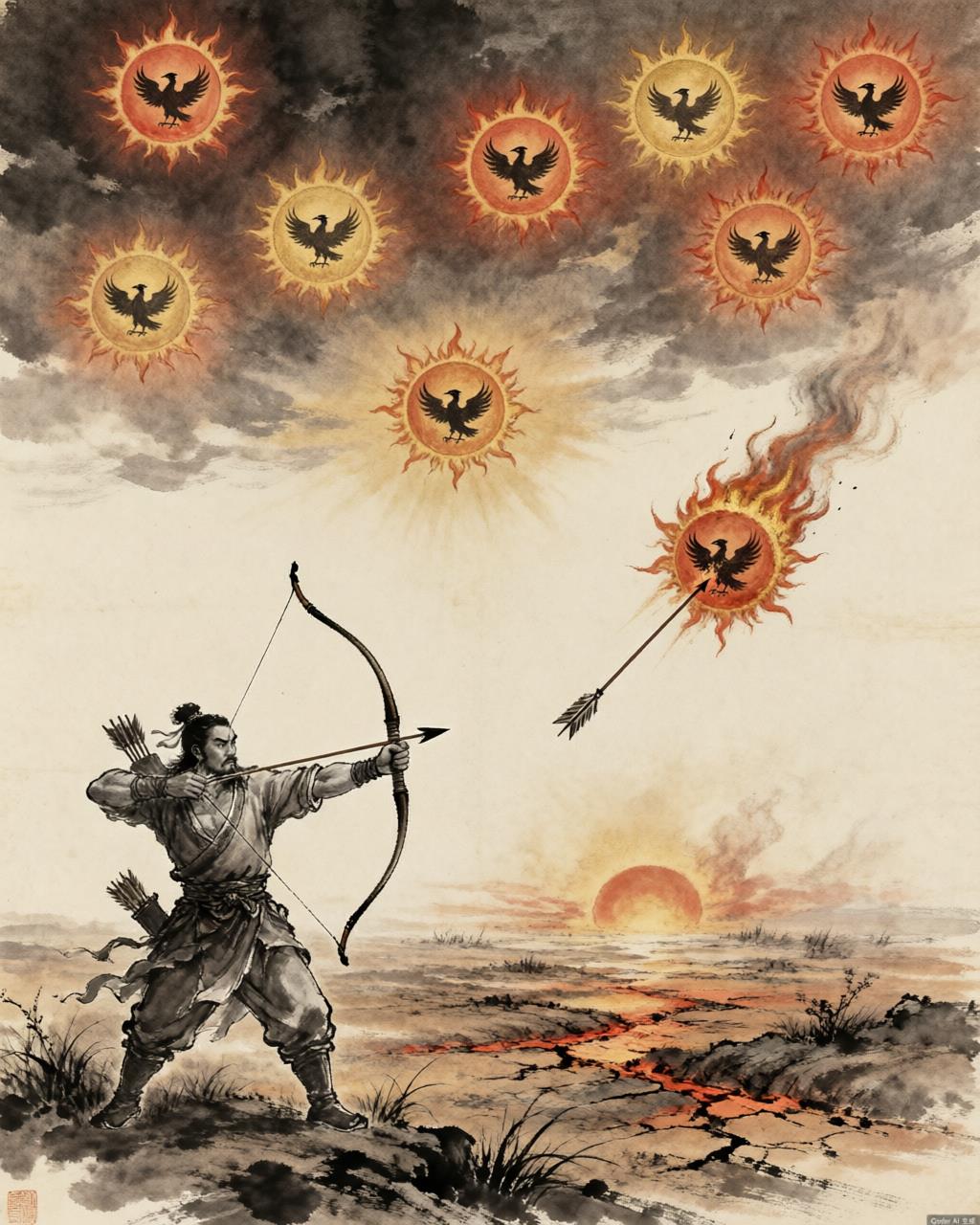
Nine Arrows, Nine Suns
The arrow crossed the distance between earth and sky in a single heartbeat. It struck the sun dead center, and the effect was extraordinary. The golden light shattered like a dropped mirror, and from within the broken radiance tumbled the true form of the sun — a three-legged crow, vast and blazing, its golden feathers scattering like sparks from a struck anvil. It fell, screaming a sound like tearing metal, trailing fire and plumage, and struck the earth with a concussion that flattened the remaining trees for a league in every direction. Where it landed, the ground was scorched to glass, and the heat of its death-throes created a pillar of flame that was visible from every corner of the world.
The remaining nine suns scattered in panic, cawing in terror, climbing higher into the sky. But Hou Yi was already nocking his second arrow. And his third. And his fourth. He shot with a rhythm that was almost meditative — draw, aim, release, draw, aim, release — each motion flowing into the next with the fluid grace of a master calligrapher's brush. There was no haste in him. No anger. No triumph. Only the absolute, serene focus of a craftsman performing the work he was born to do.
The second sun fell. The third. The fourth. With each impact, the temperature dropped. The rivers, those that had not yet boiled entirely away, slowed their steaming. The cracked earth, released from the relentless pressure of tenfold radiation, began — impossibly, tentatively — to cool. The monsters, sensing the shift, retreated toward their holes. The people in their caves and crevices looked up, shielding their eyes, and saw the great archer on the mountaintop, his red bow flashing, his white arrows singing their deadly song.
Five suns fell. Six. Seven. The sky, which had been a uniform sheet of white-gold agony, began to show patches of its true blue. Eight suns fell. Nine. And Hou Yi reached into his quiver for the tenth arrow — and found it empty. Or rather, he found one arrow remaining, and he nocked it, and he drew the red bow for the tenth time, and he aimed at the last sun, which cowered at the zenith of the sky, its golden feathers ruffled with terror, its three legs tucked beneath its body in a posture of absolute submission.
And he did not release.
The Last Sun Spared
The accounts differ on what stayed his hand. Some say the people cried out — that the surviving multitudes, emerging from their shelters into the blessed, singular shade of one remaining sun, shouted to the archer: Enough! Leave us one! Without the sun, we die in darkness and cold as surely as we die in its excess. Some say it was the Jade Emperor's voice, speaking from the highest heaven: One is enough. One is the order. Do not unmake the sky entirely. Some say it was Hou Yi's own wisdom — the understanding that his task was not to destroy the suns but to restore the balance, and that a world without any sun was as dead as a world with ten.
Whatever the reason, Hou Yi lowered the bow. The last sun remained — trembling, diminished, but alive. It would rise each morning and set each evening, alone, as the original order had decreed. The cycle of ten days would continue, but with only one sun to carry it. The world would have its light, its warmth, its seasons. But it would never again know the horror of ten simultaneous noons.
The last sun, the texts tell us, never forgot its terror. It rises each morning with a faint tremor in its light — a barely perceptible flickering that the ancients attributed to the memory of nine white arrows singing past its feathers. And it sets quickly at dusk, hurrying below the horizon as though afraid that the archer might yet be waiting in the western mountains, his red bow drawn, his final arrow patient and true.
Hou Yi descended from Mount Kunlun to a world reborn. The rivers flowed again. The rains returned. Green shoots pushed through the blackened soil with the desperate urgency of life reclaiming its territory. The monsters, weakened by the cooling of the earth, were hunted down one by one — Hou Yi's final gift to the people he had saved. He slew the Ya Yu in its mountain lair. He pierced the nine heads of the Jiu Ying with nine arrows, one for each sun he had felled. He drove the remaining horrors back into the earth and sealed their passages with stones inscribed with celestial script. And then, his work complete, he turned his face toward home.
The Archer's Fall
But the story of Hou Yi does not end in triumph. It never does. The greatest of Chinese myths are not simple tales of heroism rewarded; they are tragedies dressed in the clothing of adventure, and the tale of the archer is no exception.
Hou Yi returned to the mortal world not as a god but as a man. The texts are ambiguous on whether this was punishment or choice — whether the Jade Emperor, displeased that Hou Yi had killed nine of Di Jun's sons rather than merely frightening them into obedience, stripped the archer of his immortality; or whether Hou Yi, having tasted the mortal world's suffering and beauty, chose to remain among the people he had saved. Either way, he became mortal. He aged. His hands, which had drawn the red bow with supernatural steadiness, began to tremble with the years.
He took a wife. Her name was Chang'e, and she was beautiful in the way that the moon is beautiful — cool, luminous, untouchable. Their love was genuine but troubled, as the loves of heroes often are. Hou Yi, diminished from god to man, struggled with the weight of his own legend. He had saved the world, and the world had repaid him with mortality. The bitterness grew in him like a crack in jade — slowly, invisibly, but inevitably.
In the most widely told version of the tale, Hou Yi obtained the elixir of immortality from the Queen Mother of the West — a single dose, enough for one person to ascend to heaven and regain divine status. He brought it home, intending to share it with Chang'e, to find a way to divide it, to ascend together. But fate, which had already taken so much from him, took this also. Chang'e drank the elixir — whether by accident, by desperation, by theft, the stories disagree — and rose from the earth like a lantern released into the night sky. She rose and rose, growing smaller and brighter, until she reached the moon and alighted upon its silver surface, where she remains to this day: the goddess of the moon, accompanied only by a jade rabbit who pounds the elixir of immortality in an endless, futile mortar.
Hou Yi watched her go. He stood in the courtyard of their home, his red bow hanging useless on the wall behind him, and watched the woman he loved become a point of light in the sky. He could have shot her down. The thought occurred to him — the texts are honest enough to admit it. One arrow. The same bow that had felled nine suns could surely reach the moon. But he did not draw. He stood, and he watched, and he wept, and the moon rose higher and higher until it was beyond all reaching.
The Moon and the Memory
This is why, the tradition holds, the moon is brightest on the fifteenth day of the eighth lunar month — because on that night, the distance between earth and moon is shortest, and Chang'e leans closest to the world she left, looking down for the husband she can never again touch. And this is why, on that night, families gather in their courtyards and eat mooncakes and gaze upward: not merely to admire the moon's beauty, but to witness the eternal separation of Chang'e and Hou Yi, to remember that even the greatest hero cannot hold what fate has decided to take.
The Mid-Autumn Festival — Zhongqiu Jie — is, beneath its surface of lanterns and mooncakes and family reunion, a festival of absence. It celebrates the fullness of the moon precisely because that fullness is unattainable. You can look at it. You can admire it. You can offer it fruit and incense. But you cannot hold it. Chang'e is there, eternal and untouchable, and Hou Yi is here, mortal and aging, and between them stretches the same unbridgeable distance that separates the archer's arrow from the sun it can never quite reach again.
The cultural resonance of the Hou Yi myth extends far beyond the festival. He is the patron of all who act decisively in the face of overwhelming crisis — the one who does what must be done while others cower. But he is also the patron of those who discover that heroism is not rewarded, that saving the world does not entitle one to happiness, that the bow which fells nine suns cannot prevent the loss of the one person who matters. He is, in the end, the most human of Chinese mythological heroes: not a god who descends to help, not a sage who transcends suffering, but a man who acts greatly and suffers greatly and endures.
In the temples and shrines across China, Hou Yi is depicted with his red bow drawn, his white arrow aimed at the sky, his face a mask of absolute concentration. But in the older paintings — the ones in the small village temples, the ones painted by unknown hands for local congregations — there is sometimes a second image beside him. A woman, rising. A moon, full and cold. And between them, the empty space where an arrow might have flown but did not. The archer who shot nine suns but could not shoot the moon. The man who saved the world but could not save his own heart.
On clear autumn nights, when the moon hangs full and golden above the Chinese plain, the old people will sometimes point upward and say: There she is. Chang'e. Still waiting. And if you ask what she waits for, they will smile and say nothing, because the answer is obvious and unbearable. She waits for the world to end. For the sky to crack again. For some new catastrophe that will require an archer, and for that archer to be red-bowed and white-arrowed and mortal enough to die, so that he might finally ascend, and the distance between them might close, and the long separation might end. Until then, the moon rises. The moon sets. And the archer's bow hangs on the wall, gathering dust, its string still singing faintly in the night wind with the memory of nine golden crows falling from the sky.