A Love Written in the Stars
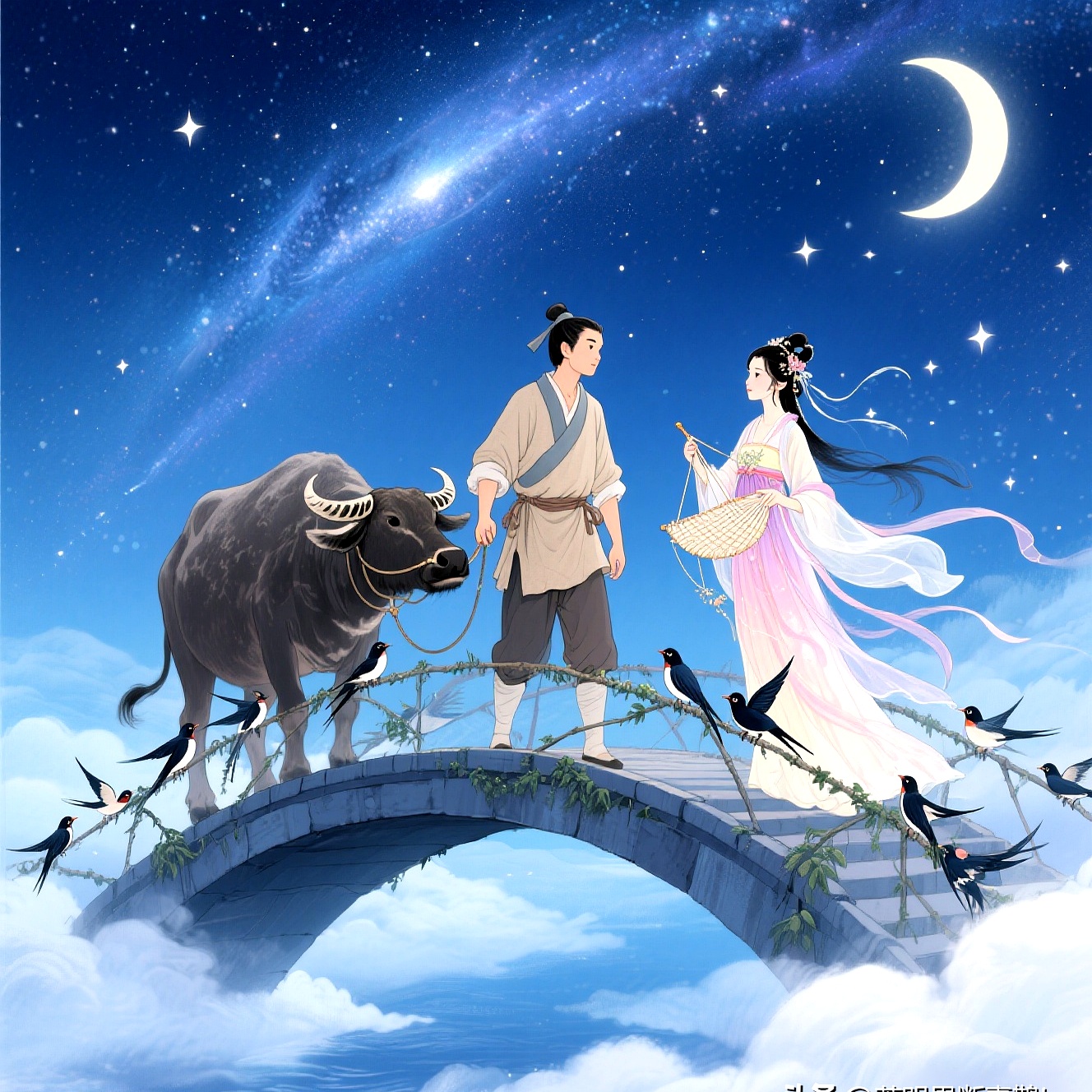
Long before telescopes mapped the heavens, before astronomers gave Latin names to distant suns, the Chinese looked upward and saw a story. There, straddling the great silver river of the Milky Way, two stars burn with quiet devotion — Vega, brilliant and blue-white in the constellation Lyra, and Altair, steady and golden in Aquila. To the Western mind they are points of light separated by sixteen light-years of cold vacuum. To the Chinese imagination, they are lovers. They are Zhinü, the Weaver Girl, and Niulang, the Cowherd — separated by the decree of heaven, reunited only once a year on the seventh night of the seventh lunar month, when ten thousand magpies take flight and form a bridge of living wings across the galaxy.
This is not merely a fairy tale. It is the emotional architecture of one of the world's oldest continuous civilizations, a narrative so deeply woven into Chinese consciousness that it shapes language, art, festival, and the very way love is understood. For over two thousand years, poets have wept ink over Zhinü and Niulang. Painters have rendered their parting in silk and gold. Grandmothers have whispered the tale to children on warm summer nights, pointing upward to where the two stars face each other across the dark river of heaven. To know this story is to hold a key to the Chinese heart.
The Weaver Girl at Her Loom
In the highest palace above the clouds, where the air smells of osmanthus and the floors are paved with compressed starlight, there lived a maiden named Zhinü — the Weaver Girl. She was the youngest daughter of the Jade Emperor, sovereign of all heaven, and her hands were more skilled than any celestial artisan's. Day after day, she sat at her loom of jade and cloud-wood, weaving the fabric of the sky itself. The rosy dawn was her handiwork. The violet dusk was her creation. The gossamer veils of mist that draped the mountains at morning — these were threads from Zhinü's shuttle, drawn fine as spider-silk and dyed in the colors of eternity.
Yet for all the beauty her fingers produced, Zhinü's life was one of exquisite loneliness. The heavenly palace was vast and cold, its corridors echoing with the footsteps of servants who dared not speak freely. Her father, the Jade Emperor, governed the cosmos with the detached precision of a mathematician. Her mother, the Queen Mother of the West, guarded the boundaries between heaven and earth with jealous vigilance. Zhinü was treasured, yes — but as a treasure is treasured: kept behind glass, admired from a distance, never permitted to wander.
And so she wove. She wove the seasons into being. She wove the patterns of frost on winter windows. She wove the iridescence of dragonfly wings and the slow blush of peonies opening in spring. And as she wove, she dreamed of a world she had never seen — the world below the clouds, where the air was thick with the smell of turned earth, where rivers ran muddy and alive, where creatures laughed and quarreled and loved with a ferocity that heaven, in all its perfection, could not match.
The Cowherd and the Old Ox
Far below the celestial loom, in a village nestled between green hills and a slow brown river, there lived a young man called Niulang — the Cowherd. He was an orphan, cast out by a cruel elder brother who had claimed their parents' inheritance and given Niulang nothing but an old ox, so ancient that its hide hung loose over its ribs and its eyes were clouded with cataracts. The villagers pitied the boy. They said he spoke to the ox as though it were a friend, as though it could understand.
They were right to wonder, for this was no ordinary beast. The old ox had once been the Golden Ox Star, a celestial spirit banished from heaven for a transgression now forgotten. In his mortal form, he retained the wisdom of ages and a deep, abiding love for the kind young man who shared his meager meals and slept beside him on cold nights to share warmth.
One evening, as the sun melted into the western hills and the first stars pricked through the lavender sky, the old ox spoke. His voice was low and rough, like stones grinding together in a riverbed. "Niulang," he said, "tomorrow, at the hour when the mist rises from the lake beyond the willow grove, the daughters of heaven will descend to bathe in the mortal waters. Among them will be the youngest and most beautiful — the Weaver Girl. If you wish for a wife, hide her feathered robe when she sets it upon the bank. Without it, she cannot return to the sky."
Niulang's heart hammered. He was a poor cowherd, a nobody, a young man with calloused hands and patched clothes. What had he to offer a daughter of heaven? But the old ox looked at him with those ancient, knowing eyes, and Niulang understood that some fates are not chosen. They arrive, like the seasons, whether one is ready or not.
The Stolen Robe and the Sacred Vow
At dawn, Niulang crept through the willow grove, its trailing branches brushing his shoulders like the fingers of cautious ghosts. The lake lay still as polished bronze, wreathed in mist so thick it seemed solid. And then — a shimmer, a whisper of silk on air — and they were there. Seven maidens descended through the parting clouds, their laughter like silver bells, their forms luminous as moonlight given flesh. They shed their robes upon the grass — garments that shifted color like oil on water, woven from cloud-stuff and starfire — and slipped into the lake.
Niulang's hands trembled as he reached for the robe set apart from the others, the one that glowed with a faint rose-gold light. He gathered it to his chest and stepped back into the shadows. When the maidens finished their bathing and reached for their garments, six took flight in spirals of iridescent color, ascending back toward heaven. But the seventh — Zhinü — found only empty grass where her robe had lain.
She stood at the water's edge, mortal and vulnerable for the first time in her eternal existence, and she was not afraid. She was curious. When Niulang emerged from the willows, bowing low and stammering an apology that was also a declaration, Zhinü looked at this rough-handed young man with his honest eyes and his threadbare clothes, and she saw something no celestial suitor had ever offered: a life that was small, and warm, and entirely real.
They married beneath the willow tree, with the old ox as their only witness. Zhinü traded her shuttle of jade for a mortal loom of bamboo. Niulang built them a cottage with his own hands, thatched with golden reeds. And for a time — a time that felt both endless and impossibly brief — they were happy.
Seven Years of Earthly Joy
The years that followed were the stuff of which mortal dreams are made. Zhinü wove cloth of such beauty that merchants traveled three provinces to purchase it, yet she wove it not for heaven's glory but to clothe her children. For children came — first a boy, round-cheeked and loud-voiced, then a girl, quiet and watchful, with her mother's star-bright eyes. Niulang tended his small herd of cattle, now grown fat and glossy under his care, and in the evenings he would carry his son upon his shoulders while Zhinü walked beside him, their daughter riding in the crook of her arm.
They argued, as all couples do — about the price of salt, about whether the roof would hold through monsoon season, about whose turn it was to mend the children's shoes. They laughed until their sides ached. They grew older, though Zhinü aged more slowly than her husband, and the first silver threads in Niulang's hair only made her love him more fiercely, for they reminded her that this life was finite, and therefore precious beyond measure.
The old ox watched over them all, growing frailer with each passing year. When at last the time came for him to leave the mortal world, he laid his great head in Niulang's lap and spoke one final time: "When I am gone, keep my hide. In the hour of your greatest need, wrap it about your shoulders, and it will carry you where you must go." Then the ancient eyes closed, and the Golden Ox Star returned to his place in the heavens, leaving behind only a weathered hide and a grief that settled over the little cottage like autumn fog.
The Hairpin of the Queen Mother
Heaven does not forgive. It does not forget. And it does not permit its daughters to choose mortality over duty. When the Queen Mother of the West discovered that Zhinü had abandoned her celestial loom — that the dawns had grown pale, the dusks threadbare, the fabric of the sky fraying at its edges for want of the Weaver Girl's hands — her wrath was a cold and terrible thing, precise as a blade.
She descended to the mortal world in a chariot of black cloud, flanked by celestial soldiers whose armor rang like funeral bells. They found Zhinü in her garden, hanging laundry on a line strung between two peach trees. She did not run. She did not weep. She simply turned to Niulang, pressed their sleeping children into his arms, and whispered, "Remember me in the stars."
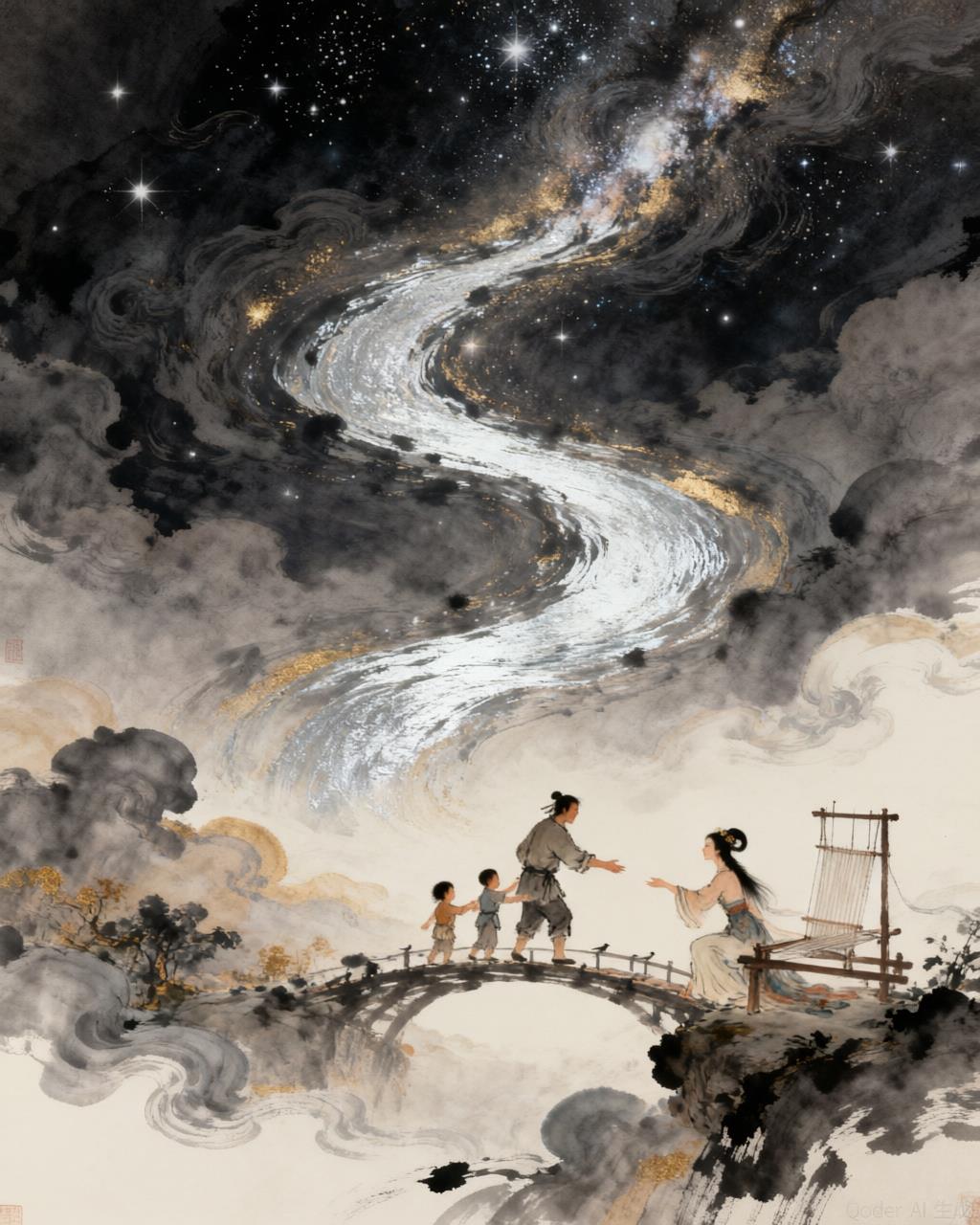
The soldiers seized her. The chariot rose. And Niulang, wild with grief, remembered the old ox's final gift. He wrapped the hide about his shoulders, seized a carrying pole, hung his two children in baskets at either end, and leaped into the sky. Up he soared, the wind screaming past his ears, the earth falling away below him, his children crying out in terror and wonder. He could see her — Zhinü, radiant and weeping, dragged upward in the black chariot. He was almost close enough to touch her hand.
Then the Queen Mother turned. With a single, contemptuous gesture, she drew the golden hairpin from her elaborate headdress and slashed it across the sky. Where the pin cut, the void split open. A river of silver fire erupted between them — vast, roaring, impassable. The Milky Way itself, born from a mother's fury, poured its torrent of stars between husband and wife. Niulang fell to one bank. Zhinü to the other. And between them, the galaxy churned, cold and eternal.
The Bridge of Ten Thousand Wings
But love, even mortal love, is not so easily extinguished. Zhinü wept at her loom in heaven, and her tears fell as rain upon the earth. Niulang sat on the mortal bank of the sky-river, his children clinging to him, and he wept too, and his tears rose as mist. The sound of their grief reached every corner of creation — every nest, every burrow, every branch where a feathered creature roosted.
And the magpies heard. All the magpies in the world — black and white, chattering and bold — heard the weeping of the lovers and were moved. On the seventh day of the seventh lunar month, when the summer air hung heavy and sweet with lotus blossom, they took flight. Ten thousand, a hundred thousand, a million magpies rose from every rooftop and treetop and fencepost in the land. They flew upward, higher than any bird had ever flown, until the air thinned and the stars blazed close enough to touch. And there, spanning the impossible width of the Milky Way, they locked wing to wing, claw to claw, beak to beak, forming a bridge of living feathers and beating hearts.
The Magpie Bridge. Que Qiao. Once a year, on that single night, Zhinü crosses from the western bank and Niulang from the eastern, carrying his children in their baskets, and they meet in the middle of the galaxy. They hold each other. They speak the words accumulated over three hundred and sixty-four days of silence. The children press their faces to their mother's neck and breathe in the scent of starlight and osmanthus. And for a few hours, the universe is whole again.
Then dawn comes. The magpies scatter, exhausted, many of them featherless and worn from the effort. The lovers part. And the cycle begins again — another year of weaving, another year of herding, another year of gazing across the silver river at the light of the one you love.
Qixi: The Night of Seven Sevens
The seventh night of the seventh month — Qixi, the Festival of Double Sevens — has been celebrated in China for over two millennia. It is, in the modern parlance, Chinese Valentine's Day, though this translation flattens its richness considerably. Qixi is not merely about romance. It is about fidelity. About the sacred weight of a promise kept across impossible distance. About the quiet heroism of waiting.
In the old days, young women would gather in courtyards on Qixi night, setting out offerings of fruit and incense beneath the open sky. They would thread needles by moonlight — a test of dexterity dedicated to Zhinü, patroness of weavers and needleworkers — and whisper prayers for skillful hands and faithful husbands. They would float melon seeds in bowls of water and read the patterns they made. They would lie on their backs in the grass and search for the two stars, Vega and Altair, watching for the faint shimmer that might be the magpie bridge forming between them.
The great Song dynasty poet Qin Guan captured the essence of the legend in his ci poem "Que Qiao Xian" — "Immortals at the Magpie Bridge" — written in the eleventh century and still recited today:
纤云弄巧,飞星传恨,银汉迢迢暗度。
金风玉露一相逢,便胜却人间无数。"Delicate clouds weave cunning patterns; shooting stars carry messages of longing. Across the vast Silver River they cross in secret. One meeting in the golden wind and jade dew surpasses a thousand mortal nights together."
The poem's genius lies in its inversion. Where other poets lamented the lovers' separation, Qin Guan argued that a single night of true, hard-won love outweighs a lifetime of easy companionship. The scarcity is what makes it sacred. The distance is what makes it eternal.
The Stars That Never Touch
Step outside on a clear summer night in August. Look upward. There — high overhead, almost at the zenith — burns Vega, the fifth brightest star in the night sky, a blue-white diamond blazing twenty-five light-years from Earth. It is Zhinü, still at her loom, still weaving. Now look lower, to the southeast. There is Altair, flanked by two smaller stars — Tarazed and Alshain — which Chinese tradition names as the Cowherd's two children, forever carried on their father's shoulders, forever reaching for their mother.
Between them, the Milky Way stretches its pale band of unresolved stars — two hundred billion suns smeared into a river of light. The Chinese called it Tianhe, the Heavenly River, or Yinhe, the Silver River. It is the scar left by a golden hairpin. It is the boundary between duty and desire, between heaven's law and the heart's rebellion. And every year, when the seventh month arrives and the summer triangle blazes overhead, the Chinese look up and remember: love is not the absence of separation. Love is what persists across it.
Today, Qixi is celebrated with gift-giving, romantic dinners, and social media declarations of devotion. Shopping malls drape themselves in magpie motifs and star imagery. Young couples post photographs beneath the hashtag #Qixi# and quote Qin Guan to each other. The ancient ritual has dressed itself in modern clothes, but the heart of it remains unchanged. On the seventh night of the seventh month, China still looks up. China still believes in the bridge. China still knows that the truest love stories are not the ones that end in union, but the ones that endure despite everything the universe conspires to place between them.
The Cowherd tends his stars. The Weaver Girl tends hers. And between them, patient as gravity, the magpies wait for their annual summons — ready, as they have always been, to build a road of wings across the impossible dark.