The Archer and the Goddess: A Love Story Written in Starlight
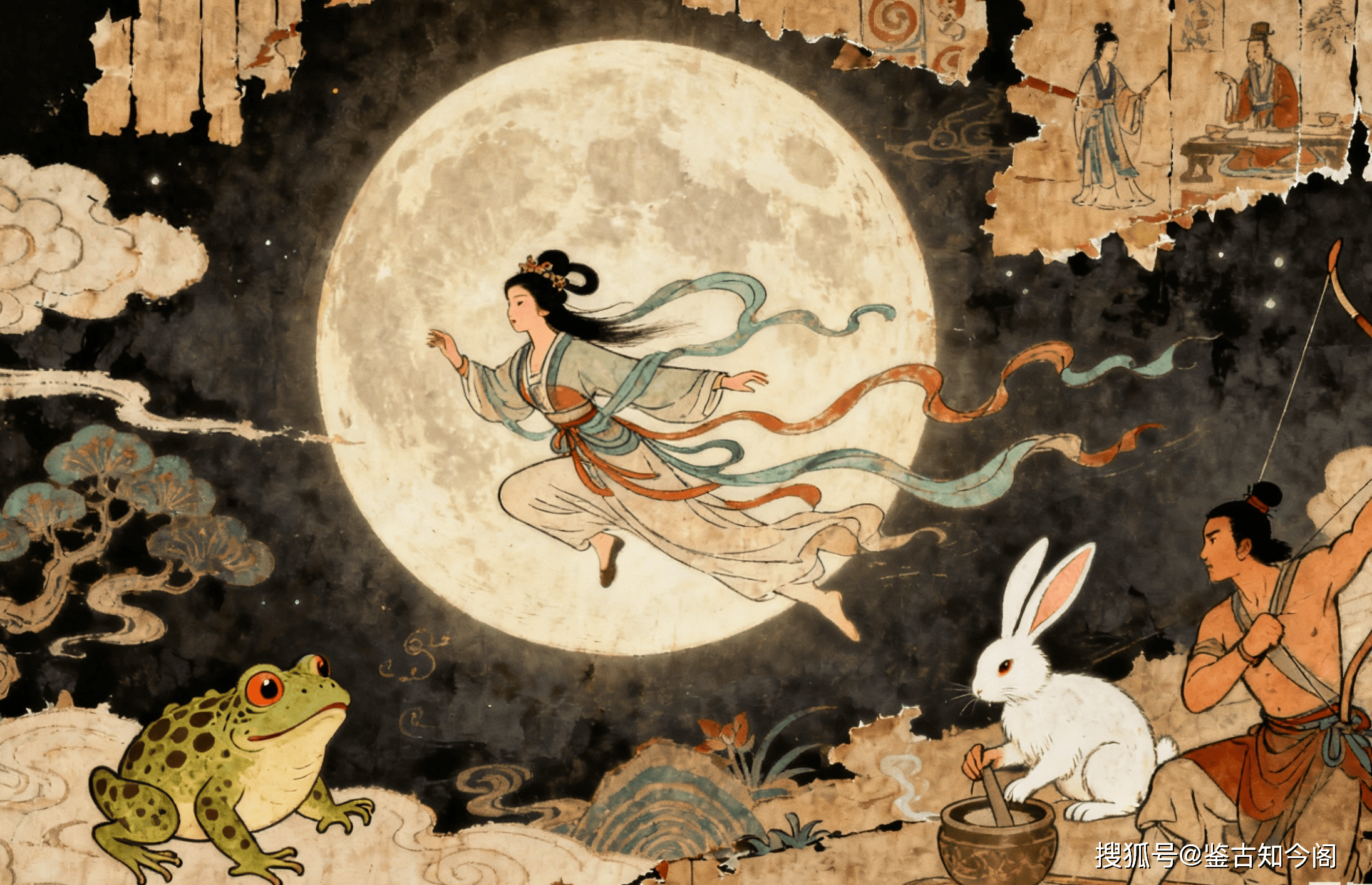
Long before the first dynasties carved their names into oracle bones, when the sky still hung low enough for mortals to dream of touching it, there lived an archer whose bow could split the sun itself. His name was Hou Yi, and beside him stood a woman whose beauty was said to make the autumn moon pause in her orbit. Her name was Chang'e. Together, they were the most celebrated couple in all the land — he, the hero who had shot down nine of the ten suns that scorched the earth; she, the gentle companion whose grace tempered his ferocity. Yet their story would end not in triumph, but in an eternal separation so profound that it would define how an entire civilization gazes upon the night sky.
The legend of Chang'e is not merely a fairy tale told to children during harvest season. It is the emotional architecture of Chinese lunar culture — the reason families gather beneath the full moon, the reason round pastries are pressed into wooden molds, the reason poets have spent a thousand years composing verses about loneliness and silver light. To understand Chang'e is to understand something essential about the Chinese imagination: its tenderness toward separation, its reverence for sacrifice, and its insistence that even the most beautiful immortality is incomplete without the one you love.
The Elixir of Immortality: A Gift That Divides
After Hou Yi shot down the nine rogue suns — the wayward sons of the Jade Emperor who had scorched rivers to dust and turned fields to glass — the grateful Queen Mother of the West, Xi Wangmu, rewarded him with a single vial of elixir. The potion was enough for two people to achieve immortality together, or for one person to ascend alone to the heavens. Hou Yi, unwilling to leave Chang'e behind in the mortal world, entrusted the vial to her for safekeeping. He would rather grow old beside her than rule eternity without her.
But the elixir drew envy like honey draws wasps. Here the legend fractures into its famous variants, each revealing a different facet of human nature. In the oldest and most unflattering version, recorded in fragments of the Huainanzi and whispered in Han Dynasty court gossip, Chang'e simply stole the elixir. Driven by curiosity or ambition, she drank it in secret and floated upward, leaving Hou Yi to rage at an empty sky. This version paints her as a cautionary figure — beautiful, yes, but faithless.
The second version, more sympathetic and far more popular in folk retelling, casts Chang'e as a protector. A treacherous apprentice named Feng Meng, jealous of Hou Yi's glory, broke into their home while the archer was away hunting. He demanded the elixir at swordpoint. Chang'e, knowing she could not defeat him and refusing to let the sacred potion fall into wicked hands, drank it herself. The choice was not greed but desperation — a wife protecting her husband's legacy with the only weapon available: her own body as vessel.
The third version, gentler still, suggests pure accident. Chang'e was merely inspecting the vial, perhaps cleaning the shelf where it rested, when a drop touched her lips. The heavens claimed her before she could cry out. In this telling, fate is the true villain, and the tragedy carries the particular cruelty of things that happen without reason.
The Ascent: Silk Ribbons and Silver Light
However the elixir was consumed, the ascent itself is rendered with identical, breathtaking imagery across every version. Chang'e's feet lifted from the earth. Her body grew weightless as dandelion seed. The silk ribbons of her robes caught an invisible wind and streamed behind her like the tails of celestial kites. She rose past the rooftops, past the treetops, past the startled cranes circling the mountain peaks. The world below shrank to a watercolor — green fields, brown rivers, and one tiny figure of a man running, arms outstretched, shouting a name the wind swallowed whole.
Hou Yi, in some tellings, drew his bow and took aim at the rising figure of his wife. But his hands trembled. He could not loose the arrow. He watched her diminish into a point of light, watched the sky close over her like water over a stone, and then there was only the moon — fuller and brighter than it had ever been, as though it had swallowed a second sun and chosen to glow rather than burn.
He set out offerings in the courtyard that night: her favorite fruits, her incense, a mirror so she might see her own face and remember she was still someone's beloved. The neighbors, moved by his grief, set out their own offerings. And so, the poets tell us, the Mid-Autumn Festival was born — not from joy, but from the collective ache of watching someone you love become unreachable.
The Moon Palace and Its Inhabitants: Jade Rabbit, Wu Gang, and the Cassia Tree
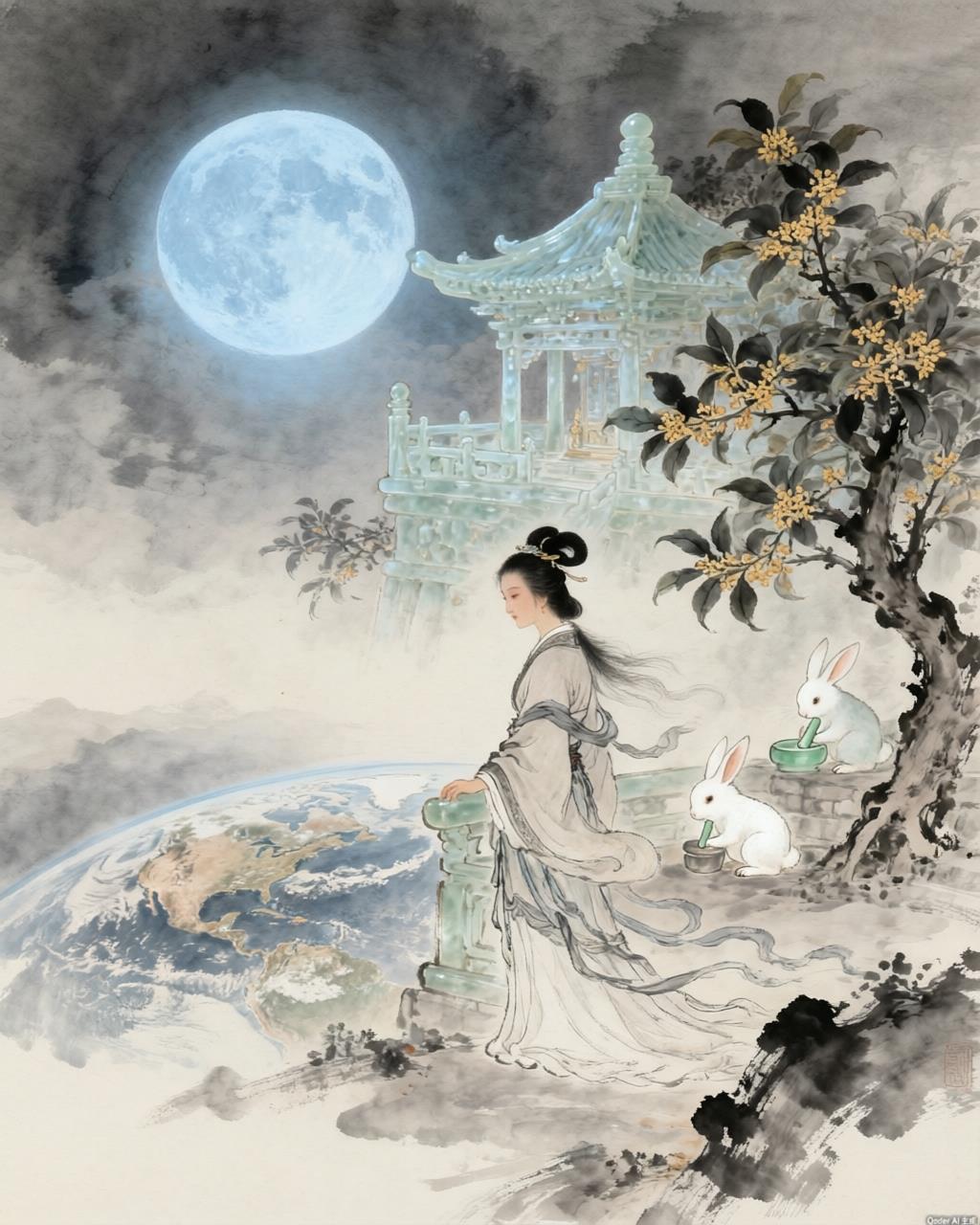
Chang'e did not ascend to paradise. She ascended to the Guanghan Gong — the Palace of Vast Cold — a crystalline fortress of jade and frost perched on the moon's silver plains. It is beautiful beyond mortal description, but it is beautiful the way a winter lake is beautiful: still, silent, and utterly indifferent to your loneliness. The palace gleams. The air shimmers. And Chang'e wanders its endless corridors with nothing but the echo of her own footsteps for company.
She is not entirely alone. Beneath a cassia tree in the palace courtyard crouches the Jade Rabbit — Yu Tu — pounding medicine in a jade mortar with a jade pestle. The rabbit's task is eternal: it grinds the herbs of immortality, though for whom, no one can say. Some scholars read the rabbit as a companion, a small warm presence in the cold. Others read it as a mirror of Chang'e herself — condemned to an endless, repetitive labor that produces nothing she can use. The rabbit cannot stop pounding. Chang'e cannot stop longing. The moon turns, and the work continues.
Then there is Wu Gang, the woodcutter, whose punishment is perhaps the most philosophically cruel element of the lunar mythology. Wu Gang offended the heavens — in some versions by laziness, in others by arrogance — and was condemned to chop down the cassia tree that grows beside the Moon Palace. But the tree is enchanted: every axe wound heals the instant the blade is withdrawn. Wu Gang swings. The bark splits. He pulls the axe free, and the wood knits itself shut, seamless as though it had never been touched. He swings again. And again. And again. It is Sisyphus in silk robes, and his presence on the moon transforms Chang'e's loneliness into something communal — a shared sentence of futility served under the same cold light.
The Mid-Autumn Festival: When an Entire Nation Looks Up
On the fifteenth night of the eighth lunar month, when the harvest moon hangs at its fullest and most golden, families across China and the broader Sinosphere step outside and look up. They set round tables in courtyards and on balconies. They slice mooncakes — dense, golden pastries stamped with characters for longevity and reunion — and share them in precise wedges, one per person, so that the circle of the cake mirrors the circle of the moon and the circle of the family gathered beneath it. Children carry lanterns shaped like rabbits. Elders pour tea and point upward: There. Do you see her? The shadow in the light. That is Chang'e, still waiting.
The festival, known as Zhongqiu Jie, is officially a celebration of harvest and family reunion. But its emotional core is the Chang'e legend — the ache of separation made bearable by ritual. The roundness of the mooncake is not merely aesthetic; it is a prayer. A wish that what is scattered will be gathered, that what is separated will be made whole. When a family member is absent — working in another city, studying abroad, gone to the ancestors — their slice of mooncake is still cut. Their place at the table is still set. The circle holds, even with a gap in it. This is the genius of the Chang'e myth: it does not promise reunion. It promises that the longing itself is sacred, that looking at the same moon as someone you miss is a form of togetherness.
Poets of the Moon: Li Shangyin, Su Shi, and a Thousand Years of Longing
No Chinese poet worth their ink has resisted the moon, and none have resisted Chang'e. Li Shangyin, the late Tang master of ambiguity and desire, wrote of her with a tenderness that borders on identification: "Chang'e must regret stealing the elixir / Blue sea, blue sky, night after night her heart." The repetition of "blue" — sea and sky merging into a single endless expanse — captures the monotony of eternity. There is no tomorrow on the moon. There is only an endless, luminous tonight.
Su Shi, the great Song Dynasty polymath, composed his most famous ci poem during a Mid-Autumn Festival spent drunk and separated from his brother. "When did the bright moon first appear? / I raise my cup and ask the blue sky... / People have sorrow and joy, parting and reunion; / The moon waxes and wanes, grows bright and dim. / This has never been perfect since ancient times. / May we all be blessed with longevity / Though thousands of miles apart, we share the beauty of the moon." The poem does not resolve the separation. It sanctifies it. The moon becomes a medium of connection precisely because it is shared across distance — the original long-distance call, the first video link between hearts too far apart to touch.
These poems are not museum pieces. They are recited at festival dinners, printed on mooncake boxes, quoted in text messages between separated lovers. Chang'e's loneliness is not ancient history. It is the loneliness of every migrant worker watching the harvest moon from a factory dormitory, every student in a foreign city calling home on a glowing screen. The myth endures because the feeling it encodes is inexhaustible.
From Myth to Moon Rover: Chang'e in the Space Age
In 2007, China launched its first lunar orbiter and named it Chang'e 1. In 2013, the Chang'e 3 mission delivered a rover to the lunar surface — and the rover was named Yutu, Jade Rabbit. In 2019, Chang'e 4 achieved the first-ever soft landing on the far side of the moon, and its relay satellite was named Queqiao — the Magpie Bridge, the constellation of birds that, in another legend, reunites separated lovers once a year. The naming was not mere branding. It was a civilization fulfilling its oldest dream with its newest technology. The woman who flew to the moon in silk robes now flies in titanium and carbon fiber. The rabbit that pounded jade now rolls on aluminum wheels, photographing craters where poets once imagined palaces.
There is something profoundly moving about this continuity. The engineers who programmed Chang'e 4's descent trajectory grew up hearing their grandmothers point at the moon and whisper her name. The myth did not compete with the science; it motivated it. It gave the mission emotional weight beyond national prestige. China did not merely go to the moon. China went to find Chang'e. And in a sense, they did: every photograph returned by Yutu is a letter written to a goddess, confirming that her palace, if not made of jade, is made of something equally wondrous — regolith and silence and four billion years of patient, undisturbed dark.
The Meaning of the Moon: Why This Story Still Matters
At its deepest level, the Chang'e legend is a meditation on the cost of transcendence. Immortality, the myth insists, is not a reward. It is an exile. To rise above the mortal world is to lose everything that made mortal life worth living — the warmth of a hand, the sound of a familiar voice, the small daily rituals of shared existence. Chang'e is beautiful, eternal, and utterly alone. The moon is perfect, luminous, and cold. The myth asks: what good is perfection if it cannot be shared?
This is why the Mid-Autumn Festival is, at heart, a festival of imperfection. The mooncake is round, but the family around the table is not always complete. The moon is full, but someone is always missing. The festival does not deny this absence. It holds space for it. It says: Look up. She is there. They are there. The light that touches your face has traveled the same distance it traveled to theirs. You are not as far apart as you feel.
In a world of relentless optimization, where every problem is meant to have a solution and every separation a remedy, the Chang'e myth offers something rarer: permission to grieve beautifully. It says that some distances cannot be closed, and that the act of looking across them — of setting out fruit and incense and a single extra plate — is not weakness. It is the highest form of love. It is what makes us human, even beneath the gaze of an immortal who forgot what that meant.