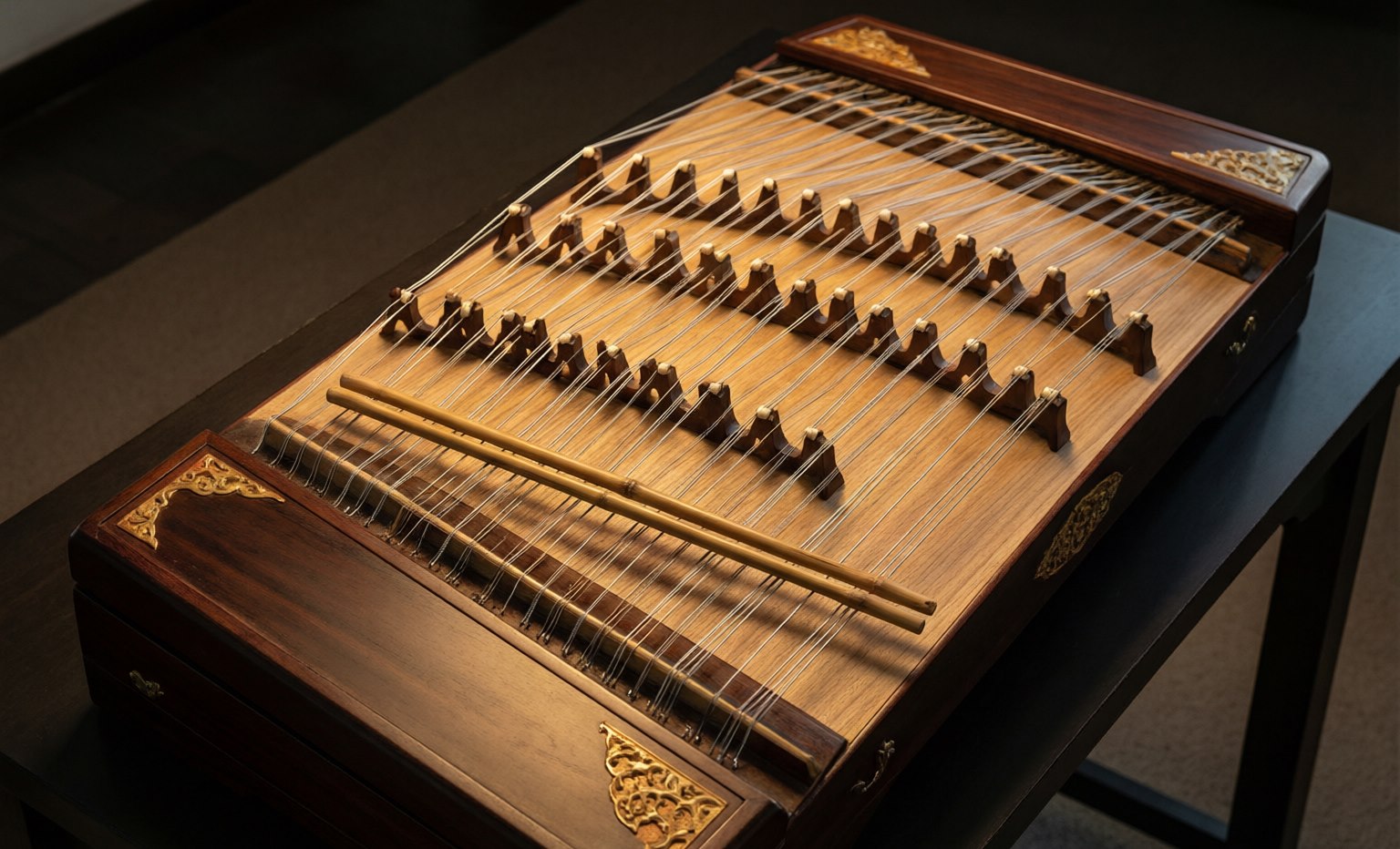
Among China's great traditional instruments, the yangqin (扬琴, yángqín) is the one that does not pretend to be ancient. Its name gives the secret away: the first character, yang (洋), means "ocean" or "foreign" — the same character used in words for things that arrived from overseas. The yangqin is, quite literally, the "foreign zither," and it wears its foreignness with pride. It came to China from the West, most likely from Persia and the broader Middle East, traveling the maritime trade routes in the late Ming dynasty some four centuries ago. Yet in that relatively short time it has become so thoroughly woven into the fabric of Chinese music that many listeners, hearing its bright, rippling chords beneath a folk melody or an opera aria, would be astonished to learn it was ever anything but native. The yangqin is the great assimilator's instrument: a guest that became family, and in the process became indispensable.
The Long Road From Persia
The yangqin belongs to a vast family of hammered dulcimers that stretches across Eurasia. Its ancestors include the Persian santur, the Iraqi santur, the European dulcimer, the Hungarian cimbalom, and dozens of regional cousins — all of them trapezoidal or box-shaped instruments whose strings are struck rather than plucked. This family is old; struck-string instruments appear in the Middle East and Europe by the medieval period, and the basic idea — stretching metal strings over a resonant box and hitting them with small hammers — seems to have arisen, or traveled, across a wide swath of the Old World.
How exactly the instrument reached China is debated, but the most widely accepted account places its arrival in the late Ming dynasty (1368–1644), entering through the southern coastal ports — Guangdong and the maritime trade networks that connected China to Southeast Asia, the Indian Ocean, and the Persian Gulf. Some scholars emphasize a sea route via the Portuguese presence in Macau; others trace connections through Central Asia. What is clear is that by the Qing dynasty (1644–1912) the instrument was established in southern China, where it was adopted into local ensemble traditions and, crucially, into the accompaniment of regional opera and narrative singing. From the south it spread northward and westward, adapting to each region's musical dialect until it became a fixture across the country.
Trapezoid, Strings, and Two Bamboo Hammers
The yangqin's shape is its signature: a wide, shallow trapezoidal box, broader at one end than the other, sitting on a low stand before the seated player. Across its face run many strings — modern concert instruments commonly have fourteen or more courses (groups of strings tuned in unison or octaves), amounting to well over a hundred individual strings in all. The strings are arranged in ranks, and two long bridges divide them into sounding lengths; the player strikes on either side of the bridges to access different pitches and timbres. Beneath the strings lies the resonating chamber, often fitted with sound holes, sometimes with a sliding panel or cover that mutes the tone.
The hammers — qin zhu (琴竹, "zither bamboos") — are the instrument's voice. They are slender, flexible beaters, traditionally of bamboo, with a rounded head at one end and often a pointed or hooked end at the other. The rounded end produces a full, mellow strike; the pointed end can be used to pluck the strings, giving the yangqin a secondary, harp-like color. The player holds one hammer in each hand and strikes the strings with a relaxed, wrist-driven motion, the flexibility of the bamboo allowing the beater to rebound so the string rings freely. Mastery lies in controlling that rebound and in the independence of the two hands, which can play melody and accompaniment simultaneously, like a pianist's.
The comparison to the piano is not accidental. Both are struck-string instruments; both can play melody and harmony at once; both serve as harmonic anchors in ensemble settings. The yangqin is sometimes called "the Chinese piano," and while the analogy is imperfect — the yangqin's tone is brighter, more percussive, more bell-like, with a quicker decay — it captures the instrument's structural role. Where the guqin is monophonic and introspective and the pipa is a virtuosic soloist, the yangqin is the harmonist, the instrument that fills in the chords and binds the texture together.
The Glue of the Ensemble
This is the yangqin's defining function, and the reason it became so central to Chinese music despite its late arrival. In the traditional instrumental ensemble — the small group of strings, winds, and percussion that plays folk music, opera interludes, and narrative song — someone must supply the harmonic foundation and the rhythmic pulse. The plucked and bowed instruments carry the melody; the winds add color and volume; but it is the yangqin, with its ability to strike chords and articulate clear rhythmic patterns, that holds everything together. It is the continuo of the Chinese ensemble, the equivalent of the harpsichord in a Baroque group or the rhythm guitar in a folk band — not always the star, but the element whose absence everyone would immediately feel.
"The strings carry the tune, but the yangqin carries the strings. Remove it and the whole fabric loosens."
— A common observation among Chinese ensemble players on the yangqin's role as the harmonic and rhythmic anchor of the group
Its importance is especially great in the silk-and-bamboo (丝竹, sizhu) ensembles of the Jiangnan region around Shanghai and Suzhou, where the yangqin's bright, flowing arpeggios interlock with the erhu and the dizi in music of extraordinary delicacy. It is equally vital in the regional opera traditions of the south, where it accompanies the singers, underscores the drama, and bridges the gaps between vocal phrases. In each setting, the yangqin does the unglamorous, essential work of making many instruments sound like one.
Opera, Storytelling, and the Popular Stage
The yangqin's deepest roots in Chinese culture lie in popular performance. It became a standard accompaniment for narrative singing — the tradition of a solo performer telling a story in song, often with spoken passages between the verses. In forms such as the various regional shuochang (说唱, "speaking-singing") arts, the performer would sing and play the yangqin simultaneously, the instrument providing both harmonic support and rhythmic drive. This made the yangqin the companion of storytellers and street performers, an instrument of the people rather than the literati — a social position quite different from the scholar's guqin or the court's pipa.
In regional opera, the yangqin's role expanded further. As Chinese local operas (地方戏, difangxi) developed their own orchestras in the nineteenth and twentieth centuries, the yangqin took a place in the pit alongside the erhu, the percussion, and the winds, accompanying the singers and coloring the drama. Its bright attack cut through the texture without overwhelming the voice, and its harmonic flexibility let it adapt to the shifting modes and moods of the stage. The instrument that had arrived as a curiosity from overseas was now, in opera houses across the south, simply part of the sound of Chinese theater.
From Folk Accompanist to Solo Voice
For most of its history the yangqin was an ensemble and accompaniment instrument, rarely heard alone. The twentieth century changed that. As China built its conservatories and developed a solo concert repertoire for traditional instruments, players and composers began to ask what the yangqin could do on its own. The answer turned out to be: a great deal. New solo works exploited the instrument's full range, its ability to play rapid melodic passages and rich chords at once, its tremolo (produced by alternating the two hammers rapidly on a single course) and its plucked-string effects, its dynamic contrast from a whisper to a percussive crash.
The modern concert yangqin is a larger, more chromatic instrument than its folk ancestor, with an expanded range and a more even tone across the registers, designed to meet the demands of newly composed solo and concerto literature. Pieces such as Lin Chong Ye Ben (林冲夜奔, "Lin Chong Flees by Night"), drawn from the Water Margin outlaw saga, show the instrument at its most dramatic — depicting the hero's desperate flight through a snowstorm with galloping rhythms and turbulent figures. Other works explore its lyrical side, its capacity for singing melody over flowing accompaniment. The accompanist had become a soloist without ceasing to be the ensemble's backbone.
A Foreign Instrument, Fully at Home
The yangqin's story is, in miniature, the story of Chinese culture's capacity to absorb the foreign and make it native. China's musical history is full of such adoptions — the pipa from Central Asia, the suona from the West, the erhu's bowed ancestors from the northern steppe — and in each case the borrowed instrument was not merely copied but transformed, given a Chinese technique, a Chinese repertoire, and a Chinese soul. The yangqin is perhaps the clearest example, because its foreignness is so recent and so openly acknowledged in its very name. It never had the luxury of a fabricated ancient pedigree; it simply arrived, proved useful, proved beautiful, and stayed.
"It crossed the sea with a foreign name, and within a few generations it was speaking Chinese better than some of the natives."
— A wry summary of the yangqin's assimilation, often echoed in writings on the instrument's Ming-dynasty arrival and rapid naturalization
Today the yangqin occupies a secure place in the Chinese orchestra, in conservatory teaching, and in the solo repertoire. It appears in film scores and in contemporary cross-genre work, its bright, hammered timbre instantly evoking a certain shimmering, festive Chinese sound. Students learn it in music schools across the country, drawn by its approachable layout and its immediate, satisfying tone — like the guzheng, it rewards a beginner quickly, a quality that has helped it spread. And in ensembles from village opera troupes to national orchestras, it continues to do the work it has done for four centuries: striking the chords, keeping the time, holding the music together.
The Sound That Holds Everything Together
There is a lesson in the yangqin's modesty. It is not the most famous Chinese instrument, nor the most ancient, nor the most photographed. It does not carry the moral prestige of the guqin or the literary romance of the pipa. But ask an ensemble player what happens when the yangqin drops out, and the answer is immediate: the music falls apart. Its value lies not in standing alone but in making others sound better — a virtue as applicable to human life as to music.
When you next hear a Chinese folk ensemble or an opera aria, listen beneath the melody for that bright, rippling, hammered sound — the chords that fill the harmony, the rhythm that drives the phrase, the shimmer that binds it all. That is the yangqin: the foreign zither that crossed an ocean, learned a new language, and became the quiet center of the music. Four centuries after it sailed into a southern port, it has not stopped holding everything together.