The Man Who Failed Everything Except Writing
In the autumn of 1657, a seventeen-year-old boy in Zichuan (淄川), a small district in Shandong province, passed the first level of the imperial examinations with the highest marks. The examiners were impressed. The boy was brilliant — everyone agreed. His name was Pu Songling (蒲松龄), and he would spend the next fifty-six years failing every subsequent examination he took.
This is not a metaphor. Pu Songling sat for the provincial-level examination (xiangshi, 乡试) repeatedly — by some accounts as many as nine times — over a period spanning decades. He never passed. The system that had recognized his genius at seventeen refused to confirm it at any point thereafter. He grew old in the examination halls, watching lesser minds advance while he remained a shengyuan (生员), a mere licentiate, the lowest rung of the scholarly elite. He was seventy-one years old before he finally received, as a consolation, a nominal promotion to gongsheng (贡生) — a tribute student, a title that acknowledged his longevity more than his merit.
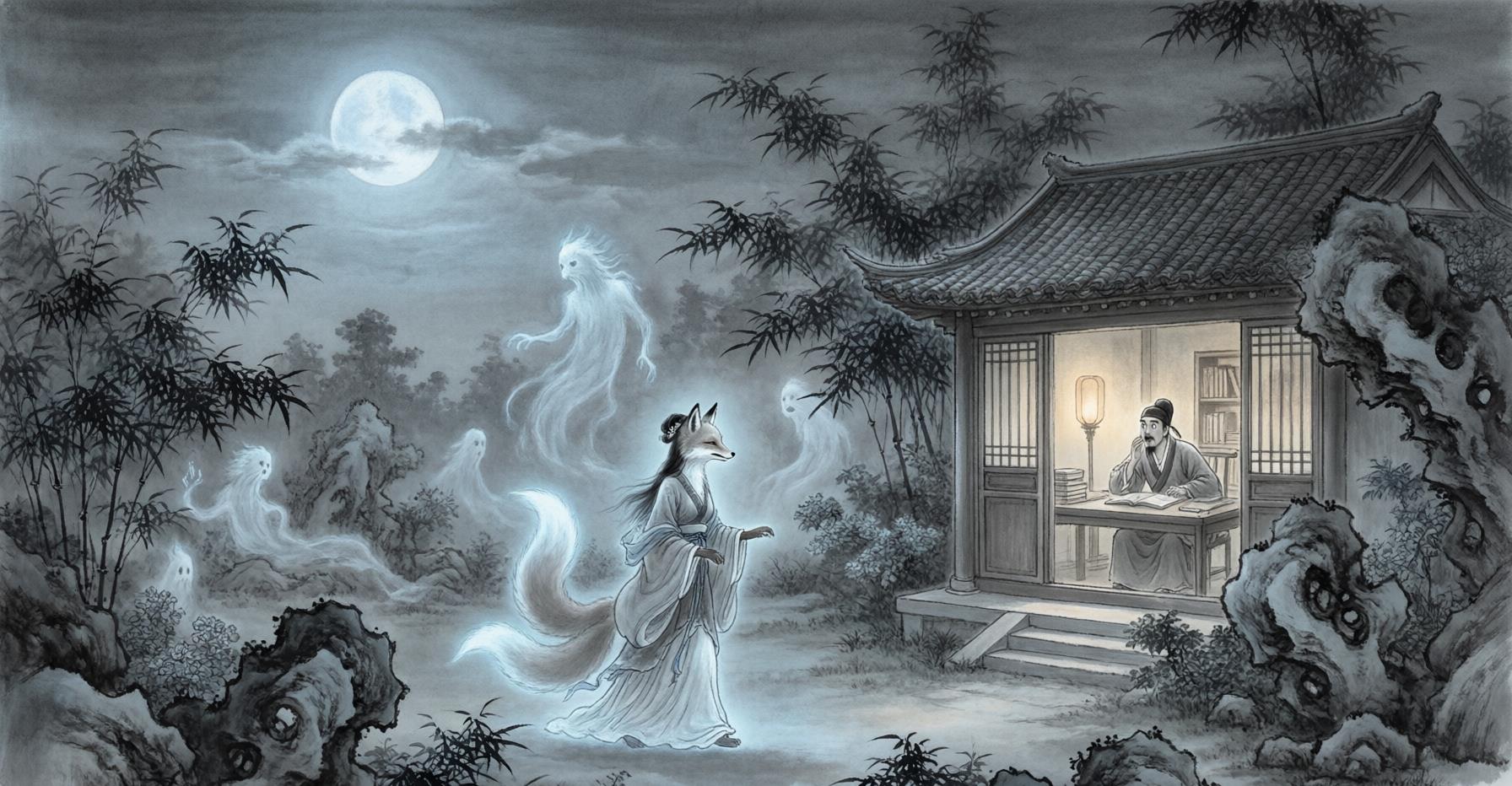
In the meantime, he lived. He tutored the children of wealthy families, most notably the Bi household, where he resided for roughly thirty years as a private teacher. He raised a family. He wrote poetry, composed practical guides on agriculture and medicine, and corresponded with friends. And at night, by lamplight, he wrote the stories that would make his name immortal. He called them Liaozhai Zhiyi (聊斋志异) — "Records of the Strange from the Studio of Leisure" — though the title is almost universally rendered in English as Strange Tales from a Chinese Studio. The "Studio of Leisure" (Liaozhai) was his writing room, a modest space where a man who had failed at everything the world valued sat down each evening and built a world in which justice, beauty, and intelligence still mattered.
Nearly Five Hundred Ways to Be Astonished
The collection, as it has come down to us, contains approximately 490 tales, though the exact number varies by edition. They range in length from a few paragraphs to extended narratives of many pages. They are written in classical Chinese (wenyan, 文言) — the compressed, allusive, grammatically complex literary language that was, by Pu Songling's time, already giving way to vernacular prose in popular fiction. This choice was deliberate and, in its way, defiant. Pu Songling was writing in the language of the examination essays that had rejected him, but he was using it to tell stories that the examination system would never have tolerated: stories about ghosts, foxes, demons, reincarnation, and the spectacular failures of the scholar-official class.
The tales resist easy categorization, but several broad types emerge. There are the fox-spirit romances, in which a young scholar encounters a beautiful woman who is, in fact, a huli jing (狐狸精) — a fox spirit who has cultivated supernatural powers over centuries. There are the ghost stories, in which the dead return to settle debts, avenge wrongs, or simply seek companionship. There are tales of karmic justice, in which the cruel are punished and the kind rewarded across multiple lifetimes. There are satirical fables aimed at corrupt magistrates, foolish students, and the absurdities of the examination system itself. And there are stranger tales still — stories about sentient flowers, about men who enter paintings, about judges in the underworld who are more fair than their living counterparts.
The collection was not published in book form until 1766, more than fifty years after Pu Songling's death in 1715. Before that, the tales circulated in manuscript copies, passed hand to hand among literati who recognized, in this obscure Shandong tutor, a writer of extraordinary gifts. The delay in publication is not unusual for the period, but it meant that Pu Songling never saw his life's work in print. He died knowing the stories existed, knowing they were admired in small circles, but without the broader recognition that might have consoled him for a lifetime of examination failures.
The Fox and the Scholar
If there is a single image that defines Liaozhai Zhiyi in the Chinese imagination, it is this: a young scholar, alone in a mountain temple or a rented room, reading by candlelight. A beautiful woman appears at his door. She is witty, accomplished, and irresistibly attractive. They become lovers. She helps him with his studies, with his poetry, with his confidence. She is, in every way that matters, superior to him. And she is a fox.
The huli jing (狐狸精) — the fox spirit — is one of the oldest figures in Chinese folklore. Foxes, in traditional belief, could cultivate spiritual power over centuries, eventually gaining the ability to assume human form. They were ambiguous figures: sometimes malevolent seductresses who drained men of their vital energy, sometimes benevolent spirits who rewarded kindness. Pu Songling inherited this tradition and transformed it. His fox spirits are, overwhelmingly, intelligent, loyal, and morally serious. They are often better than the humans they encounter — more faithful, more perceptive, more capable of genuine love. They choose scholars not because scholars are powerful (they are usually poor and unsuccessful) but because scholars are capable of recognizing beauty and responding to it with language.
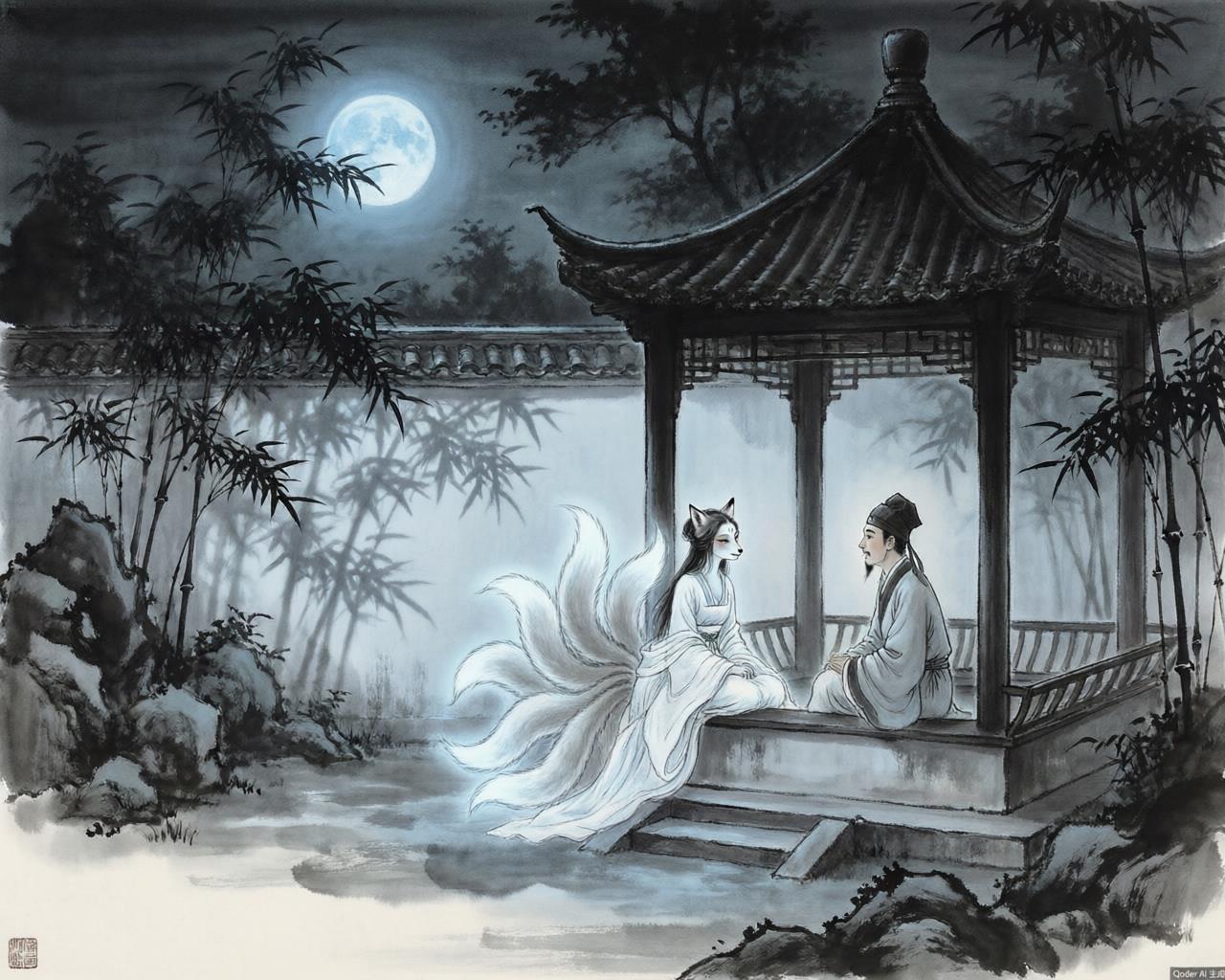
This is, of course, a fantasy — but a revealing one. Pu Songling, the perpetual failure, the man who could not pass an examination, created a literary world in which the qualities he possessed (sensitivity, literary skill, moral seriousness) were recognized and rewarded by beings of superior perception. The fox spirits do not care about examination rankings. They care about whether a man can write a good poem, whether he is kind to animals, whether he keeps his word. In the economy of Liaozhai, the values of the examination system are inverted. The scholars who succeed in the tales are not the ones who pass the tests. They are the ones who deserve to.
Famous Tales: Painted Skins and Faithful Ghosts
Among the nearly five hundred tales, certain stories have achieved a fame that transcends the collection. "The Painted Skin" (Huapi, 画皮) is perhaps the most widely known: a scholar encounters a beautiful woman on the road and takes her home as a concubine. A Daoist priest warns him that she is not what she seems. The scholar, skeptical, spies on her through a window and sees her true form — a hideous demon, painting a beautiful human skin like an artist preparing a canvas. The image is unforgettable: the monstrous carefully applying beauty like makeup, constructing attractiveness as a disguise. The tale has been adapted into film multiple times and has entered the Chinese language as an idiom for deceptive appearances.
"Nie Xiaoqian" (聂小倩) tells the story of a young woman's ghost, enslaved by a demon in a temple, who seduces travelers so the demon can feed on their blood. When the virtuous scholar Ning Caichen (宁采臣) arrives, she finds herself unable to harm him. Their subsequent romance — between a living man and a ghost seeking liberation from bondage — is one of the most tender love stories in Chinese literature. It has been adapted into film and television numerous times, most famously in the 1987 Hong Kong film A Chinese Ghost Story (Qian Nü You Hun, 倩女幽魂).
"The Fox's Wedding" (Huli Jia Nü, 狐狸嫁女) offers a gentler register: a man stumbles upon a fox spirit's wedding procession and is drawn into their celebration. The tale is less a narrative than an atmosphere — a glimpse into a parallel world that mirrors human society in its rituals and hierarchies but surpasses it in elegance and courtesy. Other celebrated tales include "The Cricket" (Cuzhi, 促织), in which a family is destroyed by the emperor's demand for fighting crickets, and "Xi Fangping" (席方平), in which a son descends to the underworld to appeal his father's unjust death and discovers that the courts of hell are as corrupt as those of the living world.
The Historian of the Strange
Pu Songling's narrative technique is distinctive and worth examining. Many of the tales are framed as reports — things heard from reliable witnesses, incidents recorded from local gazetteers, stories told by travelers. The narrator positions himself not as an inventor of fictions but as a collector and transmitter of accounts that already exist. This is the pose of the historian, and it is significant that Pu Songling's narrator often appends a brief commentary at the end of a tale, introduced by the phrase "The Historian of the Strange says" (Yishi shi yue, 异史氏曰). This directly echoes the formula of Sima Qian, the great Han Dynasty historian, who concluded his biographies with "The Grand Historian says" (Taishi Gong yue, 太史公曰).
The imitation is pointed. Pu Songling is claiming, for his tales of ghosts and foxes, the same authority that the historian claims for his accounts of emperors and generals. The strange, he insists, is worthy of record. The supernatural is not mere entertainment; it is evidence. It reveals truths about human nature, social injustice, and moral order that conventional history cannot capture. When a fox spirit is more faithful than a human wife, when a ghost is more just than a living magistrate, the supernatural becomes a lens for examining the failures of the real.
"Gathering tales of the strange, recording accounts of the extraordinary — this is my way of expressing the indignation that has accumulated in my breast."
— Pu Songling (蒲松龄), from his preface to Liaozhai Zhiyi
This is the key to the collection's method. The supernatural in Liaozhai is not an escape from reality. It is a way of seeing reality more clearly. The fox spirit who exposes a corrupt official, the ghost who avenges a murder the living courts ignored, the demon who punishes a scholar's cruelty — these are not fantasies of wish fulfillment. They are satires. They say: the world is so unjust that only the dead, only the non-human, only the impossible, can deliver the justice that human institutions have failed to provide.
Classical Chinese as a Literary Instrument
One aspect of Liaozhai Zhiyi that is difficult to convey in translation is the sheer beauty of its prose. Pu Songling wrote in wenyan — classical Chinese — at a time when the great novels of the Ming and Qing were increasingly written in vernacular prose (baihua, 白话). This was not conservatism. It was a conscious aesthetic choice. Classical Chinese, with its compressed syntax, its tonal rhythms, its capacity for suggestion rather than statement, was the ideal instrument for tales that depended on atmosphere, implication, and the eloquent unsaid.
A Liaozhai tale can establish a mood in a single sentence. A landscape is sketched in four characters. A character's emotional state is conveyed through a classical allusion that carries centuries of resonance. The prose is dense, musical, and allusive in a way that vernacular prose cannot replicate. This is part of why the tales resist translation so stubbornly. A translator must choose between fidelity to the compressed original and readability in English, and something is always lost. The best English translations — those by Herbert Giles, John Minford, and Sidney Sondergard, among others — capture the narratives admirably, but the texture of the prose, its particular music, remains largely untranslatable.
Pu Songling's mastery of classical Chinese is, in a sense, his revenge on the examination system. The system demanded wenyan competence as a gatekeeping mechanism — a way of restricting literary production to those who had passed through its rituals. Pu Songling took the language of the gatekeepers and used it to build a world that mocked their values. He proved, in the most elegant prose imaginable, that the examination system measured the wrong things. The man who could not pass the test could write circles around those who did.
From Page to Screen: The Afterlife of Liaozhai
The influence of Liaozhai Zhiyi on Chinese popular culture is difficult to overstate. The collection is, in effect, the foundational text of Chinese supernatural fiction — the source from which the entire genre of ghost stories, fox-spirit romances, and tales of the uncanny draws its conventions. When a Chinese film or television series features a beautiful ghost, a shape-shifting fox, or a scholar who stumbles into a parallel world, it is working within a tradition that Pu Songling codified and elevated to art.
The adaptations are numerous. "Nie Xiaoqian" alone has been filmed at least six times, beginning with the Shaw Brothers production in 1960 and reaching its most famous iteration in Ching Siu-tung's 1987 A Chinese Ghost Story, which became a landmark of Hong Kong cinema. "The Painted Skin" was adapted into a major film in 2008 and a sequel in 2012. Television series based on Liaozhai tales have been produced in mainland China, Hong Kong, Taiwan, and Singapore across multiple decades. The stories have inspired operas, comic books, video games, and countless works of web fiction.
But the adaptations inevitably simplify. Film and television tend to emphasize the horror and romance elements — the beautiful ghost, the terrifying demon, the doomed love affair. What they often lose is the satirical edge, the moral seriousness, the quiet indignation that animates Pu Songling's prose. The tales are not merely spooky or romantic. They are arguments. They are a failed scholar's lifelong protest against a world that rewards the wrong people, punishes the innocent, and mistakes institutional success for moral worth. The ghosts and foxes are not decorations. They are the only honest witnesses in a dishonest world.
Why the Strange Endures
There is a reason Liaozhai Zhiyi has survived nearly three centuries of changing tastes, political upheavals, and literary revolutions. It is not merely that the stories are entertaining, though they are. It is not merely that the prose is beautiful, though it is. It is that Pu Songling understood something fundamental about the relationship between the real and the impossible: that the strange, properly handled, is more truthful than the realistic.
A realistic story about a corrupt magistrate can be dismissed as an isolated case, a fictional exaggeration, a political complaint. A story in which the magistrate is tried in the courts of hell, found guilty by demons, and sentenced to be reborn as an ox — that story carries a different kind of truth. It speaks to the moral imagination. It says: the injustice you tolerate in life does not go unrecorded. The universe keeps accounts. The strange is watching.
Pu Songling spent his life on the margins — of the examination system, of official life, of literary recognition. He died in 1715, in the same small district where he was born, still a tutor, still a failure by the standards he had been taught to value. But in his studio of leisure, by lamplight, he had built something that outlasted every magistrate who ever rejected his examination papers. He had built a world in which the strange was sovereign, in which foxes were wiser than scholars, in which ghosts were more faithful than the living, and in which the only true failure was not failing an examination but failing to see what was real.
"Writing of ghosts and spirits, he surpasses all others; satirizing greed and cruelty, his brush cuts to the bone."
— Guo Moruo (郭沫若), inscription at the Pu Songling Memorial Hall in Zibo, Shandong
The Studio of Leisure still stands, in a sense. The Pu Songling Memorial Hall in Zibo (淄博) preserves the site where he lived and wrote. Visitors can see his desk, his inkstone, the modest room where nearly five hundred tales were composed over a lifetime of evenings. It is a quiet place. There are no examination certificates on the walls. There are foxes.