The sound arrives before the singer does. It drifts across the valley in the blue hour before full daylight — a high, clear female voice launching a phrase into the mist, hanging on the last syllable like a question. Then, from the far bank of the river, a second voice answers: lower, rougher, male. The two melodies braid together over the rice paddies, rising and falling with the contours of the terraced hillsides. The women are already at work, ankle-deep in the flooded fields, their indigo jackets dark against the silver water, their silver earrings catching the first light. They sing without looking up. They sing the way they breathe — continuously, naturally, as though silence were the anomaly and song the default state of being.
This is Guangxi. This is the world of the Zhuang.
Who Are the Zhuang?
With a population of approximately nineteen million, the Zhuang are China's largest ethnic minority — a people whose numbers exceed the entire populations of many sovereign nations. They are concentrated overwhelmingly in the Guangxi Zhuang Autonomous Region, where they constitute roughly one-third of the regional population, with smaller communities in Yunnan, Guangdong, Guizhou, and Hunan provinces.
The Zhuang language belongs to the Tai-Kadai family, making it a distant cousin of Thai and Lao rather than of Chinese. It is a tonal language with eight tones in its northern dialects and six in the south, and for centuries it was written in sawndip — a logographic script that adapted Chinese characters to represent Zhuang words, much as the Japanese developed kanji for their own tongue. A romanized alphabet was introduced in the 1950s and revised in 1982, and today both systems coexist in education and publishing.
Their roots in southern China are ancient — far older than the Han Chinese presence in the region. Archaeological and linguistic evidence places Tai-Kadai-speaking peoples in the Lingnan region (modern Guangxi and Guangdong) for well over two thousand years, and possibly much longer. The Zhuang did not migrate to southern China; they were already there when the first Han settlers arrived, and their culture bears the deep imprint of that primordial connection to the subtropical landscape: the karst peaks, the red earth, the monsoon rains, the rice.
Bronze Drums and Ancient Glory
If one object could symbolize the depth of Zhuang civilization, it would be the bronze drum. Cast using a sophisticated lost-wax technique, these large, flat-topped drums — some over a meter in diameter — have been central to Zhuang ritual life for more than two thousand years. Their surfaces are incised with intricate designs: radiating sun motifs, geometric bands, stylized birds, and — most distinctively — tiny three-dimensional frogs perched at the cardinal points of the drum face. The frog, a creature of water and fertility, is the Zhuang totem par excellence.
Bronze drums were instruments of power. In the ancient Zhuang polities, possession of a drum signified chiefly authority; to beat the drum was to summon the community, to declare war, to honor the dead, to call the rains. The drums were buried with their owners, interred in caches as ritual offerings, and passed down through generations as sacred heirlooms. Over five hundred ancient bronze drums have been excavated in Guangxi alone, and the tradition of drum-casting and drum-beating persists in Zhuang villages to this day.
The other great monument of ancient Zhuang culture is the Huashan rock art — a vast gallery of painted figures on the cliff faces above the Zuo River in Ningming County. Created between the fifth century BCE and the second century CE, these ochre-red paintings depict hundreds of human figures in postures of dance and ritual, many with arms raised and legs spread in a frog-like stance, surrounded by bronze drums, boats, and dogs. The largest figure stands over three meters tall. UNESCO inscribed the Huashan rock art as a World Heritage Site in 2016, recognizing it as an extraordinary testament to the ritual culture of the ancient Luo Yue people — ancestors of the modern Zhuang.
Dress and Brocade: Woven Identity
Zhuang brocade — zhuangjin — ranks among China's four famous brocades, alongside the silk brocades of Nanjing, Suzhou, and Sichuan. Woven on a traditional bamboo loom using a supplementary weft technique, zhuangjin is characterized by bold geometric patterns, vivid color contrasts, and motifs drawn from the natural world: phoenixes, butterflies, flowers, dragons, and the ever-present frog. The ground cloth is typically cotton, the pattern threads silk or synthetic, and the effect is one of dense, luminous complexity — a textile that seems to contain an entire cosmology in its weave.
The craft is matrilineal. A girl learns to weave at her mother's loom, and her skill at the loom was traditionally a measure of her marriageability. A bride's trousseau included brocade quilts, brocade bags, and brocade baby carriers — each one a record of her patience, her artistry, and her love. The patterns are not written down; they live in the hands and memory of the weaver, passed from mother to daughter in an unbroken chain of practice.
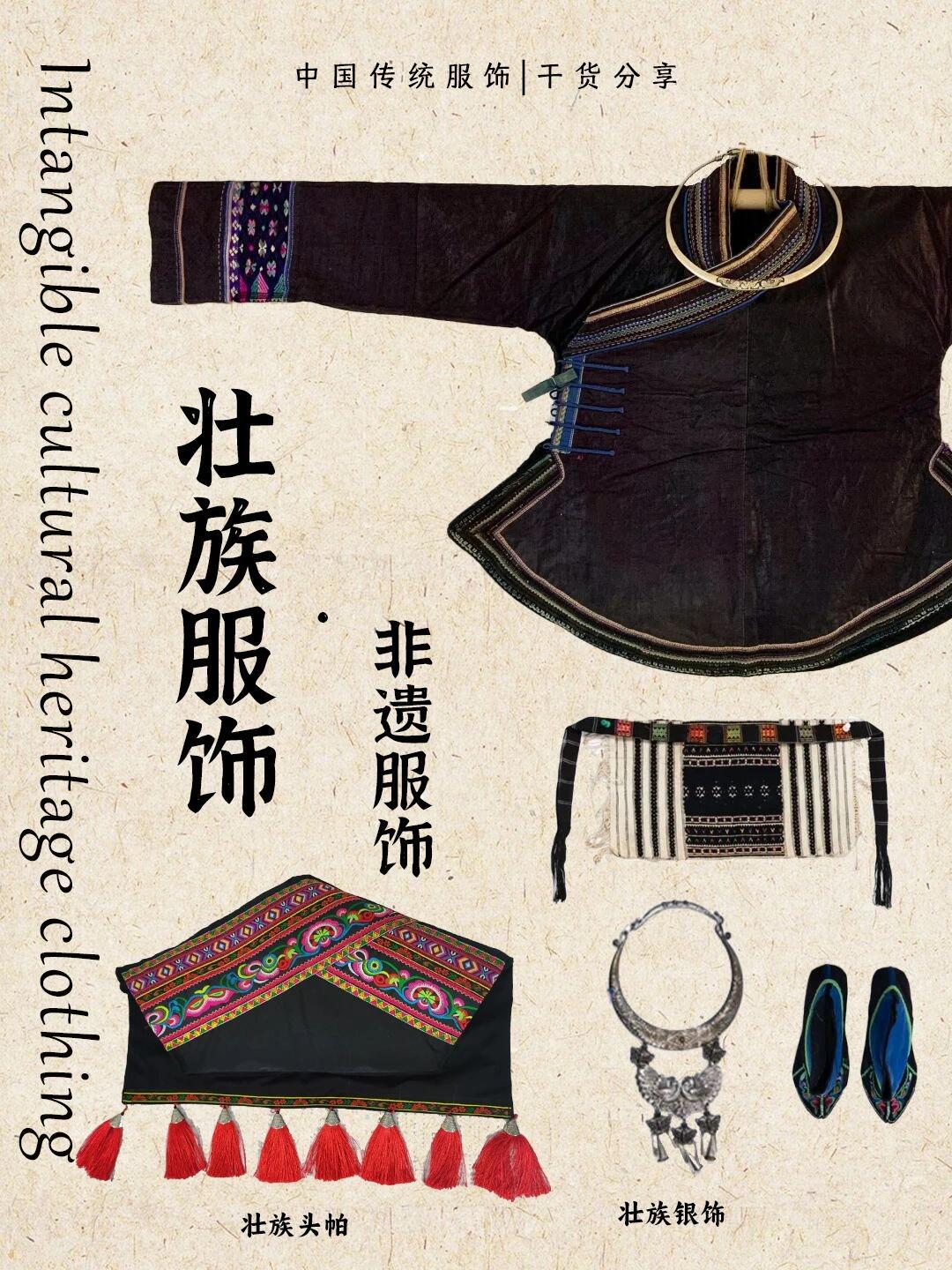
Everyday Zhuang dress, by contrast, is defined by indigo. The deep blue-black of indigo-dyed cotton is the color of Zhuang identity: jackets, trousers, head wraps, and aprons all emerge from the dye vat in that particular shade that seems to absorb light rather than reflect it. The dyeing process itself is laborious — repeated immersions in a fermented indigo solution, oxidation between dips, and a final treatment with egg white or ox-blood to give the cloth a subtle sheen. Women's jackets are often trimmed with contrasting piping and silver buttons; men's are simpler, with mandarin collars and frog closures.
Headdresses vary dramatically by sub-group and locality. In some areas, women wrap their hair in long black cloths wound into elaborate turbans. In others, they wear flat, embroidered panels or towering structures of wrapped cloth adorned with silver pins and tassels. Each configuration announces the wearer's village, age, and marital status with the precision of a heraldic device.
The Singing Culture
"The rice fills the belly, but the song fills the heart. Without song, a Zhuang is only half alive."
— Zhuang folk saying
Among the Zhuang, singing is not entertainment. It is infrastructure. It is the medium through which courtship is conducted, history is preserved, disputes are mediated, and community is constituted. The tradition of duige — antiphonal singing, in which two individuals or groups alternate verses in improvised poetic dialogue — is the social technology that holds Zhuang village life together.
A young man courting a young woman does not write a letter or send a message. He sings to her. He stands beneath her window, or across the field, or on the opposite bank of a stream, and he launches a verse — a compliment, a question, a playful provocation. If she is interested, she sings back. The exchange continues, verse by verse, each singer improvising within strict tonal and metrical constraints, testing the other's wit, vocabulary, and emotional sincerity. A courtship may unfold over dozens of singing sessions spanning weeks or months. To be tongue-tied in song is to be genuinely disadvantaged in love.
The apex of the singing tradition is the Sanyuesan festival — the Third of the Third Month in the lunar calendar — when entire communities gather for days of competitive singing. Groups from different villages face each other in formal antiphonal contests, the verses growing more complex and allusive as the hours pass. The festivals are also markets, reunions, and celebrations: stalls sell five-colored sticky rice, young people flirt, elders judge the singing, and the air vibrates with overlapping melodies until the hillsides themselves seem to hum.
The legendary figure of Liu Sanjie — "Third Sister Liu" — embodies the cultural centrality of song. According to tradition, she was a Tang Dynasty peasant girl whose singing was so beautiful and so sharp that it shamed landlords and enchanted mountains. She sang the grievances of the poor, and the powerful could not silence her. In the end, the story goes, she sang so beautifully that she ascended to heaven on the back of a carp. Her legend inspired the 1961 film Liu Sanjie, which made her a national icon, and the annual singing festivals of Guangxi are popularly understood as celebrations of her spirit.
Festivals and Food
The Sanyuesan festival is more than singing. It is a feast, and the feast is inseparable from the agricultural calendar. The signature dish is five-colored sticky rice — glutinous rice dyed yellow, purple, red, black, and white using natural plant extracts (turmeric, maple leaves, butterfly pea flowers, and the soot of burned rice straw). The colors represent the five directions and the five elements, and the dish is prepared as an offering to ancestors and to the spirits of the land before it is shared among the living.
Stuffed rice dumplings — zongzi wrapped in bamboo leaves — appear at Sanyuesan as well, though the Zhuang versions tend to be larger and more savory than their Han counterparts, filled with mung bean paste and pork fat. In some areas, the festival includes bullfighting: not the matador's spectacle but a contest between two water buffalo, horns locked, the crowd roaring, the losing animal simply turning and walking away unharmed.
The frog totem pervades Zhuang festival life. In the Guaipo (Frog Festival) of the Hongshui River region, communities perform a multi-day ritual in which a live frog is ceremonially "married," mourned, and buried, accompanied by bronze drum beating, masked dances, and antiphonal songs pleading for rain. The logic is agricultural: the frog croaks before the rain; to honor the frog is to ensure the monsoon; to ensure the monsoon is to ensure the rice.
The Zhuang in Modern China
Guangxi's transformation over the past four decades has been dramatic. Nanning, the regional capital, has grown from a sleepy river town into a metropolis of nearly nine million, its skyline bristling with glass towers, its metro system humming beneath streets lined with banyan trees. High-speed rail connects it to Guangzhou in under three hours. The old rice paddies on the city's edges have become industrial parks and university campuses.
Yet the Zhuang identity persists, adapted but unbroken. The Zhuang language is taught in bilingual schools across Guangxi, and a standard written form is used in local government, publishing, and broadcasting. The Sanyuesan festival is now an official public holiday in the autonomous region — a rare institutional recognition of minority cultural practice. Tourism has made Zhuang singing, dress, and cuisine visible to a national audience: the Impression Liu Sanjie show, staged on the Li River at Yangshuo with a cast of hundreds, draws millions of visitors annually.
The tension is real, however. Decades of intermarriage, urbanization, and Mandarin-dominant education have eroded Zhuang language fluency among younger generations, particularly in cities. Many urban Zhuang identify ethnically but no longer speak the language or practice the old customs. The brocade weavers of Jingxi County are aging, and their daughters work in factories in Guangdong. The singing tradition, while celebrated on stage, has thinned in the villages where it once structured every social interaction.
And yet: in the terraced valleys of Longsheng, in the drum halls of Donglan, in the indigo workshops of Mashan, the old ways endure. A grandmother still teaches her granddaughter the patterns. A young man still sings beneath a window in the blue hour. A bronze drum still sounds across the water, calling the community together, calling the rain. The Zhuang have survived two millennia of contact, conquest, and change. They are still singing.