Begin with the land, because the land explains everything. Southwest China — the provinces of Yunnan, Guizhou, and western Sichuan, bleeding into Guangxi and Hunan — is a place where the earth itself refuses to be uniform. The Hengduan Mountains run north-south in parallel ridges, carving deep river gorges that isolate valley from valley, ridge from ridge. Elevations plunge from 6,740-meter glacial peaks to 200-meter tropical floodplains within a single day's walk. The Mekong, the Salween, and the Yangtze run within sixty kilometers of each other, separated by walls of stone.
This topographic violence created a laboratory of human culture. Isolated communities, separated by a single mountain pass, developed distinct languages, distinct religions, distinct architectures, distinct cuisines — and maintained them for centuries. The result: Yunnan Province alone is home to 25 of China's 55 recognized ethnic minorities. No other province on Earth concentrates such diversity within its borders. To travel from the tropical Dai lowlands of Xishuangbanna to the Tibetan-influenced highlands of Shangri-La is to cross not merely a landscape but a dozen civilizations.
This is a journey through those civilizations — the peoples who turned isolation into art, and geography into identity.
The Yi: Fire and the Torch Festival
Numbering approximately nine million, the Yi are the largest minority group in the southwest and among the most culturally formidable. They inhabit the high plateaus and cold mountains of Liangshan in Sichuan, the hills of northern Yunnan, and parts of Guizhou and Guangxi — a vast territory unified not by geography but by a shared mythological ancestry and a fierce sense of distinctiveness.
The Yi's signature celebration is the Torch Festival (火把节), held in the sixth lunar month, usually late June or July. For three nights, entire villages ignite massive torches of pine and artemisia, parading through fields to drive away pests and evil spirits. Bonfires crown every hilltop. Young people circle the flames dancing, wrestling, courting. The effect, seen from a distance, is of the earth itself constellated — a galaxy brought to ground. The festival's origins lie in a myth of a hero who defeated a sky-god's plague of insects by teaching his people to fight fire with fire.
But the Yi are far more than a festival. Their traditional script — an ancient syllabary of over 800 characters, standardized in 1975 — is one of the few indigenous writing systems in East Asia not derived from Chinese characters. Their priestly class, the Bimo, preside over an elaborate animist religion involving ancestor worship, spirit exorcism, and the recitation of vast oral scriptures. The Bimo manuscripts, written in the Yi script on bark paper, constitute one of the largest bodies of indigenous religious literature in the world.
Yi lacquerware — wooden vessels and armor painted in bold black, red, and yellow geometric patterns — represents a decorative tradition stretching back over a thousand years. And the Yi solar calendar, dividing the year into ten months of thirty-six days each, demonstrates an astronomical sophistication that predates Han Chinese calendrical influence in the region.
The Dai: Water, Buddhism, and the Tropical South
Descend from the Yi highlands to the steamy lowlands of Xishuangbanna, and the world transforms utterly. Here, among the banana groves and rubber plantations, live the Dai — approximately 1.3 million people whose cultural gravity points not toward Beijing but toward Chiang Mai, Luang Prabang, and Mandalay. The Dai are Tai peoples, cousins of the Thai and Lao, and their culture shares the Theravada Buddhist foundation that defines mainland Southeast Asia.
Every Dai village centers on its wat — a Buddhist temple with a sweeping, multi-tiered roof that catches the equatorial light. Young men traditionally spend a period as novice monks, and the monastic calendar structures communal life. The Dai script, derived from ancient Mon-Khmer alphabets, flows in elegant curves utterly unlike the angular Chinese characters used a few hundred kilometers north.
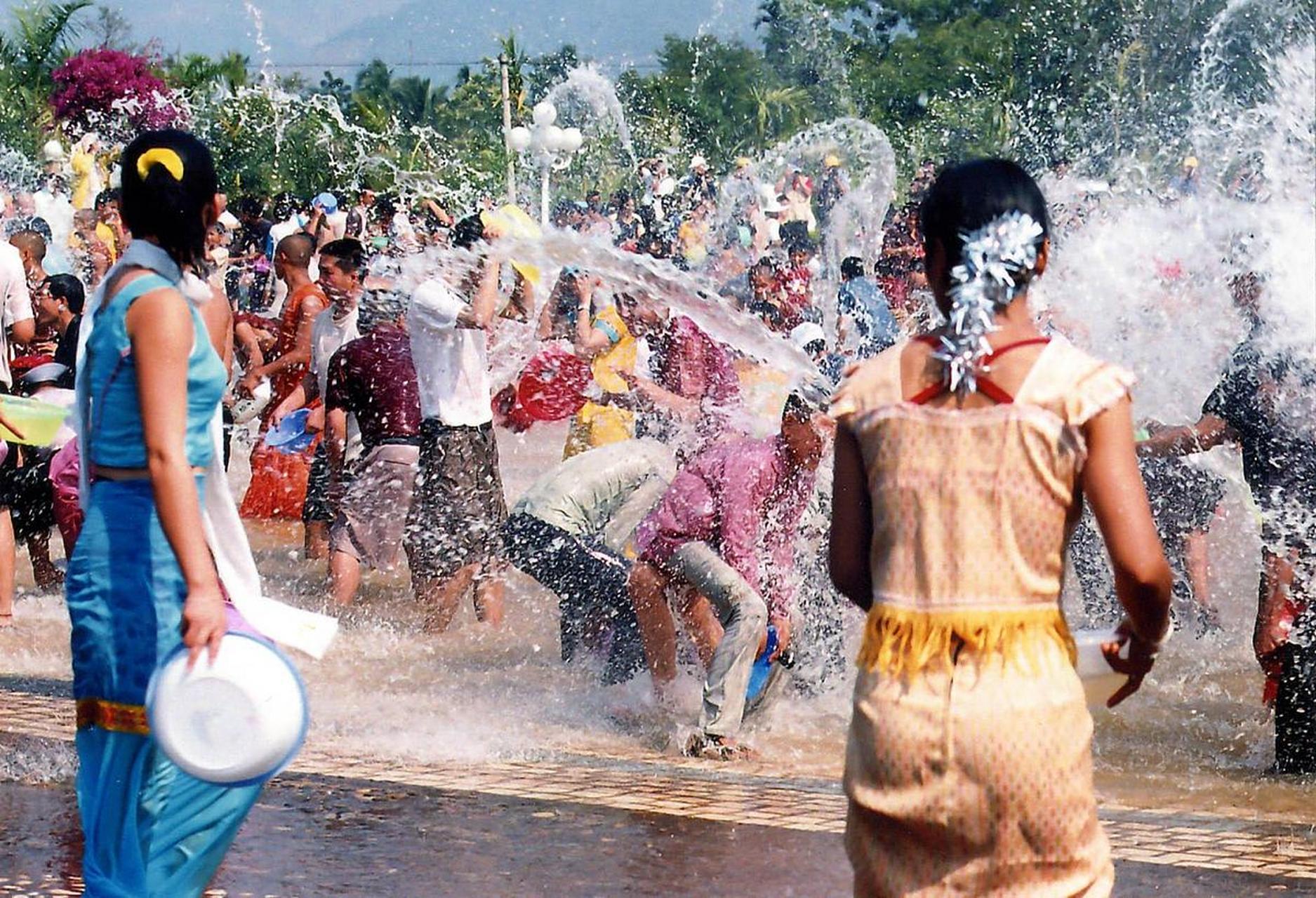
The Dai's most famous celebration is the Water Splashing Festival (泼水节), held in mid-April to mark the Buddhist New Year — the same Songkran celebrated across Thailand and Laos. For three days, entire towns become water battlegrounds. Buckets, hoses, water guns — everyone is fair game. The splashing is not mere play; it is ritual purification, washing away the old year's misfortunes. Elders receive gentle sprinklings on the shoulder; the young drench each other with abandon.
Dai architecture is defined by the bamboo stilt house — raised two meters above the ground on hardwood pillars, its steep thatched or tiled roof shedding monsoon rains, its open veranda catching river breezes. The peacock dance, performed by a solo dancer in an elaborate feathered costume, mimics the bird's courtship display with liquid, undulating movements — a tradition said to be over a thousand years old. Dai cuisine, sour and spicy and herbaceous, built around lemongrass, wild ginger, and river fish, is the tropical counterpoint to the heavy, numbing flavors of Sichuan just a few mountains away.
The Bai: Marble, Tie-Dye, and Three Pagodas
Around the shores of Erhai Lake, with the Cangshan Mountains rising behind them like a painted screen, the Bai people — approximately two million strong — have built one of China's most refined regional cultures. Their capital, Dali, was the seat of the Nanzhao and Dali Kingdoms, independent states that flourished from the eighth to the thirteenth centuries, trading with Tang China, Tibet, and Southeast Asia simultaneously.
The Three Pagodas of Chongsheng Temple, rising above Dali's northern plain, are the Bai's most enduring monument. The central pagoda, built in the ninth century, stands 69 meters tall — a sixteen-story brick-and-stone tower that has survived a millennium of earthquakes. Flanked by two smaller tenth-century pagodas, the trio reflects perfectly in the lake waters at dawn, an image that has defined Dali's identity for over a thousand years.
Bai women's headdresses are among the most symbolically dense in China. The elaborate structure — a white top, a curved tail, embroidered flowers, and a crescent shape — encodes four poetic images: the wind of Xiaguan, the flowers of Shangguan, the snow of Cangshan, and the moon over Erhai. To wear the headdress is to wear the landscape itself.
The Bai are master dyers. Their tie-dye tradition (zha ran, 扎染) produces intricate blue-and-white patterns on cotton cloth — geometric designs, botanical motifs, and symbolic figures created by binding, folding, and stitching fabric before immersing it in natural indigo vats. The town of Zhoucheng, north of Dali, has practiced this craft for over a thousand years, and its workshops remain active today. Bai architecture, too, is distinctive: white-washed walls with painted decorative panels, upturned eaves, and elaborate gatehouses that proclaim a family's status and aesthetic refinement.
The Naxi: Keepers of the World's Last Pictographic Script
In the shadow of Jade Dragon Snow Mountain, in the ancient town of Lijiang with its canal-laced old quarter, the Naxi people — approximately 320,000 strong — guard something the modern world nearly lost: a living pictographic writing system. The Dongba script, used by Naxi priests for over a thousand years, consists of approximately 1,400 characters that are, in essence, pictures. A sun is drawn as a circle with rays. A mountain is three peaks. A man is a stick figure. It is writing at its most elemental — and in 2003, UNESCO inscribed the Dongba manuscripts on its Memory of the World Register, recognizing them as irreplaceable human heritage.
The Dongba religion that employs this script is a syncretic animist tradition blending indigenous shamanism with Tibetan Bon influences. The dongba priests — the word means "wise man" — preside over elaborate ceremonies for birth, marriage, death, and healing, chanting from manuscripts that narrate the creation of the world, the battles of gods and demons, and the journeys of the soul through the afterlife. Fewer than a hundred fully trained dongba remain, making their knowledge among the most endangered cultural treasures in China.
The Naxi also preserve an extraordinary musical tradition: Naxi ancient music (纳西古乐), performed by ensembles of elderly musicians playing instruments — the sugudu lute, the bo flute — in styles that musicologists believe preserve melodic structures from the Tang and Song dynasties, lost elsewhere in China for centuries. Listening to a Naxi ancient music performance in a Lijiang courtyard is, quite literally, hearing a thousand-year-old sound.
Among the Naxi's Mosuo sub-group, living around Lugu Lake on the Yunnan-Sichuan border, a matrilineal social structure persists that has fascinated anthropologists for decades. Property descends through the female line; women head households; romantic relationships take the form of "walking marriages" in which partners maintain separate residences. The Mosuo represent not a primitive survival but a sophisticated alternative social architecture.
The Dong: Bridges, Drums, and Polyphonic Song
Cross eastward from Yunnan into the misty mountains of Guizhou, Guangxi, and Hunan, and you enter the territory of the Dong people — approximately three million speakers of a Tai-Kadai language, living in villages of extraordinary architectural ambition. The Dong built, without nails, without blueprints, without metal fasteners of any kind, some of the most beautiful wooden structures in Asia.
Their wind-and-rain bridges (风雨桥) are covered wooden bridges spanning rivers, their multiple pavilion-topped sections providing shelter from the region's relentless rain. The most famous, the Chengyang Bridge in Guangxi, stretches 77 meters across the Linxi River on five stone piers, its three pagoda-style pavilions rising in tiers above the water. Every joint is mortise-and-tenon. Every beam is hand-fitted. The structure has stood since 1912, and similar bridges throughout Dong territory have endured for centuries.
The drum tower (鼓楼) is the Dong village's spiritual and social center — a multi-eaved wooden tower, sometimes rising nine or thirteen stories, its interior housing a massive drum used to summon the community. Villagers gather beneath it to settle disputes, celebrate festivals, and sing.
And sing they do. The Kam Grand Song (侗族大歌) is a form of polyphonic choral singing — multiple independent vocal lines weaving together without instrumental accompaniment — performed by trained village choirs. The tradition, passed orally for over 2,500 years, was inscribed on UNESCO's Intangible Cultural Heritage list in 2009. The songs imitate natural sounds: cicadas, flowing water, birdsong. They are, in the Dong conception, humanity's contribution to the chorus of the natural world.
Dong indigo dyeing produces the deep, lustrous blue-black cloth from which their traditional clothing is made — fabric beaten with wooden mallets until it achieves an almost metallic sheen, a process requiring months of repeated dyeing and pounding.
The Hani: Rice Terraces as Living Sculpture
In the Ailao Mountains of southern Yunnan, the Hani people — approximately 1.6 million strong — have spent over 1,300 years carving an entire mountain range into art. The Honghe Hani Rice Terraces, inscribed as a UNESCO World Heritage Site in 2013, cascade down slopes from 2,000 meters to the river valleys below in as many as 3,000 individual steps. Seen from above, they resemble a topographic map rendered in water and green — each terrace a mirror reflecting the sky, each retaining wall a hand-laid curve of stone.
This is not merely agriculture. It is a complete hydraulic civilization. The Hani engineered a system that captures mountain rainfall in forests at the peaks, channels it through bamboo and stone aqueducts, distributes it across thousands of terraced paddies, and returns the surplus to the rivers below — a closed-loop water management system of extraordinary sophistication, maintained without centralized authority through village-level cooperation and customary law.
Hani villages cluster on mid-slope terraces, their distinctive mushroom-shaped houses (茅草房) built with thick earthen walls and steep thatched roofs that shed the mountain rains. The October New Year (十月年) is the Hani's principal festival — a week of feasting, ancestor worship, and the ritual sacrifice of pigs and chickens to ensure the terraces' fertility for another cycle. Long-table banquets (长街宴) stretch the entire length of a village street, hundreds of families contributing dishes in a communal display of abundance and solidarity.
And Many More
The southwest's ethnic catalog extends far beyond these headline peoples. The Lisu, dwelling in the gorges of the upper Salween, are renowned for their crossbow hunting traditions and their annual Knife-Pole Festival, in which barefoot men climb a ladder of sharpened blades. The Wa, in the remote mountains along the Myanmar border, maintained a fierce independence and a headhunting reputation well into the twentieth century; their wooden drum dances remain among the most viscerally powerful performances in Yunnan. The Lahu are skilled hunters and gourd-pipe musicians. The Blang are among the earliest cultivators of Pu'er tea, their ancient tea gardens on Bulang Mountain producing some of the most prized leaves in the world. The Achang forge the legendary Husa knives. The Pumi maintain a pastoral culture on the Yunnan-Sichuan border. The Nu people, named for the river (Salween) that defines their world, cross its raging waters on zip-line cables of woven bamboo. The Derung, in the most remote valley of all, are among China's smallest ethnic groups, their women traditionally bearing facial tattoos. The Jino, recognized only in 1979, number approximately 23,000 and maintain a rich tradition of bamboo-tube percussion music.
Each of these peoples is a complete world — a language, a cosmology, a cuisine, a way of building, planting, singing, mourning, celebrating. Together, they make the southwest not merely a region of China but a continent of human possibility compressed into a few hundred thousand square kilometers of mountain, river, and cloud. To travel here is to be reminded, at every turn, that the human species is not one story but ten thousand — and that some of the most beautiful chapters are written in languages the wider world has barely heard.