China is a nation of staggering scale — 1.4 billion souls, megacities that swallow populations larger than most European countries, an economy whose output reshapes global markets. Yet within this vastness exists a quiet paradox that few pause to consider: among the fifty-six officially recognized ethnic groups of the People's Republic, some number fewer people than a modest village. The Lhoba count barely four thousand. The Tatar community could fill a single school auditorium. The Hezhen, once lords of an entire river system, now number scarcely five thousand.
These are not footnotes. They are not statistical rounding errors to be glossed over in a census report. Each of these tiny peoples carries within their songs, their crafts, their cosmologies, and their languages an irreplaceable thread of human cultural diversity — a way of seeing the world that, once extinguished, can never be reconstructed from memory. To lose them would be to lose colors from the spectrum of human experience, permanently and without appeal.
The Lhoba: China's Smallest Recognized People
Deep in the Yarlung Tsangpo gorge — where the great river of Tibet carves the deepest canyon on Earth before plunging into the subtropical lowlands of southeastern Tibet — live the Lhoba, China's smallest officially recognized ethnic group. Numbering approximately four thousand, they inhabit a landscape so vertiginous and remote that for centuries the outside world barely knew they existed.
The Lhoba possess no written script. Their entire history, their genealogies, their moral codes, and their cosmological narratives have been transmitted orally across uncounted generations. Elders recite creation myths that trace the Lhoba to a union between the sky and the earth, stories in which every river bend and mountain ridge carries spiritual significance. Their religion is animist at its core: the forest breathes with spirits, the river holds memory, and the boundary between the human and natural worlds is permeable, negotiable, alive.
Their material culture is equally distinctive. Lhoba artisans work bamboo and cane with a mastery that transforms humble grasses into architecture, clothing, and tools of remarkable sophistication. Their conical hats, woven so tightly they shed monsoon rain like lacquer, and their longhouses raised on stilts above the humid forest floor represent centuries of accumulated environmental knowledge — engineering solutions refined by a people who understood their ecosystem with an intimacy no outside survey could replicate.
Yet the Lhoba face an existential pressure that no previous generation encountered. Roads now reach their valleys. Schools teach in Mandarin. Young people leave for towns and cities, and with each departure, the chain of oral transmission weakens by one more link. The challenge of maintaining Lhoba identity in a rapidly modernizing region is not merely cultural — it is a question of whether a people can remain a people when the conditions that shaped them dissolve.
The Hezhen: Fish-Skin People of the Amur
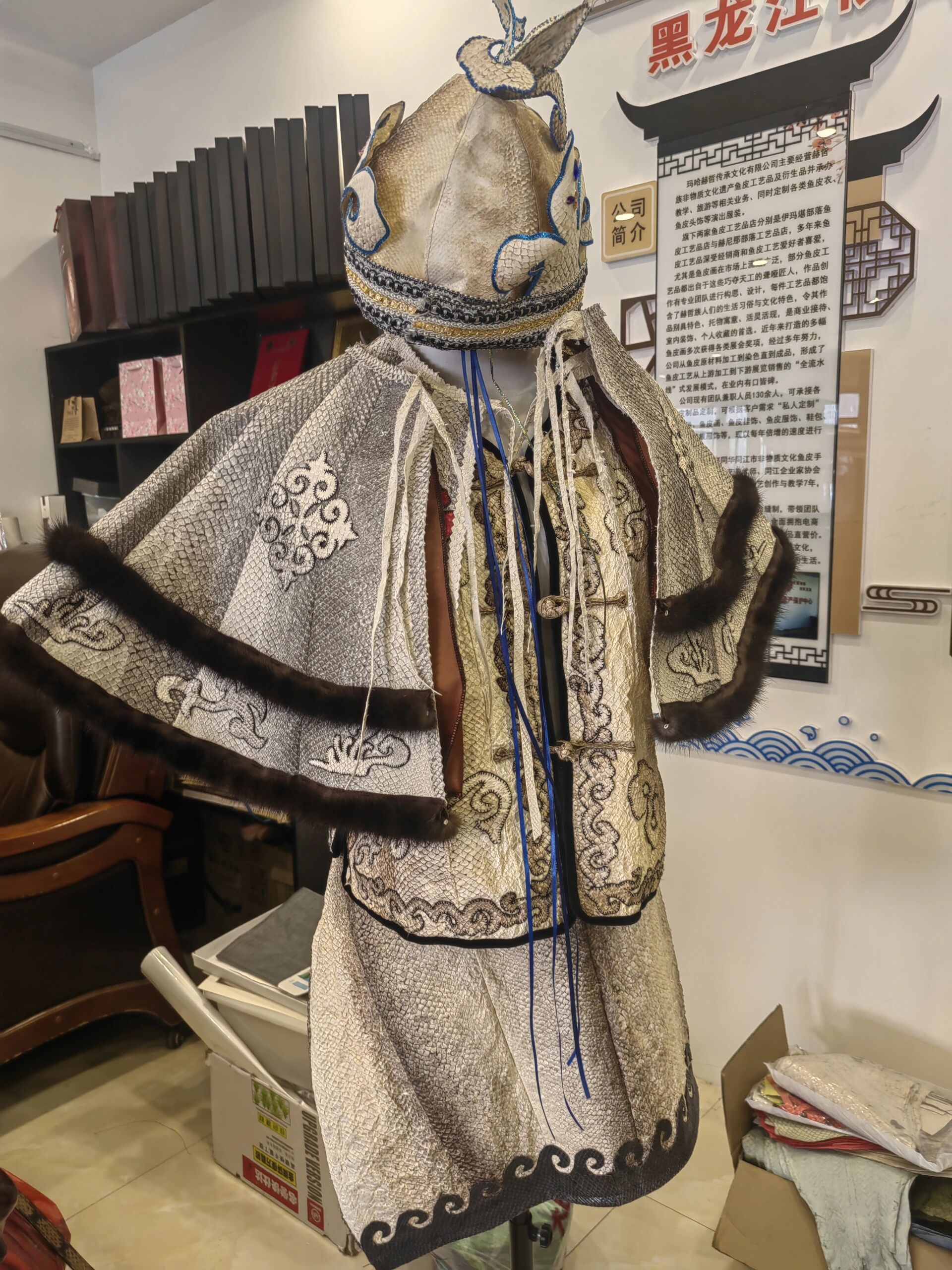
At China's northeastern extremity, where the Amur River forms the border with Russia and the winters drive temperatures below minus forty, the Hezhen people have practiced an art found nowhere else on Earth: the crafting of clothing from fish skin. For millennia, Hezhen women processed the hides of salmon, carp, and pike — scraping, softening, and stitching them into coats, boots, and bedding that were lighter than leather, warmer than woven cloth, and impervious to water. A single winter coat might require the skins of fifty fish, each prepared by hand over weeks of patient labor.
The Hezhen number approximately five thousand today, concentrated in a handful of villages along the lower Amur and its tributaries in Heilongjiang province. They are, in the deepest sense, a river people. Their identity was forged by the salmon runs, by the rhythm of ice-break and freeze-up, by a fishing culture that dictated the shape of their year and the structure of their society. Their shamanic tradition held that the river was a living entity, that fish carried the souls of ancestors, and that the shaman's drum could negotiate between the human world and the watery realm beneath.
The twentieth century dealt the Hezhen a series of devastating blows. Soviet-era border demarcations split their community in two, separating families who had fished the same waters for generations. Collectivization disrupted traditional fishing patterns. Industrial pollution diminished the salmon runs that sustained them. By the 1980s, the fish-skin tradition had nearly vanished — only a handful of elderly women retained the knowledge.
Today there is a quiet revival. Fish-skin craft has been reimagined as art rather than necessity. Hezhen artisans create decorative pieces that travel to exhibitions in Beijing and beyond. The Chinese government has designated fish-skin making an intangible cultural heritage. Yet the revival carries an inherent tension: a tradition preserved as museum art is not the same as a tradition lived as daily practice. The salmon still run, but the world that gave the Hezhen their meaning has shifted beneath them like ice in spring.
The Tatar: European Faces, Chinese Hearts
In the cities and towns of Xinjiang, one occasionally encounters faces that seem to belong to another continent entirely — high cheekbones, light eyes, features that recall the Volga more than the Tarim Basin. These are the Tatar, descendants of Volga Tatars who migrated eastward in the nineteenth century, fleeing conscription, economic hardship, and the long twilight of the Russian Empire's expansion. Today they number approximately four thousand, making them the only European-origin ethnic group officially recognized within China's borders.
The Tatar brought with them their Islamic faith, their literary tradition, and their most beloved celebration: the Saban festival, the ancient plough festival that marks the spring planting with wrestling, horse racing, and communal feasting. In Kazan and the Tatar homeland, Saban is a national holiday. In Xinjiang, it persists as an intimate community gathering — smaller, quieter, but no less fervent in its joy.
Over generations, the Tatar have woven themselves into the fabric of Xinjiang's multi-ethnic society. Intermarriage with Uyghur and Kazakh families has been common, and many Tatar speak Uyghur as fluently as their ancestral tongue. Their cuisine blends Tatar and Central Asian traditions — belish meat pies beside pilaf, chak-chak honey pastry beside naan. They are a people defined not by isolation but by synthesis, a living testament to the Silk Road's ancient promise that cultures need not conquer one another to create something new.
The Derung: Tattooed Faces of the Hidden Valley
Until 1999, the Derung River valley in northwest Yunnan was effectively cut off from the rest of China for six months of every year. Snow sealed the mountain passes, and the approximately seven thousand Derung people who lived within those walls of rock and ice existed in a solitude so complete that it shaped every aspect of their culture. When the tunnel was finally bored through the mountains, connecting the valley to the outside world by all-weather road, it ended an isolation that had persisted for longer than living memory could measure.
The Derung are perhaps most widely known — or rather, were known — for the facial tattoos worn by their women. Young girls received intricate patterns on their chins and cheeks, a practice tied to notions of beauty, clan identity, and spiritual protection. The last women to bear these tattoos are now elderly, and when they pass, the living record of this tradition will pass with them. No photograph can capture what it meant to wear one's identity on one's face, to carry the mark of belonging in every interaction with the world.
Their spiritual life centers on animist beliefs: the valley is populated by spirits of the forest, the river, and the mountain, and a ritual specialist mediates between the human community and these unseen powers. Their agriculture was traditionally slash-and-burn, adapted to the steep terrain and the valley's microclimate. The transition to settled, modern agriculture — encouraged and supported by government programs — has brought material improvement but also a severing of the relationship between the Derung and their landscape that once defined their calendar, their rituals, and their sense of place.
The Gin: Vietnam's Kin on Chinese Shores
Off the coast of Guangxi, on three small islands — Wanwei, Shanxin, and Wuwu — live the Gin people, China's only ocean-fishing ethnic group. Numbering approximately thirty thousand, they are the largest of the communities profiled here, yet their distinctiveness is no less pronounced. The Gin are, linguistically and culturally, kin to the Vietnamese. Their ancestors crossed the Gulf of Tonkin centuries ago, settling on these islands and developing a maritime culture unlike anything found among China's other ethnic groups.
Their most spectacular tradition is the哈 festival — the singing festival — held annually at the village communal house. For several days, the community gathers to sing antiphonal songs, perform ritual dances, and feast on the ocean's bounty. The songs are not mere entertainment; they encode history, moral instruction, and the community's relationship with the sea. To hear a Gin singing festival is to hear a people narrating themselves into continued existence.
The Gin also practice a distinctive form of fishing using large stilted nets — great wooden frames that rise from the shallows like the legs of wading birds, lowered and raised with the tide. This technique, shared with fishing communities in Vietnam, is a visible reminder of the cultural bridge the Gin represent: a people who belong fully to China yet carry within their language, their music, and their daily practice the memory of another shore.
Preservation and the Question of Survival
The languages of these small peoples occupy the most precarious positions on UNESCO's Atlas of Endangered Languages. Several have fewer than one thousand fluent speakers. Some have fewer than one hundred. When a language dies, what perishes is not merely a set of vocabulary and grammatical rules — it is an entire way of parsing reality, a unique cognitive architecture that took millennia to construct and can never be rebuilt.
"Every language is a unique solution to the problem of being human. When we lose a language, we lose a way of understanding what it means to be alive — and no amount of documentation can fully resurrect what lived in the mouths and minds of its speakers."
Government preservation programs have made genuine efforts: language documentation projects record elders' speech, cultural centers teach traditional crafts to younger generations, and intangible heritage designations provide both recognition and funding. The Derung tunnel, the Hezhen cultural village, the Lhoba heritage museum — these represent real investment and real intention.
Yet tourism, often cited as a preservation tool, cuts both ways. A fish-skin coat made for a gift shop is not the same object as one made for a child's first winter. A singing festival performed for visitors with cameras is not the same act as a community singing itself into the new year. The economic benefits are real; the spiritual cost is harder to measure but no less real.
And beneath all the practical questions of policy and funding lies a philosophical one that admits no easy answer: what is lost when a people's last speaker dies? Not just words. Not just songs or recipes or techniques. What is lost is a perspective — a particular angle of vision on the human condition that no other culture, however vast or powerful, can replicate. The Lhoba see the forest differently than the Han. The Hezhen understand the river in ways no hydrologist can capture. The Tatar carry a synthesis of worlds that exists nowhere else.
In a nation of 1.4 billion, four thousand people can seem negligible. But cultural diversity is not a numbers game. It is a question of range, of possibility, of the full breadth of human expression. Every small people that endures enriches not only itself but the civilization that contains it. Their survival is not charity. It is self-interest of the highest order — the preservation of options, of perspectives, of ways of being human that we may not yet know we need.