Dawn on the steppe does not arrive gently. It breaks — a thin blade of gold splitting the horizon, flooding an ocean of grass that stretches in every direction until the earth itself seems to curve away beneath you. The air is sharp with cold and the green smell of dew-soaked fescue. Somewhere ahead, a column of smoke rises from a white ger, its felt walls glowing amber in the first light. A horse whinnies. A dog barks once, then falls silent. And then you hear it: the low, guttural hum of a herder calling his flock, a sound so ancient it might be the voice of the land itself.
This is Inner Mongolia. Not the Mongolia of history books and conquest narratives, but a living, breathing world where six million people still carry the name of the Eternal Blue Sky — Mönkh Khökh Tenger — in their hearts, their songs, and the very cut of the robes they wear.
Who Are China's Mongols?
China is home to approximately six million ethnic Mongols, making it the country with the largest Mongol population in the world — larger than the independent nation of Mongolia itself. The vast majority live in the Inner Mongolia Autonomous Region, a sweeping arc of grassland, desert, and forest that traces China's northern border for over 2,400 kilometers. Smaller communities are scattered across Xinjiang, Qinghai, Gansu, Heilongjiang, Jilin, and Liaoning provinces.
To understand China's Mongols, one must first set aside the common conflation with the Mongolian state. The two peoples share language, ancestry, and cultural roots, but their modern histories diverged sharply in the twentieth century. China's Mongols are citizens of the People's Republic, educated in Chinese schools, integrated into the Chinese economy, and — increasingly — urban. Yet they maintain a fierce pride in their distinct identity, rooted in a lineage that stretches back to the unification of the steppe tribes under Chinggis Khan in 1206 and the establishment of the Yuan Dynasty (1271–1368), which made Beijing a Mongol imperial capital.
The Mongolian language belongs to the Mongolic family and is written in a script unlike any other in China: the traditional vertical Mongolian script, read from top to bottom in columns running left to right. Developed in the thirteenth century and adapted from the Uyghur script, it remains in official use in Inner Mongolia alongside Chinese characters — a visible assertion of cultural continuity on street signs, government documents, and school textbooks.
The Ger and the Grassland: Nomadic Life
The ger — known in the West by its Turkic name, "yurt" — is one of humanity's most elegant architectural solutions to the problem of shelter. A circular lattice of collapsible wooden walls supports a crown of roof poles radiating from a central ring, the whole structure wrapped in layers of felt and canvas. A skilled family can dismantle a ger in under an hour and reassemble it in another. The door always faces south, toward the sun. The interior is organized by strict convention: the north side is the place of honor, the west belongs to men, the east to women, and the hearth sits at the exact center, its smoke rising through the open crown to the sky above.
For the pastoral Mongol, the ger is not merely a house. It is a cosmogram — a microcosm of the universe, with the sky above, the earth below, and the family at the center of all things.
The pastoral economy revolves around the "five snouts" — horses, sheep, goats, cattle, and camels — each animal suited to a different terrain and season. Sheep provide meat, milk, and wool. Goats yield cashmere. Horses are transportation, companionship, and identity. Cattle pull carts and give milk. Camels carry loads across the Gobi. A herder's wealth is measured not in currency but in the health and number of his animals, and his knowledge of the grassland is encyclopedic: which slopes green first in spring, where the water table holds through August, how to read the behavior of marmots as a forecast of winter severity.
Seasonal migration — moving between spring, summer, autumn, and winter camps — was once the defining rhythm of Mongol life. While sedentarization policies and land privatization have reduced full nomadism, many families in Inner Mongolia still move their herds between two or more seasonal pastures, maintaining a relationship with the landscape that is intimate, reciprocal, and irreplaceable.
The Deel: Dressing for the Steppe
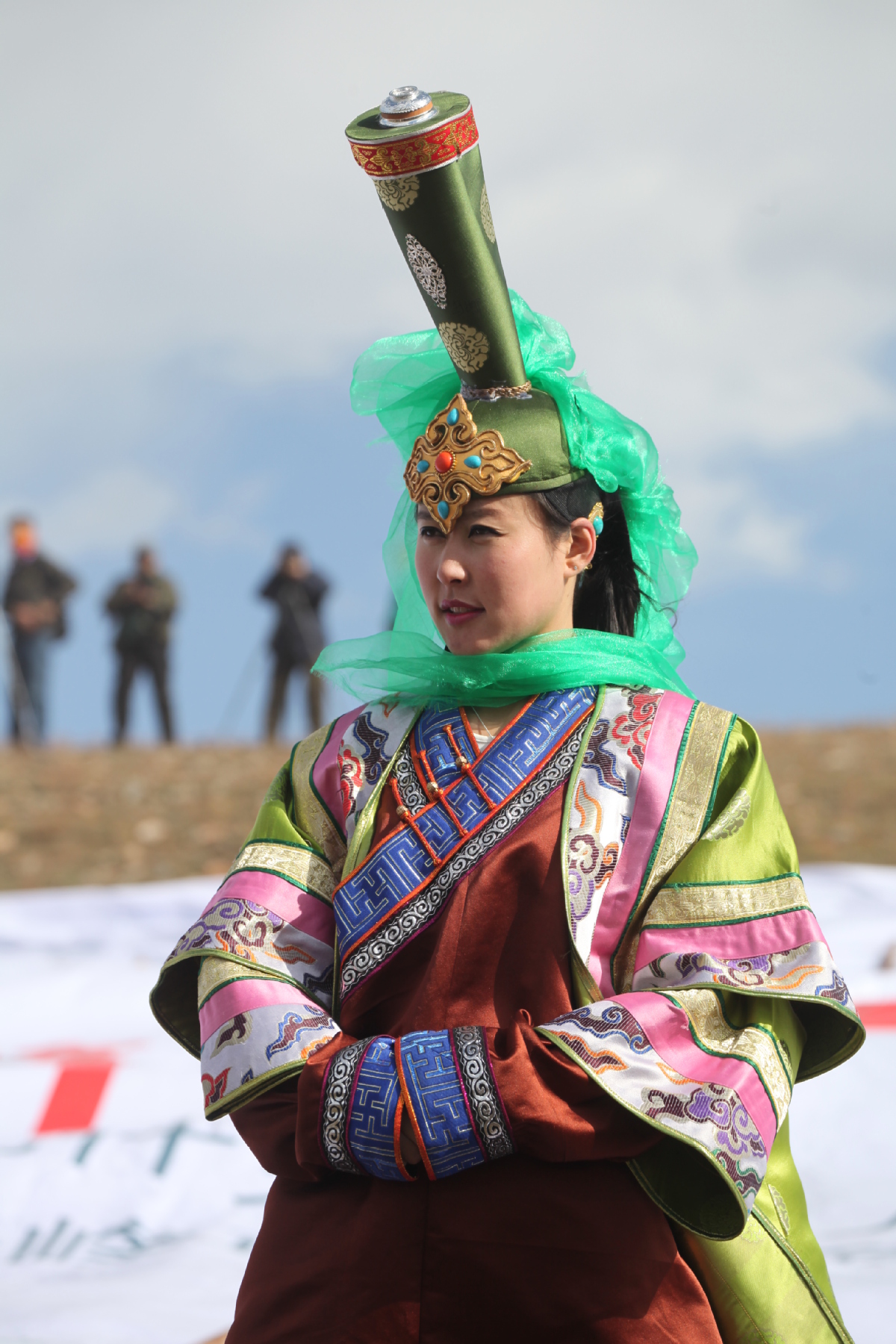
The deel is the Mongol robe: a long, overlapping-front garment that wraps across the body and fastens at the right shoulder and under the arm. Its high collar shields the neck from wind. Its wide, overlapping panels create an insulating air pocket against the chest. Its length protects the legs while riding. Cinched at the waist with a broad silk sash — often several meters long, wound tight — the deel transforms the wearer into a compact, wind-resistant form, perfectly adapted to life in the saddle and to temperatures that swing from +35°C in summer to -40°C in winter.
Seasonal variations are pronounced. The summer deel is lightweight cotton or silk, often in bright blue, green, or orange. The winter deel is lined with sheepskin or fox fur, its outer layer heavy wool or quilted fabric. For festivals and weddings, the deel becomes a canvas of extravagance: brocade silk in deep reds and golds, trimmed with otter or sable fur, embroidered with cloud patterns and the eternal knot.
Women's ceremonial dress reaches its zenith in the married-woman's headdress — an elaborate construction of silver, coral, turquoise, and pearl that can weigh several kilograms. Among the Ordos Mongols, these headdresses feature long lateral "wings" of coral beads and silver filigree that frame the face like the horns of a mythical deer. Each sub-group has its own distinctive form, making the headdress a precise marker of regional and marital identity.
The boots, too, are distinctive: upturned-toe leather boots with thick felt soles, designed to grip stirrups and shed snow. The upward curl of the toe is said to prevent the wearer from disturbing the earth — a gesture of respect to the land that sustains them.
Music of the Open Sky
"A Mongol without a horse is like a bird without wings. A Mongol without a song is like a sky without stars."
— Mongolian proverb
No instrument embodies the Mongol soul more completely than the morin khuur, the horsehead fiddle. Its two strings are traditionally made from horsehair — one from a stallion's tail, one from a mare's — and its scroll is carved into the shape of a horse's head. The sound it produces is haunting: a deep, resonant drone that swells into keening, vocal-like melodies, evoking the gallop of hooves, the whistle of wind over grass, and the loneliness of a rider under an infinite sky. UNESCO recognized the morin khuur tradition as a Masterpiece of the Oral and Intangible Heritage of Humanity in 2003.
Alongside the fiddle, the Mongols practice khöömii — throat singing — in which a single vocalist produces two or more simultaneous pitches by manipulating the resonant cavities of the throat, mouth, and nose. The effect is otherworldly: a low, steady drone beneath a shimmering, flute-like overtone melody. It is, in essence, the sound of the landscape translated into the human voice — the hum of the earth and the whistle of the wind, sung by one throat.
The urtiin duu, or "long song," is the vocal counterpart to this vastness. A single phrase may stretch over thirty seconds, its melodic line rising and falling in slow, ornate waves, each syllable elaborated with vibrato and grace notes. The lyrics speak of horses, parents, the homeland, and the sky. There is no fixed meter; the singer breathes when the phrase demands it, and a master performance can reduce listeners to tears with its sheer, aching beauty.
The great oral epic Jangar — a cycle of heroic poems recounting the deeds of the warrior Jangar and his companions — represents another dimension of Mongol musical tradition: the sung narrative, performed by specialized bards who memorize thousands of verses and deliver them in marathon performances that can last through the night.
Nadam: The Three Games of Men
Each summer, as the grass reaches its peak and the herds fatten, Mongol communities gather for Nadam — the festival whose full name, Eriin Gurvan Naadam, means "the three games of men." Though its origins lie in military training and religious ceremony, Nadam today is above all a celebration of Mongol identity: a reunion of scattered families, a display of regional pride, and a living link to the warrior culture of the steppe.
The three sports are wrestling, horse racing, and archery. Mongol wrestling (bökh) is unlike any other grappling tradition: there are no weight classes, no time limits, and no ground fighting. Two men face each other in a brief ritual dance — the "eagle step," arms spread wide — then lock grips and attempt to force any part of the opponent's body above the knee to touch the earth. A single touch ends the bout. Winners perform the eagle dance again, circling the judges' table, and the champion of a major Nadam earns a title — Lion, Elephant, or, at the highest level, Titan — that he carries for life.
The horse races are not the short sprints of Western racing but endurance tests across open grassland: fifteen to thirty kilometers, ridden by children as young as five, who ride bareback or with minimal saddles. The thunder of hundreds of small hooves, the dust cloud rising, the high-pitched cries of the child jockeys — it is a spectacle that connects the present directly to the cavalry charges of the thirteenth century.
Archery, the third discipline, uses blunt-tipped arrows shot at a target of woven leather rings on the ground. Men shoot from seventy-five meters, women from sixty. The judges stand beside the target and sing a traditional praise song — the uukhai — after each successful hit, their voices rising in a rhythmic chant that is itself a form of music.
The Mongol World Today
The grassland is changing. Across Inner Mongolia, mining operations, highway construction, and the expansion of cultivated farmland have fragmented the pastoral landscape. Many young herders have moved to cities — Hohhot, Baotou, Ordos — where they work in industry, services, or government. The number of full-time nomadic households has declined sharply over the past three decades, and with that decline comes a fear: that the knowledge system of the steppe — the grasses, the seasons, the animal husbandry, the songs — will thin and eventually fall silent.
Yet the culture is not passive in the face of this pressure. There is a vigorous revival of traditional Mongolian script literacy among urban youth, driven by social media and a renewed pride in linguistic heritage. Cultural tourism brings visitors to grassland camps where families demonstrate ger-building, horseback riding, and dairy processing. The morin khuur is taught in conservatories and performed in concert halls. Throat singing has found new audiences through fusion musicians who blend khöömii with rock, electronic, and jazz idioms.
Horse culture, too, persists in adapted forms. Racing stables in the suburbs of Hohhot train thoroughbreds alongside Mongol ponies. Equestrian tourism operators offer multi-day rides across the Xilingol and Hulunbuir grasslands. And in the countryside, a boy on a horse is still the most natural sight in the world — small figure, vast sky, the animal's mane streaming in the wind like a black flag.
The Mongols of China carry a double inheritance: the weight of an imperial past that reshaped the world, and the quiet, daily reality of a pastoral present that asks only for grass, water, and open sky. To encounter their culture — to sit in a ger drinking salted milk tea while a morin khuur sings outside, to watch a wrestler perform the eagle dance under a July sun, to hear a long song unspool across a silent valley — is to understand that some ways of being human are shaped entirely by the land, and that the land, if listened to, still speaks.