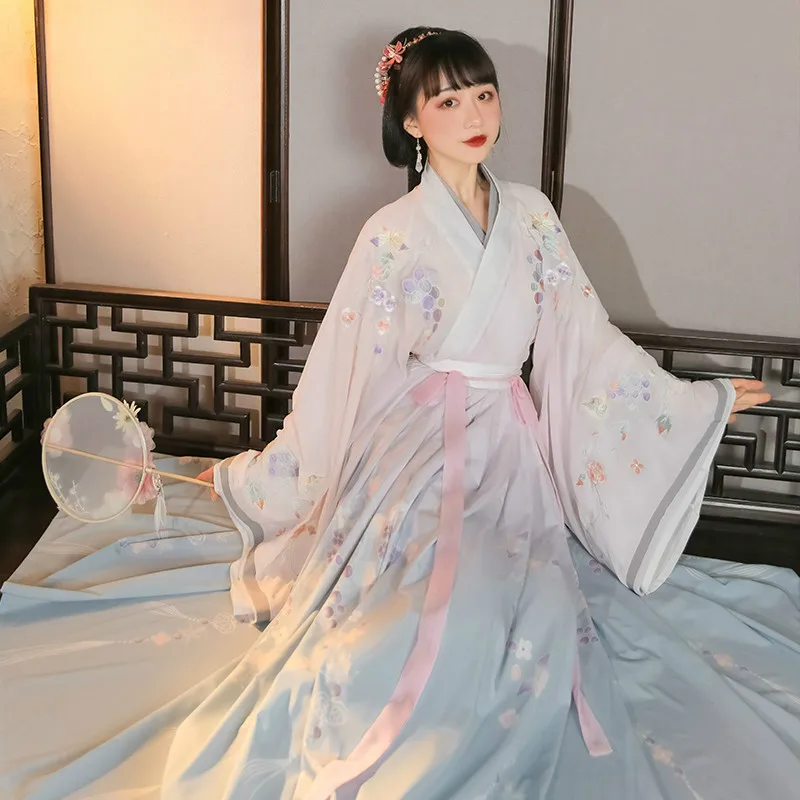
Before the qipao, before the Mao suit, before the Western business attire that now uniforms the world — there was Hanfu. For over three thousand years, from the legendary Yellow Emperor through the fall of the Ming dynasty in 1644, the Han Chinese dressed in a clothing system of such coherence, such philosophical depth, and such sheer beauty that it constituted not merely a fashion but a civilization's self-portrait in silk. Hanfu — literally "Han clothing" — was the garment of scholars and emperors, of farmers and poets, of women composing verses behind silk screens and men debating statecraft in palace halls. Its disappearance was not gradual but violent: the Manchu conquest imposed the queue and the changshan, and three centuries of forgetting followed.
Now, in the twenty-first century, Hanfu has returned. In parks and universities, on subway platforms and social media feeds, young Chinese people are wrapping themselves once more in cross-collared robes and flowing sleeves. This is not costume. It is not cosplay. It is, for its practitioners, an act of cultural recovery — a refusal to accept that three thousand years of sartorial wisdom can be erased by three hundred years of foreign imposition and a century of modernization.
The Grammar of Hanfu
Hanfu is not a single garment but a system — a grammar of construction from which infinite variations can be generated. Its fundamental principles are few but absolute. The collar crosses at the front, left over right (jiaoling youren, 交领右衽), forming a y-shape at the throat. This directionality is not arbitrary: in Chinese cosmology, the left is yang, the living side; to wrap right-over-left is to dress the dead. The sleeves are wide — sometimes extravagantly so — allowing the arm to move freely while concealing the hand in gesture. The garment is secured not with buttons but with a sash (dai), tied at the waist, allowing the fabric to drape rather than constrain.
The basic unit of Hanfu is the separation of upper and lower garments: the yi (upper robe) and the chang (lower skirt). From this binary, all forms derive. The ruqun pairs a short upper garment with a long skirt, the classic feminine silhouette of the Tang and Song dynasties. The aoqun lengthens the upper piece into a lined jacket, favored in the Ming. The zhiju and quju are one-piece robes wrapped straight or diagonally, the formal attire of Han dynasty scholars. The shenyi (深衣), literally "deep robe," unites upper and lower into a single flowing garment — the most ancient and most ceremonially significant form, worn for rites of passage and ancestral worship.
Dynasties in Silk
Each dynasty inflected the Hanfu system according to its own aesthetic temperament. The Han dynasty (206 BCE – 220 CE) favored gravity and structure: dark, sober colors, straight lines, the dignified shenyi that made every scholar look like a column in a temple. The Wei-Jin period (220–420) loosened the silhouette; scholars affected flowing, almost disheveled robes as expressions of Daoist spontaneity, their garments billowing in the wind like the ink landscapes they painted.
The Tang dynasty (618–907) exploded the palette. Cosmopolitan, confident, open to the world, Tang fashion embraced color, pattern, and the female form. Women wore low-cut bodices with high-waisted skirts in peony pinks and kingfisher blues, their hair piled in elaborate constructions adorned with gold and jade. The Song dynasty (960–1279) retreated into refinement: narrower sleeves, subtler colors, an aesthetic of quiet luxury that prized the quality of the silk over the boldness of the design. The Ming dynasty (1368–1644) synthesized and formalized, producing the most complete and codified Hanfu system — the one most commonly referenced by today's revivalists.
"The Yellow Emperor, Yao, and Shun simply let their robes hang down, and the world was governed."
— Book of Changes (Yijing), Xi Ci Xia
This passage from the Yijing reveals the philosophical weight carried by Chinese clothing. The sage-kings did not govern through force but through wuwei — non-action, naturalness. Their robes "hung down" because they did not need to strive. Clothing, in this vision, is not decoration but moral architecture: it shapes the body into a posture of dignity, restraint, and grace.
The Confucian Body
Confucian thought treats clothing as inseparable from ethics. The Liji (Book of Rites) devotes entire chapters to the correct dress for every occasion, every rank, every season. To dress properly is to acknowledge one's place in the web of human relationships. The width of the sleeve signals generosity. The length of the robe signals respect — for the occasion, for the other, for oneself. The sash, tied by one's own hand, represents self-discipline: no one else can dress you; you must compose yourself.
This is why the forced adoption of Manchu dress in 1644 was experienced not as a fashion change but as a civilizational wound. The edict "keep your hair, lose your head; keep your head, cut your hair" compelled Han men to shave their foreheads and wear the queue — an act that violated the Confucian principle that the body, hair included, is a gift from one's parents and must not be mutilated. The clothing change was the visible mark of subjugation, and its memory persisted for centuries.
Fabric, Color, and the Language of Rank
In the traditional system, what you wore announced who you were. The emperor wore yellow — specifically, the bright "imperial yellow" (minghuang) reserved exclusively for the throne. Officials wore colors according to rank: purple for the highest, then crimson, green, and blue for lower grades. Commoners wore undyed or indigo cloth. The fabric itself carried meaning: silk for the gentry, hemp and cotton for the working classes, though sumptuary laws were frequently violated in practice.
The patterns embroidered onto formal robes constituted a visual language. The dragon with five claws was imperial; four claws for princes; three for lesser nobility. Clouds signified the heavens; waves signified the earth; the shier zhang (twelve symbols) — sun, moon, stars, mountains, dragons, pheasants, ritual cups, waterweed, grain, fire, axe, and fu symbol — adorned only the emperor's sacrificial robes, encoding his role as mediator between heaven and humanity.
The Modern Revival
The contemporary Hanfu movement began in the early 2000s, initially as a small online community of enthusiasts studying museum collections and historical texts to reconstruct accurate garments. By the 2020s, it had become a mass cultural phenomenon. Hanfu-themed festivals draw tens of thousands. Social media platforms host millions of posts. The market for Hanfu garments exceeds billions of yuan annually. Young women — and increasingly young men — wear Hanfu not only for festivals and photo sessions but for daily life: to work, to university, to the grocery store.
The movement is not without controversy. Debates rage over historical accuracy versus creative adaptation, over whether "Hanfu" should include only Han Chinese forms or acknowledge the multi-ethnic reality of Chinese history, over the boundary between cultural pride and ethnic nationalism. Yet at its best, the movement represents something genuinely moving: a generation's decision that modernity need not mean amnesia, that progress need not require the abandonment of beauty, and that the body deserves to be clothed in something more thoughtful than a fast-fashion t-shirt.
Hanfu, Qipao, Kimono: A Clarification
Western observers often confuse Hanfu with the qipao (cheongsam) or even the Japanese kimono. The distinctions are fundamental. The qipao is a Manchu-derived garment, tailored to the body with darts and a high collar — a product of 1920s Shanghai modernity, not ancient Han tradition. The kimono, while historically influenced by Tang dynasty Chinese clothing, evolved into a distinct system with its own construction logic, its own rules of wearing, and its own cultural meanings. Hanfu is neither: it is the parent tradition, the source from which both others diverged. To confuse them is to confuse the river with its tributaries.
To put on Hanfu today is to perform a small act of temporal defiance. The silk falls across the shoulders as it fell across the shoulders of Li Bai, of Su Shi, of the unnamed women who wove it in workshops along the Yangtze. The sash is tied as it was tied a thousand years ago. The sleeves fall, and the hands disappear, and the body becomes architecture — not the rigid architecture of the Western suit, but the flowing architecture of a Chinese garden, where walls curve and roofs sweep upward and every line suggests movement held in graceful suspension.