In the West, we say "red." In China, a civilization that has spent five millennia refining the vocabulary of beauty, there is no single word sufficient to capture what red truly means. There is 朱 (zhū), the vermillion of cinnabar ground for imperial seals. There is 绯 (fēi), the flushed crimson of a young official's robe. There is 绛 (jiàng), the deep burgundy of aged lacquerware. There is 胭脂 (yānzhī), the rouge of a courtesan's cheek in a Tang dynasty poem. To speak of color in Chinese is not merely to describe a wavelength of light — it is to invoke history, hierarchy, emotion, and cosmology in a single syllable.
The Five Elemental Colors: A Cosmological Palette
The foundation of Chinese color theory rests upon the Five Phases (五行, wǔxíng) — wood, fire, earth, metal, and water — each governing a cardinal direction, a season, an organ, and a color. This system, codified during the Warring States period and elaborated by Han dynasty scholars, produced five "correct" colors (正色, zhèngsè): blue-green (青, qīng) for wood and the east, red (赤, chì) for fire and the south, yellow (黄, huáng) for earth and the center, white (白, bái) for metal and the west, and black (黑, hēi) for water and the north.
These were not arbitrary aesthetic choices. They were ontological claims. The color of an object revealed its elemental nature, its place in the cosmic order. A physician might diagnose illness by the color of a patient's complexion — a yellowish cast suggesting earth-element imbalance, a bluish tinge indicating stagnant wood-energy. A general might choose the color of his banners based on the direction from which he attacked. Color was not decoration; it was diagnosis, strategy, and prayer.
"The five colors blind the eye; the five tones deafen the ear; the five flavors dull the palate."
— Laozi, Dao De Jing, Chapter 12
Yet even as Laozi warned against sensory excess, the civilization he critiqued was busy developing the most sophisticated color vocabulary the world had ever seen. The tension between Daoist restraint and Confucian ceremonial splendor would define Chinese color culture for centuries.
Imperial Monopolies: Who May Wear Yellow?
In Tang dynasty China, color was law. The sumptuary codes (品色服, pǐnsè fú) dictated precisely which hues each rank of official could wear. The emperor alone wore 明黄 (mínghuáng), the "bright yellow" of the sun at its zenith — the color of the earth element at the center of all things. To don this shade without authorization was not a fashion crime; it was treason, punishable by death.
Below the emperor, the hierarchy cascaded: purple for the highest ministers, crimson for mid-rank officials, green and blue for lower ranks. The system was so rigid that the phrase "wearing crimson" (着绯, zhuófēi) became synonymous with achieving high office. When the poet Bai Juyi finally received his crimson robe after decades of minor postings, he wrote of it with the gravity of a man receiving a sacred ordination.
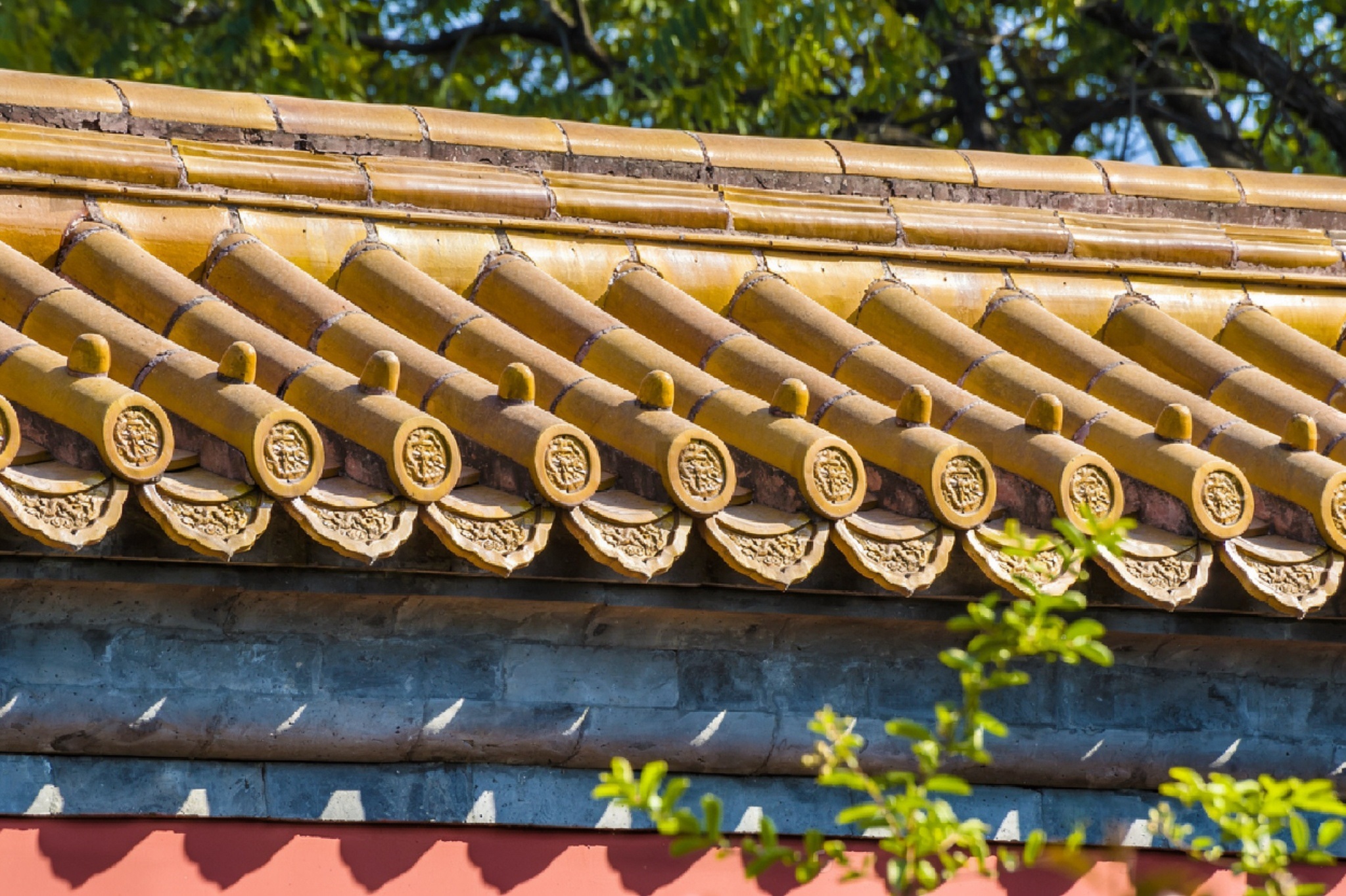
These restrictions extended beyond clothing. The glazed tiles of the Forbidden City blaze in imperial yellow. The walls glow in vermillion — the color of fire, of the south, of yang energy. Even the nails in the gates were regulated: nine rows of nine golden studs for the emperor, seven for princes, five for lesser nobles. Every surface was a text to be read, and color was its grammar.
Poetic Colors: Naming the Unnameable
Where the court demanded precision, the poets demanded beauty. Chinese literary tradition produced color names of such evocative delicacy that they resist translation entirely. Consider 月白 (yuèbái), literally "moon white" — not pure white, but the faintest blue-silver luminescence of moonlight on fresh snow. Or 黛 (dài), the blue-black of distant mountains seen through evening mist, the same pigment women used to paint their eyebrows, so that a poet could write of "distant mountains like painted brows" and mean both landscape and beloved simultaneously.
There is 天青 (tiānqīng), "sky after rain" — the legendary celadon glaze that Emperor Huizong of the Song dynasty demanded from his potters, reportedly saying, "I want the color of the sky where the clouds have just broken after rain." The Ru ware kilns spent years attempting to capture this single fleeting atmospheric moment in fired clay. There is 藕荷 (ǒuhé), "lotus root pink," the pale mauve of a lotus petal just beginning to unfurl. There is 鸦青 (yāqīng), "crow blue-black," the iridescent darkness of a crow's wing catching light.
These names are not mere labels. They are compressed poems, each one a tiny act of attention to the natural world. To name a color 雨过天青 is to freeze a meteorological event into an aesthetic category, to insist that beauty is not permanent but momentary, and that the highest art is to capture the moment just after transformation.
Color in Painting and Ceramics: The Philosophy of Restraint
The Chinese painting tradition presents a paradox to Western eyes: the most celebrated works are often executed in a single color — black ink, ground from soot and glue, diluted with water into infinite gradations. The Tang dynasty critic Zhang Yanyuan declared that "ink possesses five colors" (墨分五色, mò fēn wǔsè), meaning that a master calligrapher or painter could achieve the full range of visual expression through tonal variation alone, without reaching for pigment.
This was not poverty but philosophy. The Song dynasty literati painters, influenced by Chan Buddhism, saw the rejection of color as a rejection of surface distraction. A painting in polychrome might please the eye, but a painting in ink spoke to the mind. The blue-green landscape (青绿山水, qīnglǜ shānshuǐ) tradition, with its lavish mineral pigments of azurite and malachite, was associated with court painters and professional artisans. The scholar-amateur painted in ink, and this choice was itself a moral statement about authenticity versus ornament.
In ceramics, the Song dynasty represents perhaps the apex of Chinese color philosophy. The five great kilns — Ru, Guan, Ge, Jun, and Ding — produced wares celebrated not for painted decoration but for the subtle alchemy of their glazes. A Ru ware bowl is the color of a rainy sky. A Jun ware vase shifts from lavender to blue like twilight settling over a lake. The beauty lies in what the fire does to the earth, in the collaboration between human intention and natural process.
Living Colors: Vermillion in the Modern World
Walk through any Chinese city during Spring Festival and the ancient color vocabulary erupts into the streets. Lanterns glow in 大红 (dàhóng), "great red" — the color of joy, prosperity, and yang vitality. Wedding invitations arrive on red paper sealed with gold. New money is gifted in red envelopes (红包, hóngbāo). The color is not merely decorative; it is apotropaic, a shield against the mythical beast Nian and against misfortune itself.
Yet contemporary Chinese designers are increasingly reaching beyond the obvious red-and-gold palette, rediscovering the subtler hues of the classical tradition. Fashion houses reference 月白 and 黛 in their collections. Interior designers specify 天青 tiles for luxury hotels. The ancient vocabulary, far from being a museum relic, is experiencing a renaissance — proof that a civilization's deepest aesthetic insights never truly age.
To learn the language of Chinese colors is to learn a different way of seeing. It is to understand that a color is never merely a color. It is a season, a direction, an emotion, a rank, a prayer. It is the sky clearing after rain, captured forever in a bowl of fired clay. It is the flush on a beloved's cheek, preserved in two characters for a thousand years. In Chinese, to name a color is to write a poem — and to see the world as the poets always have: saturated with meaning, trembling with significance, alive.